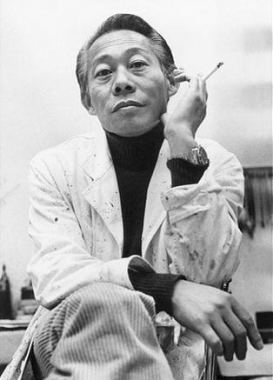
Why Wu Dayu matters
Wu Dayu is one of the founding figures of abstraction in twentieth-century Chinese painting. Trained in Paris in the 1920s alongside the first generation of Chinese artists sent abroad on government work-study fellowships, he returned home to help build the country's modern art education system, then spent much of his later career painting in near-total isolation after the Cultural Revolution destroyed most of his early work. For collectors, he represents a rare case: a teacher whose influence on later Chinese modernists is well documented, whose own painted output is scarce because so much of it was lost, and whose market has developed almost entirely within mainland Chinese, Hong Kong, and Taiwan auction rooms rather than the international majors.
- Nationality
- Chinese
- Media
- Painting, Oil painting, Abstraction
- Movement
- Chinese modernism, Pioneer of Chinese abstraction
- Education
- École nationale supérieure des Beaux-Arts, Paris, enrolled 1922. Sources differ on further Paris training (some cite the studio of sculptor Antoine Bourdelle from 1923, others cite Georges Braque); the specific instructor is not confirmed with certainty. No degree is documented in available sources.
- Signature motifs
- Dynamic Expressionism, Non-representational color abstraction
- Representation
- Tina Keng Gallery
By the numbers
- Approx. RMB 41,400,000 (precise sale unconfirmed)Auction highMutualArt lists a maximum auction price; the record-setting work, house, and sale date could not be independently confirmed as of 2026-07-09
- 6th National Fine Arts Exhibition, 1984Honor Prizefor Colorful Grass
- Tina Keng GalleryRepresented by
- National Hangzhou Arts Academy, 1928Founding facultylater the China Academy of Art
Biography
Wu Dayu was born in 1903 in Yixing County, Jiangsu Province, China. He began studying painting privately around 1909 and took further painting lessons in Shanghai in 1918. In 1922 he traveled to Paris as part of an early Chinese government work-study program and enrolled at the École nationale supérieure des Beaux-Arts, where he first studied oil painting. Sources disagree on his further Paris training: some describe a transfer in 1923 into the sculpture studio of Antoine Bourdelle, others cite study under Georges Braque; this profile treats the specific instructor as unconfirmed. No source locates a formal degree or diploma from this period; his Paris years are documented as study and enrollment rather than graduation.
He returned to Shanghai in 1927 and began teaching. In 1928 he was a founding faculty member of the National Hangzhou Arts Academy, the school that later became the China Academy of Art, and served as chair of its Western painting department. That same period he helped found the Art Movement Society and its journal Apollo, alongside Lin Fengmian and Lin Wencheng, and showed in China's First National Art Exhibition. He continued to exhibit with the National Art Movement Society in Shanghai through the early 1930s.
During the Cultural Revolution, the great majority of Wu Dayu's paintings were destroyed. He nonetheless kept working, producing small, unsigned abstract paintings largely in private through the last two decades of his life. In 1981 his painting Red Flowers was presented at China's 3rd National Exhibition and entered the collection of the China Art Museum in Shanghai. In 1984 his painting Colorful Grass won the Honor Prize at the 6th National Fine Arts Exhibition and is now held by the National Art Museum of China in Beijing. Wu Dayu died in Shanghai in 1988; available sources confirm the year and city of his death but do not give an exact day or month.
Critical reception
Wu Dayu is widely described in gallery and museum literature as one of the forefathers of Chinese abstraction, credited with fusing Western modernist training, absorbed in Paris at the École des Beaux-Arts under teachers whose specific identity is not fully confirmed across sources, with Chinese pictorial and philosophical traditions. His own painted style has been given the informal label Dynamic Expressionism in gallery writing. His institutional rehabilitation began after his death, with retrospectives at the Shanghai Art Museum in 1995 and again in 2003, a retrospective and career seminar convened between the National Museum of History in Taipei and Beijing in 1996, and a further Taipei exhibition in 2001. No verbatim, attributable critical quotation from a named critic in a major outlet could be confirmed for this profile; art press coverage, including a Frieze feature on a Chinese Academy of Oil Painting exhibition of his work, discusses his historical importance without wording that could be reproduced with certainty here.
Market
Market data aggregators indicate Wu Dayu's auction prices have reached roughly RMB 41,400,000 at the high end, according to MutualArt, but the specific record-setting work, auction house, and sale date could not be independently confirmed as of this writing. Broader auction databases record several hundred public sale results for the artist, mostly paintings and drawings, indicating a genuinely active secondary market, but one concentrated in mainland Chinese and greater-China sale rooms rather than in London or New York. His market today is served on the gallery side by Tina Keng Gallery in Taipei, which has mounted exhibitions of his work and functions as a point of reference for provenance and market context, though no source consulted describes a formal representation agreement.
Selected exhibitions
| Years | Exhibition | Venues |
|---|---|---|
| 2011 | Wu Dayu Solo Exhibition | Tina Keng Gallery, Taipei |
| 2003 | Retrospective of Wu Dayu Oil Paintings | Shanghai Art Museum |
| 2001 | Exhibition of Wu Dayu's Paintings | National Museum of History, Taipei |
| 1996 | Retrospective and career seminar | National Museum of History, Taipei; Beijing |
| 1995 | A Retrospective Exhibition of Oil Painting in Shanghai | Shanghai Art Museum |
| 1987 | Contemporary Oil Paintings From the People's Republic of China | Harkness House, New York |
| 1984 | 6th National Fine Arts Exhibition | China |
| 1929 | First Exhibition of the National Art Movement Society | Shanghai |
Museum collections
- China Art Museum, Shanghai
- Shanghai Art Museum
- National Art Museum of China, Beijing
- National Museum of History, Taipei
Awards and honors
- Honor Prize, 6th National Fine Arts Exhibition (China), for Colorful Grass (1984)
Authentication and provenance
No catalogue raisonne.
No published catalogue raisonne has been identified for this artist. Works are generally situated through exhibition history and gallery records, most notably those of Tina Keng Gallery, which has presented exhibitions of his work; no source confirms a formal representation or estate agreement.
Primary reference: https://www.tinakenggallery.com/en/artists/31-wu-dayu/biography/
What collectors should know
There is no published catalogue raisonne for Wu Dayu, and no certificate-of-authenticity program has been identified; buyers should expect authentication and provenance work to run through exhibition history and gallery records rather than a single reference catalogue. His exact birth date and death date are not documented in any source consulted, only the years 1903 and 1988 and the cities of Yixing and Shanghai, so collectors should treat any more precise date claims with caution. The precise all-time auction record, including the specific work, auction house, and sale date, also could not be independently confirmed; only an approximate high-water price figure is available. Because so much of his output was destroyed during the Cultural Revolution, surviving works are scarce, and because most of his auction history runs through mainland Chinese, Hong Kong, and Taiwan sale rooms rather than international majors, comparing his results against Western-market benchmarks requires care.
Further reading and resources
Data current as of 2026-07-09.

