Yoko Ono
Japanese, American, b. 1933
Conceptual art · Performance art · Film · Installation · Music
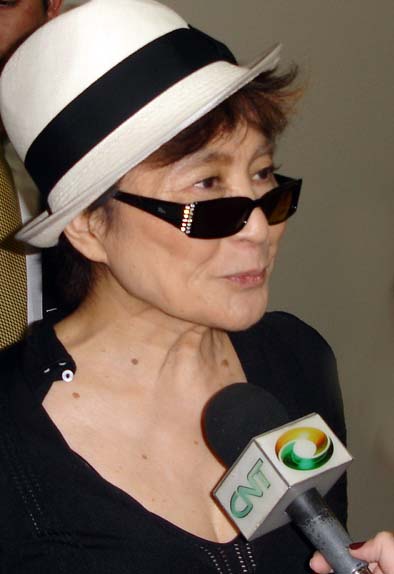
Why Yoko Ono matters
Yoko Ono is one of the founding figures of postwar conceptual and performance art, an artist whose instruction pieces, participatory works, and Fluxus era experiments reshaped what a work of art could be before most of her peers had caught up. For a collector, she is a case study in how cultural importance and museum devotion can run far ahead of a thin, infrequently traded auction market, since her name recognition is enormous while her market for physical, saleable objects remains small.
- Born
- 1933-02-18, Tokyo, Japan
- Nationality
- Japanese, American
- Media
- Conceptual art, Performance art, Film, Installation, Music
- Movement
- Fluxus, Conceptual art
- Education
- Attended Gakushuin University, Tokyo, philosophy program, 1951 to 1952, no degree; attended Sarah Lawrence College, Bronxville, New York, 1952 to 1955 or 1956, no degree
- Signature motifs
- Instruction pieces, Participatory works, Wish Tree installations
- Representation
- Galerie Lelong & Co., Tomio Koyama Gallery
By the numbers
- USD 116,500Auction highPlay It by Trust (in 33 parts), Sotheby's New York, May 2010
- Golden Lion for Lifetime Achievement, 2009Venice Biennale
- Yoko Ono: Music of the MindCurrent retrospectiveTraveling internationally, 2024 to 2026
- Galerie Lelong & Co.; Tomio Koyama GalleryRepresented by
Selected works
Click any work to view it full screen.
Biography
Yoko Ono was born on 18 February 1933 in Tokyo, Japan, to Eisuke Ono and Isoko Yasuda Ono. She attended the Gakushuin school and in 1951 entered Gakushuin University's philosophy program as its first female student, leaving after about a year. In 1952 she moved to the United States and enrolled at Sarah Lawrence College in Bronxville, New York, where she studied for several years without completing a degree.
By the late 1950s Ono was active in New York's downtown avant garde, staging early instruction based works and performances and becoming associated with the Fluxus movement. Her 1964 book Grapefruit collected instruction pieces, brief, poetic prompts meant to be completed by a reader or performer, and her 1964 performance Cut Piece, in which audience members were invited to cut away pieces of her clothing, became one of the defining works of postwar performance art. She married the musician John Lennon in 1969, with whom she had a son, Sean, and pursued joint art, music, and peace activism projects until Lennon's death in 1980.
Ono continued to build a museum centered career in the decades that followed. The 1989 survey Yoko Ono: Objects, Films at the Whitney Museum of American Art helped reestablish her standing in the American art world, and the touring retrospective YES YOKO ONO, curated by Alexandra Munroe and originating at Japan Society in New York in 2000, traveled to thirteen museums across the United States, Canada, Japan, and South Korea through 2003. A later comprehensive retrospective, Yoko Ono: Music of the Mind, opened at Tate Modern in London in 2024 and has since traveled to the Kunstsammlung Nordrhein-Westfalen in Dusseldorf, the Gropius Bau in Berlin, the Museum of Contemporary Art Chicago, MUSAC in Leon, Spain, and The Broad in Los Angeles. As of mid-2026, reporting describes Ono, now in her nineties, as living on a farm near Franklin, New York, that she and Lennon purchased in 1978.
Critical reception
Critical and curatorial opinion has moved decisively toward treating Ono as a central figure of postwar conceptual and performance art rather than as a peripheral Fluxus figure or a public personality defined chiefly by her marriage. The 2000 to 2003 traveling retrospective YES YOKO ONO, curated by Alexandra Munroe, won the AICA-USA award for best museum show originating in New York in 2001 and is widely credited with prompting a broad critical reassessment of her 1960s work. That reassessment culminated in the 2009 Golden Lion for Lifetime Achievement at the Venice Biennale and in the large scale 2024 to 2026 traveling retrospective Yoko Ono: Music of the Mind, organized by Tate Modern and shown at institutions across Europe and the United States. Commentary consistently returns to her instruction pieces and participatory works, such as Cut Piece and the Wish Tree installations, as early and influential examples of art that requires audience completion.
Market
Ono's auction market is small relative to her cultural profile. Her current auction record, per Artnet's market analysis, is USD 116,500, paid for the multi-part instruction work Play It by Trust (in 33 parts) at Sotheby's New York in May 2010. No higher price for a work by Ono herself has been reported since. This figure should not be confused with a Jean-Michel Basquiat painting, Cabra, from Ono's personal collection, which Sotheby's estimated could fetch up to USD 12 million at auction: that estimate belongs to Basquiat's market, not hers. Much of what comes to auction under her name consists of multiples, editions, and ephemera from the 1960s onward rather than unique paintings or sculptures, which keeps individual lot values modest even as institutional demand for her work remains high.
Top auction results
| Work | Price | Sale |
|---|---|---|
| Play It by Trust (in 33 parts) | USD 116,500 | Sotheby's, New York, 2010-05 |
Selected exhibitions
| Years | Exhibition | Venues |
|---|---|---|
| 2024 | Yoko Ono: Music of the Mind | Tate Modern, London |
| 2024 to 2025 | Yoko Ono: Music of the Mind | Kunstsammlung Nordrhein-Westfalen, Dusseldorf |
| 2025 | Yoko Ono: Music of the Mind | Gropius Bau, Berlin |
| 2025 to 2026 | Yoko Ono: Music of the Mind | Museum of Contemporary Art Chicago |
| 2025 to 2026 | Yoko Ono: Insound and Instructure | MUSAC, Leon, Spain |
| 2026 | Yoko Ono: Music of the Mind | The Broad, Los Angeles |
| 2000 to 2003 | YES YOKO ONO | Japan Society, New York, traveling to thirteen museums in the US, Canada, Japan, and South Korea |
| 1989 | Yoko Ono: Objects, Films | Whitney Museum of American Art, New York |
Museum collections
- Museum of Modern Art, New York
- Tate, London
- Mori Art Museum, Tokyo
- Faurschou Foundation
- Kunstsammlung Nordrhein-Westfalen, Dusseldorf
- The Broad, Los Angeles
Awards and honors
- Golden Lion for Lifetime Achievement, Venice Biennale (2009)
- Grammy Award, Album of the Year, for Double Fantasy (with John Lennon) (1981)
- AICA-USA award, Best Museum Show Originating in New York, for YES YOKO ONO (2001)
- Oskar Kokoschka Prize (2012)
- Edward MacDowell Medal (2024)
Authentication and provenance
No catalogue raisonne.
No published catalogue raisonne has been identified for Ono's work. Given the prevalence of Fluxus-era multiples, instruction pieces, and editions in her output, buyers should confirm authenticity directly with her current representatives, Galerie Lelong & Co. or Tomio Koyama Gallery.
Primary reference: https://galerielelong.com/artists/35-yoko-ono/
What collectors should know
Ono's market is thin and irregularly traded, and her highest recorded auction price to date, USD 116,500 in 2010, is modest next to her institutional standing. There is no published catalogue raisonne, and much of her output takes the form of multiples, instruction based editions, and ephemera rather than unique objects, so provenance and edition documentation matter more than they would for a painter with a conventional studio practice. Because Ono is represented by more than one gallery across different regions, collectors should confirm current representation and authentication directly with Galerie Lelong & Co. or Tomio Koyama Gallery before a purchase.
Further reading and resources
Data current as of 2026-07-18.

