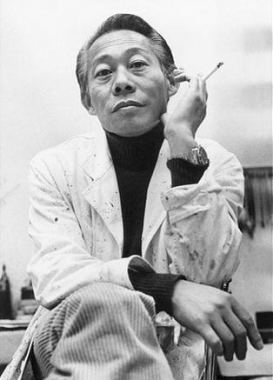
Why Zao Wou-Ki matters
Zao Wou-Ki is the postwar artist who most fully fused Chinese ink tradition with European abstraction, and the market has rewarded that singular position. His monumental triptych Juin-Octobre 1985 sold for roughly USD 65 million in 2018, at the time the most expensive painting ever sold at auction in Hong Kong and a record for an Asian oil painting. For a collector, Zao is a case study in how an artist can sit at the center of two collecting bases at once, Western postwar abstraction and contemporary Asian art, and in how a deep, decades-long body of work supports a market with both blue-chip peaks and consistent depth across periods and media.
- Born
- 1921-02-13, Beijing, China
- Nationality
- Chinese-French
- Media
- Painting, Works on paper, Printmaking
- Movement
- Lyrical Abstraction, Post-War, Contemporary Asian Art
- Education
- Hangzhou National College of Art (China Academy of Art), 1935 to 1941, under Wu Dayu
- Signature motifs
- Lyrical abstraction, Atmospheric color fields, Calligraphic gesture, Hurricane Period triptychs
- Representation
- Lévy Gorvy Dayan, Waddington Custot, Villepin
- In the Masterworks collection
- 8 works
By the numbers
- USD 65MAuction highJuin-Octobre 1985, Sotheby's Hong Kong, 2018
- 128 pairsDocumented repeat sales1996 to 2025
- ~82%Resale appreciation rateof works resold at auction; reported as 89% across 98 pairs as of late 2023
- Online, in progressCatalogue raisonne
Selected works
Click any work to view it full screen.
Biography
Zao Wou-Ki was born in Beijing in 1921 (the Fondation Zao Wou-Ki cites 1920, reflecting a Chinese record of February 13 and a French naturalization date of February 1) and trained at the Hangzhou National College of Art under Wu Dayu, where he absorbed a modernist sensibility rooted in the Chinese literati tradition's attention to nature. In 1948 he moved to Paris, befriending avant-garde figures including Alberto Giacometti and Joan Miro. The work of Paul Klee in particular pushed him toward the lyrical abstraction that would define his mature painting. By the mid-1950s he was folding his Chinese inheritance back into the work, at times incorporating calligraphic marks.
In 1957 Zao visited New York for the first time, and two years later held his first United States solo exhibition at the Kootz Gallery, which placed him among the gallery's postwar painters alongside Pierre Soulages, Hans Hofmann, and Robert Motherwell. The years from 1959 to 1972 mark his so-called Hurricane Period, a sustained run of large panel paintings that synthesize his Chinese and Western sources. In the 1970s his handling loosened toward gestural brushwork, blurred grounds, and saturated color, dreamlike atmospheres that allude to landscape while staying abstract. This opened into the luminous, brighter Infinity Period of the 1980s.
Zao taught at the Ecole Nationale Superieure des Arts Decoratifs in Paris in the early 1980s before his career grew too demanding. France honored him repeatedly, naming him Officier de l'Ordre de la Legion d'honneur in 1984, Commandeur in 1993, and Grand Officier in 2006. He retired from oil painting in 2008 but continued to make watercolors, moved to Switzerland in 2011, and died in Nyon in 2013. His work is held in the permanent collections of more than 150 institutions worldwide, including Tate Modern, the Museum of Modern Art, the Guggenheim, the Metropolitan Museum of Art, and the Centre Pompidou.
Critical reception
Zao's critical standing rose early and has held, anchored on the idea that he resolved a problem many postwar painters only circled: how to bring the Chinese ink and calligraphic tradition into dialogue with European abstraction without making either a costume. French critics championed him from the 1950s, and institutional recognition followed at the highest level when he was elected to the Academie des Beaux-Arts in 2002, the first artist of Chinese origin to join. Much of the scholarship reads his work through that dual inheritance, sometimes cautioning against treating him purely as a bridge figure, since his mature abstraction stands on its own terms. The major retrospectives map that arc: an early survey at the Museum Folkwang in Essen in 1965, a 2003 retrospective at the Galerie Nationale du Jeu de Paume in Paris, and No Limits, the first United States retrospective, organized in 2016 by Asia Society Museum and the Colby College Museum of Art and curated by Melissa Walt, Ankeney Weitz, and Michelle Yun. Across that writing the consensus is durable: the Hurricane Period oils and the luminous later canvases are where his reputation rests.
Watch
Market
Zao's market is notable for both a towering peak and unusual depth beneath it. The USD 65 million paid for Juin-Octobre 1985 anchors the top of the market, but the broader picture is one of consistency: across 98 documented repeat-sale pairs as of late 2023, his paintings had appreciated in value about 89 percent of the time they returned to auction, and in 2022 he ranked as one of the highest Chinese artists by auction turnover. Internal records now track 128 repeat-sale pairs running from 1996 to 2025, a long and statistically meaningful series for any postwar name.
Within that market, period drives value. The Hurricane Period oils of the 1960s and the large works of the 1980s command the strongest prices, and a large share of his top results occurs in the Hong Kong salerooms, reflecting deep demand across Greater China and the wider Asian collecting base.
Top auction results
| Work | Price | Sale |
|---|---|---|
| Juin-Octobre 1985 (1985) | USD 65,000,000 (HKD 510,371,000) | Sotheby's, Hong Kong, 2018-09-30 |
Selected exhibitions
| Years | Exhibition | Venues |
|---|---|---|
| 2025 to 2026 | Zao Wou-Ki: Master Printmaker | M+, Hong Kong |
| 2024 | Zao Wou-Ki: Art without Border | Villepin, Hong Kong |
| 2022 to 2023 | Paris and Nowhere Else | Musee national de l'histoire de l'immigration, Paris |
| 2018 to 2019 | Zao Wou-Ki: L'espace est silence | Musee d'Art Moderne de Paris |
| 2017 to 2018 | Infinities of Zao Wou-ki | Asia University Museum of Modern Art, Taichung |
Museum collections
- Tate Modern, London
- Museum of Modern Art, New York
- Solomon R. Guggenheim Museum, New York
- The Metropolitan Museum of Art, New York
- Centre Pompidou, Paris
- M+, Hong Kong
Awards and honors
- Officier de l'Ordre de la Legion d'honneur (France) (1984)
- Commandeur de l'Ordre de la Legion d'honneur (France) (1993)
- Grand Officier de l'Ordre de la Legion d'honneur (France) (2006)
Authentication and provenance
Catalogue raisonne published.
Authentication runs through the Fondation Zao Wou-Ki, with confirmation handled by the foundation director against its records. A catalogue raisonne exists and is published online by the foundation; the painting volumes are being released in stages, with the next installment forthcoming. The foundation in Geneva is the primary reference for verification.
Primary reference: https://www.zaowouki.org/en/
What collectors should know
Zao's work spans oils, watercolors, ink, and a substantial body of prints, and those media sit at very different points on the price and liquidity spectrum. The early oils and the monumental 1980s canvases are the scarce, top-of-market works; the prints and watercolors offer far more accessible entry points but trade very differently. Period, scale, and medium drive value far more than the signature alone. The catalogue raisonne, published online by the Fondation Zao Wou-Ki, is being released in stages, so a buyer should confirm whether a given work falls within a published volume and verify it against the foundation's records before transacting.
Further reading and resources
Data current as of 2026-06-18.

