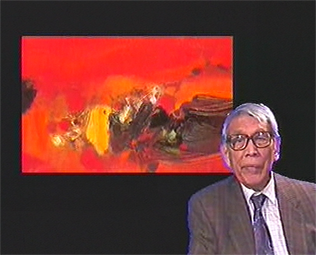
Why Zhu Teh-Chun matters
Zhu Teh-Chun, better known in the market by the Wade-Giles spelling Chu Teh-Chun, was one of a small group of Chinese-born painters, alongside Zao Wou-Ki and Wu Guanzhong, sometimes called the "Three Musketeers," who carried Chinese ink sensibility into the language of postwar European abstraction. He was the first artist of Chinese origin elected to the Academie des Beaux-Arts of the Institut de France, and his paintings are held in more than fifty public collections worldwide. For collectors, he represents a rare case of an artist with deep institutional validation on both sides of the Chinese-French axis whose auction market has grown since his death in 2014, even though the exact shape of that market's upper end is still not fully settled in public reporting.
- Born
- 1920-10-24, Xiao County, Anhui, China
- Nationality
- Chinese-French
- Media
- Painting, Printmaking
- Movement
- Abstract art, Lyrical abstraction
- Education
- National School of Fine Arts, Hangzhou (now China Academy of Art), 1935 to 1941; studied Chinese ink painting under Pan Tianshou and Western oil painting under Fang Ganmin and Wu Dayu
- Signature motifs
- Snow and winter light, Calligraphic brushwork, Color-light abstraction
- Representation
- Fondation Chu Teh-Chun (estate, Paris), Waddington Custot (London), Alisan Fine Arts (Hong Kong)
By the numbers
- USD 11.8M (confirmed)Auction highVertige Neigeux (Snowy Vertigo), Christie's Hong Kong, November 2016; higher figures reported elsewhere for other works could not be independently confirmed
- Elected 1997Academie des Beaux-ArtsFirst artist of Chinese origin admitted to the Institut de France's Academie des Beaux-Arts
- 50+ institutionsPublic collectionsPer Fondation Chu Teh-Chun and gallery documentation
- Fondation Chu Teh-Chun; Waddington Custot; Alisan Fine ArtsRepresented by
Biography
Zhu Teh-Chun (Zhu Dequn, 朱德群) was born on 24 October 1920 in Xiao County, in what is most commonly reported as Anhui, China; some sources place his birth in neighboring Jiangsu, and a French national library authority record lists 1926 rather than 1920, though the great majority of art-market and museum sources use 1920. In 1935 he entered the National School of Fine Arts in Hangzhou, later renamed the China Academy of Art, where he studied Chinese ink painting under Pan Tianshou and Western oil painting under Fang Ganmin and Wu Dayu, completing his studies around 1941.
He taught drawing and architecture at National Central University in Nanjing in the early to mid-1940s, then left mainland China for Taiwan in 1949, where he taught Western painting at National Taiwan Normal University in Taipei and held his first solo exhibition, in 1954 at Chung Shan Hall. In 1955 he settled in Paris, where a formative encounter with Rembrandt's paintings at the Louvre pushed him from figuration toward abstraction. His mature style fused the gestural energy of Chinese calligraphy with the color and light of European lyrical abstraction, often organized around snow, ice, and seasonal light. He was naturalized as a French citizen in 1980 and, on 17 December 1997, became the first artist of Chinese origin elected to the Academie des Beaux-Arts, part of the Institut de France. He died on 26 March 2014, in his early nineties, in the Paris area; art-world sources most often give the location simply as Paris, while a French national library authority record gives the nearby commune of Le Kremlin-Bicetre and a death date one day earlier, 25 March 2014. The Fondation Chu Teh-Chun, established in Paris, now documents his work and its place in public collections.
Critical reception
Zhu Teh-Chun's paintings are generally discussed as a bridge between Chinese ink tradition and Western abstraction, with critics and curators emphasizing his handling of light, atmosphere, and seasonal change over identifiable subject matter. Christie's editorial writing on the artist has singled out his skill in selecting and compressing a scene in space while tracking the fleeting changes of light across a canvas. Institutional recognition, culminating in his 1997 election to the Academie des Beaux-Arts, reinforced a critical consensus that placed him, alongside Zao Wou-Ki and Wu Guanzhong, among the most significant Chinese-born painters to build a career in postwar France.
Market
Zhu Teh-Chun's market has risen since his death, driven by strong demand for his large-scale abstractions at Hong Kong evening sales. The best-documented auction result is Vertige Neigeux (Snowy Vertigo), which sold at Christie's Hong Kong in November 2016 for approximately USD 11.8 million (HKD 91,820,000), surpassing an earlier 2013 Christie's result for an Untitled diptych (HKD 70,680,000). Some later sources report considerably higher prices, including a 2020 Sotheby's Hong Kong sale cited under the titles Ode to Nature or Les elements confederes at roughly USD 14.6 million, and a Wikipedia entry citing a 2021 Sotheby's Hong Kong sale of a work titled Harmonie hivernale at HKD 229,568,000, about USD 29.5 million. Neither of these higher figures could be corroborated against a primary saleroom record or a second independent source in this research, so they should be treated as unverified rather than as the confirmed auction high. Because auction supply for his work is concentrated in a relatively small number of major Hong Kong evening sales, individual results can move the picture of his market considerably.
Top auction results
| Work | Price | Sale |
|---|---|---|
| Vertige Neigeux (Snowy Vertigo) (2016) | USD 11,800,000 (HKD 91,820,000) | Christie's, Hong Kong, 2016-11 |
Selected exhibitions
| Years | Exhibition | Venues |
|---|---|---|
| 2024 | In Nebula | Fondazione Giorgio Cini, Venice |
| 2020 | Centenary exhibitions | Alisan Fine Arts, Hong Kong, with French May collaborations (Art+ Shanghai Gallery, Artify Gallery) |
| 2010 | Retrospective (exact dates unconfirmed) | National Art Museum of China, Beijing; Shanghai Art Museum |
| 1983 | Retrospective | Musee national d'art moderne, Paris |
| 1964 | International exhibition | Carnegie Museum of Art, Pittsburgh |
| 1957 | Paris Salon du Printemps | Paris, France (Silver Medal for Ching-Chao Portrait) |
| 1954 | First solo exhibition | Chung Shan Hall, Taipei |
Museum collections
- Musee d'art moderne de la Ville de Paris
- Bibliotheque nationale de France, Paris
- Musee Cernuschi, Paris
- Shanghai Art Museum
- National Art Museum of China, Beijing
- Taipei Fine Arts Museum
- Hong Kong Museum of Art
Awards and honors
- Silver Medal, Paris Salon du Printemps (1957)
- Elected to the Academie des Beaux-Arts, Institut de France (first artist of Chinese origin admitted) (1997)
- Chevalier de la Legion d'Honneur, France (2001)
- Chevalier de l'Ordre des Palmes Academiques, France (2001)
- Officier de l'Ordre National du Merite, France (year approximate) (2007)
- Medaille d'Or du Merite Europeen, Luxembourg (2006)
Authentication and provenance
No catalogue raisonne.
No published catalogue raisonne is confirmed. The Fondation Chu Teh-Chun, established in Paris, documents his output and its presence in public collections. Verification of individual works should be sought through the foundation and through the specialist departments of major auction houses.
Primary reference: https://chu-teh-chun.org/en/chu-teh-chun/biography/
What collectors should know
There is no published catalogue raisonne for Zhu Teh-Chun. The Fondation Chu Teh-Chun in Paris documents his output and its presence in public collections, and verification of individual works should be sought through the foundation and through the specialist departments of major auction houses rather than through a single reference catalogue. Public reporting on his auction record is inconsistent above the confirmed 2016 high of about USD 11.8 million, with some outlets citing considerably higher prices for other works without matching, corroborated sale details; collectors should treat any headline figure above that level with caution until it can be traced to a primary sale record. His deep museum presence across France, China, and Taiwan, and his rare standing within the Institut de France, remain the more durable signals behind his market.
Further reading and resources
Data current as of 2026-07-16.

