
Masterworks Research · June 2026
The seven checks a fund runs before it wires money for a painting, why a casual buyer skips most of them, and where the real risk hides.
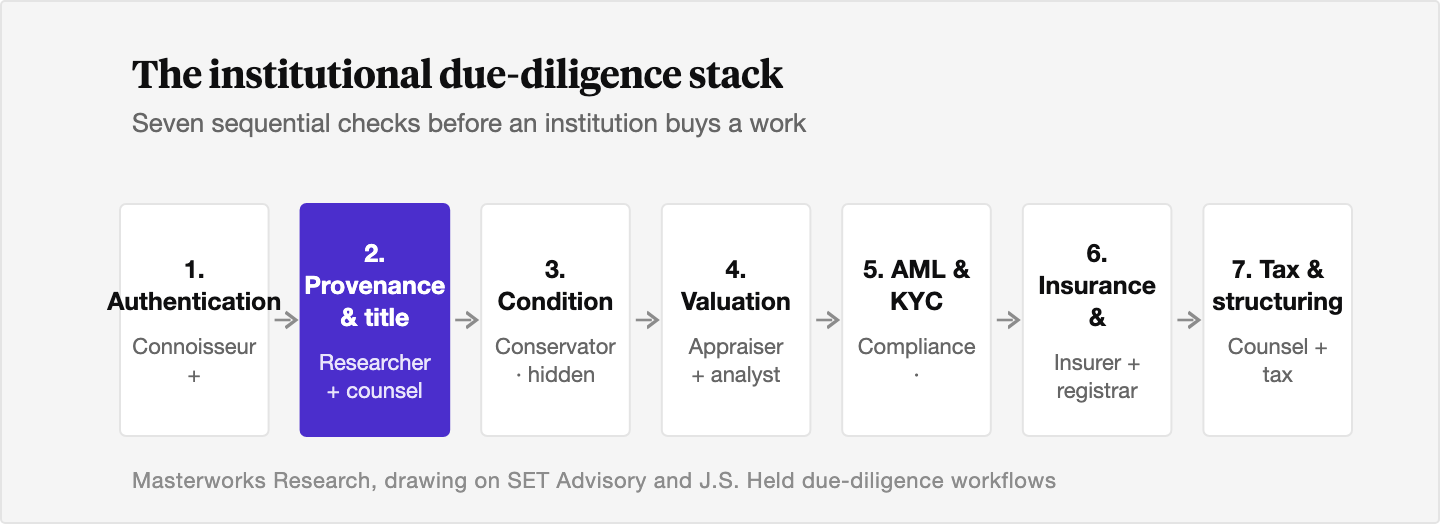
Institutional due diligence for an art purchase is a staged review that answers seven separate questions before any money moves: is the work authentic, who has owned it, can anyone else claim it, what physical condition is it in, what is it actually worth, are the parties clean under anti-money-laundering rules, and how will it be insured, stored, and held. A fund, family office, or private bank runs all seven with a team of specialists and counsel. A casual buyer usually runs one or two, leans on the seller's word, and signs. The gap between those two processes is where most of the art market's losses and lawsuits live, and it is the single biggest reason art has been hard to own as an investment rather than as a decoration.
We spend a lot of time on this question because we built the firm around it. Half of the art market trades at public auction with records going back centuries, which means the diligence can be done with data rather than vibes. The other half trades privately, where the burden falls entirely on the buyer. What follows is the institutional version of that work, described at a general level.
What You Need to Know
- Diligence is a seven-part stack, not a single check. Authentication, provenance, title, condition, valuation, compliance, and custody are distinct reviews, each with its own specialist and its own failure mode. Institutions run all seven. Retail buyers typically run one or two [1][7].
- Provenance is the weakest link in the whole market. An often-cited estimate holds that roughly 60% of works on the market carry insufficient, unverifiable, or suspect ownership history [7]. That single number explains why title and authenticity claims dominate high-value art litigation.
- The US art market is largely unregulated, which raises the diligence burden on the buyer. The roughly $28.3 billion American art market has been called the largest unregulated market in the world [8]. As of 2025, US art dealers still sit outside the Bank Secrecy Act; only antiquities dealers have been pulled in [3].
- The cost of skipping a step is measured in tens of millions. The Knoedler gallery sold around 40 forged Abstract Expressionist works for an estimated $60 to $80 million before closing in 2011 [7]. Most buyers never commissioned the pigment test that would have caught them.
- Institutions treat art like an illiquid alternative, with valuation, insurance, storage, and entity structuring built in from day one. Wealth managers have followed: 51% offered art-related services in 2025, up from 25% in 2011 [2].
1. Authentication: connoisseurship plus the lab
The first question is whether the work is by the artist whose name is on it. Institutions answer it two ways at once. The first is connoisseurship, an expert reading of brushwork, palette, signature, support, and where the work sits in the artist's body of production, checked against verified examples and the catalogue raisonne, the scholarly master list of an artist's known works. The second is forensic science: pigment analysis, infrared reflectography to reveal underdrawings, X-ray imaging, and carbon dating for organic material [1][7].
Neither tool is decisive on its own, and the honest version of this is that none of the three pillars, science, provenance, and connoisseurship, can positively authenticate a work by itself [7]. They reduce risk in layers. Science is very good at the negative finding. In the Wolfgang Beltracchi case, the forger built convincing fakes attributed to Max Ernst and Heinrich Campendonk and a fictional collection to support them. He was convicted in 2011 of forging 14 works. What unraveled him was a pigment, titanium white, that was not commercially available when the paintings were supposedly made [9]. The connoisseurs had been fooled. The lab was not.
The casual buyer rarely commissions any of this. They take a certificate of authenticity at face value, which is a problem, because a certificate is only as good as the person who signed it. The same authentication work that resets a value can also create it. Salvator Mundi sold for roughly $60 in 1958 as a copy and for $450.3 million in 2017 once it was attributed to Leonardo [7]. That is the full range of what attribution is worth.
For a deeper read on this layer, see how art authentication actually works and how investors protect against fakes.
2. Provenance and title: who owned it, and can anyone take it back
Authentication asks if the work is real. Provenance asks who has owned it, in an unbroken chain from the artist to the seller, and title asks whether that chain is clean enough that no one can later claim the work out from under you. These are the checks that retail buyers skip most often and regret most expensively.
The institutional process reconstructs the chain of title from invoices, consignment agreements, exhibition catalogues, prior auction records, estate and probate files, and export and import documents, then runs a gap analysis to find the missing years [1][7]. Two gaps matter more than the rest. The first is any ownership change in Europe between 1933 and 1945, which raises Nazi-era restitution risk and can keep a title contested for decades. The second is a theft or looting history, which is screened against stolen-art databases such as the Art Loss Register and Interpol's stolen works database [1]. A hit on either can stop a sale cold.
There is also a quiet financing risk that counsel checks for and amateurs never think about: a prior lender's security interest. If a previous owner pledged the work as collateral and a UCC-1 financing statement was filed, that lien can survive a sale depending on the facts [1]. You can buy a real painting, with a clean attribution, and still not own it free of someone else's claim.
The reason this matters so much is structural. Roughly 60% of works on the market are estimated to carry weak or suspect provenance [7], and the US market that most of them trade in is largely unregulated [8]. The buyer is the regulator. Our longer treatment of why ownership history drives value is here.
3. Condition: what a conservator finds that the eye misses
A painting that looks pristine on a gallery wall can be heavily restored underneath. Before closing, institutional buyers commission a condition or conservation report, especially on higher-value works. A conservator looks for relining, overpainting, inpainting, tears, losses, varnish problems, and structural instability, then judges whether those interventions are stable or value-negative [1].
Condition is not cosmetic. It feeds directly into four downstream decisions: market value, whether an insurer will write the policy and at what premium, how much transport risk the work carries, and what future conservation will cost over a multi-year hold [1]. A work that cannot travel safely or cannot be insured at replacement value is a different investment than the same image in sound condition. The casual buyer typically relies on a visual inspection and the dealer's description, which is exactly the information a seller controls.
4. Valuation: comparable sales, not the asking price
Institutions do not treat a seller's asking price or an auction house's presale estimate as fair value. They build an independent number from comparable sales: works by the same artist, similar in medium, size, period, condition, and provenance, adjusted for the differences, drawn from a relevant sales window [4]. Achieved hammer prices, reserve behavior, sell-through rates, and private-sale intelligence carry the weight. The estimate on the catalogue page is a marketing signal, and the direction of its misses is itself a data point, which we have written about separately in our work on auction estimates.
This is the step where our own approach is most visible. We built a private database of art transactions and artist-level indices precisely so that the comparable-sales question can be answered with evidence rather than opinion. A note on how this works: the value of an artist's market is paramount, because even the best example by an unknown artist will probably end up worth little, and only after the artist market checks out do you ask whether this specific work is the best available example at the lowest defensible price. When a team fair-values a work at a million and it can be bought near 700,000, that is a sound entry. At two million it is not.
For the mechanics of how appraisers build these numbers, see comparable sales analysis for art.
Valuations that will be used for insurance, lending, estate planning, or a tax filing carry a higher bar. They are expected to follow the Uniform Standards of Professional Appraisal Practice (USPAP), maintained by the Appraisal Foundation, and to be prepared by a credentialed appraiser, often a member of the Appraisers Association of America. A USPAP report discloses its assumptions about authenticity and title and states how value would change if either were later challenged [10].
5. AML and KYC: the 2025 compliance picture
This is the check that has changed most, and the one most casual buyers do not know exists. The compliance question is whether the parties and the source of funds are clean under anti-money-laundering (AML) and know-your-customer (KYC) rules.
The US picture as of 2025 is uneven. The Anti-Money Laundering Act of 2020 amended the Bank Secrecy Act to add dealers in antiquities to the definition of a financial institution, which pulls them toward full AML programs, customer identification, and suspicious-activity reporting [3]. Traditional art dealers, galleries, and auction houses were left outside that definition. A 2022 Treasury study examined money-laundering risk in the art trade and stopped short of recommending that art dealers be regulated under the Bank Secrecy Act right away [3]. So the headline holds: the roughly $28.3 billion US art market remains largely unregulated [8].
Two qualifiers matter for any institutional buyer. First, sanctions law applies regardless. The Office of Foreign Assets Control treats artwork with an estimated value over $100,000 as high-value artwork that is not categorically exempt from sanctions, and its 50% rule reaches entities owned by a blocked person, so screening counterparties and their beneficial owners is mandatory even with no Bank Secrecy Act duty [3]. Second, the rules may be about to tighten. A bipartisan Art Market Integrity Act was introduced in the Senate in July 2025 that would put most art-market participants under AML obligations [3]. It is a bill, not law.
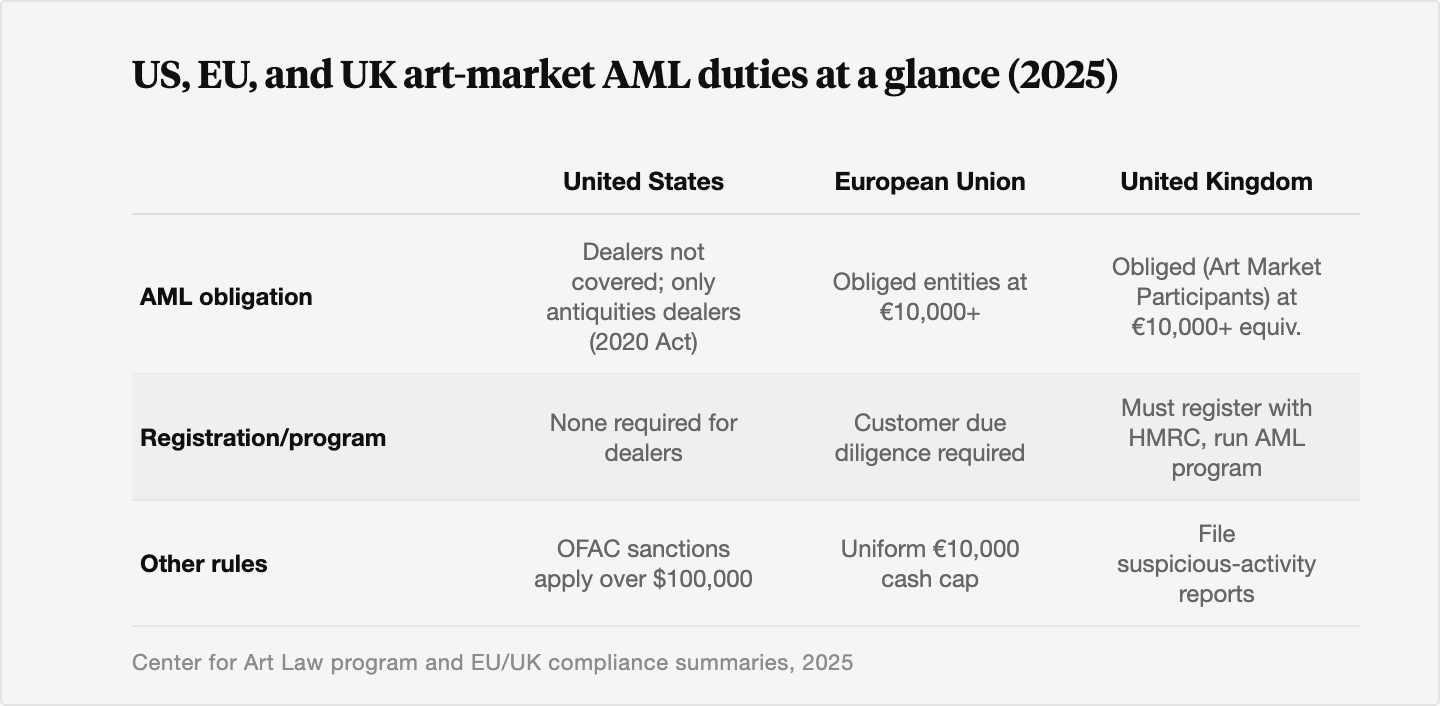
The EU and UK already run full regimes. EU art dealers, galleries, and auction houses are obliged entities on transactions of 10,000 euros or more, with mandatory customer due diligence, beneficial-owner checks, and a uniform 10,000 euro cash cap [5]. UK Art Market Participants must register with HMRC, maintain a written AML program, appoint a nominated officer, and file suspicious-activity reports [3][5]. An institution buying across borders builds to the strictest of the three, since one transaction can touch all of them.
A word on a persistent myth. The popular idea that art is an easy money-laundering vehicle is overstated. KYC rules already bind banks and the European and UK art trades, and laundering through art is harder than the headlines suggest. The compliance work is real, but it is risk management, not a sign that the market is dirty.
6. Insurance, storage, and logistics: the cost of holding it
Owning the work is the start of the diligence, not the end. Institutions insure at replacement value or an agreed value, not simply at purchase price, and refresh coverage after acquisitions, loans, restorations, or large market moves [4]. Underwriters care about where the work is kept, who handles it, how often it moves, and whether condition and provenance are documented [4].
Storage is a deliberate choice. Climate-controlled facilities stabilize temperature, humidity, and light and cut handling risk, while freeports offer secure, customs-efficient storage for works being held or moved internationally [4]. Movement is minimized and, when it happens, handled by specialist fine-art shippers with custom crating, condition reports on departure and arrival, a documented chain of custody, and door-to-door insurance [4]. The global fine art insurance market was valued at $548.5 million in 2022 and projected to reach $857.2 million by 2032, a roughly 4.7% annual growth rate [4]. That figure is small next to the value insured, which tells you these are core operating costs rather than a market in their own right.
This holding cost is also where art-secured lending enters. The art-secured lending market was estimated at about $26 billion in a 2024 Citi and ArtTactic survey, up from roughly $20 billion in 2019 [6]. A lender's underwriting leans on the same stack, authenticity, provenance, condition, market depth, and custody controls, which is why a work that fails diligence also fails to support a loan [6].
7. Tax and structuring: how the work is held
The last layer is how ownership is held. Institutions commonly hold art in LLCs or similar entities for liability separation, governance, financing flexibility, and estate-planning efficiency [4]. For estates, works move through trusts, family partnerships, charitable vehicles, or LLC interests to manage governance and transfer taxes [4].
One change matters for any US investor who remembers the old playbook. Some buyers once used like-kind exchanges under Section 1031 to defer gains on art. The Tax Cuts and Jobs Act of 2017 limited 1031 treatment to real property, so art no longer qualifies under current US federal law [4]. The structuring file an institution keeps, purchase invoice, full provenance, condition report, insurance schedule, storage location, shipping records, and entity documents, is the same file that makes a future sale, donation, or loan clean [4]. The casual buyer usually keeps a receipt.
The Bottom Line
- Institutional art diligence runs seven distinct checks: authentication, provenance, title, condition, valuation, AML and KYC, and custody. A casual buyer typically runs one or two and trusts the seller for the rest.
- Provenance and title are the weakest links in the market, with roughly 60% of works carrying weak or suspect ownership history, and they drive most high-value art litigation.
- The US art market is largely unregulated, around $28.3 billion in size, and as of 2025 only antiquities dealers, not art dealers, fall under the Bank Secrecy Act, though sanctions rules and a pending 2025 bill raise the bar.
- Valuation should be built from comparable sales rather than the asking price or the presale estimate, and serious valuations follow USPAP standards.
- Insurance, specialist storage, logistics, and entity structuring are not afterthoughts. They are built in from purchase, and they are the same controls a lender requires to accept the work as collateral.
- Past performance is not predictive, and no diligence process removes all risk. Diligence lowers the odds of fraud, defective title, hidden damage, and overpayment. It does not promise a return.
Sources
- SET Advisory. "Art Due Diligence." SET Advisory, April 9, 2025. https://setadvisory.com/services/art-due-diligence/
- Deloitte Private and ArtTactic. "9th Deloitte Private and ArtTactic Art & Finance Report." Deloitte, November 4, 2025. https://www.deloitte.com/nl/en/services/deloitte-private/research/art-and-finance-report.html
- Center for Art Law. "Regulation Without Legislation: Combatting Money Laundering in the U.S. Art Market." Center for Art Law, February 21, 2026. https://itsartlaw.org/art-law/regulation-without-legislation-combatting-money-laundering-in-the-u-s-art-market/
- Deloitte Private and ArtTactic. "The Art & Finance Report." Deloitte, 2023 to 2025 editions. https://www2.deloitte.com/lu/en/pages/art-and-finance/topics/art-and-finance.html
- Artlogic. "Navigating Compliance in the Evolving Art Market: How AML and KYC Regulations Are Reshaping Transparency." Artlogic, April 20, 2026. https://artlogic.net/blog-posts/64-navigating-compliance-in-the-evolving-art-market-how-aml-and-kyc-regulations-are-reshaping-transparency
- J.S. Held. "Unlocking Liquidity Through Fine Art Appraisal and Lending." J.S. Held, June 9, 2025. https://www.jsheld.com/insights/articles/unlocking-liquidity-through-fine-art-appraisal-and-lending
- NYU Journal of Intellectual Property & Entertainment Law. "Risky Business: Fraud, Authenticity, and Limited Legal Protections in the High Art Market." JIPEL, 2021. https://jipel.law.nyu.edu/risky-business-fraud-authenticity-and-limited-legal-protections-in-the-high-art-market/
- Antiquities Coalition Financial Crimes Task Force. "Reframing U.S. Policy on the Art Market: Recommendations for Combatting Financial Crimes." Antiquities Coalition, June 18, 2025. https://acthinktank.scholasticahq.com/article/130888-reframing-u-s-policy-on-the-art-market-recommendations-for-combatting-financial-crimes-a-comprehensive-report-by-the-financial-crimes-task-force
- Cleveland State Law Review. "Authentication of Art." EngagedScholarship@CSU. https://engagedscholarship.csuohio.edu/cgi/viewcontent.cgi?article=4362&context=clevstlrev
- MoMAA. "Art Valuation and Appraisal for Investment." MoMAA, June 21, 2025. https://momaa.org/art-valuation-investment/
- Van Berings. "Authenticity and Provenance of Artworks: What Are the Legal Challenges." Van Berings, May 13, 2025. https://vanberings.com/EN/Site/News/2025/Authenticity-and-Provenance-of-Artworks-What-Are-the-Legal-Challenges
- GjvD Avocats. "Ensuring the Authenticity of an Artwork." GjvD Avocats, October 3, 2025. https://gjvdavocats.com/en/art-market-law/artwork-authenticity/
- Bank of America Private Bank. "Art Market Analysis Spring 2026: Trends, Sales, Auctions." Bank of America, April 22, 2026. https://www.pbig.ml.com/articles/art-market-spring-update.html
- Agile Legal. "Private Funds: Navigating the Finalized AML/KYC Regulations." Agile Legal, July 22, 2025. https://www.agilelegal.com/business-law-news/private-funds-navigating-the-finalized-aml-kyc-regulations
Disclosures
Investing involves risk. Past results are not indicative of future outcomes.
Masterworks is providing this communication as an agent for its issuer entities, not Masterworks Advisers. This material is produced by Masterworks for informational purposes only and does not constitute investment advice, a recommendation, or an offer or solicitation to buy or sell any security. Masterworks is not a licensed broker-dealer by the SEC or FINRA.
Masterworks can only make and accept sales after an offering statement has been filed, and "qualified", by the SEC. Any offers may be revoked before notice of qualification. Indications of interest involve no obligation. For further disclosure visit the offering documents filed with the SEC and Important Disclosures at masterworks.com/cd.
Forward-looking statements and internal estimates are based on assumptions that may prove incorrect, and actual outcomes may differ materially. Figures denoted in brackets are subject to confirmation. Investing in art and alternative assets involves risk, including loss of principal.
Art sales price data is comparative only. Each painting is unique and historical data is not a direct proxy for any specific painting or investment. Data represents whole art, not an investment into our offerings which includes fees and expenses. Any comparative images are not currently live offerings and are provided for educational purposes only.
Masterworks, LLC is located at 1 World Trade Center, 57th Floor, New York, NY 10007.


