
Masterworks Research · June 2026
Macro & Markets | Fine Art Market Strategy
What the everything bubble thesis argues, what the data does and does not support, and how investors think about protecting capital when most things look expensive at the same time.
The "everything bubble" is the argument that more than a decade of low interest rates and abundant central-bank liquidity pushed valuations higher across stocks, bonds, housing, and many alternatives at the same time, leaving few obviously cheap places to put capital. The evidence its proponents cite is real: the Shiller CAPE ratio sat near 41 in June 2026, close to its dot-com record, U.S. home prices reached roughly five times median income, high-yield credit spreads compressed to around 3%, and in 2022 stocks and bonds fell together for the first time in decades. The counterargument is also real: low rates and higher corporate profit margins can justify some of the repricing, "this time is different" has fooled people before, and proving a bubble before it bursts is close to impossible. For investors the practical question is what to do when the usual hiding places look fully priced, and the usual answer is discipline about valuation, diversification across return drivers, and attention to liquidity.
What You Need to Know
- The thesis is about correlation, not any single market. The everything bubble claim is that one force, cheap money, lifted many assets at once, so spreading capital across them does not lower risk the way it did when assets moved on their own drivers.
- The headline valuation numbers are genuinely elevated. The Shiller CAPE was about 41 in June 2026 versus a long-run median near 16 [1][2]. U.S. home prices reached roughly 5x median income, near record highs [3]. ICE BofA high-yield spreads sat near 3%, close to historical tights [4].
- 2022 is the cautionary case. A standard 60/40 portfolio fell about 17.5% in 2022, its worst year since 1937, because rate hikes hit stocks and bonds together and bonds offered no cushion [5].
- The counterarguments have teeth. Goldman Sachs argued in October 2025 that valuations were stretched but short of past bubble extremes, supported by real earnings and strong balance sheets rather than pure speculation [6]. Lower discount rates and higher margins can justify some, though not all, of the premium [7].
- Timing or proving a bubble is the hard part. Expensive markets can stay expensive or grow more expensive for years. The disciplined response is process, not a market call: valuation awareness, true diversification across drivers, and enough liquidity to avoid forced selling.
1. What the everything bubble thesis actually claims
The everything bubble thesis is a statement about a common cause rather than a claim that every asset is a fraud or that a crash is imminent. From roughly 2009 to 2021, policy rates near zero and successive rounds of quantitative easing lowered the discount rate applied to nearly every future cash flow at once. When the rate you use to value a future dollar falls, the present value of stocks, bonds, real estate, and long-duration alternatives all rise together, regardless of their individual merits.
The investing problem this creates is about correlation. Holding different assets works because they move on different drivers, so a shock to one does not sink the rest. If a single macro force inflated many of them in parallel, then spreading money across those assets spreads exposure to the same force rather than reducing it. Rudyard Griffiths, writing in The Hub in May 2026, put the concern directly: spreading a portfolio across inflated assets embeds exposure to the underlying condition rather than reducing it [8].
This is a hypothesis about a shared sensitivity, and it is testable: the test is what happens when the shared driver reverses. We got a preview of that test in 2022.
2. Why valuations look stretched across markets
The case rests on several measures that are elevated at the same time.
Equities. The cyclically adjusted price-to-earnings ratio, the Shiller CAPE, averages roughly ten years of inflation-adjusted earnings to smooth out the cycle. It read about 41 in June 2026 [1][2]. Its long-run median is near 16, and its prior all-time high was about 44 at the dot-com peak in late 1999 and early 2000 [2]. So U.S. equities in 2026 were trading within a few points of the most expensive level in roughly 145 years of record. The so-called Buffett Indicator, total U.S. market capitalization to GDP, also sat at record territory above 200% [8].
Housing. The U.S. median home price reached roughly five times median household income in 2024 and 2025, up from about 3.5x in 1985 and near the highest ratio on record [3]. Affordability, measured against incomes and mortgage rates, sat near multi-decade lows.
Credit. High-yield bond spreads, the extra yield investors demand over Treasuries to hold riskier corporate debt, compressed to around 3% in 2025 and 2026, near the tight end of their historical range [4]. Tight spreads mean investors are accepting little extra compensation for credit risk.
Other real and alternative assets. By May 2026, gold traded above $4,500 an ounce, silver above $72, copper above $12,000 a tonne for the first time on record, and Bitcoin at all-time highs [8]. International developed-market equities rallied about 32% in 2025 and emerging markets about 33% [8].
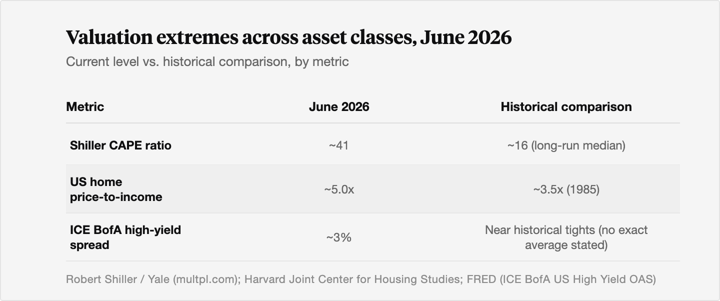
No single one of these proves a bubble. Read together, the proponents argue, they describe a market where cheap valuations are scarce.
3. The 2022 stress test: when stocks and bonds fell together
The strongest evidence for the thesis is not a valuation snapshot but a year when the shared driver reversed and the diversification most investors relied on stopped working.
In 2022 the Federal Reserve raised rates at the fastest pace in four decades to fight inflation. Higher rates lift the discount rate, which is the same force the everything bubble thesis says had been suppressing it. The result was a simultaneous decline. The S&P 500 fell about 18%, and the Bloomberg U.S. Aggregate bond index fell about 13% [5]. A standard 60/40 portfolio, 60% U.S. stocks and 40% investment-grade bonds, dropped roughly 17.5%, its worst calendar year since 1937 [5].
For most of modern history, bonds rose when stocks fell, which is why the 60/40 worked. According to a Morningstar study covering roughly 150 years, 2022 was effectively the one year in that span when bonds provided no diversification benefit during an equity downturn [5]. The two assets fell together because the same variable, the path of interest rates, drove both.
That is what a correlated repricing looks like in practice. It is one year of data, and the 60/40 recovered in the years that followed. We would not over-read a single episode. But it is a clean demonstration of the mechanism the thesis describes, which is why both sides of the debate keep returning to it.
4. The counterargument: rates, earnings, and "this time"
Parts of the bull case are well supported. One counterpoint is mechanical. A higher CAPE is partly justified when long-term real yields are low, because a lower discount rate raises the present value of future earnings [7]. Real yields were not at the zero levels of the late 2010s. The 10-year TIPS yield, a clean read on the real cost of money, sat near 2.2% in June 2026 [9]. That is restrictive enough to undercut the simplest version of "rates are still zero," and it cuts both ways in the debate. Some argue that with positive real yields back, the remaining valuation premium has less justification, not more.
Another is about earnings quality. Goldman Sachs Research argued in October 2025 that valuations were stretched but had not reached the levels typical of past bubbles before they burst [6]. Their reasoning: the gains in the technology sector were driven so far by real earnings growth rather than pure speculation, the leading companies carried unusually strong balance sheets, and on a growth-adjusted basis (the PEG ratio) the biggest names looked far less extreme than their late-1990s counterparts [6]. Index-level profit margins also expanded over the past decade as the market tilted toward asset-light software and platform businesses [8].
The last counterpoint is the oldest one: "this time is different" is the phrase that precedes most bubbles, and skepticism of high valuations has a long record of being early or wrong. Jeremy Siegel has argued for years that accounting changes since the 1990s bias the CAPE upward and that a fair "new normal" sits well above the historical 16 [7]. He may be right. The honest position is that some of the premium is explainable and some is not, and reasonable analysts disagree on the split.
We hold a view here, and we will hedge it the way the evidence demands. In our reading, valuations are high enough to lower expected long-run returns from these levels, which is a different and more defensible claim than predicting a crash.
5. Why proving a bubble is so hard
Even if you accept that markets are expensive, two problems stand between that observation and any action.
One is that valuation is a weak timing tool. A high CAPE has historically been associated with lower returns over the following decade, not with the timing of the next decline [2]. One widely cited estimate put the implied real return for U.S. equities over the next ten years at roughly 1% given June 2026 valuations [8]. That is a statement about a ten-year average, and it says nothing about next quarter. Markets can stay expensive, or get more expensive, for years. Anyone who sold U.S. equities on valuation in 2015 spent a long time being wrong.
The other is definitional. A bubble is usually only confirmed after it pops. Before that, the same data supports a bubble story and a "new era" story, and there is no clean test to separate them in real time. This is why the debate stays unresolved even among serious people who share the same numbers. To us, the useful takeaway is humility. We do not have a reliable way to call the top, and we are wary of anyone who claims they do. As the house line goes, there is never a crystal ball.
So the question worth asking is not "when does it pop" but "how do I build a portfolio that does not depend on getting that answer right."
6. What investors actually do to protect capital
When most assets look fully priced and the usual hiding places are sensitive to the same force, the standard playbook is process, not prediction. Four ideas recur.
Valuation discipline. Pay attention to the price you pay, because the entry price is one of the few reliable predictors of long-run return. A high starting valuation lowers the expected return, which argues for trimming the most stretched exposures rather than chasing them.
Diversification across drivers, not just labels. Owning ten things that all move on the level of interest rates is concentration wearing a diversified costume. Real diversification means holding return streams that respond to different forces, so that a single macro shock does not move all of them together. The 2022 episode is the reminder of why this distinction is not academic.
Real assets. Tangible assets with their own supply-and-demand dynamics, real estate, commodities, gold, and selectively fine art, can behave differently from financial assets in some environments, particularly around inflation and currency debasement. They carry their own risks and are not a free lunch, but they widen the set of drivers a portfolio is exposed to. We have written more on this in hard assets versus financial assets and on why art enters the fiscal-dominance conversation.
Liquidity. Keep enough liquid, low-volatility holdings that you are never a forced seller at the bottom. The investors who do worst in a correlated drawdown are usually the ones who have to sell something to meet a need at the worst possible moment. Cash is a position, and in an expensive market it is also an option to buy later at better prices.
None of this is exciting, and none of it requires a market call. That is deliberate.
7. Where art fits, honestly
When correlations across mainstream assets rise, allocators start looking for return streams driven by something other than the level of interest rates. Blue-chip art is one of the candidates some investors use at a small weight, and we want to describe it accurately rather than sell it.
The case for considering it is that the art market runs on a different clock. Prices for blue-chip work are driven mostly by wealth creation at the very top and by a supply of major works that tends to shrink over time as pieces enter museum collections. Historically, art's correlation to equities over long periods has been low, with its highest correlation, to gold, still modest. That is the property an allocator wants when the worry is that everything else is moving together.
The honest caveats matter more here than the case. Art is illiquid. Selling can take months or longer, and you cannot rebalance it on a screen. It can also be richly valued in its own right, and it has its own cycle. The global art market contracted about 12% in 2024 to an estimated $57.5 billion, its third-largest decline in fifteen years, with the high end hit hardest [10]. And art is not immune to a liquidity-driven downturn. When financing dries up and the wealthy turn cautious, demand at the top can soften, and it has before. You can read how that cycle has played out in how art market cycles work, and how rate signals interact with risk appetite in what a yield-curve inversion signals.
So the role, if there is one, is narrow. A small allocation to a low-correlation real asset, held for years, sized so that its illiquidity is a feature rather than a trap. We make no claim that it is a safe haven, and we would be skeptical of anyone who did.
Sources
- GuruFocus. "S&P 500 Shiller CAPE Ratio: 40.43 (Jun 2026)." GuruFocus Economic Indicators, June 2026. https://www.gurufocus.com/economic_indicators/56/sp-500-shiller-cape-ratio
- multpl. "Shiller PE Ratio by Year." multpl.com, June 18, 2026. https://www.multpl.com/shiller-pe/table/by-year
- Visual Capitalist. "Charted: American Income vs. Home Prices (1985 to 2025)." Visual Capitalist, 2025. https://www.visualcapitalist.com/charted-american-income-vs-home-prices-1985-2025/
- Federal Reserve Bank of St. Louis (FRED). "ICE BofA US High Yield Index Option-Adjusted Spread (BAMLH0A0HYM2)." FRED, accessed June 2026. https://fred.stlouisfed.org/series/BAMLH0A0HYM2
- Morningstar. "The 60/40 Portfolio: A 150-Year Markets Stress Test." Morningstar, 2025. https://www.morningstar.com/economy/6040-portfolio-150-year-markets-stress-test
- Goldman Sachs Research. "Why we are not in a bubble... yet." Goldman Sachs, October 8, 2025. https://www.goldmansachs.com/insights/goldman-sachs-research/why-we-are-not-in-a-bubble-yet
- MDPI, Journal of Risk and Financial Management. "Why the High Values for the CAPE Ratio in Recent Years Might Be Justified." MDPI, 2023. https://www.mdpi.com/1911-8074/16/9/410
- Griffiths, Rudyard. "The everything bubble: a twice-in-145-year valuation peak with no place to hide." The Hub, May 29, 2026. https://thehub.ca/2026/05/29/the-everything-bubble-a-twice-in-145-year-valuation-peak-with-no-place-to-hide/
- Federal Reserve Bank of St. Louis (FRED). "Market Yield on U.S. Treasury Securities at 10-Year Constant Maturity, Inflation-Indexed (DFII10)." FRED, June 2026. https://fred.stlouisfed.org/series/DFII10
- The Art Newspaper. "Global art sales plummeted by 12% in 2024, latest Art Basel/UBS report finds." The Art Newspaper, April 8, 2025. https://www.theartnewspaper.com/2025/04/08/global-art-sales-plummeted-12-per-cent-2024-art-basel-ubs-report
- T. Rowe Price. "Bubbles, barbells, and inflation risk: November 2025 remix." T. Rowe Price Investment Institute, November 2025. https://www.troweprice.com/en/us/investment-institute/insights/bubbles-barbells-and-inflation-risk
- Janus Henderson Investors. "High yield bonds: Can tight credit spreads persist?" Janus Henderson, 2025. https://www.janushenderson.com/en-us/investor/article/high-yield-bonds-can-tight-credit-spreads-persist/
- Harvard Joint Center for Housing Studies. "Home Prices Surge to Five Times Median Income, Nearing Historic Highs." JCHS, 2025. https://www.jchs.harvard.edu/blog/home-prices-surge-five-times-median-income-nearing-historic-highs
Disclosures
Investing involves risk. Past results are not indicative of future outcomes.
Masterworks is providing this communication as an agent for its issuer entities, not Masterworks Advisers. This material is produced by Masterworks for informational purposes only and does not constitute investment advice, a recommendation, or an offer or solicitation to buy or sell any security. Masterworks is not a licensed broker-dealer by the SEC or FINRA.
Masterworks can only make and accept sales after an offering statement has been filed, and "qualified", by the SEC. Any offers may be revoked before notice of qualification. Indications of interest involve no obligation. For further disclosure visit the offering documents filed with the SEC and Important Disclosures at masterworks.com/cd.
Forward-looking statements and internal estimates are based on assumptions that may prove incorrect, and actual outcomes may differ materially. Figures denoted in brackets are subject to confirmation. Investing in art and alternative assets involves risk, including loss of principal.
Art sales price data is comparative only. Each painting is unique and historical data is not a direct proxy for any specific painting or investment. Data represents whole art, not an investment into our offerings which includes fees and expenses. Any comparative images are not currently live offerings and are provided for educational purposes only.
Masterworks, LLC is located at 1 World Trade Center, 57th Floor, New York, NY 10007.


