
Masterworks Research · June 2026
What a family office is, who actually needs one, what it does all day, and why these offices keep pulling capital into alternatives, including art.
A family office is a private organization, usually a company or a trust, that manages the money and the affairs of one very wealthy family across generations. It centralizes everything a family of significant means has to deal with, including investing, taxes, estate planning, charitable giving, and a long list of administrative work, under a single dedicated team. The reason this matters for an ordinary investor is that family offices are some of the most patient and least constrained pools of capital in the world, and how they allocate, heavy in alternatives and private markets, is a useful map of how serious long-term money is actually invested.
What You Need to Know
- A family office is a dedicated team that runs one or more families' financial lives. It bundles investing, tax, estate planning, philanthropy, and concierge services into a single private entity built around the family rather than sold off a shelf.
- The split is single-family versus multi-family. A single-family office (SFO) serves one family and is owned by it. A multi-family office (MFO) is a commercial firm that serves several families and spreads its overhead across them. Recent estimates put the global count near 8,000 SFOs and roughly 5,000 MFOs [1][2].
- The thresholds are high and the running costs are real. A dedicated single-family office tends to make economic sense somewhere around $100 million to $250 million in investable wealth, with many private banks pointing to roughly $200 million, because a full office can cost on the order of 1% to 2% of assets, often $1 million to several million dollars a year, to run [1][3]. Below that, a multi-family office, typically open to families starting around $20 million to $30 million, is the more efficient route [1].
- The model is old and growing fast. John D. Rockefeller built the template in 1882; Deloitte projects the number of single-family offices will grow about 75%, from roughly 8,030 to more than 10,720, by 2030, with assets rising about 73% to $5.4 trillion [2][4].
- Family offices tilt hard toward alternatives. In UBS's 2025 survey of 317 single-family offices, alternative assets made up about 44% of the average portfolio, with private equity near 21% and real estate near 11%; US offices held about 54% in alternatives [5][6]. Art and antiques showed up as a small but distinct sleeve, around 1% on average [5].
- Art is increasingly treated as part of the wealth conversation. Deloitte estimates UHNW art and collectible wealth rose to about $2.56 trillion in 2024 and could reach $3.47 trillion by 2030, and 60% of family offices say they hold detailed knowledge of their clients' art collections for estate planning [7][8].
1. What is a family office, in plain terms?
Once a fortune passes a certain size, managing it stops looking like personal finance and starts looking like running a small institution. There are entities, trusts, multiple residences, operating businesses, tax filings in several jurisdictions, charitable commitments, and heirs with their own needs. A family office is the dedicated team a family stands up to handle all of it in one place, with a mandate to grow and preserve the wealth and pass it on intact [1][2].
The defining feature is that the office works for the family and only the family. A private bank has thousands of clients. A family office has one, or a handful. That changes the incentives. The staff, a chief investment officer, accountants, lawyers, sometimes a philanthropy lead and household managers, answer to the family rather than to a sales target [1][3]. The work runs from the obviously financial to the deeply personal: managing the investment portfolio on one end, coordinating private aircraft, art, and household staff on the other [1][2].
Deloitte counted roughly 8,030 single-family offices worldwide as of 2024, and other tallies add about 5,000 multi-family offices, putting the total near 13,000 to 15,000 entities [2]. Collectively they control trillions of dollars. They represent the organized, professionalized management of a meaningful slice of global private wealth, run on a generational clock rather than a quarterly one.
2. Single-family office vs multi-family office: what is the difference?
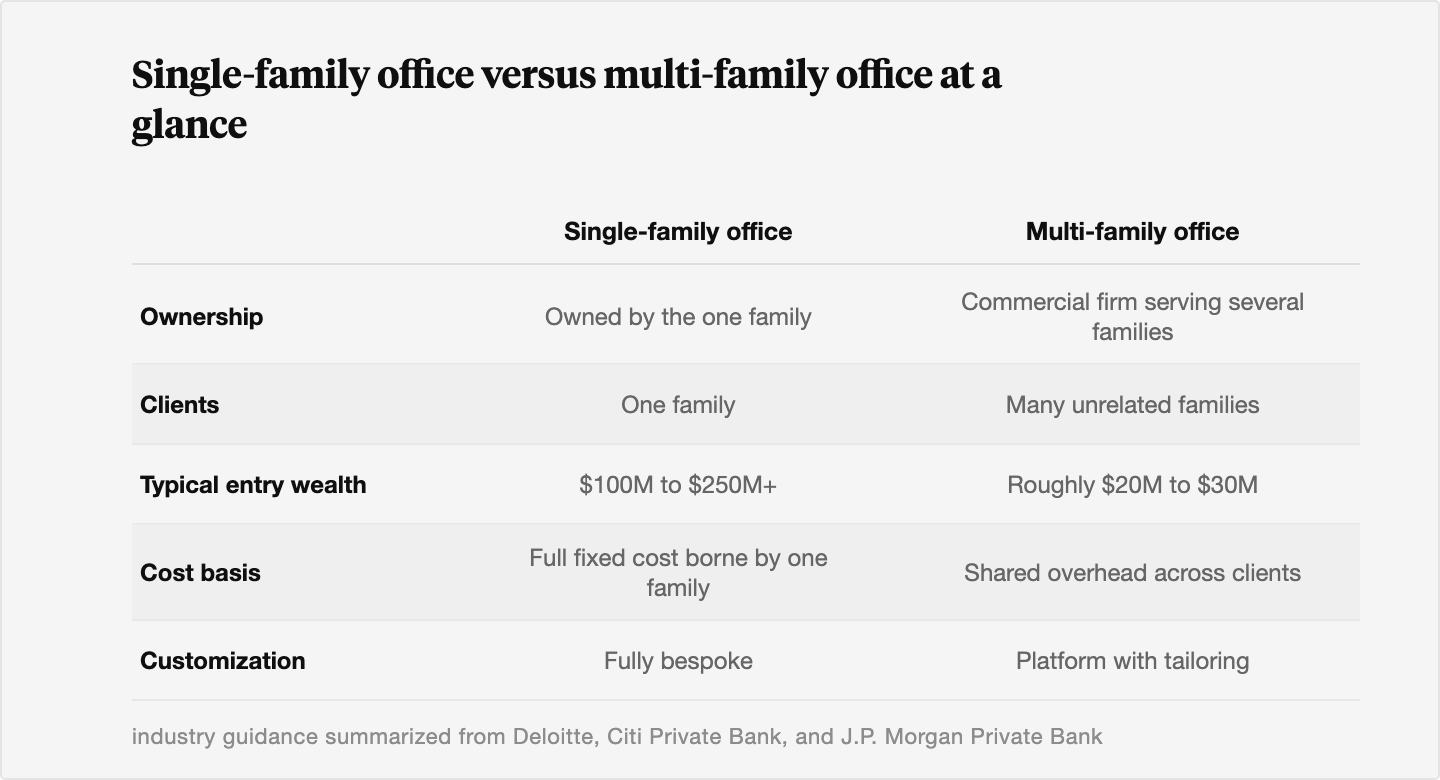
There are two main models, and the difference comes down to who owns the office and how many families it serves.
A single-family office serves exactly one family and is owned and controlled by that family [1]. The staff are effectively the family's employees, and the office is built bespoke around that family's assets, values, and quirks. This is the classic image of a family office: a private firm whose only client is the people who pay for it.
A multi-family office is a commercial business that serves several unrelated families as clients [1]. Instead of building and staffing a private firm from scratch, a family buys into a shared platform that already has the investment, tax, reporting, and planning machinery in place. The families are customers rather than owners, and the cost of the infrastructure gets spread across all of them. For most families with substantial but not dynastic wealth, this is the practical answer, because it delivers many of the same services without the fixed cost of a standalone office [1][3].
A single-family office is owning the whole building, and a multi-family office is renting a high-end floor in a building shared with peers. The choice is mostly about scale and complexity, which the next section makes concrete.
3. What does a family office actually do?
The label "family office" covers a wide range of services, but most cluster into five areas.
Investment management. This is the core. The office sets the family's long-term strategy, builds and manages the portfolio across public markets and private deals, hires and monitors outside managers, and reports on it all. In larger offices an in-house chief investment officer and team run this directly; smaller ones outsource much of it. UBS found the portfolio manager is the single most common first professional hire when a family builds an office [5].
Tax planning. Wealth at this level is taxed in complicated ways across income, capital gains, gifts, and estates, often in more than one country. A family office coordinates tax strategy and filings, structures entities and trusts to manage the burden legally, and keeps the whole picture consistent rather than letting each adviser optimize in isolation [1].
Estate and succession planning. The reason most family offices exist is to move wealth to the next generation in one piece. That means trusts, wills, ownership structures, and the harder human work of preparing heirs to receive and manage the assets. We come back to this in the art section, because collections are one of the assets that most often catch families unprepared [8].
Philanthropy. Many families channel their giving through the office, which may run a private foundation or donor-advised funds, vet grantees, and manage the charitable portfolio. Cerulli expects roughly $18 trillion of the coming wealth transfer to flow to charity rather than heirs, so this function is growing in weight [9].
Concierge and lifestyle services. At the personal end, the office can handle bill payment, household staff, property and aircraft management, security, travel, and the administration of collections, including art, cars, and wine [1][2]. This is the part that looks least like finance and is, for many families, a large reason to centralize.
Two functions increasingly sit alongside these: governance, meaning the rules and structures that keep a multigenerational family making decisions together, and succession, meaning the orderly handoff of both assets and authority. UBS's 2025 work flagged both as areas where many offices remain underprepared [5].
4. Where did the family office come from?
The idea is older than most people assume. The modern family office took recognizable shape in the United States in the late 1800s, as the great industrial fortunes matured and the families behind them needed professional teams to administer wealth that had outgrown the original business [10].
The usual starting point is John D. Rockefeller, who in 1882 set up an office of professionals to organize his business operations and manage the family's investments [10]. His son ran it from 26 Broadway in Manhattan, and the office grew into an institution. By 1992 the Rockefeller family office served around 100 client families and managed close to 300 family trusts, and its descendant, Rockefeller Capital Management, operates today as a multi-family office overseeing roughly $95 billion in client wealth [10]. The same era produced the House of Morgan, the banking dynasty built by Junius and J.P. Morgan that carried the European private-bank model into American finance [10].
The arc from a single industrialist's back office to a commercial firm serving a hundred families is the whole history of the field in miniature. The single-family office came first, born of necessity. The multi-family office came later, as a way to sell that same capability to families who had the wealth but not the scale to build it alone.
5. At what net worth does a family office make sense?
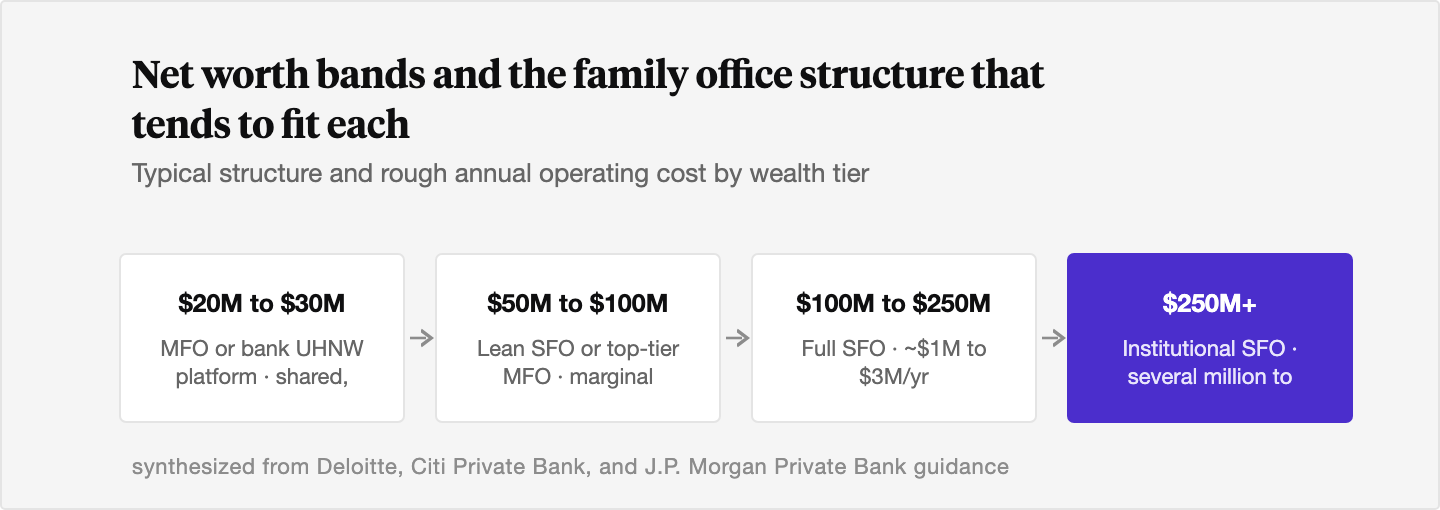
There is no official line, but the major banks and consultants cluster around a fairly consistent range, and the deciding factor is cost.
A full single-family office can cost on the order of 1% to 2% of assets a year to operate, which translates to over $1 million annually and often several million for larger, multi-jurisdiction offices [1][3]. That fixed cost is what sets the threshold. If the office eats 1.5% of a portfolio every year, the family needs enough assets that the cost is a rounding error rather than a drag on returns.
In practice:
- Around $20 million to $30 million: a multi-family office or a private bank's ultra-high-net-worth platform is usually the right fit, because the full cost of a standalone office would be too large a share of the portfolio [1][3].
- Around $50 million to $100 million: a family may be a top-tier multi-family office client or build a very lean single-family office that outsources most functions. The economics are marginal and depend heavily on complexity, such as operating businesses or property across several countries [1].
- Around $100 million to $250 million: a dedicated single-family office becomes clearly viable, with annual costs of roughly $1 million to $3 million [1][3]. Citi Private Bank points to around $200 million as the level where a dedicated office becomes plainly economical [3].
- $250 million and up: classic single-family office territory, often with in-house investment, tax, and philanthropy teams, where annual costs can run from several million into the tens of millions for the largest global families [1].
These are guideposts, not rules. A family with a complex operating business and assets in five countries might justify an office at $80 million, while a family with a simpler balance sheet might be better served by a multi-family office well past $200 million. Complexity, not just net worth, drives the decision.
6. How do family offices invest? The endowment-style, alternatives-heavy tilt
How these offices allocate is a window into how unconstrained long-term capital actually behaves. The pattern looks a lot like a university endowment: patient, global, and heavy in alternatives.
UBS's Global Family Office Report 2025, which surveyed 317 single-family offices with an average net worth of $2.7 billion and $1.1 billion in average assets, found that alternative assets made up roughly 44% of the average portfolio [5][6]. Private equity was the largest alternative sleeve at about 21%, followed by real estate near 11%, with hedge funds and private debt rounding out the rest [5]. Public equities sat around 30% and fixed income near 18% [5]. US family offices leaned even harder into alternatives, at about 54% of the portfolio, with 27% in private equity and 18% in real estate [6].
Why the tilt? Two reasons, both rooted in what makes family-office capital different. The time horizon is generational, so these offices can hold illiquid assets that pay off over a decade rather than a quarter, which is exactly the terrain where private equity, real estate, and other alternatives earn their premium. The other is diversification away from the public markets rather than a bet that everything will rise together. Real diversification means owning assets that move to their own rhythm, largely indifferent to whatever is driving stocks on a given day. We explore this allocation discipline in more depth in Art as an alternative allocation: a framework for advisors.
This is the endowment model in family-office form. It is also the doorway through which art enters the portfolio.
7. Why do family offices allocate to art?
Art shows up in family-office portfolios for reasons that follow directly from the alternatives tilt, and the data is starting to make the sleeve visible.
In the UBS 2025 survey, art and antiques registered as a distinct line in the average family-office portfolio at roughly 1% [5]. That sounds small, and as a share of a diversified book it is. As a pool of capital it is large, because it sits on top of a base of art and collectible wealth that Deloitte estimates rose from about $2.17 trillion in 2022 to $2.56 trillion in 2024, with a projection near $3.47 trillion by 2030 [7]. For UHNW families, art is already a meaningful slice of total net worth before any deliberate allocation decision is made.
There are four reasons family offices treat art as part of the portfolio rather than as decoration.
The alternatives logic extends to art. A family that already holds 44% of its portfolio in private, illiquid, long-horizon assets is structurally comfortable with an asset like art: patient capital, no daily quote, a multi-year hold. Art fits the same slot in the portfolio that private equity and real estate occupy.
Low correlation to the rest of the book. Art tends to move on its own clock, with low correlation to public equities and a closer relationship to gold than to stocks. For an office whose whole investing thesis is owning things that do not all rise and fall together, that property is the appeal. We would caution, as we always do, that past performance is not predictive, and that art's measured low correlation is partly an artifact of how infrequently it trades.
It is already a generational-transfer asset. Collections pass down through families, which is precisely the problem a family office is built to manage. Deloitte found that 60% of family offices hold detailed knowledge of their clients' art collections for estate planning, far above the 31% of private banks, which tells you the family office, not the bank, is where serious art-succession work happens [8]. The same research warns that the next generation of heirs is largely unprepared, with 61% of collectors not discussing their collection with heirs at all, so the planning gap is real and the office is the natural place to close it [8]. We size this coming handoff in How the $84 trillion wealth transfer is changing art demand.
Professional art advisory has gone mainstream. Deloitte's 2025 reading found a 79% consensus among wealth managers, collectors, and art professionals that art and collectibles should be part of a wealth management offering, and many family offices now run art advisory and collection management through partnerships with outside specialists [7][8]. The result is a small but growing share of UHNW capital being managed with the same rigor as any other alternative. The trend across multi-family offices specifically is covered in Art in multi-family office portfolios: current allocation trends, and the broader story of why these offices are turning to art is in The rise of family offices and why they're allocating to art.
Before anyone reads this as a recommendation: art is illiquid, pays no income, carries real holding costs, and has spent several recent years in a correction; the global market was about $59.6 billion in 2025, up 4% after a multi-year decline [11]. It belongs in a portfolio the way other alternatives do, as a small, long-term, loss-tolerant sleeve, and only for investors who can hold through a cycle. Past performance is not predictive of future results.
The Bottom Line
- A family office is a private team that manages one or more wealthy families' investing, tax, estate, philanthropy, and lifestyle affairs across generations, with a mandate to preserve and grow the wealth.
- The structure is single-family (one family, owned by it) or multi-family (a commercial firm serving several families and sharing the overhead), and roughly 8,000 SFOs and 5,000 MFOs operate worldwide.
- A dedicated single-family office tends to make sense from about $100 million to $250 million in wealth, with many banks citing around $200 million, while families starting near $20 million to $30 million are usually better served by a multi-family office.
- The model traces to John D. Rockefeller's 1882 office and is growing quickly, with Deloitte projecting about 75% more single-family offices and $5.4 trillion in assets by 2030.
- Family offices invest like endowments, holding roughly 44% of the average portfolio in alternatives, and US offices about 54%, because their generational horizon rewards patient, illiquid, diversifying assets.
- Art enters that portfolio as a small alternatives sleeve, around 1% on average, supported by a multi-trillion-dollar base of UHNW collectible wealth, its low correlation to public markets, and its central role in generational transfer. Past performance is not predictive.
Sources
- Wikipedia. "Family office." Wikipedia, accessed June 2026. https://en.wikipedia.org/wiki/Family_office
- AgilLink. "How to Define a Family Office." AgilLink Insights, 2024. https://www.agillink.com/insights/Blog/define-a-family-office.html
- Citi Private Bank. "What is a family office?" Citizens Private Banking Insights, accessed June 2026. https://www.citizensbank.com/private-banking/insights/what-is-a-family-office.aspx
- Deloitte Global. "Family Office Insights Series, Global Edition: the rapid expansion of family offices." Deloitte Private Press Room, September 2024. https://www.deloitte.com/global/en/about/press-room/global-edition-explores-the-rapid-expansion-family-offices-and-ffers-vision-of-the-future-landscape.html
- Caproasia. "UBS Global Family Office Report 2025: 317 Family Offices, asset allocation and operating cost." Caproasia, June 5, 2025. https://www.caproasia.com/2025/06/05/ubs-global-family-office-report-2025-317-family-offices-with-1-1-billion-average-aum-2-7-billion-average-net-worth-average-cost-to-operate-family-office-from-0-353-to-0-44-top-first-hire-in-fam/
- UBS. "Global Family Office Report 2025." UBS Global, May 21, 2025. https://www.ubs.com/global/en/media/display-page-ndp/en-20250521-global-family-office-report-2025.html
- Funds Society. "The Great Wealth Transfer will drive art investment: it will reach $3.5 trillion by 2030 (Deloitte Art & Finance Report 2025)." Funds Society, December 10, 2025. https://www.fundssociety.com/en/news/alternatives/the-great-wealth-transfer-will-drive-art-investment-it-will-reach-3-5-trillion-by-2030/
- Deloitte & ArtTactic. "Art & Finance Report 2025." Deloitte Private / ArtTactic, 2025. https://www.deloitte.com/nl/en/services/deloitte-private/research/art-and-finance-report.html
- Cerulli Associates. "Cerulli Anticipates $124 Trillion in Wealth Will Transfer Through 2048." Cerulli Press Release, 2025. https://www.cerulli.com/press-releases/cerulli-anticipates-124-trillion-in-wealth-will-transfer-through-2048
- Compound Manual. "A History of Family Offices." Compound Planning Manual, accessed June 2026. https://manual.compoundplanning.com/chapters/history-of-family-offices
- Art Basel and UBS. "The Art Basel and UBS Global Art Market Report 2026: Global sales rise 4% to $59.6 billion in 2025." Art Basel, March 2026. https://www.artbasel.com/stories/the-art-basel-and-ubs-global-art-market-report-2026
- J.P. Morgan Private Bank. "The why, who, what and how of starting a family office." J.P. Morgan Private Bank Insights, accessed June 2026. https://privatebank.jpmorgan.com/nam/en/insights/markets-and-investing/ideas-and-insights/the-why-who-what-and-how-of-starting-a-family-office
- Dakota. "Deloitte: Number of Family Offices to Grow 75% by 2030." Dakota Fundraising News, 2024. https://www.dakota.com/fundraising-news/deloitte-number-of-family-offices-to-grow-75-by-2030
Disclosures
Investing involves risk. Past results are not indicative of future outcomes.
Masterworks is providing this communication as an agent for its issuer entities, not Masterworks Advisers. This material is produced by Masterworks for informational purposes only and does not constitute investment advice, a recommendation, or an offer or solicitation to buy or sell any security. Masterworks is not a licensed broker-dealer by the SEC or FINRA.
Masterworks can only make and accept sales after an offering statement has been filed, and "qualified", by the SEC. Any offers may be revoked before notice of qualification. Indications of interest involve no obligation. For further disclosure visit the offering documents filed with the SEC and Important Disclosures at masterworks.com/cd.
Forward-looking statements and internal estimates are based on assumptions that may prove incorrect, and actual outcomes may differ materially. Figures denoted in brackets are subject to confirmation. Investing in art and alternative assets involves risk, including loss of principal.
Art sales price data is comparative only. Each painting is unique and historical data is not a direct proxy for any specific painting or investment. Data represents whole art, not an investment into our offerings which includes fees and expenses. Any comparative images are not currently live offerings and are provided for educational purposes only.
Masterworks, LLC is located at 1 World Trade Center, 57th Floor, New York, NY 10007.


