
Masterworks Research · June 2026
Art Movements | Fine Art Market Strategy
A three-year movement, a market that survives almost entirely through one name, and what a scarce category teaches about where value concentrates.
Fauvism was a French painting movement that ran for roughly three years, from the 1905 Salon d'Automne in Paris to about 1908, built around violent non-naturalistic color and led by Henri Matisse and Andre Derain. As an investable category today, it is small and concentrated. Most of the lasting market value sits with Matisse, whose auction record is $80.75 million [1], while the other Fauves trade far below that, and true Fauve-period canvases come up for sale a handful of times per decade [2]. For an investor, Fauvism is useful less as a place to allocate and more as a clean lesson in how value concentrates inside a movement: a short, famous moment in art history can produce one durable blue-chip market and very little else.
What You Need to Know
- Fauvism was over almost as soon as it started. The movement is usually dated 1905 to 1908, about three years, with only three group exhibitions [3]. By 1908 most of its painters had moved on to Cubism, a Cezanne-influenced structural style, or a quieter classicism.
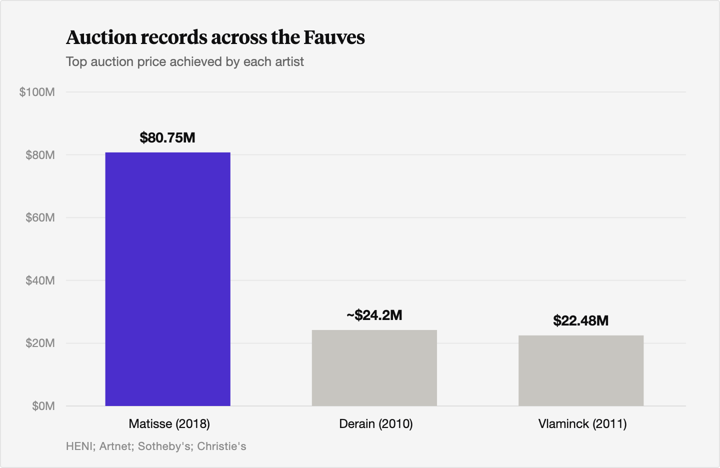
- The value concentrated in one artist. Matisse's auction record is $80.75 million, set at Christie's New York in May 2018 for the 1923 work "Odalisque couchee aux magnolias," and roughly 41 of his works have cleared $10 million at auction [1]. Derain's record is about $24.2 million; Vlaminck's is $22.48 million [2][4].
- True Fauve canvases are genuinely scarce. Scholars put Derain's full Fauve-period output in the low hundreds of oils, and a museum-quality 1905 to 1907 Fauve picture by Derain or Vlaminck now surfaces at the top evening sales roughly once or twice a decade each [2].
- The best works are locked in museums. Core Fauve paintings sit at MoMA, the Centre Pompidou, the Met, and the Hermitage and Pushkin (the old Shchukin and Morozov collections), which thins public supply and supports pricing when a work does appear [5].
- Modern and Impressionist material was a winner in the 2025 recovery. Modern auction sales rose about 35% year over year in 2025, and the segment posted some of the highest price-to-estimate ratios of any category [6]. Past performance is not predictive.
1. What Fauvism was, and why it lasted three years
Imagine you are standing in Room VII of the Salon d'Automne in Paris in the autumn of 1905. The walls are covered in landscapes and portraits where the sky is red, the faces are streaked green and orange, and the paint looks like it was squeezed straight from the tube. A classical bronze sits in the middle of the room. The critic Louis Vauxcelles, writing in Gil Blas, called it "Donatello among the wild beasts," and the name stuck. The painters became "les fauves," the wild beasts, and the movement became Fauvism [3].
The core was Matisse and Derain, who had spent the summer of 1905 painting together in Collioure, a fishing port on the Mediterranean [5]. Around them sat Maurice de Vlaminck, Kees van Dongen, Albert Marquet, Raoul Dufy, Othon Friesz, and briefly Georges Braque. The shared idea was simple. Color did not have to describe the world. It could be chosen for feeling and composition instead, applied in pure saturated patches, with the brushwork left visible and raw [3].
The movement was effectively over by 1908, after only three group shows [3]. There was no manifesto and no binding program, so once the initial shock had landed the painters scattered. Braque went off to invent Cubism with Picasso. Derain turned toward a sober, almost classical realism. Matisse softened his palette into the decorative interiors and odalisques of his Nice years. Friesz returned to tradition. Vlaminck moved toward a darker, heavier landscape style [3]. The thing collectors call "Fauvism" is really a three-year window of work by a group that immediately walked away from it.
That is the supply story: a short movement, no continuation, and finite output.
2. Why almost all the value sits with Matisse
A movement this brief produces very few works, and a market this old has had a century to sort out which names matter. The sorting was decisive. Matisse became one of the canonical modern masters, grouped by auction houses and dealers alongside Picasso, Monet, and Giacometti. The other Fauves became, in market terms, satellites.
The numbers make the gap concrete. Matisse's auction record is $80.75 million, set at Christie's New York on 8 May 2018 for "Odalisque couchee aux magnolias" (1923), a lot from the Peggy and David Rockefeller collection [1]. His previous record had been the sculpture "Nu de dos, 4e etat (Back IV)" at $48.8 million in 2010, so the 2018 sale was a step-change of roughly 65% [1]. According to the Artnet Price Database, about 41 works by Matisse have exceeded $10 million at auction [1]. That is real depth at the top of a market, not a single freak result.
Now compare the others. Derain's record is "Arbres a Collioure" (1905), a Fauve-period canvas sold at Sotheby's London on 22 June 2010 for about $24.2 million [2][4]. Vlaminck's record is "Paysage de banlieue" (c. 1905), sold at Christie's New York on 4 May 2011 for $22,482,500 [4]. Both records are themselves Fauve-period works, which tells you the market prizes the wild-color moment in those artists. But both records sit at roughly a quarter to a third of Matisse's [2][4].
Translate this to investing logic. We have written before about what blue-chip art actually means in market terms (/academy/posts/what-blue-chip-art-actually-means-and-why-it-matters). Matisse passes every test of it: museum-locked masterworks, deep auction comparables across decades, global bidding, and a record that resets higher over time. The rest of the movement does not clear that bar with the same conviction. A famous brief movement can hand you exactly one liquid blue-chip market and a handful of names that trade thinly around it.
3. The scarcity is real, and it cuts both ways
Investors hear "scarce" and assume "valuable." Fauvism shows why scarcity is more complicated than that.
True Fauve-period canvases are genuinely rare. Just Derain's London series, painted across 1906 and 1907, comprises 29 recorded paintings [2]. Counting his Collioure work of 1905, the London views, and the early Chatou landscapes, scholars put his entire Fauve-period oil output in the low hundreds [2]. Vlaminck's Fauve years run a little higher, perhaps 200 to 300 canvases, depending on how strictly you define the period [2]. These are not large bodies of work.
And most of the best examples are not even on the market. Core Fauve paintings are held at SFMOMA, which owns Matisse's "Woman with a Hat" (1905), at the Centre Pompidou in Paris, at the Met, and at the Hermitage and Pushkin, which inherited the foundational Matisse holdings of the Russian collectors Sergei Shchukin and Ivan Morozov [5]. When the Met staged "Vertigo of Color: Matisse, Derain, and the Origins of Fauvism" in 2023 and 2024, it had to borrow about 65 works from those institutions and from private collections to assemble the show [5]. That concentration is exactly why a museum-quality 1905 to 1907 Fauve canvas by Derain or Vlaminck now appears at a top evening sale only once or twice a decade for each artist [2].
On one end of the spectrum, you have an artist like Arshile Gorky, culturally important but with so few good paintings left in private hands that there is barely enough supply to sustain a market. On the other end you have an artist whose supply is so large it drowns out demand. There is a middle, and it is where steady markets live. Pure Fauve Derain and Vlaminck sit close to the thin end. The works are rare and prized, but the markets are too small and too infrequent to behave like deep, liquid, repeatable categories. Rarity supports the price of the one trophy that appears. It does not, on its own, build a market you can rely on.
4. Why a small category can still be investment-relevant
So if the category is tiny and mostly museum-bound, why does it matter to an investor at all?
Because demand in art attaches to names rather than categories. What drives prices at the top of the market is wealth creation among the very richest collectors, the kind of buyers who want a specific signature rather than a slice of a movement. For Fauvism, that demand has concentrated almost entirely into Matisse, and concentration is a feature of his market rather than a flaw. A scarce, well-documented oeuvre by a name that institutions and ultra-wealthy collectors compete for can hold value and re-rate quickly when the cycle turns, even when the surrounding category is small by volume.
The 2025 data supports the point. The global art market reached about $59.6 billion in 2025, up 4%, with public auction sales around $20.7 billion, up 9%, per Clare McAndrew's Art Basel and UBS Global Art Market Report 2026 [6][7]. Inside that, Modern art auction sales rose about 35% year over year, and Modern, Post-War, and Impressionist works posted the highest price-to-estimate ratios of any segment, a sign that bidding concentrated on established names during the recovery [8]. The high end recovered too: the largest houses grew total sales 11.1% to $4.55 billion, driven largely by a surge in supply of works priced above $10 million [8]. Past performance is not predictive, and a flight to quality is itself a cyclical behavior.
This is the broader pattern we have written about in how different price tiers behave (/academy/posts/price-tier-analysis-how-100k-1m-and-10m-works-behave-differently). The trophy tier, where Matisse lives, runs on its own logic, distinct from the high-volume low-price end of the market. A small concentrated artist market plugs into the same capital flows that move the very top, which is what makes it relevant out of proportion to its size.
5. How a Fauvism investor should actually think about it
If you wanted exposure to this corner of the market, the honest framing is narrow. The investable target is Matisse, and within Matisse it is the best examples, the works museums and serious collectors would want, bought at a sensible price.
Getting the artist market right comes first, and on that test Matisse is about as established as modern art gets. Institutional demand is active and current: the Met and the Museum of Fine Arts, Houston co-organized the 2023 to 2024 Fauvism show, the Art Institute of Chicago is staging "Matisse's Jazz" from 7 March to 1 June 2026, and the Perez Art Museum Miami is showing modern masterpieces including Matisse from the Berggruen collection starting in June 2026 [5]. Museums build their programming around names they treat as load-bearing for the story of modern art, and Matisse is consistently bracketed with Picasso and Klee. That is the curatorial version of a blue-chip rating.
The harder question is which Matisse. The market has a clear preference. His record is not a raw Fauve canvas from 1905. It is the 1923 odalisque, a high-color decorative interior from the Nice years that inherited Fauvism's palette in a more controlled form [1]. His top results cluster around saturated, ornamental works rather than the rawest early experiments [1]. The lesson for an investor is that "buy the famous movement" is the wrong instruction. Buy the best example by the name the market has chosen, at a fair price, and let the quality of the work carry the result.
One more honest limit. This is a thin, infrequent market even at the Matisse level above $10 million, and art is an illiquid, long-horizon holding. Different parts of the art market also move on different clocks, which is part of why Modern and Contemporary often diverge (/academy/posts/when-markets-diverge-why-contemporary-art-and-old-masters-dont-move-together). A scarce category like this can sit quiet for years and then re-rate on a single trophy sale. That is the nature of it.
Sources
- Artnet News. "Henri Matisse Drawings Rake in More Than $2.5 Million at Auction." Artnet, October 2025. https://news.artnet.com/market/henri-matisse-drawings-benefit-auction-2684925
- Christie's / Art & Object. "A Rare Fauve View of the Thames by Andre Derain to Star in Christie's Impressionist and Modern Art." Art & Object, February 2018. https://www.artandobject.com/press-release/rare-fauve-view-thames-andre-derain-star-christies-impressionist-and-modern-art
- Tate. "Fauvism." Tate Art Terms (updated June 2026). https://www.tate.org.uk/art/art-terms/fauvism
- Sotheby's. "Andre Derain | Art for Sale, Results & Biography." Sotheby's (updated March 2026). https://www.sothebys.com/en/artists/andre-derain
- The Metropolitan Museum of Art. "Vertigo of Color: Matisse, Derain, and the Origins of Fauvism." The Met (updated May 2026). https://www.metmuseum.org/exhibitions/vertigo-of-color
- Artsy. "The global art market rebounded to $59.6 billion in 2025, Art Basel & UBS report finds." Artsy, March 2026. https://www.artsy.net/article/artsy-editorial-global-art-market-rebounded-596-billion-2025-art-basel-ubs-report-finds
- UBS. "The Art Basel and UBS Global Art Market Report 2026." UBS, April 2026. https://www.ubs.com/global/en/our-firm/art/art-market-research.html
- Bank of America Private Bank. "Art Market Analysis Spring 2026: Trends, Sales, Auctions." Merrill / Bank of America, April 2026. https://www.pbig.ml.com/articles/art-market-spring-update.html
- HENI. "The Odalisque That Set Matisse's Auction Record." HENI (updated June 2026). https://heni.com/news/article/henri-matisse-odalisque-couchee-aux-magnolias-2018-05-08
- The Museum of Modern Art. "Fauvism" essay; Metropolitan Museum of Art. "Fauvism." The Met (updated June 2026). https://www.metmuseum.org/essays/fauvism
- Wikipedia. "Fauvism." (updated April 2026). https://en.wikipedia.org/wiki/Fauvism
- Artnet. "Maurice de Vlaminck Auctions Results." Artnet (accessed June 2026). https://www.artnet.com/artists/maurice-de-vlaminck/past-auction-results
Disclosures
Investing involves risk. Past results are not indicative of future outcomes.
Masterworks is providing this communication as an agent for its issuer entities, not Masterworks Advisers. This material is produced by Masterworks for informational purposes only and does not constitute investment advice, a recommendation, or an offer or solicitation to buy or sell any security. Masterworks is not a licensed broker-dealer by the SEC or FINRA.
Masterworks can only make and accept sales after an offering statement has been filed, and "qualified", by the SEC. Any offers may be revoked before notice of qualification. Indications of interest involve no obligation. For further disclosure visit the offering documents filed with the SEC and Important Disclosures at masterworks.com/cd.
Forward-looking statements and internal estimates are based on assumptions that may prove incorrect, and actual outcomes may differ materially. Figures denoted in brackets are subject to confirmation. Investing in art and alternative assets involves risk, including loss of principal.
Art sales price data is comparative only. Each painting is unique and historical data is not a direct proxy for any specific painting or investment. Data represents whole art, not an investment into our offerings which includes fees and expenses. Any comparative images are not currently live offerings and are provided for educational purposes only.
Masterworks, LLC is located at 1 World Trade Center, 57th Floor, New York, NY 10007.


