Masterworks Research · June 2026
Art Movements | Fine Art Market Strategy
What Color Field painting is, why Rothko and Newman command nine-figure prices, and where the strand sits inside the blue-chip postwar market.
Color Field painting is the strand of Abstract Expressionism built on large, flat expanses of color rather than visible brushwork, and its leading names, Mark Rothko and Barnett Newman, sit among the most expensive postwar artists in the world. The term was coined by the critic Clement Greenberg in the 1950s to separate painters like Rothko, Newman, and Clyfford Still from the gestural action painters such as Jackson Pollock and Willem de Kooning [1][2]. For an investor, the strand matters because a handful of these works trade in the same nine-figure neighborhood as the marquee action paintings, the supply is fixed, and the buyers are some of the most concentrated capital on earth.
What You Need to Know
- Color Field is a defined strand of Abstract Expressionism, not a separate movement. Greenberg used "color-field painting," and later "post-painterly abstraction," to describe work that favored open fields of color over the dense, gestural surfaces of Pollock and de Kooning [1][2][3]. The first-generation names are Rothko, Newman, and Still.
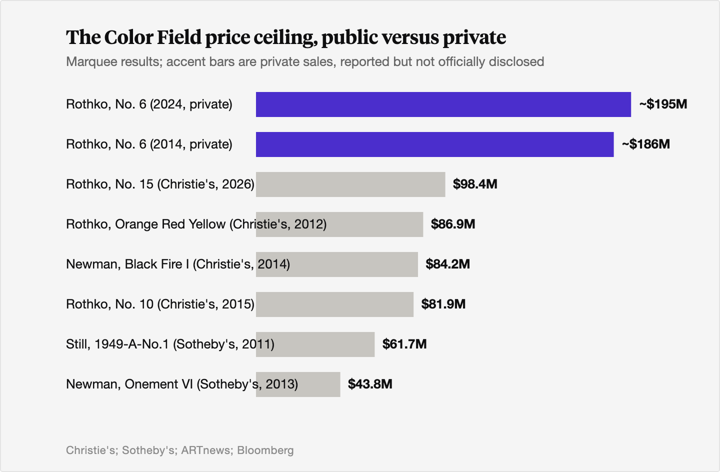
- The top names trade at nine figures. A 1964 Rothko, "No. 15 (Two Greens and Red Stripe)," sold for $98.4 million with fees at Christie's in May 2026, a new auction record for the artist [4]. Barnett Newman's "Black Fire I" (1961) made $84.2 million at Christie's in 2014 [5].
- The very largest figures change hands privately. Rothko's "No. 6 (Violet, Green and Red)" (1951) reportedly sold for about $186 million in 2014 and again for roughly $195 million in 2024, both private transactions, so we treat those numbers as reported rather than disclosed [6].
- Below the top tier the strand thins fast. Helen Frankenthaler's auction record is about $7.9 million and Morris Louis sits near $5.7 million, a reminder that "Color Field" as a category spans a very wide price range [7][8].
- This sits at the center of the blue-chip market, and it carries real risk. Postwar art was the largest auction sector by value in 2025, and sales above $10 million grew about 30 percent year over year, but most works, even by famous artists, do not appreciate [9][10]. Past performance is not predictive.
1. What Color Field painting is, and how it differs from gestural Abstract Expressionism
Color Field painting describes large canvases dominated by flat, unbroken areas of color, with little surface incident and a single unified image [2]. Britannica defines it as work that "differs qualitatively from the gestural, expressive brushwork" of Pollock and de Kooning [2]. That distinction is what the label captures. Abstract Expressionism splits into two tendencies, and Color Field is one of them.
On one side are the action painters, Pollock, de Kooning, and Franz Kline, who emphasized gesture, drip, and the visible record of the artist's movement. On the other are the Color Field painters, Rothko, Newman, and Still, who suppressed the brushstroke and worked in broad zones of saturated color. Rothko stacked soft rectangles of color. Newman split his canvases with a single vertical line he called the "zip." Still built jagged, edge-to-edge fields. The look is calmer and more open, but the ambition is the same as the rest of the movement.
The critic Clement Greenberg did the naming. He used "color-field" in the 1950s, then titled a 1964 exhibition at the Los Angeles County Museum of Art "Post-Painterly Abstraction" to describe a second generation that pushed the same logic further [1][3]. He traced the lineage back through the flat color of the nineteenth-century French painter Edouard Manet to Rothko and Newman [2]. For an investor, the takeaway is that this strand arrived with its own critical apparatus and its own canon, in place within a decade. That early canonization is part of what makes the names durable today. We dealt with the broader rise of Abstract Expressionism, and how New York displaced Paris, in our piece on how America became the center of the art world. This note is about the Color Field strand specifically, and its market.
2. The second generation: soak-stain and the Washington painters
The story does not stop with Rothko and Newman. In 1952 a twenty-three-year-old painter named Helen Frankenthaler made "Mountains and Sea" by thinning her paint and pouring it onto raw, unprimed canvas, letting the pigment soak in like dye rather than sit on the surface [11]. That soak-stain technique opened a second generation of Color Field work and directly influenced Morris Louis and Kenneth Noland, the core of what became known as the Washington Color School [11].
This matters for an investor for a simple reason. "Color Field" is a wide tent. It holds Rothko at one end, where a single canvas can clear $90 million, and it holds Louis and Noland at the other, where strong examples trade in the low single-digit millions. The label alone tells you almost nothing about price; the artist market does. We make this point often, and it holds here. The strand you are buying matters far less than the specific name, and the specific name matters far less than the example.
3. Why Rothko and Newman command nine figures
Mark Rothko holds a current public auction record of $98.4 million, set in May 2026 when "No. 15 (Two Greens and Red Stripe)" (1964), from the collection of Agnes Gund, sold at Christie's in New York on a hammer of $85 million [4]. Before that, his benchmark public results were "Orange, Red, Yellow" (1961) at $86.9 million at Christie's in 2012, "No. 10" (1958) at $81.9 million at Christie's in 2015, and "White Center" (1950) at $72.8 million at Sotheby's in 2007 [4][12][13]. Barnett Newman's auction record is "Black Fire I" (1961), which made $84.2 million at Christie's on May 13, 2014, nearly doubling his prior record [5]. His "Onement VI" (1953), consigned by the Microsoft co-founder Paul Allen, had set that prior mark at $43.8 million at Sotheby's in 2013 [14]. Clyfford Still's record is "1949-A-No.1," which sold for $61.7 million at Sotheby's in November 2011, far past its $35 million high estimate, as part of a group sold to endow the Clyfford Still Museum in Denver [15].
The single largest Rothko figures never appeared on an auction block. "No. 6 (Violet, Green and Red)" (1951) reportedly sold for about $186 million in 2014 in the private transaction at the center of the Bouvier affair, and reportedly changed hands again for roughly $195 million in 2024 [6]. Private sales are not officially disclosed, so those figures come from the financial and art-market press, not from a printed hammer price. We treat them as estimates.
4. Why these prices hold: fixed supply and concentrated demand
Two forces explain the records. The first is supply that cannot grow. Rothko died in 1970, Newman in 1970, and Still in 1980. No new work by any of them will ever be made, and the best canvases keep leaving the market as collectors donate them to museums. Newman painted a small body of finished work in his lifetime, which is part of why a single canvas like "Black Fire I" can carry the whole artist record. Scarcity that increases over time is rare among assets, and it is a feature this strand shares with the rest of the blue-chip market.
The second force is who is bidding. We tend to think about high-end art as a call option on the very top of the wealth distribution, really the top 0.01 percent. A serious collection runs into the tens or hundreds of millions, so the marginal buyer for a $90 million Rothko is a billionaire, and what moves these prices is wealth creation at that altitude. That is visible in the data. In 2025 the United States accounted for 78 percent of the global market for works sold above $10 million, and all ten of the most expensive lots sold worldwide were auctioned in New York [9]. We have argued that the next leg of this demand may come from a new generation of wealth created by AI, supply of blue-chip art being fixed while the wealth of the people who can buy it expands. We do not know the timing. We do think the direction matters for this strand more than for most.
5. Where Color Field sits in the blue-chip market
Color Field sits at the core of the postwar market. Postwar art was the largest fine art auction sector by value in 2025, at roughly a 31 percent share, and the global market returned to growth that year, with sales rising about 4 percent to an estimated $59.6 billion and public auction sales up about 9 percent to $20.7 billion [9][10]. The recovery was concentrated at the top, where the trophy works live. Sales above $10 million grew about 30 percent year over year [9]. Rothko's $98.4 million result in May 2026 landed squarely inside that recovering top tier [4].
The strand sits next to two neighbors investors should understand. One is gestural Abstract Expressionism, where the very top, a Pollock or a de Kooning, trades even higher than Color Field's ceiling. The other is Minimalism, the movement that grew partly out of Newman's reductive logic in the 1960s, where the reduction goes further still. We cover that turn in why less commands more at auction. What links all three is that they make up the spine of what the market calls blue-chip art: a small set of names with deep institutional ownership, decades of price history, and demand that does not depend on a single fashion cycle.
6. The risks an investor should weigh
The case for the strand is real, and so are the limits. We will name them plainly.
Most works do not appreciate. Even within a great artist market, an A or B example behaves very differently from a minor one, and a lesser Rothko on paper is not the same investment as a major canvas. The category is illiquid. These are long-hold assets, usually three to ten years at minimum, and the trophy works that set records are exactly the works that come up rarely and sell privately, which makes the public record an incomplete guide. The headline figures also skew the picture. A handful of nine-figure Rothkos sit atop a much larger base of work that trades for far less, and survivorship bias means the names you read about are the ones that worked.
The market is also cyclical, and it tested patience recently. The postwar segment corrected hard from its 2022 peak before the top recovered in 2025 and into 2026 [9][10]. Art runs on its own clock, with correlation to equities over long periods near zero, which is the reason an investor would own it at all. That same independence means it can lag a roaring stock market for years. We explore why these segments move on different schedules in why contemporary art and Old Masters do not move together. Past performance is not predictive of future results.
Sources
- Greenberg, Clement, and editors. "Post-painterly abstraction." Wikipedia, accessed June 2026. https://en.wikipedia.org/wiki/Post-painterly_abstraction
- Encyclopaedia Britannica. "Color-field painting." Britannica, accessed June 2026. https://www.britannica.com/art/color-field-painting
- The Art Story. "Color Field Painting Movement Overview." TheArtStory, accessed June 2026. https://www.theartstory.org/movement/color-field-painting/
- Greenberger, Alex. "Agnes Gund's Rothko Painting Sells for $98 M., Setting New Record." ARTnews, May 2026. https://www.artnews.com/art-news/market/mark-rothko-painting-agnes-gund-set-record-break-1234786013/
- HENI. "The Abstract That Set Barnett Newman's Auction Record." HENI News, May 13, 2014. https://heni.com/news/article/barnett-newman-black-fire-i-2014-05-13
- Doroshenko, Peter, et al. "A $186 Million Rothko Pits Russian Tycoon Against Art Merchant." Bloomberg, April 27, 2015; "Rothko's Most Expensive Painting Sold Again." World Art News, March 7, 2024. https://www.bloomberg.com/news/articles/2015-04-27/a-186-million-rothko-pits-russian-tycoon-against-art-merchant
- HENI. "The Fireworks That Set Helen Frankenthaler's Auction Record." HENI News, June 29, 2020. https://heni.com/news/article/helen-frankenthaler-royal-fireworks-2020-06-29
- Invaluable. "Morris Louis Paintings and Artwork for Sale, Art Value Price Guide." Invaluable, accessed June 2026. https://www.invaluable.com/artist/louis-morris-3epvwhkuu7/sold-at-auction-prices/
- Escalante-De Mattei, Shanti. "Art Market Reaches $59.6 Billion in 2025 as High-End Sales Drive Recovery." ARTnews, 2026. https://www.artnews.com/feature/art-market-report-2025-growth-high-end-sales-1234777143/
- Art Basel and UBS. "Global sales rise 4% to $59.6 billion in 2025, amid ongoing market recalibration." The Art Basel and UBS Global Art Market Report 2026, by Dr. Clare McAndrew, 2026. https://www.artbasel.com/stories/the-art-basel-and-ubs-global-art-market-report-2026
- The Art Story. "Helen Frankenthaler." TheArtStory, accessed June 2026. https://www.theartstory.org/artist/frankenthaler-helen/
- The Art Wolf. "Rothko's 'Orange, Red, Yellow' sells for $86.9 million at Christie's." TheArtWolf, May 2012. https://theartwolf.com/news/rothko-sold-christies-2012/
- ARTnews. "The Most Expensive Works by Mark Rothko Sold at Auction." ARTnews, accessed June 2026. https://www.artnews.com/list/art-news/artists/most-expensive-works-by-mark-rothko-auction-records-1234604959/
- Bloomberg. "Barnett Newman Leads Sotheby's NYC $294 Million Auction." Bloomberg, May 15, 2013. https://www.bloomberg.com/news/articles/2013-05-15/barnett-newman-fetches-record-44-million-at-sotheby-s
- HENI. "The Painting That Set Clyfford Still's Auction Record." HENI News, November 9, 2011. https://heni.com/news/article/clyfford-still-1949-a-no-1-2011-11-09
Disclosures
Investing involves risk. Past results are not indicative of future outcomes.
Masterworks is providing this communication as an agent for its issuer entities, not Masterworks Advisers. This material is produced by Masterworks for informational purposes only and does not constitute investment advice, a recommendation, or an offer or solicitation to buy or sell any security. Masterworks is not a licensed broker-dealer by the SEC or FINRA.
Masterworks can only make and accept sales after an offering statement has been filed, and "qualified", by the SEC. Any offers may be revoked before notice of qualification. Indications of interest involve no obligation. For further disclosure visit the offering documents filed with the SEC and Important Disclosures at masterworks.com/cd.
Forward-looking statements and internal estimates are based on assumptions that may prove incorrect, and actual outcomes may differ materially. Figures denoted in brackets are subject to confirmation. Investing in art and alternative assets involves risk, including loss of principal.
Art sales price data is comparative only. Each painting is unique and historical data is not a direct proxy for any specific painting or investment. Data represents whole art, not an investment into our offerings which includes fees and expenses. Any comparative images are not currently live offerings and are provided for educational purposes only.
Masterworks, LLC is located at 1 World Trade Center, 57th Floor, New York, NY 10007.


