Masterworks Research · June 2026
Why a homeowners policy rarely protects a serious work, the two ways to fix it, and what a fine-art policy actually pays for when something goes wrong.
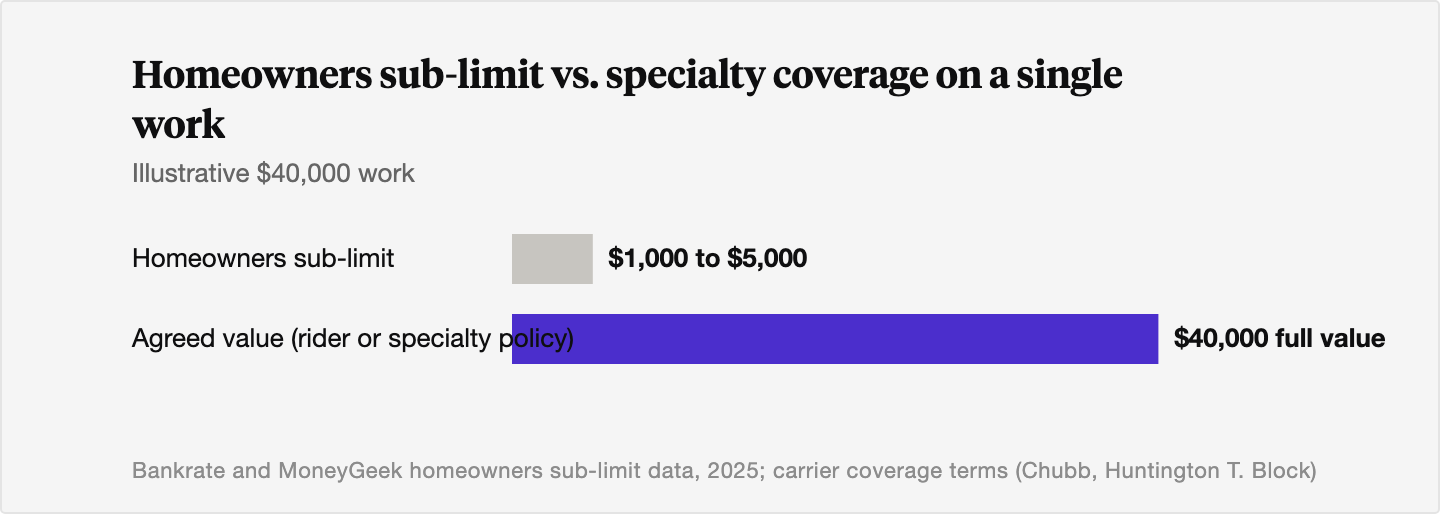
To insure fine art properly, you move the work off the small print of a homeowners or renters policy and onto coverage built for the asset, either a scheduled rider added to your home policy or a standalone specialty fine-art policy. Both options can be written on an agreed-value basis, which means the insurer pays a fixed sum you set in advance when a covered total loss happens, with no haggling over depreciation. The reason this matters to an investor is simple. A standard homeowners policy typically caps theft of art and collectibles somewhere between $1,000 and $5,000 [1][2], so a single $40,000 canvas hanging in your living room is almost certainly underinsured the day you buy it.
What You Need to Know
- A homeowners policy is the wrong tool for a valuable work. Standard policies set sub-limits on art and collectibles of roughly $1,000 to $5,000 and on jewelry near $1,000 to $2,500, and they pay actual cash value after depreciation rather than the full agreed sum [1][2].
- You have two real options. A scheduled rider (also called a floater) lists the work on your home policy for its full appraised value, or a standalone specialty policy from a carrier such as Chubb, AXA XL, AIG Private Client, Hiscox, or Huntington T. Block covers the collection on its own terms [3][4][5].
- Agreed value is the standard you want. Specialty carriers fix the payout in advance, and some go further. Chubb, for example, will pay up to 150% of the itemized amount to account for a rise in market value before a loss [3].
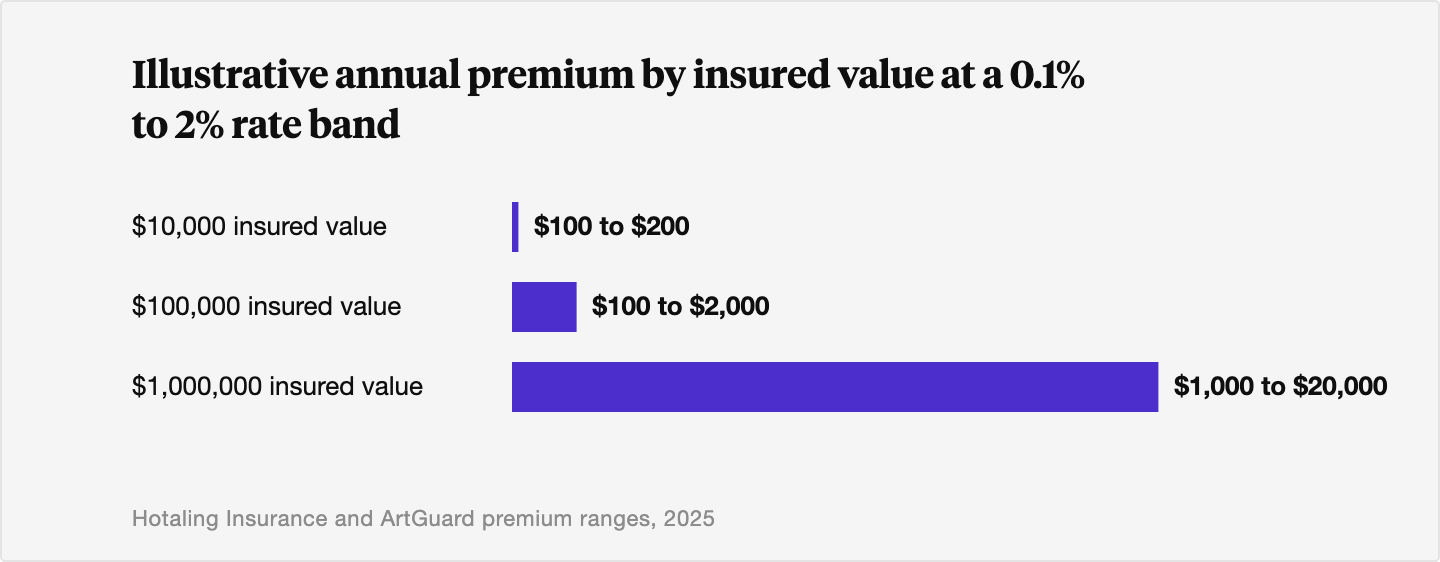
- Cost is a small fraction of value. Fine-art coverage commonly runs about 0.1% to 2% of insured value per year, so a $10,000 work often costs roughly $100 to $200 annually to insure [6][7].
- A current appraisal and provenance file are the price of entry. Carriers require an appraisal or recent bill of sale to schedule a work, and insurers generally recommend refreshing the valuation every three to five years [5][8].
1. Why a homeowners or renters policy usually fails the work
A standard homeowners policy is built to rebuild a house and replace ordinary contents. It treats a painting the way it treats a sofa. That logic breaks the moment the object is worth more than the line item allows.
Two structural problems do the damage. The first is the sub-limit. Most homeowners policies cap theft of fine art and collectibles at roughly $1,000 to $5,000, and cap jewelry near $1,000 to $2,500 [1][2]. Those caps exist because art, jewelry, and similar items are easy to steal and hard to verify, so carriers ring-fence them [2]. A work worth $50,000 sits far outside that fence.
The second problem is how the policy pays. Standard contents coverage often settles at actual cash value, which subtracts depreciation, and it usually carries the same deductible as the rest of your home policy. Many policies also exclude or limit common art perils such as accidental breakage. So even a claim that gets paid can come back well under what the work is worth.
Filing an art claim against the home policy can also affect that policy's loss history and pricing. Pulling valuables onto their own coverage keeps the two problems separate.
2. Option one: a scheduled rider on your homeowners policy
The first fix keeps art on the home policy but lists each work individually. This is a scheduled personal property rider, sometimes called a floater or an endorsement. You name the piece, attach a value backed by an appraisal or bill of sale, and the carrier covers it up to that amount [9].
A rider buys three things a base policy lacks. It raises the limit to the work's full value rather than the sub-limit. It usually drops or eliminates the deductible on that item. And it broadens the perils, often to an all-risk basis, so accidental damage that the base policy would argue about is covered [9].
Riders work well for a handful of pieces. Schedule a $30,000 work, pay a small added premium, and that object is now covered for its stated value. The limits are that you re-document and re-schedule each piece as values change, the menu of art-specific features is thinner than a specialty policy's, and a home carrier's appetite for a large or fast-moving collection is limited. For one or two meaningful works, a rider is often the cleanest answer.
3. Option two: a standalone specialty fine-art policy
The second fix takes the art off the home policy entirely and puts it with a carrier that does nothing but value protection. Chubb, AXA XL, AIG Private Client Group, Hiscox, and Huntington T. Block all write this coverage for private collectors, alongside museums, galleries, and auction houses [3][4][5].
Specialty policies are written on an all-risk basis, which means every peril is covered except the ones the policy specifically excludes [5]. They tend to carry no deductible on most losses, they extend worldwide whether the work is at home, on loan, or in storage, and they bundle features a home carrier will not, including transit coverage and access to a restoration network [3][4]. Chubb, as one example, covers a newly acquired work automatically for up to 90 days at 25% of your itemized coverage, which buys time to get a fresh piece formally scheduled [3].
The trade-off is administrative. A standalone policy is a separate relationship with its own application, its own appraisals, and its own premium. For a collection of any size, or for a single work where the home carrier's terms are weak, that separation is the point.
4. Agreed value vs. market value: the clause that decides your claim
The most important line in an art policy is how it sets the payout. There are two approaches, and the difference shows up only when you file a claim.
Agreed value means you and the insurer fix a dollar figure for each scheduled work when the policy is written, backed by an appraisal. If a covered total loss happens, the carrier pays that full sum with no depreciation and no argument. Chubb describes paying 100% of the agreed value as a cash settlement on a covered total loss [3]. This is the standard a serious collector wants, because it removes the fight at the worst possible moment.
Market value means the carrier pays what the work was worth at the time of loss, which has to be established after the fact. That can work against you in a rising market and invites a dispute about comps. Some carriers blend the two. Chubb's market-value protection pays up to 150% of the itemized amount if the work's market value has climbed above the scheduled figure before a loss [3], which softens the main weakness of a fixed number in an appreciating market.
Agreed value converts an uncertain future claim into a known number today. That certainty is most of what you are buying.
5. What is and is not covered
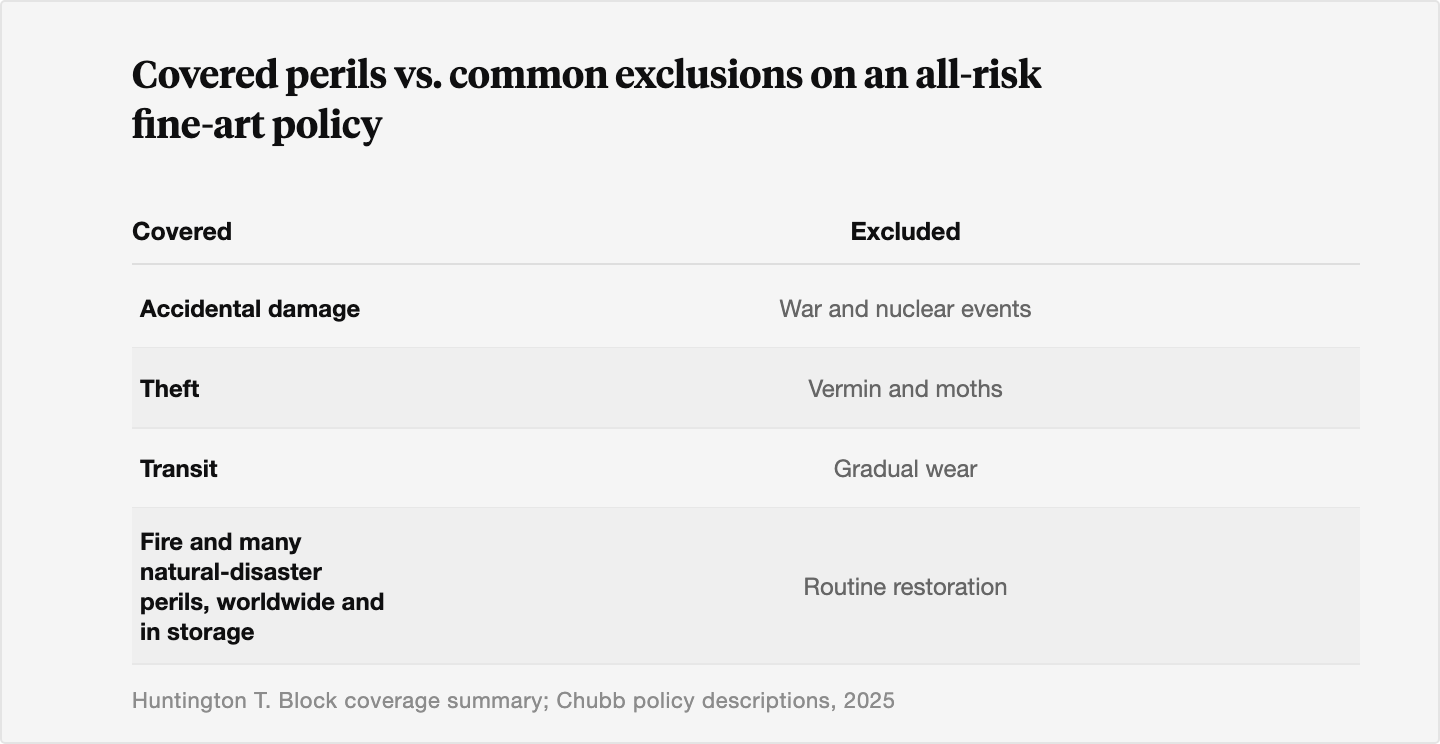
An all-risk fine-art policy covers a wide range of perils. The standard list includes accidental physical damage, such as a dropped or punctured work, theft, damage in transit while the work is shipped or driven, and damage from natural events such as fire, smoke, and many water and storm events [5][9]. Coverage generally follows the work worldwide, including time in storage, at a framer, or on loan to an exhibition [3].
The exclusions are where the policy draws its lines. Common exclusions on a fine-art policy include war, nuclear events, damage from moths and vermin, and gradual deterioration or inherent wear [5]. Restoration and conservation work is frequently excluded or limited, since that is maintenance rather than a sudden loss, and damage caused by a flawed repair can be contested. Intentional damage, fraud, and ordinary aging fall outside coverage as well.
Read the actual policy, not the brochure. Flood and earthquake treatment varies by carrier and by where the work lives, and a coastal or seismic location can change both terms and price. The exclusions list decides whether a claim gets paid.
6. The role of appraisal and provenance documentation
Coverage is only as good as the paperwork behind the value. Every carrier requires proof of what a work is worth before it will schedule it. Huntington T. Block, for example, requires an appraisal or a recent bill of sale to set the insured amount on both scheduled and blanket coverage [5].
The threshold for a formal appraisal varies. Chubb requires an appraisal only for items valued at $500,000 or more, and accepts a detailed description and estimated value below that [3]. A higher-value or fast-moving work justifies a formal appraisal from a qualified, independent appraiser regardless of the carrier's minimum.
Value moves, so documentation cannot sit still. Insurers generally recommend refreshing an appraisal every three to five years, and works in fast-moving markets such as contemporary art may warrant a review closer to every two years, since some living artists' prices can move sharply over short periods [8]. A scheduled value that is five years stale can leave a work underinsured in a rising market or overinsured, and overpaying, in a falling one.
Provenance, the documented ownership history of a work, does double duty here. It supports the appraised value, since a work with a strong exhibition and ownership record tends to command more [8], and it speeds a claim by establishing what the work is and that you own it. A clean file, high-resolution photographs, purchase receipts, condition reports, and provenance records, is part of the asset.
7. Single works vs. whole collections
How a policy is structured depends on how much you own. Carriers handle a single work and a deep collection differently, and the right answer is often a blend.
Scheduled coverage lists each work with its own agreed value. It gives you certainty per item and is the natural fit for one or a few meaningful pieces. Blanket coverage sets one overall limit for the whole collection with no per-item cap, which simplifies administration for a large or frequently changing holding but can leave value to be established at claim time [5]. Museums, universities, and galleries often use blanket coverage for exactly this reason.
A common approach for a private collector is a hybrid. Schedule the top pieces that carry most of the value on an agreed-value basis, then cover the long tail of lower-value works under a blanket limit. That balances claim certainty on the works that matter most against the simplicity of not itemizing everything you own.
8. What fine-art insurance costs
Pricing is modest relative to the asset. Fine-art coverage commonly runs about 0.1% to 2% of the insured value per year, which puts a $10,000 work at roughly $100 to $200 annually, with many quality works landing toward the lower end of that band [6][7]. A high-value, well-documented collection in a low-risk, well-secured home can price below 0.5% of value [7].
The number moves with the risk, not just the value. Location drives a large part of it, since a work in a flood zone, a wildfire corridor, or a high-crime area costs more to insure. Home security matters too, alarms, fire suppression, and proper climate control can lower the rate. Frequent transit and exhibition loans add exposure and cost. The composition of the collection matters as well, since fragile media and works that travel are harder to insure than a stable canvas that stays on one wall.
It is small in any single year and meaningful when it compounds across a long hold, the same way any carrying cost works.
9. Practical steps to insure a work or a collection
Start with an inventory. Photograph every work, record dimensions, medium, artist, and any edition details, and gather receipts, certificates, and prior appraisals into one file. Then establish value, using bills of sale for recent purchases and a formal appraisal from a qualified independent appraiser for higher-value or older works, per the carrier's threshold. With values in hand, decide the structure, a rider for one or two works, a standalone specialty policy for a real collection, or a hybrid of scheduled top pieces and a blanket limit for the rest. Confirm the policy is written on an agreed-value, all-risk basis and read the exclusions before you sign.
The work continues after the policy is bound. Manage the conditions that drive both risk and price, stable temperature and humidity, controlled light, secure mounting, and professional handling and crating whenever a work moves. Re-appraise on the three-to-five-year cadence, or sooner for a fast-moving artist, and update the schedule so values stay current. Insurance, storage, and conservation are ongoing obligations of owning the physical object, not one-time tasks.
For the steps that touch valuation directly, our companion pieces go deeper. See how to get art appraised for the appraisal process itself, how to sell art through auction, dealer, or private sale for the documentation a sale requires, and building a collection with investment discipline for how insurance fits a broader plan.
10. What the carrying cost means for an investor
Most return calculations skip this part. Insuring a physical work, storing it under the right conditions, and conserving it over time are real, recurring costs of ownership, and they come out of the net return before you ever sell. A premium of roughly 0.1% to 2% of value per year [6][7], plus storage and the occasional conservation bill, is a small drag in any single year. Over a 3 to 10 year hold, it compounds into a number worth respecting.
This is one honest, practical difference between owning a work outright and owning art through a fractional structure. When art is held inside a securitized entity, costs like insurance, storage, and conservation are managed at the entity level and disclosed in the offering rather than handled by each owner privately. We would not overstate this. It is a structural difference in who carries and discloses the cost, not a claim that one path beats the other on returns. Fees and expenses exist in both, and the disclosures below apply.
For someone deciding how to hold art at all, how to invest in art: a beginner's guide lays out the direct-ownership and fractional paths side by side, with the carrying costs counted on both.
The Bottom Line
- A standard homeowners or renters policy almost never protects a valuable work, because sub-limits of roughly $1,000 to $5,000 and depreciated, actual-cash-value payouts leave most pieces underinsured.
- The two real options are a scheduled rider on your home policy for one or a few works, or a standalone specialty fine-art policy from a carrier such as Chubb, AXA XL, AIG, Hiscox, or Huntington T. Block for a collection.
- Write the coverage on an agreed-value, all-risk basis so the payout is fixed in advance and most perils are covered except a defined exclusions list that typically includes war, vermin, gradual wear, and routine restoration.
- A current appraisal and a clean provenance file are required to schedule a work, and values should be refreshed every three to five years, or sooner for fast-moving artists.
- Fine-art coverage commonly costs about 0.1% to 2% of insured value per year, a real recurring carrying cost that, with storage and conservation, reduces net returns over a long hold.
Sources
- MoneyGeek. "Does Home Insurance Cover Fine Art and Collectibles?" MoneyGeek, 2025. https://www.moneygeek.com/insurance/homeowners/does-home-insurance-cover-fine-art-and-collectibles/
- Bankrate. "Does Homeowners Insurance Cover Jewelry?" Bankrate, 2025. https://www.bankrate.com/insurance/homeowners-insurance/does-home-insurance-cover-jewelry/
- Chubb. "Fine Art Insurance." Chubb, 2025. https://www.chubb.com/us-en/individuals-families/products/valuables/arts.html
- AXA XL. "Fine Art and Specie Insurance." AXA XL, 2025. https://axaxl.com/fine-art-and-specie
- Huntington T. Block. "Fine Art Insurance." Huntington T. Block, 2025. https://www.huntingtontblock.com/Coverages/Fine-Art-Insurance
- Hotaling Insurance Services. "Art Insurance: Costs, Coverage, and Digital Artwork Explained." Hotaling Insurance, 2025. https://hotalinginsurance.com/hotaling-insurance-blog/art-insurance-costs-coverage-and-digital-artwork
- ArtGuard. "What Determines Fine Art Insurance Cost and Is It Worth It?" ArtGuard, 2025. https://www.artguard.net/insights/how-much-is-art-insurance
- Ifo Global. "How to Have a Work of Art Appraised for Insurance? Methods, Frequency and Mistakes to Avoid." Ifo Global Insurance Family Office, 2025. https://ifo-global.com/art-appraisal-for-insurance/
- Progressive. "Insuring Artwork and Collectibles." Progressive, 2025. https://www.progressive.com/answers/art-collectibles-insurance/
- U.S. News. "What Is Scheduled Personal Property Coverage?" U.S. News and World Report, 2025. https://www.usnews.com/insurance/homeowners-insurance/what-is-scheduled-personal-property-coverage
- Distinguished. "The Role of Appraisals in Fine Art Insurance." Distinguished Programs, 2025. https://distinguished.com/blog/appraisals-in-fine-art-insurance/
- The Chillicothe Voice. "Understanding Sublimits in Homeowner's Insurance: Protecting Your Valuables." The Chillicothe Voice, December 2024. https://www.chillicothevoice.com/2024/12/02/515427/the-insurance-corner-understanding-sublimits-in-homeowner-s-insurance-protecting-your-valuables
Disclosures
Investing involves risk. Past results are not indicative of future outcomes.
Masterworks is providing this communication as an agent for its issuer entities, not Masterworks Advisers. This material is produced by Masterworks for informational purposes only and does not constitute investment advice, a recommendation, or an offer or solicitation to buy or sell any security. Masterworks is not a licensed broker-dealer by the SEC or FINRA.
Masterworks can only make and accept sales after an offering statement has been filed, and "qualified", by the SEC. Any offers may be revoked before notice of qualification. Indications of interest involve no obligation. For further disclosure visit the offering documents filed with the SEC and Important Disclosures at masterworks.com/cd.
Forward-looking statements and internal estimates are based on assumptions that may prove incorrect, and actual outcomes may differ materially. Figures denoted in brackets are subject to confirmation. Investing in art and alternative assets involves risk, including loss of principal.
Art sales price data is comparative only. Each painting is unique and historical data is not a direct proxy for any specific painting or investment. Data represents whole art, not an investment into our offerings which includes fees and expenses. Any comparative images are not currently live offerings and are provided for educational purposes only.
Masterworks, LLC is located at 1 World Trade Center, 57th Floor, New York, NY 10007.