
Masterworks Research · June 2026
How we use machine learning to quantify cultural significance, where the models earn their keep, and where a human specialist still has to make the call.
Masterworks uses machine learning and statistical models to do one job above all: turn the art world's softest concept, cultural significance, into something we can measure and compare across artists. The models are trained on our research database of more than 1.2 million auction lots, over 130,000 artists, and 6,000 plus auction houses, and they look for the correlation between future price appreciation and observable signals like the gallery that represents an artist, the museums that own the work, and the collectors who buy it. The models narrow the field and anchor our price expectations. A human specialist still decides what we buy and what we pay. For an investor, the reason this matters is simple: in a market this opaque, the quality of the underwriting is most of the risk.
What You Need to Know
- The models quantify cultural significance, not taste. We measure the correlation between future appreciation and structured signals: gallery representation, museum ownership, and collector identity. These are proxies for the durability of demand, and they can be counted.
- They are trained on the research database we built. More than 1.2 million lots, over 130,000 artists, and 6,000 plus auction houses. The dataset is the asset. The model is only as good as the transaction history underneath it.
- They augment specialists, they do not replace them. The models long-list candidates and set a fair-value anchor. Acquisition specialists evaluate quality, condition, provenance, and authenticity, and they hold the final decision.
- Our internal valuation framework has been about [~5%] more accurate. Over the last four years, on works with a low estimate of at least $100k, our framework landed within the realized price range an estimated [~5%] more often than auction house presale estimates. Treat that figure as subject to confirmation, and read the methodology note in Section 4.
- The honest limit: models price what has already happened. They interpolate well inside well-traded segments. They cannot predict a taste shift, a regime change, or the value of a thinly traded artist with almost no sales history.
1. Why Masterworks quantifies cultural significance
Cultural significance is the phrase the art market reaches for when it wants to explain why one painting is worth ten times another by an artist of similar technical skill. It usually goes undefined. We try to quantify it.
The reason is structural. Art is roughly a $1.5 trillion asset class, and global sales reached an estimated $59.6 billion in 2025, up 4% after two down years [1]. Roughly half of that volume clears in public view at auction, which gives us a long, observable price record to work from [1]. Yet almost no one treats that record as a dataset. Most allocation in art runs on relationships and connoisseurship. The information is sitting in plain sight, and it is mostly unpriced. That gap is the reason a quantitative approach can add anything at all.
So we asked a narrow, answerable question. Of the signals the art world treats as markers of importance, which ones actually correlate with future price appreciation, and by how much? The signals we can structure and count are the ones the market already watches: the gallery that represents an artist, the museums that hold the artist's work, and the identity of the collectors who buy it. Each is a proxy for the depth and durability of demand. An artist held in major museum collections and represented by a leading gallery has a wider, stickier base of buyers than one who has neither. That is a claim you can test against price history rather than assert.
2. The data the models are trained on
A model in this market is only as good as the transaction history underneath it. Ours is trained on a research database of more than 1.2 million auction lots, covering over 130,000 artists and more than 6,000 auction houses worldwide.
A note on how we built it. When we started, there was no API for art prices and no reliable index. We hired teams of researchers, bought thousands of paper auction catalogs, and recorded individual sale events by hand: what a work sold for, when, where, and by whom. We spent years and millions of dollars assembling what became one of the more complete transaction records in the post-war and contemporary segments. The companion piece on this, "Building a Usable Art Transaction Database: Lessons from 50M Records," walks through why raw auction data is so hard to make usable, see /academy/posts/building-a-usable-art-transaction-database-lessons-from-50m-records.
The scale matters for a specific statistical reason. Machine learning models need many examples to learn a stable relationship. With over 130,000 artists and more than 1.2 million lots, the models have enough repeat observations to estimate artist-level and segment-level effects rather than guessing from a handful of sales. The breadth across 6,000 plus houses also reduces sampling bias, because it captures liquidity across geographies and price tiers instead of only the marquee evening sales.
3. What the models actually do in the acquisition process
The models do not pick paintings. They shape the field of candidates and set a price expectation. The work runs in a rough sequence.
First, the models long-list. They score artists and market segments on historical risk-adjusted performance and on the cultural-significance signals from Section 1, which narrows a universe of 130,000 plus artists down to the small set with the demand characteristics we underwrite. This is the step where machine learning earns most of its keep, because the question, which artist markets are likely to hold up, is exactly the kind of pattern-in-many-examples problem statistical models handle well.
Second, the models anchor value. For a specific work, the system pulls comparable sales from the database, same artist, similar period, size, and medium, and produces a fair-value estimate. This is closely related to two methods we cover elsewhere. Hedonic regression decomposes a price into the value of its observable characteristics, see /academy/posts/hedonic-regression-in-art-pricing-how-characteristics-drive-value, and comparable-sales analysis is the appraiser's version of the same logic, see /academy/posts/comparable-sales-analysis-for-art-how-appraisers-build-price-estimates. The model output is a starting number, not a verdict.
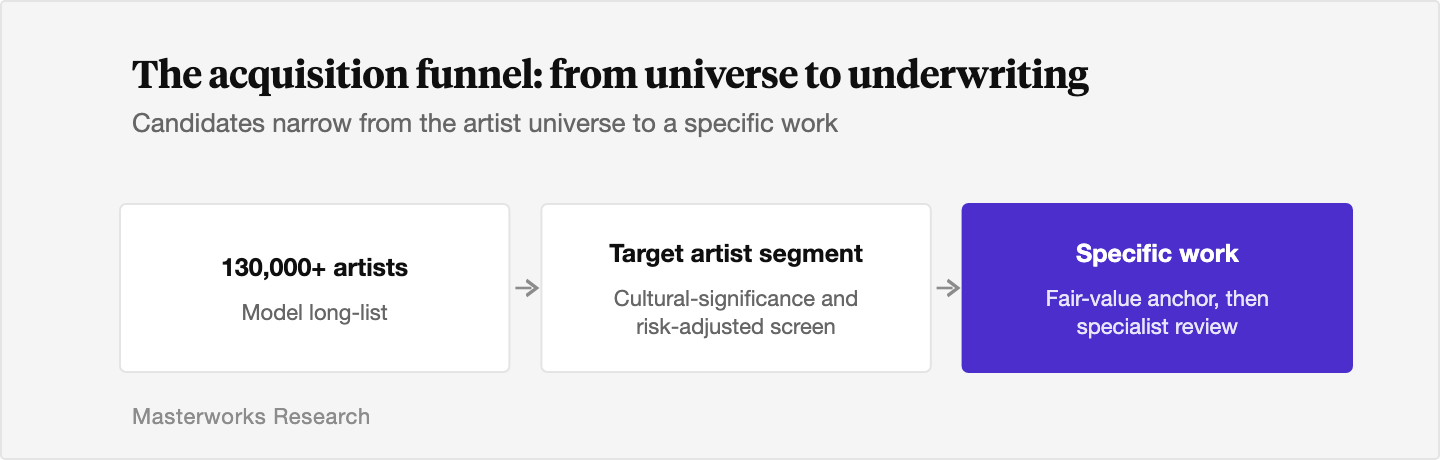
Third, the specialists take over. A model can tell us that a work is priced below our fair-value anchor. It cannot tell us whether the canvas is a prime example or a weak one, whether the condition report hides a problem, whether the provenance has a gap, or whether the attribution will survive scrutiny. Those judgments sit with acquisition specialists, and they hold the final call on what we buy and what we pay. We treat the model as a research analyst that never sleeps and the specialist as the portfolio manager who signs the ticket.
4. How accurate the valuation framework has been
The fair value of underwriting is whether it is right more often than the alternative. The natural benchmark is the auction house presale estimate, because that is the one independent valuation the whole market sees before a sale.
Auction estimates are a high bar. In a pure statistical sense they track final prices closely, explaining well over 90% of the variation in realized prices in academic studies [3]. That is the number to beat. But there is a second, more telling measure: how often the realized price actually lands inside the published low-to-high range. Here the houses are far less reliable. Across a dataset of more than 1.18 million sold lots, only about one third of works cleared within their estimate range [2]. The other two thirds split between selling below the low and above the high.
On that in-range measure, our internal valuation framework has historically been an estimated [~5%] more accurate than auction house presale estimates over the last four years, on works with a low estimate of at least $100k. A methodology note belongs here, in the spirit of showing our work. The comparison is in-range hit rate, measured on the segment we underwrite, over a defined window. It is not a claim that our model beats auction estimates on every metric or in every segment, and academic work is clear that presale estimates remain extremely strong predictors of price in the aggregate [3]. The [~5%] figure is a directional, internal result, and we bracket it because it is subject to confirmation. We are noting it so it can be logged and verified before any external use.
The reason an edge is possible at all is that estimate errors are not random. Research on auction valuations finds that presale estimates carry persistent, predictable biases, conservative at the top end and optimistic in thinner segments, which a model trained on enough history can partly anticipate [2][3]. That is the opening. We do not overstate its size.
5. What the models can and cannot predict
This piece is about how we use the models. The general science of what art valuation models can and cannot do gets its own treatment in "Machine Learning and Art Valuation: What Models Can and Cannot Predict," see /academy/posts/machine-learning-and-art-valuation-what-models-can-and-cannot-predict. The short version, applied to acquisitions, is worth stating plainly here.
The models are strong where the data is deep. For blue-chip and well-traded artists with hundreds or thousands of recorded sales, a model can interpolate a fair-value band with real confidence, because it has seen many comparable transactions [4]. This is the segment we mostly operate in, which is part of why the approach fits our strategy.
The models are weak in three places, and we say so. They cannot predict a taste shift, the generational change in what collectors want, which is the force we believe drives most appreciation in the first place. They cannot anticipate a regime change, a sudden re-rating of an artist or a category that no past sale predicted. And they break down on thinly traded artists, where a handful of sales is too little for any model to learn from and the estimates become unstable [4]. A recent study testing several model architectures on a platform dataset found uniformly poor point-prediction accuracy, and read the cause correctly: much of an artwork's value lives in narrative and reputation that the data does not capture [5]. We agree. That residual is precisely the territory where a human specialist, not a model, has to make the call.
The Bottom Line
- Masterworks uses machine learning and statistical models to quantify cultural significance, measuring how observable signals like gallery representation, museum ownership, and collector identity correlate with future price appreciation.
- The models are trained on a research database of more than 1.2 million lots, over 130,000 artists, and 6,000 plus auction houses, and the dataset is the asset that makes the approach possible.
- The models long-list candidates and set a fair-value anchor. Acquisition specialists evaluate quality, condition, provenance, and authenticity, and they hold the final decision.
- Our internal valuation framework has historically landed within the realized price range an estimated [~5%] more often than auction house presale estimates, over the last four years on works with a low estimate of at least $100k. That figure is subject to confirmation.
- The models interpolate well inside well-traded segments. They cannot predict taste shifts, regime changes, or the value of artists with almost no sales history, and we do not ask them to.
Sources
- UBS and Art Basel. "The Art Basel and UBS Global Art Market Report 2026." UBS, April 18, 2026. https://www.ubs.com/global/en/our-firm/art/art-market-research.html
- Artscapy. "Auction House Estimate Accuracy in the Art Market." Artscapy, May 7, 2026. https://artscapy.com/view-post/auction-house-estimate-accuracy-in-the-art
- Aubry, Mathieu, Roman Kraussl, Gustavo Manso, and Christophe Spaenjers. "Biased Auctioneers." Journal of Finance (working paper, City Research Online), 2025. https://openaccess.city.ac.uk/id/eprint/35368/1/Biased%20Auctioneers%20JF.pdf
- Bucci, Andrea, et al. "Machine Learning Algorithms and Fine Art Pricing." Expert Systems with Applications (ScienceDirect), April 25, 2025. https://www.sciencedirect.com/science/article/abs/pii/S0957417425000909
- "Painting Price: A Machine Learning Approach to Art Valuation." University of Warsaw Working Papers, February 2, 2026. https://ideas.repec.org/p/war/wpaper/2026-18.html
- "Deep Learning for Art Market Valuation." arXiv, December 28, 2025. https://arxiv.org/pdf/2512.23078
- Bailey, Jason. "Can Machine Learning Predict the Price of Art at Auction?" Harvard Data Science Review, April 30, 2020. https://hdsr.mitpress.mit.edu/pub/1vdc2z91
- "Social signals predict contemporary art prices better than visual features." PMC (National Library of Medicine), May 21, 2024. https://pmc.ncbi.nlm.nih.gov/articles/PMC11109285/
- Family Wealth Report. "US Remained Largest Art Market In 2025, Art Basel, UBS Report 2026." Family Wealth Report, March 12, 2026. https://www.familywealthreport.com/article.php/US-Remained-Largest-Art-Market-In-2025-%E2%80%93-Art-Basel,-UBS-Report-2026-?id=207156
- MoMAA. "Art Market Valuation Models: Quantitative Approaches to Pricing Contemporary and Historical Works." MoMAA, August 21, 2025. https://momaa.org/art-market-valuation-models-quantitative-approaches-to-pricing-contemporary-and-historical-works/
- MyArtBroker. "How Auction Houses Determine Art Valuations." MyArtBroker, January 8, 2026. https://www.myartbroker.com/auction/articles/how-auction-houses-value-art
Disclosures
Investing involves risk. Past results are not indicative of future outcomes.
Masterworks is providing this communication as an agent for its issuer entities, not Masterworks Advisers. This material is produced by Masterworks for informational purposes only and does not constitute investment advice, a recommendation, or an offer or solicitation to buy or sell any security. Masterworks is not a licensed broker-dealer by the SEC or FINRA.
Masterworks can only make and accept sales after an offering statement has been filed, and "qualified", by the SEC. Any offers may be revoked before notice of qualification. Indications of interest involve no obligation. For further disclosure visit the offering documents filed with the SEC and Important Disclosures at masterworks.com/cd.
Forward-looking statements and internal estimates are based on assumptions that may prove incorrect, and actual outcomes may differ materially. Figures denoted in brackets are subject to confirmation. Investing in art and alternative assets involves risk, including loss of principal.
Art sales price data is comparative only. Each painting is unique and historical data is not a direct proxy for any specific painting or investment. Data represents whole art, not an investment into our offerings which includes fees and expenses. Any comparative images are not currently live offerings and are provided for educational purposes only.
Masterworks, LLC is located at 1 World Trade Center, 57th Floor, New York, NY 10007.


