
Masterworks Research · June 2026
What each major art-data provider was built to do, how they compare on coverage and standardization, and why a database built for investment analysis answers a different question from a price-lookup tool.
The major art market data sources fall into two groups. Price-lookup databases such as Artnet, Artprice, AskART, and MutualArt hold tens of millions of auction results and exist to answer one question well: what did this work, or one like it, sell for. Investment-oriented sources such as the Sotheby's Mei Moses index and our own research database start from the same raw auction data but are built to answer a harder question: how does art appreciate, and how does one work compare to a fair-value estimate. Both groups matter to investors, and both have real limits. For anyone weighing art as an allocation, the useful distinction comes down to which question each one was designed to answer. Size is a secondary concern.
What You Need to Know
- Most art databases are price-lookup tools, and they are good ones. Artnet markets roughly 18 million auction results from over 500 auction houses dating to 1985.[1][2] Artprice aggregates auction data from several thousand houses going back to 1962.[3] These are deep, well-maintained records built mainly to support buying, selling, and appraisal.
- Investment analysis is a different job. Looking up a comparable price is not the same as measuring how an artist market appreciates over time, fair-valuing a specific work, or building a repeat-sales index. The Sotheby's Mei Moses index, built on about 45,000 repeat-sale pairs, is the best-known purpose-built investment index.[4]
- Our database was built for the second job. Masterworks describes coverage of more than 1.2 million auction lots, over 130,000 artists, 6,000+ auction houses, 124 currencies, and roughly 287,000 exhibition records, from 1900 to the present, inside a corpus the firm describes as "[50M+ records]."[5] We built it to run repeat-sales indices, generate comparables, and feed machine-learning valuation, not only to look prices up.
- The whole field shares the same blind spots. Roughly only 35% of the global art market trades at public auction, so every auction-based source, ours included, misses most private and dealer sales.[6] Survivorship bias, unsold lots, and heterogeneity affect everyone.
- The honest comparison is fit, not size. We apply the same scrutiny to our own data that we apply to anyone else's. The right tool depends on whether the user wants a price, a provenance record, or an investment view.
1. The set of art-data providers, and what each was built to do
Start with the size of the thing being measured. The Art Basel and UBS Art Market Report 2026 estimates global art sales of about $59.6 billion in 2025, across roughly 41.5 million transactions.[6] Of that value, about $20.7 billion, near 35%, traded at public auction, with the balance moving through dealers, galleries, and private sales.[6] Public auction is the slice that gets recorded, so it is the slice almost every data provider is built on.
A handful of providers dominate that recorded slice, and they sort into a few types.
The large reference databases come first. Artnet's Price Database markets roughly 18 million auction results covering more than 188,000 artists and designers from over 500 auction houses, with records back to 1985.[1][2] Artprice (Artmarket.com) aggregates auction prices, indices, and images from several thousand houses internationally, with coverage back to 1962, the deepest historical reach of the group.[3] AskART holds auction records dating to 1987 for hundreds of thousands of artists, with particular depth on American artists and rich artist dossiers including biographies, signatures, and provenance notes.[3] MutualArt blends a large price database with alerts, monitoring, and collector tools.[3]
Then the purpose-built investment sources. The Sotheby's Mei Moses index, which Sotheby's acquired in 2016, is a repeat-sales index of about 45,000 repeat-sale pairs across eight collecting categories, with roughly 4,000 new pairs added a year.[4] Pi-eX produces auction analytics from public results, focused on sell-through, estimates, and category performance.[7] LiveArt offers market data and indices aimed at collectors and advisors.[4]
And underneath all of them, the free primary record: the published lot results on the Sotheby's, Christie's, and Phillips websites. Those pages give realized prices, estimate ranges, sale status, and dates straight from the source. They are useful for spot checks and recent tracking, and they cost nothing.
A note on how the data gets in. Vendors source auction results three ways: direct structured feeds from houses, web capture of public catalogs and post-sale pages, and digitization of printed catalogs for the deep historical record.[6] We built our own historical layer the same painstaking way, recording individual sale events from auction catalogs going back to 1900. There was no API for this. Someone has to do the work by hand first.
2. What most databases optimize for: finding a price
The large reference databases are built around one user need, and they meet it well. An appraiser, a dealer, or a collector wants to know what a work is worth right now, so they search for the artist, filter by medium, size, and date, and read off recent comparable sales. Artnet describes its own product in exactly these terms, as a tool "for helping you make informed decisions when buying or selling an artwork."[1] The Sotheby's Institute library guide frames it the same way, as a tool to "cross-compare sale prices by date."[2]
This is genuine value, and we use these tools too. A comparable price is the starting point for any valuation. The depth here is real: Artprice's reach back to 1962 makes it useful for older artists and long-run research,[3] and AskART's artist dossiers support due diligence well beyond the price line.[3]
The limit is structural, and it has nothing to do with quality. A price-lookup database answers "what did this sell for." It does not, on its own, answer "how fast does this artist market appreciate," or "is this specific work cheap relative to fair value," or "what is the volatility of this segment." Those are investment questions, and they require the data to be organized and modeled differently. The same 18 million records can serve either purpose. The product built on top of them decides which.
This is the same gap we wrote about in what indices track art market performance and their limitations: a list of prices is not yet an index, and an index is not yet a valuation.
3. Coverage and standardization compared
Coverage is the metric buyers reach for first, and it is the easiest to overstate. Headline record counts mix fine art with design and decorative objects, count lots rather than works, and vary by how a vendor defines an "auction house." So compare carefully, and apply the same skepticism to every line, including ours.
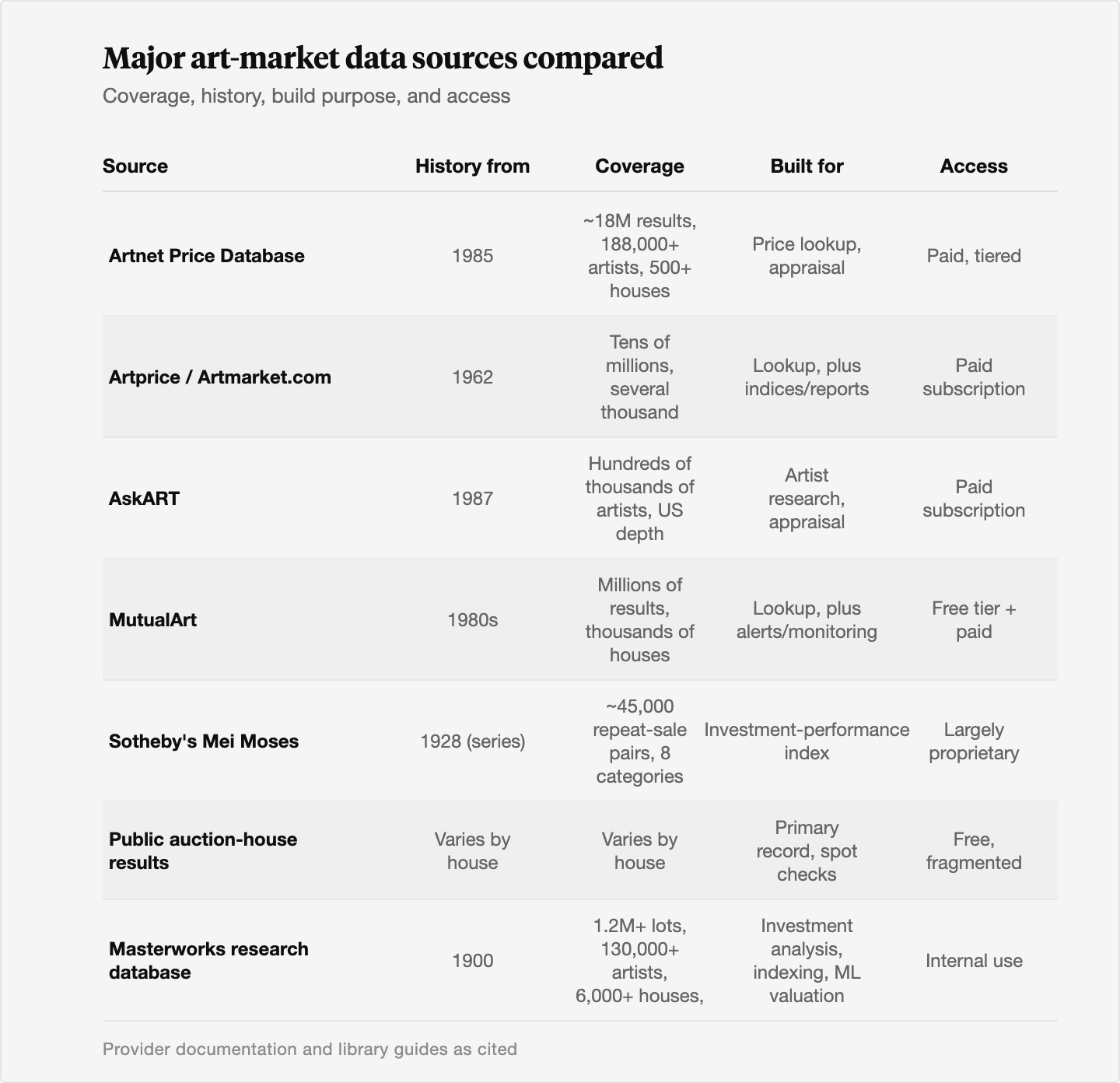
- Artnet Price Database (history from 1985): roughly 18 million auction results across more than 188,000 artists and 500-plus houses, built mainly for price lookup, appraisal, and some analytics, sold as a paid product tiered by searches.[1][2]
- Artprice / Artmarket.com (from 1962): tens of millions of records across several thousand houses, built for price lookup plus indices and reports, paid subscription.[3]
- AskART (from 1987): auction records for hundreds of thousands of artists with particular US depth, built for artist research and appraisal, paid subscription.[3]
- MutualArt (1980s onward): millions of results across thousands of houses, built for lookup plus alerts and monitoring, with a free tier and paid plans.[3]
- Sotheby's Mei Moses (series available from 1928): roughly 45,000 repeat-sale pairs across 8 categories, built as an investment-performance index, largely proprietary.[4]
- Public auction-house results (Sotheby's, Christie's, Phillips): the primary record itself, useful for spot checks, with coverage varying by house, free but fragmented.
- Masterworks research database (from 1900): [1.2M+ lots, 130,000+ artists, 6,000+ houses, 124 currencies, ~287,000 exhibition records, and a "50M+ records" total corpus], built for investment analysis, indexing, and machine-learning valuation rather than lookup, used internally.[5]
Standardization is where the differences get real, and where most of the work hides. Auction houses record artist names, attributions, mediums, dimensions, conditions, and whether the price includes buyer's premium in inconsistent ways. Prices arrive in many currencies. Building a clean, comparable dataset from that requires extensive matching, deduplication, and currency normalization, and residual inconsistencies affect any analysis built on top.[6] Vendors apply proprietary cleaning algorithms, and those methods are not fully transparent, which makes it hard to audit classification error from the outside.
We hold data in 124 currencies and normalize to a base for comparison, and we tie roughly 287,000 exhibition records to works as a measure of cultural standing.[5] We flag this because standardization is the quiet determinant of whether any of these numbers can be trusted for analysis, and that point matters more than any count we could put in a headline. A larger raw count cleaned loosely is worth less than a smaller one cleaned well.
4. Built for investment analysis: the real differentiator
Here is the distinction that matters for an investor. The job is to estimate appreciation, fair-value a specific work, and size risk. Finding a comparable price is the input to that work, not the end of it. The analysis requires three things a lookup database does not provide on its own.
First, an index. The standard methods are repeat-sales and hedonic regression. A repeat-sales index tracks the same work across two or more sales and reads appreciation from the change, the approach Robert Shiller pioneered for home prices in the Case-Shiller index.[6] A hedonic model prices a work as a bundle of characteristics, artist, size, medium, date, venue, and extracts a time trend.[6] The Sotheby's Mei Moses index is the best-known purpose-built example, repeat-sales by design, explicitly meant to compare art against other asset classes.[4] We run repeat-sales indices on our own corpus for the same reason: an index is what turns a pile of prices into a measure of return.
Second, comparables and fair value, generated systematically rather than eyeballed. With 1.2 million lots and 6,000+ auction houses behind it, a comparable set can be assembled by rule, not by memory.[5]
Third, machine-learning valuation. Several providers now use machine learning on their corpora, including Artnet and Artprice, typically training gradient-boosted trees or neural networks on artist, medium, size, venue, and date to output predicted prices and confidence ranges.[6] We do the same, and we quantify cultural significance the way our investment committee thinks about it, looking at the galleries that represent an artist, the museums that hold the work, and who collects it. We built our database for this job from the start, which is the honest summary of the difference. A price-lookup tool can be adapted toward analysis. A tool built for analysis starts there.
One caution belongs right here, applied to ourselves first. The accuracy of any valuation model is only as good as its testing. We believe our internal valuation approach has run modestly more accurate than auction-house presale estimates over recent years, on the order of [~5%] better on an in-range basis for works above a set threshold, but we treat that as a figure subject to confirmation and a methodology asterisk, not a headline.[5] Past accuracy is not predictive of future accuracy, and any model can be wrong on a single work.
For more on why even good indices lag and smooth, see appraisal lag, why art valuations are always looking backward and how reliable are repeat-sales indices for art.
5. The honest limits of all art data, including ours
Every source named above shares a set of limits, and the fair thing is to apply them to our database as squarely as to anyone else's.
Auction is only part of the market. About 35% of global sales by value traded at public auction in 2025, with the rest through dealers and private channels that almost never get recorded.[6] Any auction-based index, ours included, is built on the visible third and infers about the rest.
Survivorship and selection bias run through everything. Databases overrepresent successful artists and high-value works, because those are the ones that resell.[8] Repeat-sales indices in particular include only works that sold at least twice at auction, which selects for liquid, commercially successful objects and tends to overstate returns and understate risk.[8] This is a known weakness of the Mei Moses approach and of our own indices alike.
Unsold lots vanish. Databases generally record hammer prices for sold lots only. When a work fails to sell, the low outcome often leaves no price at all, which biases average returns upward and hides volatility. This affects every provider that works from realized prices.
Estimates are not neutral. Presale low and high estimates carry the auction house's incentives and anchor final prices, so using estimate-to-price ratios as a valuation signal can mislead. We wrote about reading that signal carefully in our note on auction estimates.
Heterogeneity resists clean comparison. Each work is unique, and observed price reflects condition, provenance, size, and subject that databases capture imperfectly. Hedonic models can overfit; simpler models omit variables. There is no clean way around this, only careful work.
We say all of this plainly because the alternative, a data source that claims no limits, should make any investor more suspicious, not less. The open-data movement is one response to these gaps, which we covered in open data initiatives in art, who's publishing what and why it matters. The data is improving across the field. None of it is complete.
The Bottom Line
- The major art data sources split into price-lookup databases (Artnet, Artprice, AskART, MutualArt) and investment-oriented sources (Sotheby's Mei Moses, and our own database). Both groups are useful, and they answer different questions.
- Price-lookup databases are deep and well-maintained, with Artprice reaching back to 1962 and Artnet marketing roughly 18 million results. They exist mainly to support buying, selling, and appraisal.
- Investment analysis requires more than a price: an index, systematic comparables, and modeled fair value. Our database was built for that job, with more than 1.2 million lots, over 130,000 artists, and coverage from 1900.
- Coverage counts are easy to overstate and hard to compare across vendors. Standardization, the quiet work of cleaning and normalizing, matters more than raw record totals.
- Every auction-based source shares the same limits: only about 35% of the market trades at public auction, and survivorship bias, unsold lots, and heterogeneity affect all of them, ours included. Past performance and past model accuracy are not predictive of future results.
Sources
- Artnet. "Search Art Prices and Auction Results, Artnet Price Database." Artnet, accessed June 2026. https://www.artnet.com/price-database/
- Sotheby's Institute of Art. "Price databases: artnet." LibGuides, May 2026. https://sia.libguides.com/pricedatabases/artnet
- New York University. "Art Provenance Research: Art Auction Databases." NYU Libraries, April 2026. https://guides.nyu.edu/provenance/art-auctions
- Sotheby's. "Sotheby's Acquires the Mei Moses Art Indices." Sotheby's, October 26, 2016. https://www.sothebys.com/en/articles/sothebys-acquires-the-mei-moses-art-indices
- Masterworks. Research database coverage figures as stated by Masterworks (more than 1.2 million auction lots, over 130,000 artists, 6,000+ auction houses, 124 currencies, ~287,000 exhibition records, coverage 1900 to present, "50M+ records" total corpus). Masterworks Research, June 2026.
- Art Basel and UBS. "The Art Basel and UBS Global Art Market Report 2026" (by Arts Economics, Dr. Clare McAndrew). Art Basel, June 2026. https://www.artbasel.com/stories/the-art-basel-and-ubs-global-art-market-report-2026
- Artnet News. "Experts Weigh in on Mei Moses Art Indices at Sotheby's." Artnet News, October 31, 2016. https://news.artnet.com/market/sothebys-acquisition-mei-moses-art-indices-725648
- MoMAA. "Art Market Data Sources and Analytics Methodology: Building Reliable Investment Intelligence." MoMAA, August 19, 2025. https://momaa.org/art-market-data-sources-and-analytics-methodology-building-reliable-investment-intelligence/
- Morgan Stanley. "Art Market Indexes: How They Work." Morgan Stanley, February 9, 2026. https://www.morganstanley.com/articles/art-market-indexes
- MyArtBroker. "Decoding Art Indices: MAB100 vs. Traditional Resources." MyArtBroker, November 5, 2025. https://www.myartbroker.com/art-and-tech/articles/decoding-art-indices-mab100-and-traditional-resources
- Renneboog, L., and Spaenjers, C. "Buying Beauty: On Prices and Returns in the Art Market." Management Science, 2013. https://onlinelibrary.wiley.com/doi/10.1111/j.1540-6261.2005.00803.x
- Observer. "Beneath the Art Market's Recovery, a Structural Reset Is Underway." Observer, March 19, 2026. https://observer.com/2026/03/art-basel-ubs-art-market-report-2026-global-art-market-report/
Disclosures
Investing involves risk. Past results are not indicative of future outcomes.
Masterworks is providing this communication as an agent for its issuer entities, not Masterworks Advisers. This material is produced by Masterworks for informational purposes only and does not constitute investment advice, a recommendation, or an offer or solicitation to buy or sell any security. Masterworks is not a licensed broker-dealer by the SEC or FINRA.
Masterworks can only make and accept sales after an offering statement has been filed, and "qualified", by the SEC. Any offers may be revoked before notice of qualification. Indications of interest involve no obligation. For further disclosure visit the offering documents filed with the SEC and Important Disclosures at masterworks.com/cd.
Forward-looking statements and internal estimates are based on assumptions that may prove incorrect, and actual outcomes may differ materially. Figures denoted in brackets are subject to confirmation. Investing in art and alternative assets involves risk, including loss of principal.
Art sales price data is comparative only. Each painting is unique and historical data is not a direct proxy for any specific painting or investment. Data represents whole art, not an investment into our offerings which includes fees and expenses. Any comparative images are not currently live offerings and are provided for educational purposes only.
Masterworks, LLC is located at 1 World Trade Center, 57th Floor, New York, NY 10007.


