
Masterworks Research · June 2026
The public logic behind which paintings we buy: pick the artist market first, then source the best example at the lowest price relative to fair value.
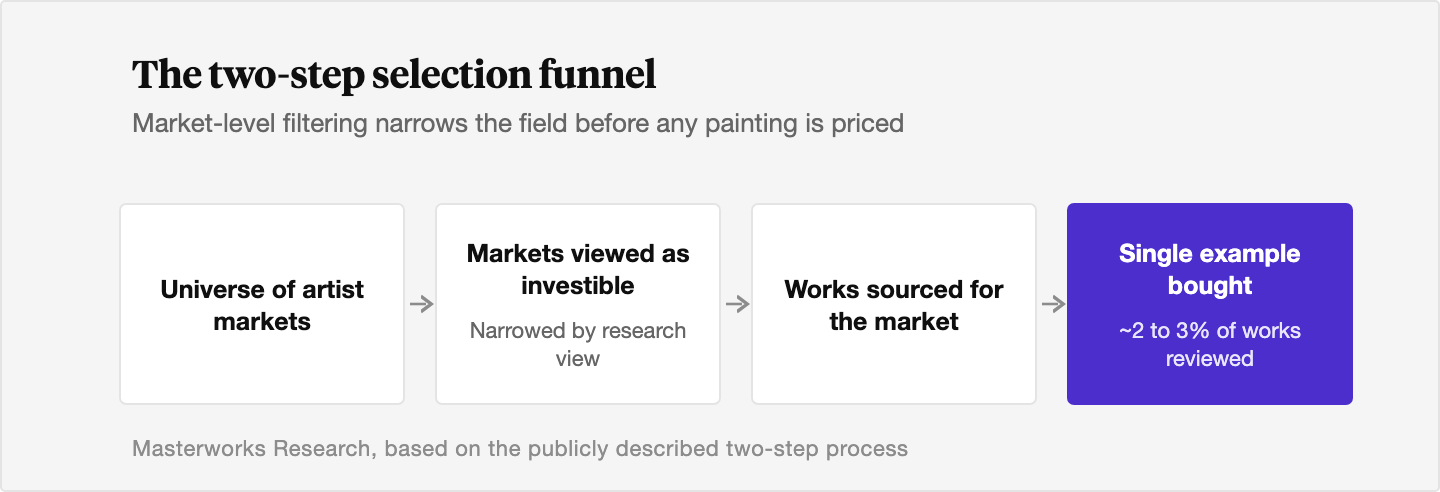
We describe our selection approach as a simple two-step process. First, we choose the artist market, which is the part that matters most. Second, we source the best example we can find at the lowest price relative to its fair value, in a market we believe is likely to appreciate. Both steps run on a research database of art auction history that spans more than [1.2 million] lots across more than [130,000] artists, and the first step carries far more weight than the second. For an investor weighing whether art belongs in a portfolio, the discipline behind that two-step screen is the part worth understanding, because it is where most of the work, and most of the risk control, actually lives.
This piece describes that logic at the level we have already discussed publicly. It does not disclose the proprietary specifics behind it.
What You Need to Know
- The artist market comes first, and it is paramount. Returns track the artist market far more than the individual canvas. The best painting by an artist whose market never develops will probably end up worth very little, so we start by choosing the market, then choose the work inside it.
- We buy the best example at the lowest price relative to fair value. Inside a market we believe is likely to appreciate, the goal is a high-quality, representative work bought at a discount to what our team views as its fair value. A work asking well above fair value is a pass, however good it is.
- We think about each artist market in Sharpe-ratio terms. Appreciation rate divided by volatility. We have publicly described publishing Sharpe ratios at the artist-market level, a risk-adjusted lens that was rarely available to anyone researching art before.
- Supply has a sweet spot. Too little supply, and a market cannot sustain itself. Too much, and new work keeps drowning demand. We look for the steady middle.
- We are highly selective. We review a large volume of works and buy only a small fraction of what we see, an estimated [2 to 3%] in the public accounts our team has given.
1. The two-step selection process: market first, then the work
We have described our approach the same way for years. It is a simple two-step process, and that may oversimplify it, but the two steps are real.
Step one is choosing the artist market. This is the part that matters most. Returns in art are highly correlated with the individual artist, so if we get the market wrong, the return tends to be wrong too [1]. The point we keep coming back to is blunt: the best example by an artist whose market never develops will probably wind up not being worth much. Quality at the level of a single canvas cannot rescue a market that is not there.
Step two is sourcing the work. Once a research view on the artist market is set, the question becomes which specific painting to buy and at what price. We look for a high-quality, representative example, then try to buy it at the lowest price we can relative to fair value, inside a market we believe is likely to appreciate [1][3]. A simple illustration of the price discipline: if our team views a work as fairly valued near a given level and it can be bought at a meaningful discount to that, the math is attractive. If it is asking well above that level, it is a pass, however good the painting.
That ordering, market before work, is the spine of everything that follows.
2. Why the artist market is paramount
It helps to put yourself in a collector's shoes. Imagine you own a single painting and your entire outcome rests on it. Now imagine you instead get to choose the broad market first, and only then pick a work within it. The second approach is where the durable advantage sits, because the market sets the ceiling and the floor for almost everything the individual work can do.
This is why we treat artist-market selection as the central bet and the painting choice as an optimization within it. Independent art-market research lands in a similar place. Across institutional and academic work, investment potential is generally tied to the depth of an artist's market, the collector base, repeat demand, and institutional visibility, because a deep market is what sustains resale demand over time [4][8]. A widely cited point from academic work summarized by Stanford Graduate School of Business is that art bought purely for return, without disciplined selection, can be a poor broad investment. The better outcomes come from choosing high-quality works inside markets with real depth [8].
So the first filter is not about a single canvas. It is about whether a real, liquid, supported market exists around the artist at all.
3. Sharpe ratios per artist market: appreciation versus volatility
Once the question is which markets to favor, we think about them the way a portfolio manager thinks about any set of return streams. We have publicly described publishing Sharpe ratios at the artist-market level, which is appreciation rate divided by volatility [3]. The metric tells you how much appreciation there has been for every unit of risk taken. It is standard practice in other asset classes, and it was rarely available to anyone researching the art market before.
The practical use is comparison. Two artist markets might appreciate at similar rates while one does so far more steadily than the other. On a risk-adjusted basis those are not the same market, and the steadier one is generally the more attractive one to underwrite. We will not detail how we build or weight these measures here, since that sits inside our proprietary research. The general principle is the part that matters: we rank artist markets on risk-adjusted return, not on headline appreciation alone.
A note on how we know this kind of analysis is even possible. It rests on a large base of evidence, a research database of auction history covering more than [1.2 million] lots and more than [130,000] artists. That depth is what lets us measure appreciation and volatility at the level of an individual artist rather than guessing from a handful of headline sales.
4. The A, B, and C example framework
Within a chosen market, not every work behaves the same. We sort examples loosely into A, B, and C tiers, and the distinction is about investment behavior, not just aesthetics.
A and B examples, the strongest and second-tier representative works, tend to appreciate in a broadly similar way. They sit close enough to the center of an artist's market that demand reaches them. C examples often behave differently, and many do not appreciate meaningfully at all. A minor or atypical work, a slight thing on the edge of an artist's practice, can stay flat for a very long time even while the artist's market rises around it.
This is why step two screens hard for representativeness. The goal is a high-quality, representative example by the artist, the kind of work that is central to why the artist's market exists, rather than a marginal piece that happens to carry the right name. Independent guidance on investment-grade art reaches the same conclusion, favoring prime-period, signature works over peripheral ones inside a strong market [4][9].
5. Quantifying cultural significance: galleries, museums, and collectors
"Cultural significance" gets used loosely across the art world. We try to quantify it, because a number we can compare is more useful than an adjective.
Three signals do a lot of the work here, and they map onto what independent due-diligence frameworks also emphasize:
- The gallery that represents an artist. Representation by a serious, established gallery is a signal of career support, price discipline, and market infrastructure. Galleries provide collector access and curatorial framing, the network effects that broaden and steady demand [4][8].
- The museums that own the work. Holdings in major museums are a proxy for institutional validation and long-term importance. Exhibition history and, especially, museum acquisition are widely treated as evidence that curators and institutions regard an artist as important [4][8]. They also permanently remove supply from the market, which matters for the next point.
- Who collects them. The profile and depth of an artist's collector base is a proxy for the quality of demand. A deep, serious set of collectors is a different thing from a thin or speculative one.
We have publicly described folding these kinds of institutional signals into how we evaluate which artists belong on the platform, alongside the price and return data [3]. We will not detail the exact variables or how they combine, since that is proprietary. The educational point is that cultural significance, for us, is a measurable set of signals about galleries, museums, and collectors, not a feeling.
6. The supply sweet spot
Supply is its own filter, and it cuts both ways. Think of it as a spectrum with a healthy middle.
On one end is too little supply. There is an artist named Gorky, culturally significant, with only a small number of good paintings left in private hands. With so few works available, it is hard to sustain enough trading activity to support a real market, however important the artist. On the other end is too much supply. An artist like Damien Hirst, whose output is so large that there is always another dot painting available, can find that new supply keeps drowning demand and weighing on the market.
The healthy place is in the middle. Enough works trade to support liquidity and price discovery, but not so many that supply outruns demand. Independent research makes the same point, warning against markets where supply is expanding too quickly relative to demand, because excess output erodes long-term price support [4][8]. Art is also one of the few asset classes where supply in major markets tends to shrink over time, as collectors donate works to museums and those works leave the market for good. Steady appreciation over a long period, on a base of disciplined supply, is the pattern we look for.
7. Liquidity, record prices, and the Basquiat exception
The last layer is about where in the market we tend to operate and why.
We generally focus below the very top of the market. The reason is liquidity. Below the very highest prices there is usually enough trading activity to support an eventual resale, while the rarest, most expensive works can be harder to move when the time comes [5]. Basquiat is the publicly noted exception. Where an artist's market has exceptional depth and demand, we have said we will sometimes buy at the very top end, and Basquiat is the example we point to.
Record prices matter here too, because of how they ripple. When an artist sets a new auction record, that price can reset the reference point for the whole market and pull up the artist's A and B works along with it [6][7]. A record is information. It tells the market what the best example is now worth, and the strong representative works tend to re-rate toward it. That dynamic is one reason the strength of an artist market, rather than any single canvas, sits at the center of how we choose.
We are also highly selective at the sourcing stage. Across the accounts our team has given publicly, we review a large volume of works and buy only a small fraction, an estimated [2 to 3%] of what we see [1][2]. The selectivity is the point. Most of what passes the artist-market screen still fails the price-and-quality screen, and we would rather pass than overpay.
For more on how these ideas connect, see how blue-chip art is defined and why it matters, how different price tiers behave, and a framework for building a collection with investment discipline. What happens after a work is bought is its own discipline, covered in how we monitor holdings between acquisition and exit.
The Bottom Line
- We select works in two steps: choose the artist market first, then source the best representative example at the lowest price relative to fair value inside a market we believe is likely to appreciate.
- The artist market is the part that matters most, because returns track the market far more than any single canvas, and a great painting in a market that never develops tends to be worth little.
- We rank artist markets on a risk-adjusted basis, thinking in Sharpe-ratio terms of appreciation versus volatility, built on a research database covering more than [1.2 million] lots and more than [130,000] artists.
- We quantify cultural significance through measurable signals, the gallery that represents an artist, the museums that own the work, and the collectors who hold it.
- We look for a supply sweet spot and generally operate below the very top of the market for liquidity, with Basquiat the publicly noted exception, and we buy only a small fraction of what we review.
- Past performance is not predictive, and none of this is a promise about any future result. It is a description of our selection discipline.
Sources
- Entrepreneurs on Fire (John Lee Dumas with Scott Lynn). "Scott Lynn on Masterworks and Investing in Art." EOFire, October 28, 2019. https://www.eofire.com/podcast/scottlynn2/
- The Meb Faber Show. "Scott Lynn & Masha Golovina, Masterworks: The World's Largest Buyer In The Art Market." Meb Faber Research, February 2, 2022. https://mebfaber.com/2022/02/02/e388-masterworks/
- Masterworks. "Masterworks CEO & Founder Scott Lynn Interview." YouTube, February 2, 2024. https://www.youtube.com/watch?v=cC9CAUZdGLg
- Artelier. "How to Invest in Art for Beginners: Why Art Is a Good Investment." Artelier, 2025. https://www.artelier.com/post/how-to-invest-in-art-for-beginners-why-art-is-a-good-investment
- Worth. "Want to Invest in a Banksy Painting? Masterworks Makes It Easy." Worth, 2025. https://worth.com/want-to-invest-in-a-banksy-painting-masterworks-makes-it-easy/
- MacroVoices. "Transcript of the Podcast Interview Between Erik Townsend and Scott Lynn." MacroVoices, May 18, 2020. https://www.macrovoices.com/guest-content/list-guest-transcripts/3684-2020-05-18-transcript-of-the-podcast-interview-between-erik-townsend-and-scott-lynn/file
- Top Traders Unplugged. "Scott Lynn on the Art Market and Masterworks." Top Traders Unplugged, 2025. https://www.toptradersunplugged.com/podcast/scott-lynn/
- Stanford Graduate School of Business. "Research: Is Art a Good Investment?" Stanford GSB Insights, 2025. https://www.gsb.stanford.edu/insights/research-art-good-investment
- Christian Sly. "Investment-Grade Art: A Guide for HNWIs on Fine Art Investment Strategies." christiansly.com, 2025. https://www.christiansly.com/post/investment-grade-art-a-guide-for-hnwis-on-fine-art-investment-strategies
- Art Basel. "The Art Basel and UBS Global Art Market Report 2026." Art Basel, 2026. https://www.artbasel.com/stories/the-art-basel-and-ubs-global-art-market-report-2026
- Not Boring (Packy McCormick). "Masterworks: Demystifying and Democratizing Art." Not Boring, 2021. https://www.notboring.co/p/masterworks-demystifying-and-democratizing
- The Responsible Art Market Initiative. "Guidelines for Experts Authenticating Works of Fine Art." Responsible Art Market, 2025. https://www.responsibleartmarket.org/guidelines/guidelines-for-experts-authenticating-works-of-fine-art/guidelines/
Disclosures
Investing involves risk. Past results are not indicative of future outcomes.
Masterworks is providing this communication as an agent for its issuer entities, not Masterworks Advisers. This material is produced by Masterworks for informational purposes only and does not constitute investment advice, a recommendation, or an offer or solicitation to buy or sell any security. Masterworks is not a licensed broker-dealer by the SEC or FINRA.
Masterworks can only make and accept sales after an offering statement has been filed, and "qualified", by the SEC. Any offers may be revoked before notice of qualification. Indications of interest involve no obligation. For further disclosure visit the offering documents filed with the SEC and Important Disclosures at masterworks.com/cd.
Forward-looking statements and internal estimates are based on assumptions that may prove incorrect, and actual outcomes may differ materially. Figures denoted in brackets are subject to confirmation. Investing in art and alternative assets involves risk, including loss of principal.
Art sales price data is comparative only. Each painting is unique and historical data is not a direct proxy for any specific painting or investment. Data represents whole art, not an investment into our offerings which includes fees and expenses. Any comparative images are not currently live offerings and are provided for educational purposes only.
Masterworks, LLC is located at 1 World Trade Center, 57th Floor, New York, NY 10007.


