
Masterworks Research · June 2026
The holding period, the market cycle, fair value signals, buyer interest, and the SEC process that together shape when a painting is sold.
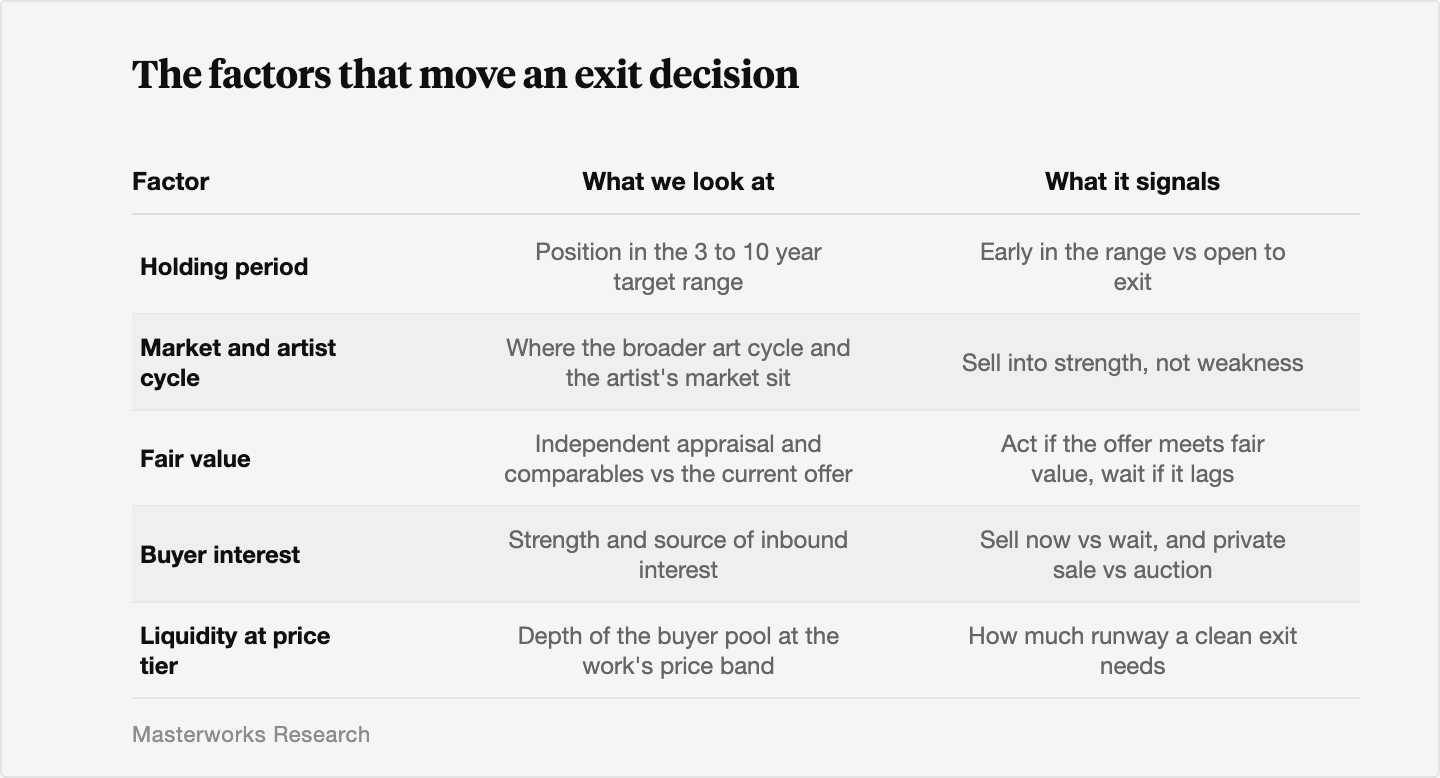
The timing of a Masterworks exit is driven by a few measurable factors: where the work sits inside its target holding period of roughly 3 to 10 years, where the broader art market is in its cycle, what independent appraisals and auction comparables say the work is worth, the strength of buyer interest at that moment, and the SEC process required to sell and distribute proceeds. We treat each painting as a long term, illiquid allocation, and we retain discretion over when and whether to sell. There is no guaranteed exit date and no guaranteed sale price. For an existing investor, the point of understanding these factors is simple: the sale decision is made on the evidence, and the evidence favors patience over a calendar.
What You Need to Know
- The holding period is a range, not a deadline. A Masterworks investment is structured as a 3 to 10 year hold [1][3]. The range is wide on purpose, because the right time to sell is set by the market and the work, not by a target date.
- We do not sell into weakness. The art market moves in multi year cycles. After the 2008 to 2009 drawdown, prices recovered and then climbed for several more years, and after the dot com correction the recovery ran for roughly a decade [9][12]. Selling into a down market locks in the trough.
- Independent appraisals and live comparables set the read on fair value. Auction estimates and recent sale prices for an artist tell us what buyers are paying for comparable works. A firm estimate and a credible reserve signal demand; a soft estimate can reveal that interest is thinning [6][7].
- Buyer interest decides the route. Inbound private offers can support a private sale, where control and discretion matter. Broad competition can favor a public auction, where bidding can lift the price [6][7].
- The exit runs through the SEC. Each painting sits in its own Regulation A entity. When the work sells, the entity reports the sale, deducts costs and fees, distributes net proceeds to shareholders on a pro rata basis, and then dissolves [2][8][10].
1. The holding period: a 3 to 10 year range, by design
Every Masterworks offering is built as a medium to long term, illiquid allocation. The stated horizon is typically 3 to 10 years [1][3]. The structure makes that explicit. Each painting is held in its own Delaware entity formed under Regulation A, and that entity exists to acquire, hold, and eventually sell a single work [2][10]. There is no investor redemption right that forces a sale on a fixed date, and the manager retains discretion over timing [10].
The reason for the range is the same reason the art market rewards patience. Art is one of the few asset classes where supply in the major markets tends to shrink over time, as collectors donate works to museums and those works leave private hands for good. There are, by Scott's count, only 21 Jackson Pollocks left in private collections. When supply is fixed and demand builds over a generation, the holding period is where the return is earned. We cover this in depth in Why Patience Is Rewarded in Art Markets.
A note on what the range is not. It is not a promise that any given work will sell at the three year mark, or the ten year mark, or at all. We hold to the thesis and the evidence, and a work can sit longer if the evidence says waiting is the better decision.
2. The market cycle: do not sell into a down market
The single most important timing factor is where the art market is in its cycle. Our position here is consistent and, we think, well supported by history: do not sell into weakness, and sell into strength.
Consider the two most relevant precedents. After the 2008 to 2009 financial crisis, the Post-War and Contemporary segment fell sharply, recovered within a couple of years, and then appreciated for several more [9][12]. After the dot com correction, the recovery ran at a strong annual pace for roughly a decade [9]. In both cases, the investors who were forced to sell at the bottom captured the worst outcome, and the ones who waited for the cycle to turn captured the recovery. Recoveries compound. That is the whole argument for not selling into weakness.
The backdrop matters here. The global art market grew about 4% in 2025 to roughly $59.6 billion, its first year of growth after two years of decline, with public auction sales up about 9% [4][11]. The recovery has been concentrated at the high end. Public auction sales of works above $10 million rose roughly 30% in value in 2025, while the dealer sector and the mid market grew only modestly [4][11]. We read that as a cycle turning, led by quality, with the broader market still catching up. We cover how these phases work in How Art Market Cycles Work.
3. Fair value signals: appraisals, estimates, and comparables
Before any sale, we want an independent read on what the work is worth. Two signals do most of the work.
The first is a fair value appraisal, which estimates where a work should trade in a normal arm's length sale. The second is the live market: auction estimates and recent hammer prices for comparable works by the same artist. An auction estimate is the salesroom's public view of what a work will bring, and the direction of those estimates carries information. A firm estimate paired with a credible reserve usually signals confidence in demand. A soft estimate, or thin recent comparables, can reveal that interest is cooling [6][7]. We monitor these signals continuously across the holdings, which we describe in How Masterworks Monitors Holdings Between Acquisition and Exit.
The gap between an independent fair value and an actual offer is what we are really watching. If a buyer is offering at or above where we believe the work should trade, that is a reason to act. If the best available bid sits well below fair value, that is usually a reason to wait. Entry price is most of the return in art, and the same discipline applies on the way out.
4. Buyer interest and the route to market: private sale versus auction
Strong buyer interest is both a timing signal and a routing decision. Inbound interest from qualified collectors, advisors, or institutions can be the clearest sign that a work should be sold now rather than later [6][7].
How we sell then depends on the work and the moment. There are two main routes, and they trade off in predictable ways.
A private sale, through a dealer, collector, or institution, offers control, discretion, and a known buyer. It avoids the public risk of a work failing to meet its reserve in the salesroom. A public auction, at a house like Christie's, Sotheby's, or Phillips, can generate competition, and competition can lift the price beyond what a single private buyer would pay [6][7]. The tradeoff is exposure. As Scott has put it, it only takes two bidders to dramatically change a price, which cuts both ways. We weigh the depth of interest, the work's profile, and the state of the salesroom calendar, and we route accordingly.
5. Artist market momentum: how a record resets the field
A timing factor specific to art is what happens when a new price record is set for an artist. A standout result establishes a fresh reference point, and that reference point can pull up expectations for the artist's other works [6]. A record at the top of a market can reset the whole market for quality examples below it.
This is why we think about the artist market first, ahead of any single work. A and B examples by a strong artist tend to appreciate together, so when a marquee work resets the artist's ceiling, the comparables we hold can be repriced in the same direction. The recovery of 2025 showed this at the top end, where trophy results by blue chip names drove much of the auction growth while the mid market lagged [4][11]. When an artist market is resetting upward and our holding is a strong example, that momentum becomes part of the case for selling into strength.
6. Liquidity at the price tier
Liquidity is not uniform across the market. It varies sharply by price band, and the band a work sits in shapes how patient we have to be to sell it well [6].
At the very top, above $10 million, the buyer pool is smallest, and each sale needs a specific match of quality, provenance, and timing. Liquidity is thinnest here, so waiting for the right buyer often matters more than moving quickly. In the roughly $1 million to $10 million range, the market is deeper and more sensitive to artist momentum and recent comparables, and public auction can work well when demand is broad. Below that, between roughly $100,000 and $1 million, the pool of capable buyers is larger and turnover is more frequent, so execution risk is lower [6]. None of these tiers is liquid in the way a public stock is liquid. All of them carry transaction costs. The tier simply tells us how much runway we need to plan for a clean exit.
7. The SEC process: how a sale becomes a distribution
Once the decision to sell is made and a sale closes, the exit runs through a defined Regulation A process. The mechanics are worth understanding, because they explain why proceeds reach investors the way they do.
Each painting is held in its own entity that sold Class A shares under Regulation A Tier 2, via a qualified Form 1-A offering circular [2][10]. When the work is sold, the steps are, in order:
- The entity reports the sale. A sale of the entity's sole asset is a significant event, which Regulation A issuers disclose to the SEC, typically on a current report [8][10].
- Selling costs come out first. Auction commissions or private sale costs, shipping, insurance, and administrative expenses are deducted from gross proceeds [3][10].
- Fees are applied per the offering documents. The management fee and the performance participation are taken as set out in each offering's filings [8][10].
- Net proceeds are distributed pro rata. Whatever remains is paid to shareholders in proportion to the shares they hold, in cash, based on the cap table at the record date [3][10].
- The entity dissolves and files its exit report. Once distributions are made, the entity winds down under Delaware law and terminates its Regulation A reporting [8][10].
Whoever holds shares at the time of liquidation receives the pro rata distribution, regardless of how many times the shares changed hands before then [10]. For the full step by step, see What Happens When Masterworks Sells a Work.
For context on the realized record, Masterworks has reported [a specific count of completed exits and the realized net returns on those sales] [NEEDS INTERNAL REVIEW: confirm current exit count and any realized net return / hold period figures cleared for publication]. We are not stating those figures here, because past results do not indicate future outcomes, and any work in process is confidential until a sale is reported through the SEC.
The Bottom Line
- A Masterworks investment is structured as a 3 to 10 year illiquid hold, and the holding period range is set by the market and the work rather than by a fixed date.
- The market cycle is the dominant timing factor, and our position is to avoid selling into weakness and to sell into strength, supported by the multi year recoveries that followed the 2008 and dot com drawdowns.
- Independent fair value appraisals, auction estimates, and recent comparables tell us what a work is worth and whether an offer is strong enough to act on.
- Buyer interest determines both whether to sell and which route to use, with private sale favoring control and public auction favoring competition.
- Each sale runs through a defined SEC process, after which net proceeds are distributed pro rata and the entity dissolves.
- Masterworks retains discretion over timing. There is no guaranteed exit date and no guaranteed sale price, and investing in art involves risk, including loss of principal.
Sources
- The Art Law Podcast. "Fractional Ownership of Art: Can Regular People Own a Piece of the High-End Art Market?" Art Law Podcast, June 9, 2022. https://artlawpodcast.com/2022/06/09/fractional-ownership-of-art-can-regular-people-own-a-piece-of-the-high-end-art-market/
- Masterworks. "Understanding Fractional Art Investing." Masterworks Insights, accessed June 2026. https://insights.masterworks.com/alternative-investments/art-investing/understanding-fractional-art/
- MoneyRates. "Masterworks Review." MoneyRates, 2026. https://www.moneyrates.com/reviews/masterworks-review.htm
- Art Basel and UBS. "The Art Basel and UBS Global Art Market Report 2026" (Dr. Clare McAndrew, Arts Economics). Art Basel, March 2026. https://www.artbasel.com/stories/the-art-basel-and-ubs-global-art-market-report-2026?lang=en
- Art Basel and UBS. "The Art Basel and UBS Art Market Report 2026 by Arts Economics" (full PDF). Art Basel, March 2026. https://theartmarket.artbasel.com/download/The-Art-Basel-and-UBS-Art-Market-Report-2026-by-Arts-Economics.pdf
- Artsy Editorial. "Determining the Best Time to Sell Your Art Collection." Artsy, accessed June 2026. https://www.artsy.net/article/artsy-editorial-determining-best-time-sell-art-collection
- Calder Contemporary. "Secondary Art Market Guide: How to Buy and Sell Blue-Chip Art." Calder Contemporary, accessed June 2026. https://caldercontemporary.co.uk/publications/9-secondary-art-market-guide-buy-sell-blue-chip/
- Berkeley Law. "Governing Documents for an Asset-Owning Entity" (Reg A reporting and fractional-art structure). UC Berkeley School of Law, 2026. https://www.law.berkeley.edu/wp-content/uploads/archive/2026/03/20260227-JONG-Governing-Documents-for-an-AOA.pdf
- Edouard Gouin. "Five Predictions for the Art Market." Substack, 2026. https://edouardgouin.substack.com/p/five-predictions-for-the-art-market
- U.S. Securities and Exchange Commission. "Masterworks Regulation A Offering Circular (Form 253G2 / Form 1-A)." SEC EDGAR, 2022. https://www.sec.gov/Archives/edgar/data/1913651/000149315222014608/form253g2.htm
- Family Wealth Report. "US Remained Largest Art Market In 2025, Art Basel, UBS Report 2026." Family Wealth Report, March 2026. https://www.familywealthreport.com/article.php/US-Remained-Largest-Art-Market-In-2025-Art-Basel,-UBS-Report-2026-?id=207156
- Merrill / Bank of America. "2026 U.S. Art Market Report." Merrill, 2026. https://mlaem.fs.ml.com/content/dam/ust/articles/pdf/US-Art-Market-Report.pdf
Disclosures
Investing involves risk. Past results are not indicative of future outcomes.
Masterworks is providing this communication as an agent for its issuer entities, not Masterworks Advisers. This material is produced by Masterworks for informational purposes only and does not constitute investment advice, a recommendation, or an offer or solicitation to buy or sell any security. Masterworks is not a licensed broker-dealer by the SEC or FINRA.
Masterworks can only make and accept sales after an offering statement has been filed, and "qualified", by the SEC. Any offers may be revoked before notice of qualification. Indications of interest involve no obligation. For further disclosure visit the offering documents filed with the SEC and Important Disclosures at masterworks.com/cd.
Forward-looking statements and internal estimates are based on assumptions that may prove incorrect, and actual outcomes may differ materially. Figures denoted in brackets are subject to confirmation. Investing in art and alternative assets involves risk, including loss of principal.
Art sales price data is comparative only. Each painting is unique and historical data is not a direct proxy for any specific painting or investment. Data represents whole art, not an investment into our offerings which includes fees and expenses. Any comparative images are not currently live offerings and are provided for educational purposes only.
Masterworks, LLC is located at 1 World Trade Center, 57th Floor, New York, NY 10007.


