Masterworks Research · June 2026
What Photorealism and Hyperrealism are, who the key artists are, and how a narrow but durable collecting category behaves next to the broader contemporary market.
Photorealism is a movement that began in the United States in the late 1960s and early 1970s, in which painters worked from photographs to produce canvases of near-photographic precision. Its central figures are Chuck Close, Richard Estes, Audrey Flack, Ralph Goings, and Robert Bechtle [1][2]. Hyperrealism is the related, later strand that builds invented or composite scenes rather than copying a single photograph [3]. As a collecting category, the two together form a defined niche: a handful of names with a loyal collector base, auction records in the high six figures to low seven figures, and steadier, smaller demand than the blue-chip core of Post-War and Contemporary art. For an investor, the question is less whether the work is good (much of it is museum-grade) and more whether the market behind it is deep enough to own with confidence.
What You Need to Know
- Photorealism is a real movement with a tight roster, not a loose style. It was named by dealer Louis K. Meisel in 1969, codified in his five-point definition in 1972, and shown internationally at Documenta 5 that same year. The central group is small, perhaps a dozen artists [1][2][4].
- The category's auction records sit in the high six figures to low seven figures. Chuck Close holds the high mark at roughly $4.3 million; Richard Estes at about $1.28 million; Robert Bechtle, Ralph Goings, and Audrey Flack below or near the $700,000 line [5][6][7][8][9].
- That is a fraction of the contemporary blue-chip ceiling. Eight-figure and nine-figure sales are routine for Basquiat, Rothko, and Warhol. Photorealism rarely clears one or two million dollars. The category trades at a structurally lower tier [10][11].
- Demand is steady but thin. Representational work holds a dedicated audience, and museum interest continues, with the Rose Art Museum's "Photorealism in Focus" running February to May 2026. Thin demand means fewer bidders per lot, which is a liquidity consideration, not a quality one [4][12].
- Gerhard Richter is a separate case. His photo-paintings draw on the same source idea, but his market is blue-chip in its own right, with an auction record near $46 million for an abstract work. Do not read Richter's prices as a Photorealism comp [13].
1. What Photorealism is, and where it came from
Photorealism emerged in New York and California in the late 1960s, then cohered as a named movement in the early 1970s. The painters worked from photographs rather than from life, often projecting an image onto the canvas and using a grid to transfer detail with mechanical precision [1][2]. The subject matter was deliberately ordinary: storefronts and reflective glass for Richard Estes, diners and pickup trucks for Ralph Goings, suburban cars and driveways for Robert Bechtle, large frontal portraits for Chuck Close, and dense still lifes for Audrey Flack, the one woman among the core group [1][2].
The dealer Louis K. Meisel coined the term "Photorealism" in 1969, and it appeared in print in the Whitney Museum's "Twenty-two Realists" catalog in 1970 [1][2]. In 1972 Meisel published a five-point definition, partly to keep the label from being stretched. To qualify, an artist had to use the camera and photograph to gather information, transfer it to canvas by mechanical or semi-mechanical means, have the technical ability to make the result look photographic, have exhibited as a Photorealist by 1972, and have devoted at least five years to the work [4]. The same year, the Swiss curator Harald Szeemann included Close, Estes, Goings, Bechtle, and others in Documenta 5 in Kassel, which gave the movement its international standing [1].
That history matters to an investor for one reason. A defined movement with a fixed founding roster has a countable supply of canonical names, and a countable supply is the starting point for any market.
2. How Hyperrealism differs, and why the distinction matters
Hyperrealism is the strand that followed. The term comes from the French "Hyperréalisme," used around 1973, and the practice differs from classic Photorealism in a specific way: rather than reproduce one photograph faithfully, Hyperrealist artists synthesize multiple sources to construct a scene that never existed in front of a single lens [3]. Some later practitioners added social and political content, using the surface polish to carry a message about inequality or consumer culture [3].
For collecting purposes, treat Photorealism and Hyperrealism as one extended category with two phases. The 1960s and 1970s founders carry the deepest market and the institutional history. The contemporary Hyperrealists are a younger, more fragmented field that trades largely in the primary market through specialist galleries and at fairs, often at accessible prices, with limited secondary-auction depth so far [12]. The two phases do not price the same way, and a comp from one is a poor guide to the other.
A note on how the lines get blurred. In everyday usage "photorealism" and "hyperrealism" are often swapped, including in auction-house catalog copy. When you are underwriting a specific work, the relevant question is not the label but the artist's own market: how often the artist's work trades, at what level, and whether prices have held.
3. The key-artist records, in plain numbers
The category's market is best understood through its top sales, because in a thin market the records define the ceiling more than any average does.
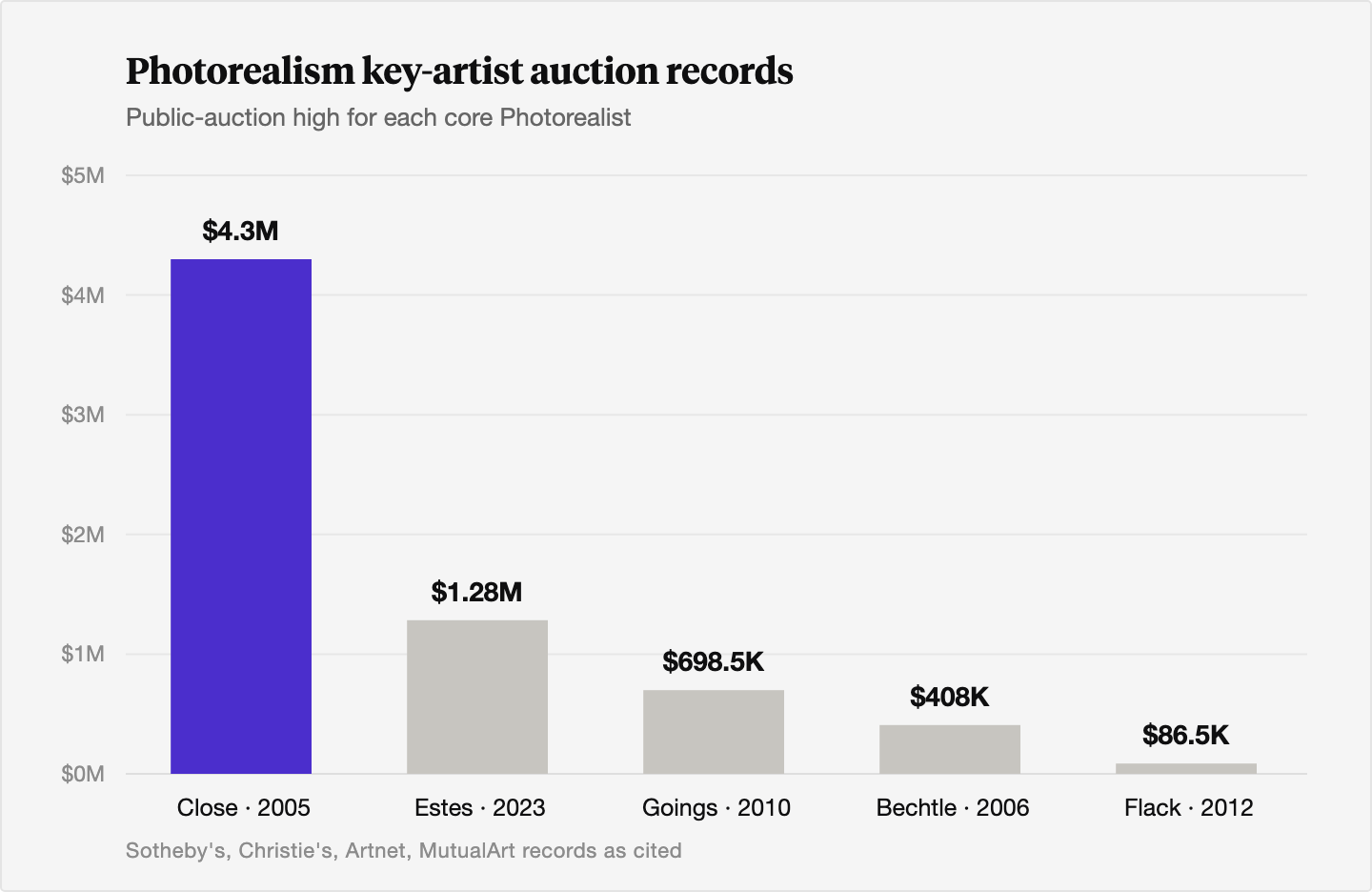
Chuck Close holds the high mark. His portrait "John" (1971) sold for $4.3 million at Sotheby's New York on May 10, 2005, which was a roughly 72% jump over his prior record set the year before [5]. Richard Estes follows, with "Gifts of Nature" (1978) reaching $1,284,000 at Christie's New York in March 2023 [6]. Robert Bechtle's record sits near $408,000, set by "'62 Chevy" (1970) at Christie's in November 2006 [7]. Ralph Goings reached $698,500 for "Still Life with Peppers" at Christie's New York in 2010 [8]. Audrey Flack's auction high is roughly $86,500, for "World War II (Vanitas)" at Christie's New York in 2012 [9].
Two patterns stand out. First, several of these records are now more than a decade old, which tells you the very top of the category does not reprice often. Second, only one artist, Close, has cleared a few million dollars, and his market carries a complication we address below. The rest of the founders trade, at their best, in the mid-to-high six figures. Past performance is not predictive, and a single record is a thin basis for a forecast, but the pattern is consistent across the roster.
4. Where the category sits relative to broader contemporary art
The simplest way to size Photorealism is to set its ceiling against the contemporary blue-chip ceiling. A core Photorealist record of one to four million dollars sits well below the level at which the marquee Post-War and Contemporary names trade. Eight-figure results are routine for Basquiat, Rothko, and Warhol, and the November 2025 sales pushed the very top of the market higher still. Across the auction houses, sales of works priced above $10 million rose about 36% in 2025, to roughly $2.3 billion, and the $1 million to $10 million band rose about 21%, to roughly $3.5 billion [10][11].
Photorealism lives mostly below that $1 million to $10 million band, in the price tier where most of art trades and where behavior differs in ways we have written about separately (see /academy/posts/price-tier-analysis-how-100k-1m-and-10m-works-behave-differently). The category is also a useful illustration of a broader truth: segments of the art market do not all move together, and a niche representational category can be flat in the same year the high end runs (see /academy/posts/when-markets-diverge-why-contemporary-art-and-old-masters-dont-move-together).
This is not a knock on the art. It is a statement about market structure. The blue-chip core is where wealth creation at the very top concentrates, and Photorealism has never been the principal target of that buying (for what "blue-chip" means and why it matters, see /academy/posts/what-blue-chip-art-actually-means-and-why-it-matters).
5. Liquidity and the thin-market problem
The defining feature of Photorealism as an investment category is the depth of demand, not the quality of supply.
Representational work of this kind holds a dedicated collector base, and that base has shown durability over fifty years. Museum interest is current rather than historical, with the Rose Art Museum at Brandeis running "Photorealism in Focus" from February 11 to May 31, 2026, a show of more than thirty artists that gives unusual weight to the women in the movement [4][12]. Specialist galleries in London and New York have built businesses around the category. None of that is in question.
What is in question is turnover. A thin market means fewer bidders per lot, longer gaps between major sales, and prices that are more sensitive to which two collectors happen to be in the room. In our view that is the central risk an investor should weigh here. It is not a risk of the work being bad. It is a risk of the work being hard to sell at a confident price on your timeline, and that risk shows up as a wider spread between what a piece might fetch on a good day and a quiet one.
There is also a name-specific reminder in this category. Chuck Close was a blue-chip figure for decades, then faced misconduct allegations beginning in late 2017 that led some institutions to cancel exhibitions [5]. We take no position on the conduct. The market point is narrow and worth stating: reputation is part of an artist's market, and in a thin category a shift in standing has fewer buyers to absorb it. Concentration in a small roster cuts both ways.
6. How we would think about it as an allocation
We build markets from the artist up, and the discipline applies cleanly here. Step one is the artist market. A great example by a Photorealist whose work rarely trades is still hard to own, because the exit depends on a small pool of buyers. Step two is the example and the price within that market.
Within the founders, the markets are not equal. Close has the highest ceiling and the most institutional history, alongside the reputational complication. Estes has the cleanest recent validation, with a seven-figure result in 2023 [6]. Bechtle, Goings, and Flack trade lower and less often, which is a signal about depth, not merit. The contemporary Hyperrealists are a separate exercise, with primary-market pricing and little secondary track record to underwrite against [12].
The way we frame any segment like this is to ask whether the demand is wide enough and steady enough to support a confident exit over a multi-year hold. Photorealism passes the steady test and is harder on the wide test. For the broader contemporary core, where turnover is higher and the buyer pool deeper, those answers tend to run the other way. That gap is the whole point.
The Bottom Line
- Photorealism is a defined movement with a small founding roster (Close, Estes, Flack, Goings, Bechtle), named in 1969 and shown internationally by 1972. Hyperrealism is the later, composite-source strand that followed.
- The category's auction ceiling runs from roughly $86,000 (Flack) to about $4.3 million (Close), with most founders trading in the high six figures. That is a structurally lower tier than the contemporary blue-chip core.
- Demand is steady but thin. The art is museum-grade, the collector base is loyal, and turnover is low, which is a liquidity consideration rather than a quality one.
- Gerhard Richter's photo-paintings share a source idea but belong to a separate, blue-chip market and should not be read as a Photorealism comp.
- We would weigh any work here on the depth of the specific artist's market first, because in a thin category the exit, not the entry, is the hard part. Past performance is not predictive.
Sources
- The Art Story. "Photorealism Movement Overview." TheArtStory.org, accessed June 2026. https://www.theartstory.org/movement/photorealism/
- Sotheby's. "Photorealism: History, Characteristics, Artists." Sotheby's, accessed June 2026. https://www.sothebys.com/en/photorealism
- Wikipedia. "Hyperrealism (visual arts)." Wikipedia, accessed June 2026. https://en.wikipedia.org/wiki/Hyperrealism_(visual_arts)
- Invaluable. "Photorealism and its Impact on Contemporary Art." Invaluable.com, accessed June 2026. https://www.invaluable.com/blog/photorealism/
- HENI. "The Portrait That Set Chuck Close's Auction Record." HENI News, accessed June 2026. https://heni.com/news/article/chuck-close-john-2005-05-10
- MutualArt. "Richard Estes: Artworks at Auction." MutualArt, accessed June 2026. https://www.mutualart.com/Artist/Richard-Estes/7B0BA723AB162FC5
- Wikipedia. "Robert Bechtle." Wikipedia, accessed June 2026. https://en.wikipedia.org/wiki/Robert_Bechtle
- Invaluable. "Ralph Goings Art Value Price Guide." Invaluable.com, accessed June 2026. https://www.invaluable.com/artist/goings-ralph-ladell-faxemf1i2l/sold-at-auction-prices/
- MutualArt. "Audrey Flack: Artworks at Auction." MutualArt, accessed June 2026. https://www.mutualart.com/Artist/Audrey-Flack/94DC7AA1A10C6272
- Art Basel and UBS. "Global sales rise 4% to $59.6 billion in 2025, amid ongoing market recalibration." The Art Basel and UBS Global Art Market Report 2026, by Dr. Clare McAndrew, March 2026. https://www.artbasel.com/stories/the-art-basel-and-ubs-global-art-market-report-2026
- Artnet News. "Introducing the Intelligence Report: The Year Ahead 2026." Artnet News, 2026. https://news.artnet.com/market/special-reports/the-intelligence-report
- Rose Art Museum, Brandeis University. "Rose Art Museum Presents Photorealism in Focus, February 11 to May 31, 2026." Brandeis University, January 2026. https://www.brandeis.edu/rose/about/press-releases/2026/rose-art-museum-presents-photorealism-in-focus-february-11may-31-2026.html
- HENI. "The Abstract That Set Gerhard Richter's Auction Record." HENI News, accessed June 2026. https://heni.com/news/article/gerhard-richter-abstraktes-bild-2015-02-10
- Britannica. "Photo-realism: Techniques, History and Artists." Encyclopaedia Britannica, accessed June 2026. https://www.britannica.com/art/Photo-realism
Disclosures
Investing involves risk. Past results are not indicative of future outcomes.
Masterworks is providing this communication as an agent for its issuer entities, not Masterworks Advisers. This material is produced by Masterworks for informational purposes only and does not constitute investment advice, a recommendation, or an offer or solicitation to buy or sell any security. Masterworks is not a licensed broker-dealer by the SEC or FINRA.
Masterworks can only make and accept sales after an offering statement has been filed, and "qualified", by the SEC. Any offers may be revoked before notice of qualification. Indications of interest involve no obligation. For further disclosure visit the offering documents filed with the SEC and Important Disclosures at masterworks.com/cd.
Forward-looking statements and internal estimates are based on assumptions that may prove incorrect, and actual outcomes may differ materially. Figures denoted in brackets are subject to confirmation. Investing in art and alternative assets involves risk, including loss of principal.
Art sales price data is comparative only. Each painting is unique and historical data is not a direct proxy for any specific painting or investment. Data represents whole art, not an investment into our offerings which includes fees and expenses. Any comparative images are not currently live offerings and are provided for educational purposes only.
Masterworks, LLC is located at 1 World Trade Center, 57th Floor, New York, NY 10007.