Masterworks Research · July 2026
The fair sells maybe a billion dollars of art a year. Its real product is price discovery, and the whole market reads the result.
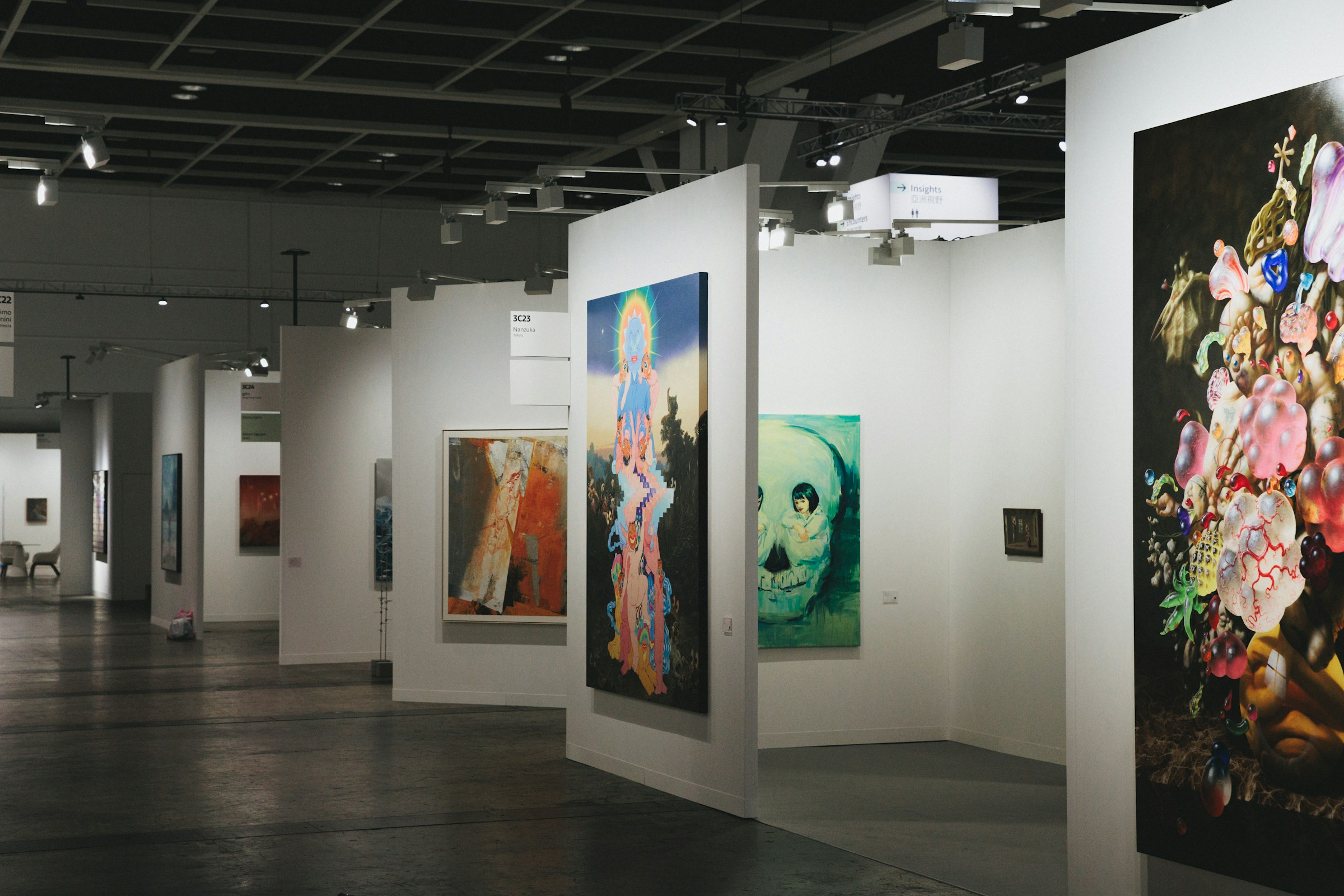
Art Basel is the world's leading series of modern and contemporary art fairs, held every year in Basel, Paris, Miami Beach, and Hong Kong, and owned by the Swiss exhibition company MCH Group. It moves the market because it pulls the best available inventory, the wealthiest collectors, and live pricing into a handful of invitation-only preview days that the trade treats as the primary test of demand for the season ahead. When a fresh Gerhard Richter changes hands for $23 million in the first hours of a Paris preview, that number becomes a reference price the rest of the market prices against for months.
For an investor, the reason to understand Art Basel has nothing to do with attending it. The fair is the closest thing the primary art market has to a live order book. Reading it well tells you where demand is firm, where it is thinning, and how confident the people at the very top of the market feel right now.
What is Art Basel, and who owns it?
Art Basel began in 1970, founded by three Basel gallerists, Ernst Beyeler, Trudl Bruckner, and Balz Hilt. The first show drew 90 galleries and about 16,000 visitors [1]. It is now the flagship property of MCH Group, a publicly listed Swiss exhibition company. James Murdoch's investment firm, Lupa Systems, holds roughly 38.5% of MCH, with the Canton and City of Basel holding much of the rest [2].
The mechanics are simple, and worth stating plainly because they explain the pricing power. Galleries apply, a committee vets them, and the selected galleries rent booths to show and sell work. A Basel edition runs about 290 galleries and roughly 4,000 artists [3]. The week opens with days reserved for the top collectors, museum curators, and advisors, then opens to the public. The money moves early, in the private hours.
That selection step matters more than it looks. Art Basel is a curated venue, so a booth is a signal in itself. Getting shown at Basel is a form of validation that feeds back into an artist's market, the same way index inclusion affects a stock. We try to quantify that kind of cultural signal in our own work, because gallery representation and institutional attention track future price behavior.
Where and when the four fairs happen
The four fairs divide the calendar, and the calendar is half of why the fair matters.
- Basel (June). The flagship, at Messe Basel, roughly 285 to 290 galleries and about 91,000 visitors in a normal year [4]. It lands just after the big May auctions in New York and sets the tone for the fall.
- Paris (October). Launched in 2022 at the Grand Palais, after Art Basel won the slot the FIAC fair used to hold [1]. It opens the European fall season and sits right before the November evening auctions in New York.
- Miami Beach (December). Running since 2002, the main event for collectors in the Americas, and the fair that closes the year.
- Hong Kong (March). Started in 2013, the anchor for Asian demand and the first read on the market each spring.
Basel is a Swiss institution for a reason. Switzerland is the plumbing of the high-end art trade, from the auction calendar to the tax-free storage where a great deal of investment-grade work actually sits. We cover that machinery in the Swiss art ecosystem and in art freeports.
Why Art Basel moves the market: price discovery in a few hours
Half of the art market trades privately, where prices are never disclosed. Art Basel is where a large slice of that private market briefly becomes legible. For a few structured days, deals happen fast, galleries email their results to the press, and the trade reads the tape.
The venue concentrates three things at once: the best fresh inventory, the deepest pool of buyers, and immediate competition among them. That density is what makes a Basel price more informative than a price set in a quiet gallery back room. The fair leans into this. Its 2026 Basel Exclusive rule requires galleries to hold at least one key work back from online previews, so the first real market test for that piece happens on the floor [5]. The point is to make first access mean something, which also makes the resulting price a cleaner signal.
Here is how that signal travels. When Hauser & Wirth places a $23 million Richter and White Cube sells an $11.5 million Julie Mehretu in the opening hours of Art Basel Paris, those numbers set the ceiling other dealers price toward, and auction house specialists fold them into the estimates and guarantees they offer for comparable works in the coming season [6][7]. A strong fair makes it easier for a house to win a consignment and justify an aggressive estimate. A weak one leads to estimate cuts and fewer guarantees. The fair and the auction room are two halves of the same price-discovery machine.
Watch who is actually buying in those first hours. A serious collection runs $50 to $100 million, so a meaningful private buyer at this level is often a billionaire. We tend to think of high-end art prices as a call option on the top 0.01%. The Basel previews are where you get to watch that option get exercised in real time.
What the 2025 and 2026 fairs told us about the market
The recent cycle has shown a market that is selective at every level and strong at the very top. Art Basel Paris in October 2025 is the clearest read. The fair ran 206 galleries from 41 countries and reported roughly $90 million in sales for the week [7][8].
The headline deals were large and they closed fast:
- Gerhard Richter, Abstraktes Bild (1987), sold by Hauser & Wirth for about $23 million [6][7].
- Julie Mehretu, Charioteer (2007), sold by White Cube for roughly $11.5 million [6].
- Amedeo Modigliani, Jeune fille aux macarons (1918), placed by Pace just under $10 million [7].
- Ruth Asawa hanging sculpture, sold by David Zwirner for $7.5 million [6][7].
Hauser & Wirth alone reported well over $30 million across the preview [7]. The June 2025 Basel edition read the same way, with dealers describing swift buying from the first day and placements running from four figures into eight, including a David Hockney tunnel painting reported in the $13 to $17 million range [9].
Below the trophies, the picture split. The Art Newspaper described Paris as a fair that rewarded the top dealers while smaller galleries faced more selective buying [6]. Observer's read was that the collectors still active are more disciplined, favoring artists with real institutional backing and pulling away from the young figurative painters that speculative money had chased a few years earlier [8].
That is a barbell. Firm demand for quality with a deep market history, thinner demand for the speculative middle. In investing terms it is a flight to quality, the way a market behaves coming out of a correction. The art market fell for roughly three years after its late-2021 peak. The Basel and Paris results suggest buyers are back, and choosy.
What Art Basel means for an investor
You are almost certainly never going to buy at Art Basel, and that is fine. The fair is still useful to you as a barometer and as a check on the thesis for owning art at all.
It tells you whether the top of the market is liquid, which is where returns for blue-chip work get set. You can see which artists and segments are gaining or losing institutional support, and buying by museums and foundations is durable demand, the kind that tends to persist. And you get the direction of collector confidence going into the auction seasons that bracket each fair.
What it does not tell you is where prices go next. A fair is a snapshot of demand on a given week, taken from a self-reported set of deals that galleries choose to disclose. It runs warm, because nobody emails the press about the work that did not sell. Read it for direction and breadth, not for precision.
Art earns a place in a portfolio for one reason. Its highest correlation to another asset is with gold, somewhere around 0.1 to 0.2, and it runs close to zero against equities over long periods. It marches to demand from the very wealthy, and Art Basel is where you can see that demand show up or stay home. For the annual data behind the same market, see our companion piece on the Art Basel and UBS Global Art Market Report.
The Bottom Line
- Art Basel is the leading global modern and contemporary art fair, staged every year in Basel, Paris, Miami Beach, and Hong Kong, and owned by Switzerland's MCH Group.
- Its economic function is price discovery. It concentrates the best inventory and the wealthiest buyers into a few preview days, and the prices set there become the reference points galleries and auction houses use for months.
- The 2025 fairs, led by roughly $90 million in reported sales at Art Basel Paris, showed a barbell market: strong and liquid at the top, more selective in the speculative middle.
- For an investor, Art Basel is a sentiment barometer, not a buying venue. Read it for whether high-end demand is firm and for the direction of collector confidence, and treat its self-reported figures as a warm signal rather than a precise one.
Sources
- Art Basel and Wikipedia. "Art Basel: history and fairs." Wikipedia, accessed July 2026. https://en.wikipedia.org/wiki/Art_Basel
- Wikipedia. "MCH Group ownership." Wikipedia, accessed July 2026. https://en.wikipedia.org/wiki/MCH_Group
- Art Basel. "Art Basel in Basel." Art Basel, 2026. https://www.artbasel.com/basel
- MCH Group. "Annual Report 2024." MCH Group, 2025. https://www.mch-group.com/assets/documents/reports/en/2024/mch_annual-report-2024_en.pdf
- Artnews. "Art Basel unveils Basel Exclusive initiative." ARTnews, 2026. https://www.artnews.com/art-news/market/art-basel-basel-exclusive-initiative-1234782365/
- The Art Newspaper. "Art Basel Paris VIP and VVIP days sales." The Art Newspaper, October 22, 2025. https://www.theartnewspaper.com/2025/10/22/art-basel-paris-vip-and-vvip-days-sales
- Art Basel. "Art Basel Paris 2025: success on the world market." Art Basel, October 2025. https://www.artbasel.com/stories/art-basel-paris-2025-success-world-market
- Observer. "Sales report: Art Basel Paris 2025 booth highlights." Observer, October 2025. https://observer.com/2025/10/sales-report-art-basel-paris-2025-booth-highlights/
- Artlyst. "Art Basel 2025 sales, plus what the dealers had to say." Artlyst, 2025. https://artlyst.com/art-basel-2025-sales-plus-what-the-dealers-had-to-say/