
Masterworks Research · June 2026
The four major collecting categories run on different clocks, driven by different buyers and opposite supply pressures, and treating art as one market hides the divergence that matters most.
The major fine art collecting categories, Post-War and Contemporary, Modern, Impressionist, and Old Masters, do not move together because each is bought by a different generation of collectors, runs on a different supply dynamic, and sits at a different stage of price discovery. Over recent decades, contemporary art has appreciated far faster than Old Masters, and in any given year the categories can move in opposite directions. In 2025 alone, Impressionist auction sales rose about 149% while ultra-contemporary fell for a fourth straight year [1][2]. For an investor, this matters because "art" is not one asset with one return. It is several markets with different risk profiles, and the choice of category does most of the work.
What You Need to Know
- Appreciation follows fashion, and fashion moves generationally. Our best estimate of long-run appreciation by category runs from Contemporary at roughly 12 to 13% a year down to Old Masters at roughly 1 to 2%, with Modern and Impressionist in between. The older the category, the slower it tends to appreciate.
- The categories diverged sharply in a single recent year. Bank of America's 2026 art market analysis reports Modern auction sales up about 35% and Impressionist up about 149% in 2025, while Contemporary and Young Contemporary works on average sold below estimate [1][2]. That is divergence inside one calendar year.
- Old Masters are a shrinking, supply-constrained niche. Global Old Masters auction sales fell from about $1.63 billion in 2014 to about $803 million in 2024, roughly a 51% decline over a decade, and the category was about 9% of fine art sales by value in 2024 [3].
- Different categories pull from different collector bases. Contemporary attracts younger, trend-driven buyers; Old Masters depend on an older, smaller connoisseur base. Millennial and Gen Z bidders now make up as much as a third of buyers at the major houses [4].
- The divergence is the diversification. Because the segments respond to different forces, owning more than one category can smooth returns in a way that loading up on a single category cannot. Past performance is not predictive.
1. Why older art appreciates more slowly than newer art
Start with the finding that surprises most people: the older art gets, the less it tends to appreciate. Many investors assume the opposite, that a Rembrandt must be climbing faster than a Basquiat because it has had centuries to compound. The data points the other way.
Our published estimate of long-run appreciation by category runs roughly like this: Contemporary art, meaning work made after about 1970, at roughly 12 to 13% a year; Modern at roughly 8 to 9%; Impressionist at roughly 6 to 7%; and Old Masters at roughly 1 to 2%. These are Masterworks' stated estimates, not guaranteed outcomes, and past performance is not predictive.
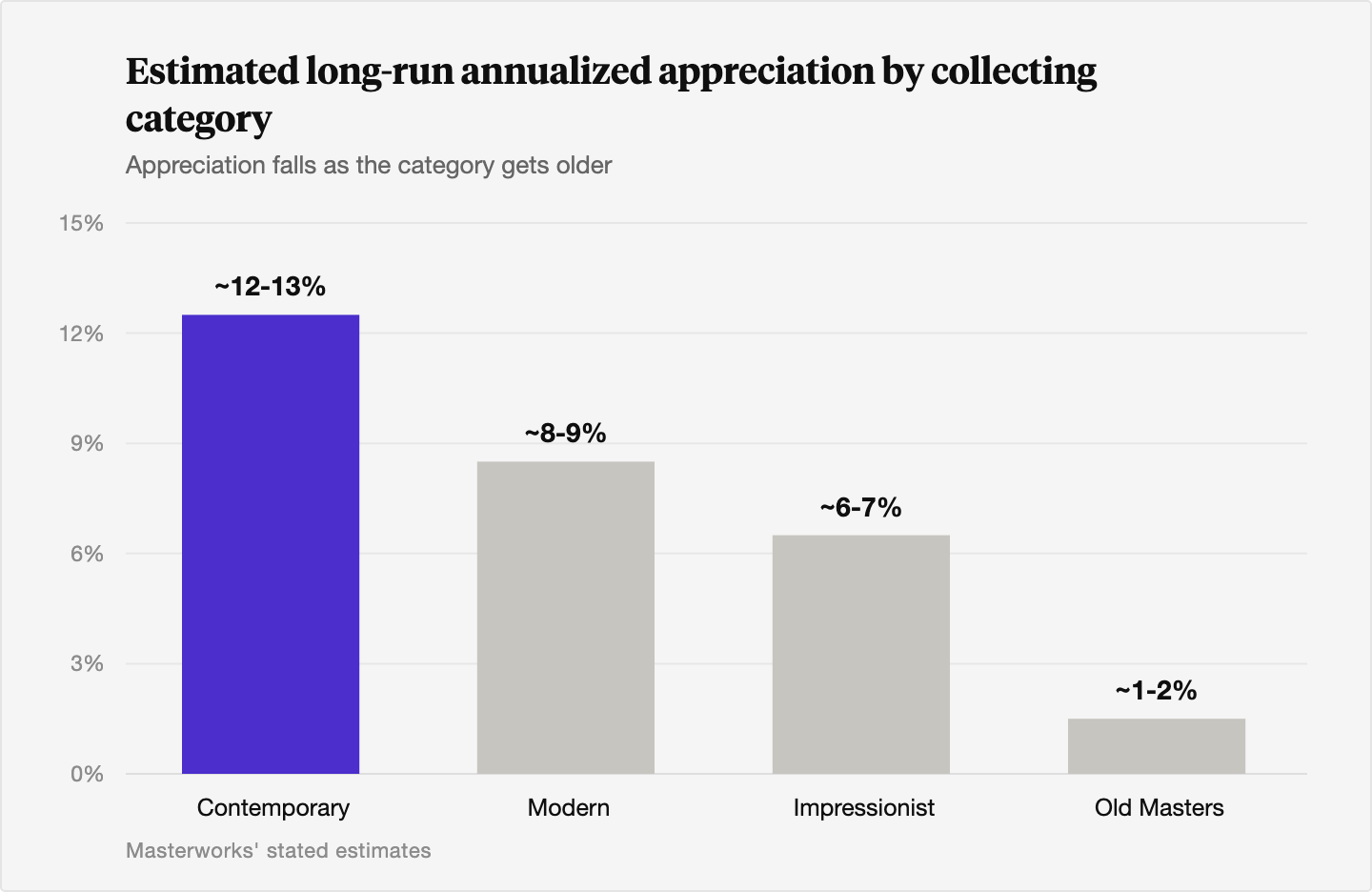
Our best hypothesis for why the ladder slopes this way is that appreciation follows fashion, and fashion moves generationally. If you have ten million dollars to spend on a single painting, you probably want to hang a Basquiat in the room, not a Rembrandt above the bed. Each generation of wealthy collectors disproportionately buys the art of its own era, and that demand is what pulls prices up.
Independent research lines up with this. Investment analysis built on the Mei Moses indices finds that the Post-War and Contemporary index has outperformed the S&P 500 since 1995, while the Old Masters and Impressionist indices have not, and characterizes Old Masters as a highly mature market where significant returns are less likely [5]. One market study found contemporary prices rose about 70% between 2004 and 2014, while a 2021 study of repeat sales across Old Master, Modern, and Contemporary works found higher average returns, and higher risk, in the newer segments [6][7].
That is the core reason the categories diverge over time. They are at different stages of price discovery, and they answer to the taste of different generations.
2. How the contemporary collector base differs from the Old Masters base
Categories move apart because the people buying them are not the same people. This is the part that gets lost when art is treated as one market.
Contemporary and ultra-contemporary works draw younger high-net-worth buyers, many from technology and finance, who are active across New York, London, Hong Kong, and Seoul and are heavily influenced by galleries, social platforms, and trend cycles [4][8]. They have a higher appetite for risk and, at the younger end, smaller average budgets. Millennial and Gen Z collectors now account for as much as one-third of bidders at Christie's and Sotheby's [4].
Old Masters pull from a different and smaller pool: older, often European collectors and institutions who prize scarcity, provenance, and art-historical depth, and who buy to hold rather than to flip [3][8]. The iconography of the category, religious and mythological subjects, portraits of unknown sitters, demands a level of art-historical literacy that does not travel as easily to new money. Museums remain important buyers, but they are selective and budget-constrained.
Because these constituencies behave differently under stress, the categories respond differently to the same macro shock. When liquidity tightened, younger speculative buyers retreated from ultra-contemporary first, while the older wealth behind Modern and Impressionist works either held or rotated up the quality curve [1][8]. The buyer base is the transmission mechanism for divergence.
3. Why the Old Masters category keeps shrinking
Two forces work against the Old Masters category at once: supply that keeps falling and a demand base that does not expand. The result is a market that can almost disappear in a weak year.
On supply, the stock is finite and steadily leaving the market. The best works sit in museums and long-held private collections that rarely re-enter circulation, and every major donation removes a key work permanently. Export controls in Italy, France, Spain, and the United Kingdom keep important pictures from crossing borders [3]. Global Old Masters auction sales fell from about $1.63 billion in 2014 to about $803 million in 2024, roughly a 51% decline over a decade, and no Old Master work sold above $10 million in all of 2024 [3].
There is also a problem that barely touches contemporary art: attribution. Many Old Master pictures came out of workshops with assistants and followers, and the gap between an autograph work and a studio piece can be an order of magnitude in price. In a single 2025 Sotheby's sale, a work attributed to Botticelli's workshop made $550,000 while fully accepted masterpieces by the same generation trade in the millions [3]. Infrared imaging, dendrochronology, and pigment analysis routinely reclassify works up or down, so buyers demand a larger discount and a longer due-diligence window. That friction is itself a drag on the category's headline appreciation.
To be clear, the category is not collapsing. When quality supply appears, it clears: Old Masters auction sales rose about 35.6% year over year in the first half of 2025 to roughly $171 million, and a July 2025 Christie's sale in London posted a 99% sell-through by value, its best in thirteen years [3]. The category is stable and connoisseur-driven. It is simply small, and it grows slowly.
4. The opposite problem: contemporary supply that keeps growing
Old Masters suffer from too little supply. Contemporary art often has the reverse problem, and the contrast explains a good deal of the divergence.
Living artists keep producing, and galleries keep bringing new names to market, so the contemporary category expands rather than contracts. There is a sweet spot for supply. Too little, and a market cannot sustain itself; an artist with twenty good paintings left in private hands cannot support enough activity to get a market going. Too much, and supply drowns out demand. Damien Hirst is the textbook case of the second problem, where the next dot painting is always available. Steady appreciation over a long period tends to come from something in the middle.
The expanding-supply nature of contemporary art makes it more sensitive to sentiment, which is why it corrected first and hardest in the recent cycle. Ultra-contemporary auction sales fell about 43% by value in 2024, to roughly one-third of their 2021 peak, and the segment posted a fourth straight year of decline in 2025 [2][9]. Average annual returns on works made after 2000 and resold at auction swung from about +9% in 2023 to about -0.3% in 2024 [2]. That is the volatility you take on at the high-appreciation end of the ladder.
This supply contrast is one of the cleaner ways to see why the categories diverge. We cover it in more depth in Living vs. Deceased Artists: How the Supply Dynamic Changes Everything and in Price Tier Analysis: How $100K, $1M, and $10M Works Behave Differently.
5. What divergence looked like in 2025
The clearest proof that the categories run on different clocks is to watch them in a single year. 2025 was that year.
Bank of America's 2026 U.S. art market analysis reports Modern auction sales up about 35% and Impressionist sales up about 149% year over year, with the $1 million-plus Impressionist band up about 173%, while Contemporary and Young Contemporary works on average sold below estimate [1][2]. Three categories pulling apart in twelve months is what divergence means in practice.
The top of the market told the same story. Fine art auction sales rose about 13.3% to roughly $11.7 billion in 2025, but a handful of works did the heavy lifting, and nine of the top ten lots sold in three days during New York's November sales [10]. Gustav Klimt took the top three spots, led by his Portrait of Elisabeth Lederer at $236.4 million, then the second-highest auction price ever recorded [10]. A single Modern painting represented over 31% of the value of the entire top-ten list [10][11].
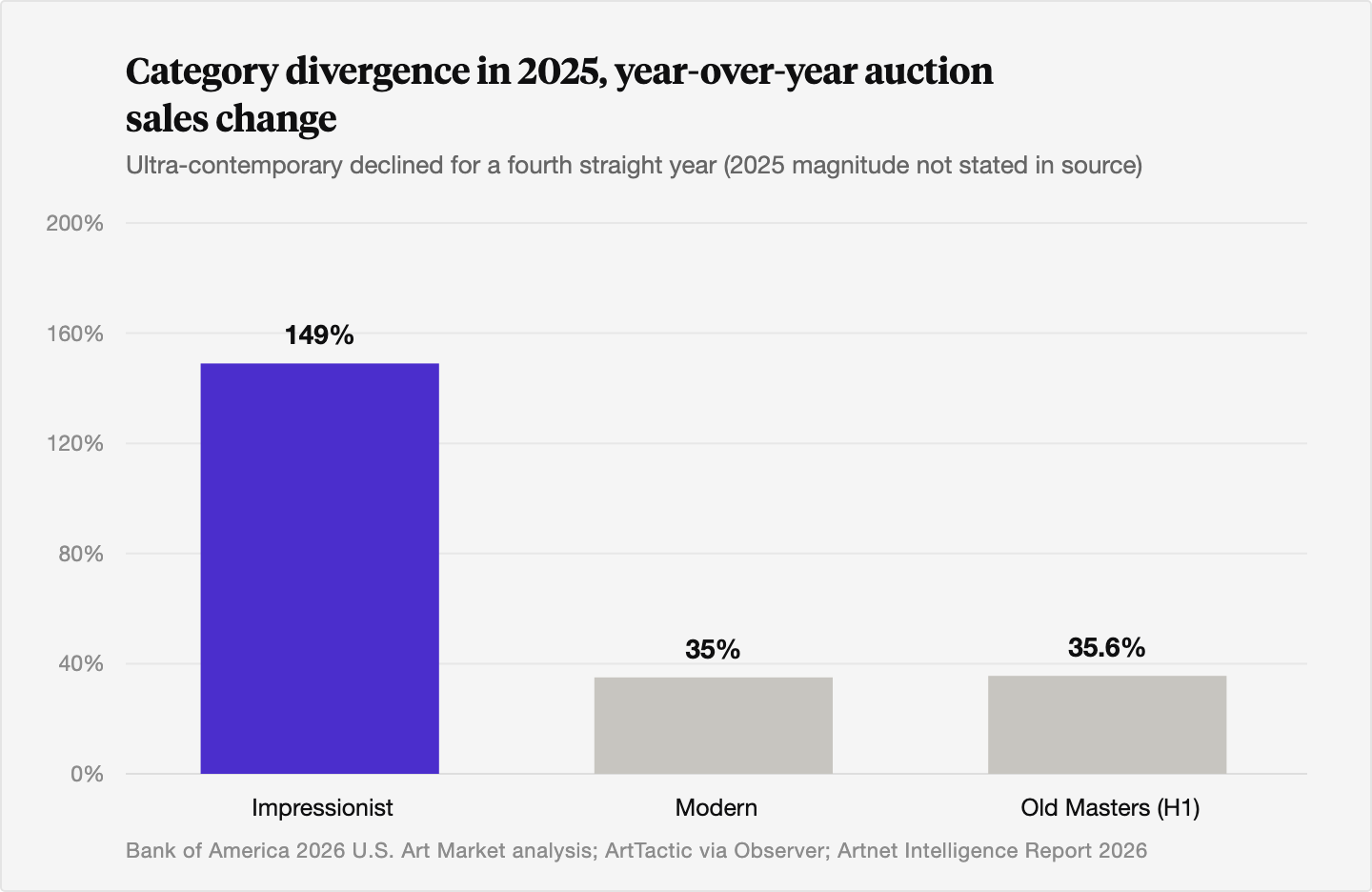
This was a K-shaped recovery. The very top revived for rare, irreplaceable Modern and Impressionist works, while the broad recovery in volume happened below $10 million; public transactions above $10 million fell about 44% in the first half of 2025 versus the year before, and works under $50,000 reached about 61% of all lots sold [1][2]. The averages hid more than they revealed.
6. What divergence means for diversifying within art
Here is the part that translates directly into portfolio terms. Because the segments respond to different forces, they give you a real diversification lever inside a single asset class.
True diversification means owning assets that are largely indifferent to the same forces. Over long horizons, every art category shares some exposure to global wealth and liquidity, so the correlation between categories is not zero. Over the short and medium term, though, the categories diverge enough that a portfolio built only on ultra-contemporary is poorly diversified within art. It is exposed to one buyer base, one taste regime, and one high-volatility cycle [8].
Holding more than one category spreads three different risks at once. It spreads demand risk, because different generations of collectors drive different segments. It spreads cycle risk, because the high-appreciation, high-volatility end (contemporary) and the low-appreciation, low-volatility end (Old Masters) tend not to peak together. And it spreads supply risk, because you are not fully exposed to either the absolute scarcity that can make Old Masters hard to trade or the expanding supply that can weigh on fashionable contemporary names [8].
The tradeoff is honest and worth naming. The categories that diversify best against contemporary, Old Masters above all, are also the ones that have appreciated the slowest. Lower correlation has historically come paired with lower expected appreciation, so diversifying within art is a choice about smoothing returns, not a free lunch. For how these categories move through the broader expansion-and-correction cycle, see How Art Market Cycles Work: Expansion, Peak, Correction, and Recovery, and for what separates the investable tier in any category, see What Blue-Chip Art Actually Means and Why It Matters.
The Bottom Line
- The major collecting categories do not move together because each is bought by a different generation, runs on a different supply dynamic, and sits at a different stage of price discovery.
- Our estimated appreciation ladder runs from Contemporary at roughly 12 to 13% a year down to Old Masters at roughly 1 to 2%, with Modern and Impressionist in between. The older the category, the slower it tends to appreciate.
- In 2025 the categories diverged inside a single year, with Modern up about 35% and Impressionist up about 149% while ultra-contemporary declined for a fourth straight year.
- Old Masters are a shrinking, supply-constrained, attribution-sensitive niche, down roughly 51% in auction sales over the decade to 2024, with a small and aging collector base.
- Owning more than one category diversifies demand, cycle, and supply risk, but the categories that diversify best have historically appreciated the slowest. Past performance is not predictive.
Sources
- Bank of America Private Bank. "Art Market Fall Update: Masterpiece Sales Slow, Sub-$10MM Market Gains Momentum." 2026. https://www.pbig.ml.com/articles/art-market-fall-update.html
- Bank of America Private Bank. "Art Market Spring Update." 2026. https://www.pbig.ml.com/articles/art-market-spring-update.html
- Observer (citing ArtTactic data). "Old Masters July Sales and a Decade of Market Trends." July 2025. https://observer.com/2025/07/art-auction-old-masters-july-sales-old-masters-market-decade-trends-analysis/
- BookofArt. "The Great Market Reset: Post-Boom Collecting in 2025." 2025. https://bookofart.net/en/art-blog/7153-the-great-market-reset-post-boom-collecting-in-2025
- With Vincent. "The Markets of Different Eras of Art." 2025. https://www.withvincent.com/research/markets-different-eras-art
- Unbolted. "Old Masters Versus Contemporary Art." 2025. https://unbolted.com/pawn/blog/old-masters-versus-contemporary-art/
- "Art Return Rates From Old Master Paintings to Contemporary Art." European Journal of Political Economy, 2021. https://www.sciencedirect.com/science/article/abs/pii/S016726812030411X
- The Art Newspaper. "Price Match: Old Masters vs Contemporary Art, What Can You Get for Your Money." July 2019. https://www.theartnewspaper.com/2019/07/05/price-match-old-masters-vs-contemporary-art-what-can-you-get-for-your-money
- Art Basel. "Unpacking the Art Market Report, Art Basel & UBS." 2025. https://www.artbasel.com/stories/unpacking-the-art-market-report-art-basel-ubs-2025?lang=en
- Artnet News. "Intelligence Report 2026: In 2025, a Handful of High-Value Artworks Did the Heavy Lifting." 2026. https://www.facebook.com/artnet/videos/intelligencereport-in-2025-a-handful-of-high-value-artworks-did-the-heavy-liftin/920650770583839/
- Artnet News. "Best Sellers at Auction, Mid-Year 2025." 2025. https://news.artnet.com/market/best-sellers-at-auction-mid-year-2025-2683763
- UBS. "The Art Basel and UBS Art Market Report 2026 by Arts Economics (Dr. Clare McAndrew)." 2026. https://www.ubs.com/global/en/our-firm/art/art-market-research/global-art-market-report-2026.html
- Morgen & Stern. "Global Blue-Chip Art Market Report 2025." 2025. https://www.morgenandstern.com/Morgen&Stern-Global-Blue-Chip-Art-Markt-Report-2025.pdf
- Artnet News. "State of the Art Market: Old Masters and Neo-Old Masters." 2025. https://news.artnet.com/market/state-of-the-art-market-old-masters-and-neo-old-masters-2327212
Disclosures
Investing involves risk. Past results are not indicative of future outcomes.
Masterworks is providing this communication as an agent for its issuer entities, not Masterworks Advisers. This material is produced by Masterworks for informational purposes only and does not constitute investment advice, a recommendation, or an offer or solicitation to buy or sell any security. Masterworks is not a licensed broker-dealer by the SEC or FINRA.
Masterworks can only make and accept sales after an offering statement has been filed, and "qualified", by the SEC. Any offers may be revoked before notice of qualification. Indications of interest involve no obligation. For further disclosure visit the offering documents filed with the SEC and Important Disclosures at masterworks.com/cd.
Forward-looking statements and internal estimates are based on assumptions that may prove incorrect, and actual outcomes may differ materially. Figures denoted in brackets are subject to confirmation. Investing in art and alternative assets involves risk, including loss of principal.
Art sales price data is comparative only. Each painting is unique and historical data is not a direct proxy for any specific painting or investment. Data represents whole art, not an investment into our offerings which includes fees and expenses. Any comparative images are not currently live offerings and are provided for educational purposes only.
Masterworks, LLC is located at 1 World Trade Center, 57th Floor, New York, NY 10007.


