
Masterworks Research · June 2026
Art Movements | Fine Art Market Strategy
How the most austere art of the 1960s became a blue-chip category, and why scarcity and museum demand push prices for Judd and Martin into eight figures.
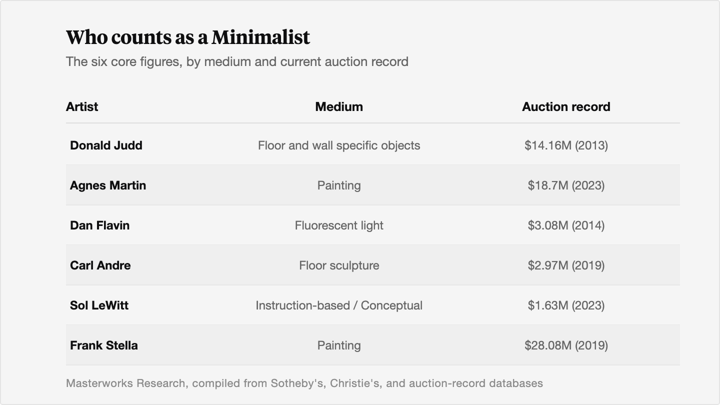
Minimalism is the art movement that emerged in New York in the early 1960s around plain geometric forms, industrial materials, and the removal of the artist's expressive gesture, with Donald Judd, Agnes Martin, Dan Flavin, Carl Andre, Sol LeWitt, and Frank Stella as its central figures [1][2]. At the top of the market that work is no longer cheap or fringe. Agnes Martin's "Grey Stone II" sold for $18.7 million at Sotheby's in November 2023, and a Donald Judd stack set a new record for the format at $12.8 million in May 2026 [3][4]. For an investor, the point is structural. A movement built on restraint now trades like a blue-chip category, and the reasons (rarity, museum demand, and a small confirmed collector base) are the same forces that drive value across the rest of investment-grade art.
What You Need to Know
- Minimalism is a defined 1960s movement with a small canon. It emerged in New York around 1960 to 1965, the term "Minimal Art" was coined by the philosopher Richard Wollheim in 1965, and Donald Judd's "Specific Objects" essay the same year gave it a thesis [1][2].
- The records are real and recent. Agnes Martin's "Grey Stone II" hit $18.7 million in 2023, her "Untitled #44" reached $17.7 million in 2021, and Judd's all-time record stands at $14.16 million for "Untitled (DSS 42)" from 2013 [3][4][5].
- Supply is thin and shrinking. The major Minimalists produced limited bodies of work, and a large share sits permanently in museums and foundations such as Dia Beacon and the Chinati Foundation in Marfa, which removes it from the market [6][7].
- Institutional validation is the engine. Museum acquisition, foundation installations, and major retrospectives are the clearest signal of cultural significance, and in Minimalism that signal is unusually deep [6][7].
- It sits inside the strongest auction category. Postwar art was the largest fine-art auction sector in 2025 at roughly a 31% share, and the recovery in 2025 was concentrated at the high end where blue-chip Minimalism lives [8][9].
1. What Minimalism actually is, and why the term is slippery
Minimalism is the body of work made mostly in New York between about 1960 and the early 1970s that stripped art down to plain geometric units, industrial fabrication, and serial repetition, and removed the personal, expressive mark that defined the Abstract Expressionists who came before [1][2]. Frank Stella's "Black Paintings" of 1958 to 1960 are usually cited as the opening move, and his line "what you see is what you see" became the movement's unofficial motto [2].
The label itself is contested, which matters for how the market reads it. The British philosopher Richard Wollheim coined "Minimal Art" in a 1965 essay, and many of the artists rejected it [1][2]. Donald Judd preferred to call his floor and wall pieces "specific objects," a new thing that was neither painting nor sculpture, set out in his 1965 essay of that name [2]. Sol LeWitt worked from written instructions and is usually filed under Conceptual art as much as Minimalism. For a buyer, "Minimalism" is a market category that gathers a small group of related artists, and the value lives in the individual artist markets, not the label.
2. The records: where the money actually is
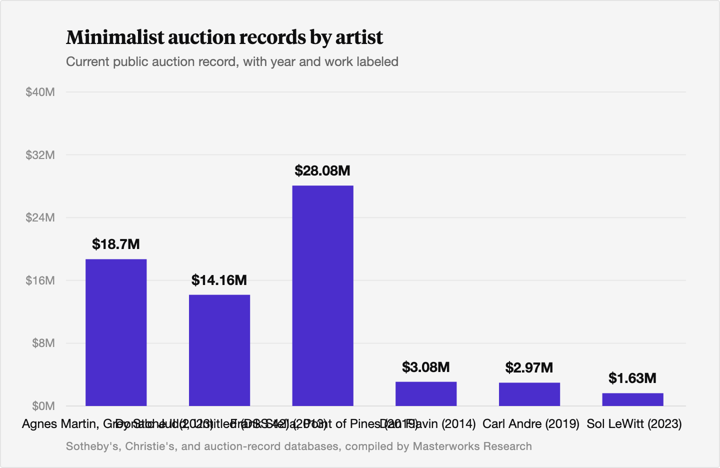
The Minimalist market is concentrated in a few names, and Agnes Martin and Donald Judd sit at the top.
Martin's "Grey Stone II," a 1961 work in oil, gold leaf, and pencil and one of only a handful of gold-leaf paintings she made, sold for $18.7 million at Sotheby's in New York in November 2023, in the Emily Fisher Landau sale [3]. That broke her prior record, "Untitled #44," which made $17.7 million at Sotheby's in November 2021 from the Macklowe collection [5]. Both came from single-owner estate sales, and the best material tends to surface only when an estate forces it.
Judd's all-time record is $14,165,000 for "Untitled (DSS 42)," sold at Christie's in 2013 [4]. The format has stayed firm since. In May 2026 a Judd stack hammered at $10.6 million and sold for $12.8 million with fees at Christie's, a new record for a stack and a data point in a sale that was otherwise selective [4]. At that same May 2026 sale, a Carl Andre floor work, "66 Copper-Carbon Corner," sold for $1.1 million with fees against a $500,000 high estimate, while works by Sol LeWitt and Dan Flavin sold below their low estimates to guarantors [4]. The pattern is familiar across blue-chip art. The best examples clear strongly and the rest find a floor near the guarantee.
The other names trade at lower but durable levels. Dan Flavin's record is about $3.08 million, set in 2014, Carl Andre's is roughly $2.97 million from 2019, and Sol LeWitt's is about $1.63 million from 2023 [5]. Frank Stella is the outlier at $28.08 million for "Point of Pines" in 2019, though that record comes from his later, more elaborate work rather than the austere Black Paintings that launched Minimalism [5].
3. Why austere work commands high prices: scarcity that gets worse
The first driver is supply, and Minimalism has the kind of supply story we look for. These artists made deliberately limited bodies of work, and a large share of the best material is locked up in institutions.
This is the same point we make about decreasing supply across the market. There are only so many Jackson Pollocks left in private hands, and once a major collector donates a work to a museum it leaves the tradable pool for good. Minimalism shows that dynamic in concentrated form. Donald Judd went a step further than selling into museums. He built two of them. With backing from the Dia Art Foundation, he bought land in Marfa, Texas, and the Chinati Foundation opened there in 1986 [6][7]. Chinati alone holds 100 aluminum works by Judd in two converted artillery sheds, 15 outdoor concrete pieces, a Dan Flavin installation across six former barracks, and works by Carl Andre [6][7]. Dia Beacon in New York gives Judd, Flavin, and Andre permanent large-scale rooms [6]. Every one of those works is, for practical purposes, off the market forever.
For a buyer, scarcity that increases over time is the rare feature. It is closer to a commodity whose above-ground supply shrinks each decade than to an equity that can issue more shares. We have written before about what separates a durable name from a fragile one, see our explainer on what blue-chip art actually means. Minimalism checks the supply box hard.
4. Institutional validation is the real moat
Cultural significance gets used loosely in the art market, so we try to quantify it. The clearest measures are which galleries represent an artist, which museums own the work, and who collects it. On the museum measure, Minimalism is about as validated as a postwar movement can be.
Agnes Martin has had full retrospectives at the Tate and the Guggenheim, and her work is held across the major modern and contemporary collections [3]. Judd, Flavin, and Andre anchor Dia Beacon and Chinati [6][7]. This depth of institutional holding does two things at once for the market. It confirms the work belongs in the canon, which reassures the next buyer, and it permanently shrinks the float, which we covered above. Validation and scarcity reinforce each other.
When a museum mounts a Martin retrospective, it raises her profile with the small group of collectors who can spend eight figures, and the next time a top example comes up the bidding reflects it. The $18.7 million Martin in 2023 did not happen in isolation. It came after decades of museum attention that turned a once-quiet artist into a name that several billionaires want on the wall. This is why we treat museum and foundation activity as a leading market signal in its own right. For more on how to read where prices sit across the market, see our price-tier analysis of how 100k, 1m, and 10m works behave differently.
5. How Minimalism sits inside the broader market
Minimalism trades inside the postwar and contemporary category, which is the heart of the high-value auction market and the part we study most closely. Its prices rise and fall with that wider tide.
In 2025 the global art market returned to growth, with sales up roughly 4% to an estimated $59.6 billion, per the Art Basel and UBS Global Art Market Report compiled by Dr. Clare McAndrew [8]. Postwar art was the single largest fine-art auction sector that year at about a 31% share by value [8]. The recovery, though, was concentrated at the top. Sales of works over $10 million rose about 36% to $2.3 billion in 2025, the $1 million to $10 million band rose about 21% to $3.5 billion, and the $100,000 to $1 million band rose about 6%, per the Artnet Price Database [9]. The very bottom of the market stayed flat [9].
That shape favors blue-chip Minimalism. The top Judds and Martins live in exactly the price bands that recovered fastest, and the thinner names sit in the bands that were merely steady. It is the same divergence we see across art and other asset classes, the highest-quality, scarcest items lead a recovery while the broad middle lags. We unpack that timing in how art market cycles work, and the way different corners of the art market can move on their own clocks in when markets diverge.
6. The investor's view: liquidity, concentration, and what can go wrong
In investing terms, Minimalism shows the three things we want in investment-grade art. Supply is small and shrinking, institutional validation is deep, and the demand base, while narrow, is wealthy and durable. Judd's record has held near $14 million for more than a decade, and Martin's has climbed from $17.7 million to $18.7 million across two cycles, which we read as a stable to firming market for the best examples [3][4][5].
The risks are real and specific. Liquidity is thin. The top examples come up rarely, often only through estates, so an investor cannot count on selling on a chosen timeline. The collector base is concentrated, which means a handful of buyers can move a single artist's market in either direction. The May 2026 sale showed both faces of this, a record Judd stack alongside a Flavin and a LeWitt that sold under estimate to guarantors [4]. There are also category-specific headaches. Dan Flavin's fluorescent works raise conservation and replacement-part questions, and many Minimalist objects were industrially fabricated and depend on certificates rather than the artist's hand, which puts a premium on clean provenance. And the broad postwar and contemporary auction total is still well below its 2021 peak, so this is a recovery off a correction, not a runaway market [8].
As with everything we publish, past performance is not predictive. A record price is evidence about a market's depth at one moment. The next sale stands on its own.
Sources
- Tate. "Minimalism." Tate Art Terms. https://www.tate.org.uk/art/art-terms/m/minimalism
- The Art Story. "Minimalism Movement Overview." https://www.theartstory.org/movement/minimalism/
- Angelica Villa. "Behind the Agnes Martin Market and Sotheby's Record-Making Sale." ARTnews, November 2023. https://www.artnews.com/art-news/market/agnes-martin-art-market-sothebys-pace-grey-stone-ii-1234687349/
- "Richter and Judd works top Christie's solid if not stellar sale of post-war and contemporary art." The Art Newspaper, May 21, 2026. https://www.theartnewspaper.com/2026/05/21/christies-marian-goodman-richters-henry-mcneil-minimalism-auction-report-new-york
- MyArtBroker. "Donald Judd Value: Top Prices Paid at Auction." https://www.myartbroker.com/artist-donald-judd/record-prices/donald-judd-record-prices
- Dia Art Foundation. "Dia Beacon." https://www.diaart.org/
- The Chinati Foundation. "Collection." https://chinati.org/
- Art Basel and UBS. "The Art Basel and UBS Global Art Market Report 2026." Arts Economics, Dr. Clare McAndrew, 2026. https://www.artbasel.com/stories/the-art-basel-and-ubs-global-art-market-report-2026
- Artnet News. "The Price Points Powering the Art Market." Artnet Intelligence, 2026. https://news.artnet.com/market/dominant-price-point-auction-2025-2770334
- Sotheby's. "Minimalism: History, Characteristics, Artists." https://www.sothebys.com/en/art-movements-minimalism
- HENI. "The Gold-Leaf Painting That Set Agnes Martin's Auction Record." November 8, 2023. https://heni.com/news/article/agnes-martin-grey-stone-ii-2023-11-08
- Artnet News. "Contemporary Art Market Declines For Fourth Straight Year, as Old Masters and Impressionist Works Rebound: Art Basel UBS Report." 2026. https://www.artnews.com/art-news/news/contemporary-art-market-cooling-old-masters-report-1234777454/
- Artsy. "Donald Judd, Auction Results and Sales Data." https://www.artsy.net/artist/donald-judd/auction-results
- Artnet News. "How Marfa Went From Donald Judd's Anti-Commercial Escape to a Mecca of Luxury Minimalism." https://news.artnet.com/art-world/kyle-chayka-minimalism-excerpt-1744791
Disclosures
Investing involves risk. Past results are not indicative of future outcomes.
Masterworks is providing this communication as an agent for its issuer entities, not Masterworks Advisers. This material is produced by Masterworks for informational purposes only and does not constitute investment advice, a recommendation, or an offer or solicitation to buy or sell any security. Masterworks is not a licensed broker-dealer by the SEC or FINRA.
Masterworks can only make and accept sales after an offering statement has been filed, and "qualified", by the SEC. Any offers may be revoked before notice of qualification. Indications of interest involve no obligation. For further disclosure visit the offering documents filed with the SEC and Important Disclosures at masterworks.com/cd.
Forward-looking statements and internal estimates are based on assumptions that may prove incorrect, and actual outcomes may differ materially. Figures denoted in brackets are subject to confirmation. Investing in art and alternative assets involves risk, including loss of principal.
Art sales price data is comparative only. Each painting is unique and historical data is not a direct proxy for any specific painting or investment. Data represents whole art, not an investment into our offerings which includes fees and expenses. Any comparative images are not currently live offerings and are provided for educational purposes only.
Masterworks, LLC is located at 1 World Trade Center, 57th Floor, New York, NY 10007.


