Masterworks Research · June 2026
How two painters rebuilt the picture plane between 1907 and 1914, and why the works that survived in private hands trade so rarely and so high.
Cubism was the movement, built mostly in Paris between 1907 and 1914 by Pablo Picasso and Georges Braque, that broke an object into facets and showed several views of it at once on a flat surface. It ran through two phases, Analytic Cubism (roughly 1909 to 1912), which took objects apart into shallow planes in a near-monochrome palette, and Synthetic Cubism (from late 1912), which rebuilt images from collage, pasted paper, and stenciled type. For an investor, the relevant fact is structural. Most of the canonical Cubist masterpieces are now permanently held by museums, so the works that can still trade are scarce, and that scarcity, paired with Picasso's standing as one of the most-traded and highest-grossing names in auction history, is what sets the price.
What You Need to Know
- Cubism is a short, dense window: 1907 to 1914. The movement was effectively a two-person project between Picasso and Braque, joined by Juan Gris and Fernand Leger, compressed into about seven years before World War I scattered the group.
- Two phases, two different looks. Analytic Cubism (about 1909 to 1912) fragmented objects into faceted planes in browns and grays. Synthetic Cubism (from 1912) introduced collage and papier colle, bringing in newspaper, wallpaper, and printed type.
- The best works are off the market for good. The Leonard A. Lauder Cubist Collection alone, 80 works by Picasso, Braque, Gris, and Leger, went permanently to the Metropolitan Museum of Art starting in 2013. MoMA, the Centre Pompidou, Tate, and the Philadelphia Museum of Art hold dozens more.
- Picasso is a top-tier auction name by both value and volume. He has sold at least two works above $100 million at auction, "Les Femmes d'Alger (Version O)" at $179.4 million in 2015 and "Garcon a la pipe" at $104.2 million in 2004, and he later cleared $139 million again with "Femme a la montre" in 2023.
- Scarcity plus iconic status is the whole pricing argument. When supply is fixed and most of it is locked in public collections, the few works that surface trade as occasional trophies, not as a continuous, liquid market.
1. What Cubism is, and why 1907 is the starting line
Cubism began with one painting that almost nobody saw for years. Picasso made "Les Demoiselles d'Avignon" in Paris in June and July of 1907, a large canvas, about 244 by 234 centimeters, of five figures rendered as flat, jagged planes, faces drawn partly from Iberian sculpture and African masks [1][2]. He kept it largely private. It was shown publicly only briefly around 1916, and it did not become widely known until the Museum of Modern Art acquired it in the late 1930s [1][2]. Art historians generally treat it as the prelude to Cubism rather than a finished example of it.
The other root is Paul Cezanne. A large Cezanne retrospective in Paris in 1907 reached the younger painters at exactly the right moment, and Cezanne's idea that nature could be treated through the cylinder, the sphere, and the cone, built up as structure rather than illusion, became the seed of what followed [1][3]. The term itself came from a critic. When Braque showed landscapes in 1908, Louis Vauxcelles described them as made of cubes, and the label stuck [3].
What makes Cubism matter for a collector is not just that it looks new. It is that a recognizable, named style with a clear birth date and a clear set of founders is the kind of thing markets can price. Movement, period, and authorship are the coordinates that turn a canvas into a comp.
2. Analytic Cubism: taking the object apart (1909 to 1912)
From about 1909 to 1912, Picasso and Braque worked so closely that Braque later compared them to two mountaineers roped together [3]. This is the Analytic phase. Objects get broken into small, overlapping facets, shown from several viewpoints at once, and packed into a shallow, compressed space with almost no traditional perspective [4][5]. The palette goes nearly monochrome, browns, grays, and ochres, so that structure rather than color carries the picture.
The canonical examples are now museum fixtures. Picasso's "Girl with a Mandolin" (1910) and "Ma Jolie" (1911 to 1912) are at MoMA [1]. Braque's "Violin and Palette" (1909 to 1910) is at the Guggenheim, and his "The Portuguese" (1911) is at the Kunstmuseum Basel [1]. The Metropolitan's Leonard A. Lauder Cubist Collection, described by the museum as unsurpassed in the number of high-quality Analytic Cubist paintings by Picasso and Braque, holds a deep cluster from exactly these years [6].
Two painters joined the core. Juan Gris brought a more systematic, almost architectural version of the geometry from about 1912, and is usually counted the third major Cubist. Fernand Leger worked a parallel line that critics called "Tubism," with cylindrical, machine-like volumes instead of flat facets [1]. The group was small, which matters later: a movement built by four hands produces a finite body of work.
3. Synthetic Cubism: rebuilding from collage (1912 onward)
Around late 1912, the method flips. Instead of analyzing an object down into facets, Picasso and Braque began constructing images out of pasted materials, newspaper, wallpaper, faux wood-grain paper, printed labels, glued onto the surface [4][5]. This is collage, and specifically papier colle, and it marks the start of Synthetic Cubism. Picasso's "Still Life with Chair Caning" (1912), oil and oilcloth with a rope frame, is a foundational work and sits in the Musee Picasso in Paris [1]. Braque's "Fruit Dish and Glass" (1912) is often cited as the first true papier colle [1].
The look changes with the method. Shapes get larger, simpler, and more decorative. Color comes back, often the inherent color of the pasted paper. Stenciled letters and numbers appear. A pasted wine label can stand in for a bottle. Tate holds representative examples, Picasso's "Bottle of Vieux Marc, Glass, Guitar and Newspaper" (1913) and Braque's "Bottle and Fishes" (around 1910 to 1912) [4]. The phase ran from 1912 into the later 1910s, then the war pulled the group apart and Cubism's most concentrated period closed.
The takeaway for valuation is that "Cubist" is not one thing. An Analytic-phase oil from 1911 and a Synthetic-phase papier colle from 1913 are different objects with different rarity, condition profiles, and buyer pools. The general scarcity story holds, but the comps live inside the phase.
4. Why the supply is so thin: museums hold the masterpieces
This is the part most investors miss. The reason top Cubist works rarely come up is that the best of them are permanently off the market, and they got there early.
Start with the Lauder gift. The Leonard A. Lauder Cubist Collection, 80 works by Picasso, Braque, Gris, and Leger, was promised and donated to the Metropolitan Museum of Art beginning in 2013, and the museum describes it as one of the most important Cubist holdings in the world [6]. A gift like that is structured to be permanent. Once a work enters a flagship public collection, it almost never comes back out. Add MoMA, which owns many of the textbook Picassos and Braques from the period, the Centre Pompidou and Musee Picasso in Paris, Tate in London, and the Arensberg Collection at the Philadelphia Museum of Art, and the pattern is clear [1][4][6]. The canonical benchmarks are national and institutional property.
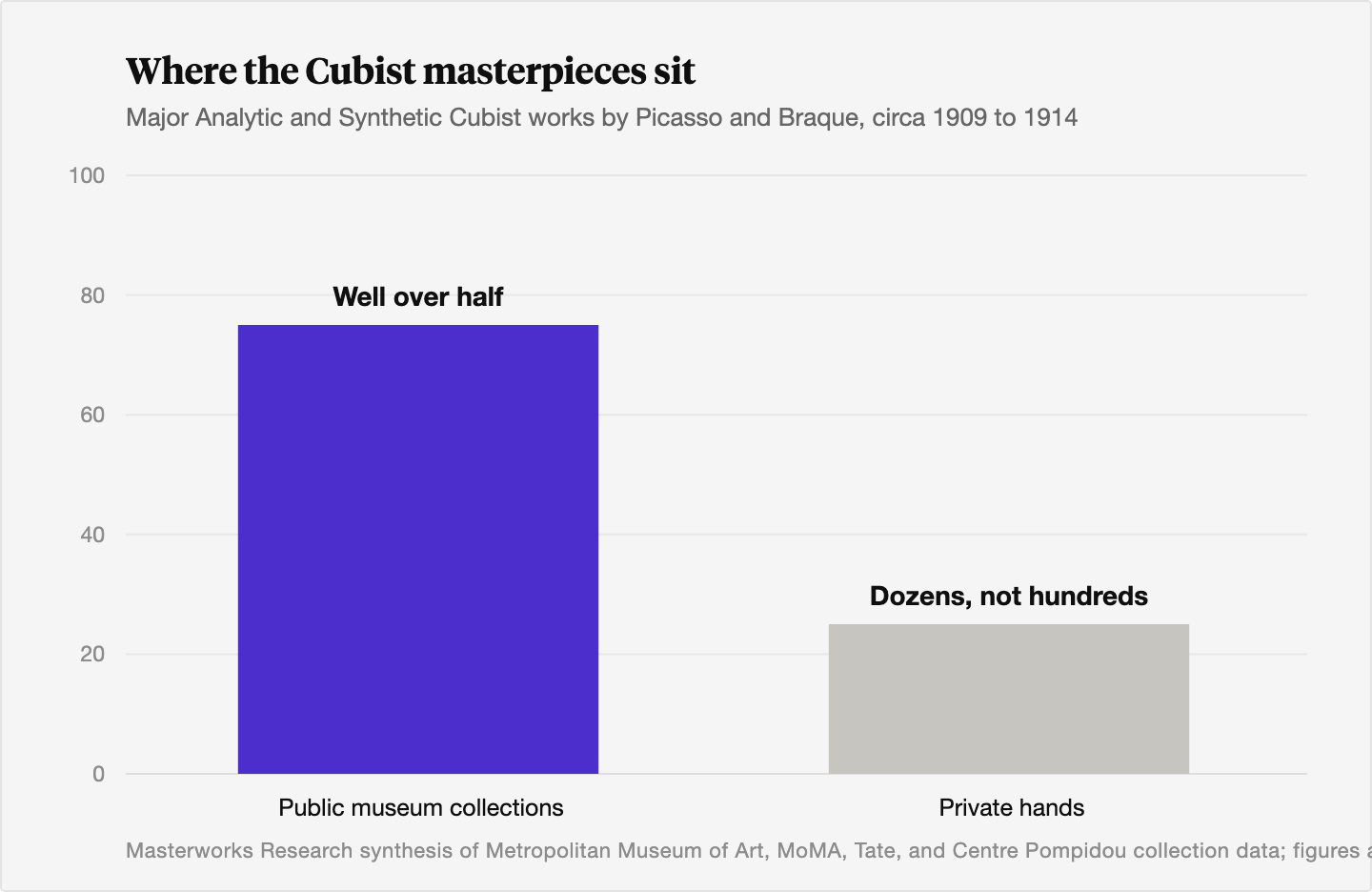
We have written before about how supply behaves in art markets generally, in Why blue-chip art holds its value. Cubism is that mechanism in its most extreme form. There is no clean public census of how many major Analytic and Synthetic Cubist paintings exist, but the defensible order of magnitude is that well over half of the seminal Picasso Cubist canvases from 1909 to 1914 sit in public collections, and the count of genuinely top-tier works still in private hands is plausibly in the dozens, not the hundreds. Many of those are held tightly in long-term family and foundation collections.
5. Braque versus Picasso: the same movement, two very different markets
Braque co-invented Cubism, yet his market is a fraction of Picasso's, and the reason is informative. Braque's auction record is about $15.8 million, for "Paysage a La Ciotat" (1907), an early work that anticipates Cubism, sold at Christie's London in 2010 [9][10]. Another major Braque made roughly the equivalent of $15.7 million at Sotheby's London in 2013 [9]. The top of Braque's market sits in the mid-teens of millions [9][10].
Set that next to Picasso, whose record is more than ten times higher. Two facts explain the gap. First, Braque painted far fewer works than Picasso, and his Cubist period is a small slice of a smaller body of work, so the absolute supply of major Braque Cubist paintings is tiny. Second, museums captured a high share of that small pool early, which means very few top Braque Cubist canvases ever reach auction. The result is that Braque's high-end market is thin and lumpy. A handful of benchmark sales set the reference level, and years can pass between them.
This is the difference between an artist whose works trade often enough to form something like a continuous market and one whose best works behave as occasional trophy trades. For how the same dynamic shows up across price bands rather than across artists, see How $100K, $1M, and $10M artworks behave differently. The lesson holds at the artist level too: depth of trading is itself a feature, and Picasso has it in a way almost no one from this movement does.
6. Picasso's auction standing: scarce supply meeting iconic demand
Picasso is the rare artist who is both extremely high in cumulative sales value and extremely high in the number of lots sold, a combination very few names manage. Market data providers consistently rank him at or near the top by total auction turnover, alongside Andy Warhol and Claude Monet, and his prolific output, more than 20,000 works across media, keeps a steady supply of lower-value lots moving while the masterpieces stay rare [2].
The headline numbers carry the demand side of the story. "Les Femmes d'Alger (Version O)" sold at Christie's New York on May 11, 2015 for $179,365,000 including premium, a world auction record for any artwork at the time [7][8]. "Garcon a la pipe" had sold at Sotheby's New York in May 2004 for $104.2 million, then a record for any work [11]. "Femme a la montre" sold at Sotheby's New York on November 8, 2023 for $139,363,500 [7]. Fewer than 25 artists in all of history have ever sold a single work above $100 million at auction, and Picasso is one of the few with more than one [11].
We tend to think about prices at this level as a call option on the wealth of the top fraction of a percent. The people who can buy a nine-figure painting are a small group, and the supply of nine-figure-quality Picassos is fixed. Past performance is not predictive, and a record is one transaction, not a trend, a point we made about single-sale headlines in Picasso at auction in 2026. But the structural setup, fixed supply on one side, expanding wealth at the very top on the other, is the cleanest version of the scarcity argument in the entire market.
7. Where the market sits in 2025 and 2026
The backdrop matters for any read on demand. After two years of decline, the global art market returned to growth in 2025, reaching an estimated $59.6 billion, up about 4% year over year, according to the Art Basel and UBS Art Market Report 2026 by Dr. Clare McAndrew [12][13]. The recovery was concentrated at the top. Works selling for more than $10 million led the rebound, and in the United States auction sales above $10 million rose by nearly 40% over 2024, while the value of the top 50 auction lots rose about 30% and the top 10 rose about 48% [13].
The names driving that top end were proven, blue-chip masters. Gustav Klimt's "Portrait of Elisabeth Lederer" sold for $236.4 million at Sotheby's New York in November 2025, a record for the artist and the second-highest auction price ever recorded [13]. Van Gogh, Rothko, and Kahlo all posted major results in the same window [13]. That is a market rotating capital back into established 20th-century names rather than chasing the newest material, which is the environment where a movement like Cubism, with finite supply and a fixed canon, tends to be valued most highly.
We would be careful here. The 2025 total still sits below the 2022 peak of $68.1 billion, and a recovery led by a few trophy lots is narrower than a broad-based one [13]. We have laid out how these phases tend to play out in How art market cycles work. For Cubism specifically, the demand signal is encouraging and the supply story is unchanged. The works that define the movement are mostly in museums, and they are not coming back.
The Bottom Line
- Cubism was built by Picasso and Braque, with Gris and Leger, in a compressed window from 1907 to 1914, and it splits into an Analytic phase of faceted, near-monochrome objects and a Synthetic phase of collage and papier colle.
- The masterpieces are concentrated in museums, including 80 works in the Met's Lauder collection given from 2013 onward, which permanently removes most of the canonical supply from the market.
- Braque co-invented the movement but his auction record is about $15.8 million, while Picasso has sold multiple works above $100 million, a gap driven by Braque's far smaller body of work and early museum capture.
- Picasso is among the most-traded and highest-grossing artists in auction history, with records of $179.4 million in 2015 and $139 million in 2023, and is one of fewer than 25 artists ever to clear $100 million at auction.
- The 2025 market returned to growth at $59.6 billion, led by the over-$10 million segment, an environment that tends to favor established names with fixed supply. Past performance is not predictive.
Sources
- Museum of Modern Art. "Pablo Picasso, Les Demoiselles d'Avignon, Paris, June-July 1907." MoMA Collection, updated July 2025. https://www.moma.org/collection/works/79766
- Singulart. "The Controversy Behind Les Demoiselles d'Avignon by Pablo Picasso." Singulart Blog, updated June 2026. https://www.singulart.com/blog/en/2019/12/03/the-controversy-behind-les-demoiselles-davignon-by-pablo-picasso/
- Parkstone International. "Les Demoiselles d'Avignon: The Breakthrough on Cubism." Parkstone International, updated March 2026. https://parkstone.international/2022/08/10/the-breakthrough-on-cubism/
- Tate. "All About Cubism." Tate Art Terms, updated June 2026. https://www.tate.org.uk/art/art-terms/c/cubism/all-about-cubism
- Museum of Modern Art. "Analytic and Synthetic Cubism." MoMA Collection Terms. https://www.moma.org/collection/terms/cubism/analytic-and-synthetic-cubism
- The Science Survey. "Revolution in Art: A Review of the New Installation of Cubist Masterpieces at the Metropolitan Museum of Art From the Leonard A. Lauder Cubist Collection." The Science Survey, March 16, 2026. https://thesciencesurvey.com/arts-entertainment/2026/03/16/revolution-in-art-a-review-of-the-new-installation-of-cubist-masterpieces-at-the-metropolitan-museum-of-art-from-the-leonard-a-lauder-cubist-collection/
- Artsy. "Pablo Picasso, Les femmes d'Alger (Version O) (1955)." Artsy, updated December 2025. https://www.artsy.net/artwork/pablo-picasso-les-femmes-dalger-version-o
- HENI. "The Painting That Set Picasso's Auction Record." HENI News, updated May 2026. https://heni.com/news/article/pablo-picasso-les-femmes-d-alger-version-o-2015-05-11
- MyArtBroker. "Georges Braque Value: Top Prices Paid At Auction." MyArtBroker, updated April 2026. https://www.myartbroker.com/artist-georges-braque/record-prices/georges-braque-record-prices
- MutualArt. "Georges Braque: 11,539 Artworks at Auction." MutualArt, updated May 2026. https://www.mutualart.com/Artist/Georges-Braque/10076A8DA79ECF40
- Christie's. "Pablo Picasso (1881-1973), Les femmes d'Alger (Version O)." Christie's Lot Detail, updated March 2026. https://www.christies.com/en/lot/lot-5895962
- UBS. "The Art Basel and UBS Global Art Market Report 2026." UBS Art Market Research, updated May 2026. https://www.ubs.com/global/en/our-firm/art/art-market-research.html
- Artlyst. "Art Basel And UBS Global Market Report 2026 Highlights Growth." Artlyst, June 17, 2026. https://artlyst.com/art-basel-and-ubs-global-market-report-2026-highlights-growth/
- Art Basel and UBS / Arts Economics. "The Art Basel and UBS Art Market Report 2026 by Arts Economics." Art Basel, 2026. https://theartmarket.artbasel.com/download/The-Art-Basel-and-UBS-Art-Market-Report-2026-by-Arts-Economics.pdf
Disclosures
Investing involves risk. Past results are not indicative of future outcomes.
Masterworks is providing this communication as an agent for its issuer entities, not Masterworks Advisers. This material is produced by Masterworks for informational purposes only and does not constitute investment advice, a recommendation, or an offer or solicitation to buy or sell any security. Masterworks is not a licensed broker-dealer by the SEC or FINRA.
Masterworks can only make and accept sales after an offering statement has been filed, and "qualified", by the SEC. Any offers may be revoked before notice of qualification. Indications of interest involve no obligation. For further disclosure visit the offering documents filed with the SEC and Important Disclosures at masterworks.com/cd.
Forward-looking statements and internal estimates are based on assumptions that may prove incorrect, and actual outcomes may differ materially. Figures denoted in brackets are subject to confirmation. Investing in art and alternative assets involves risk, including loss of principal.
Art sales price data is comparative only. Each painting is unique and historical data is not a direct proxy for any specific painting or investment. Data represents whole art, not an investment into our offerings which includes fees and expenses. Any comparative images are not currently live offerings and are provided for educational purposes only.
Masterworks, LLC is located at 1 World Trade Center, 57th Floor, New York, NY 10007.


