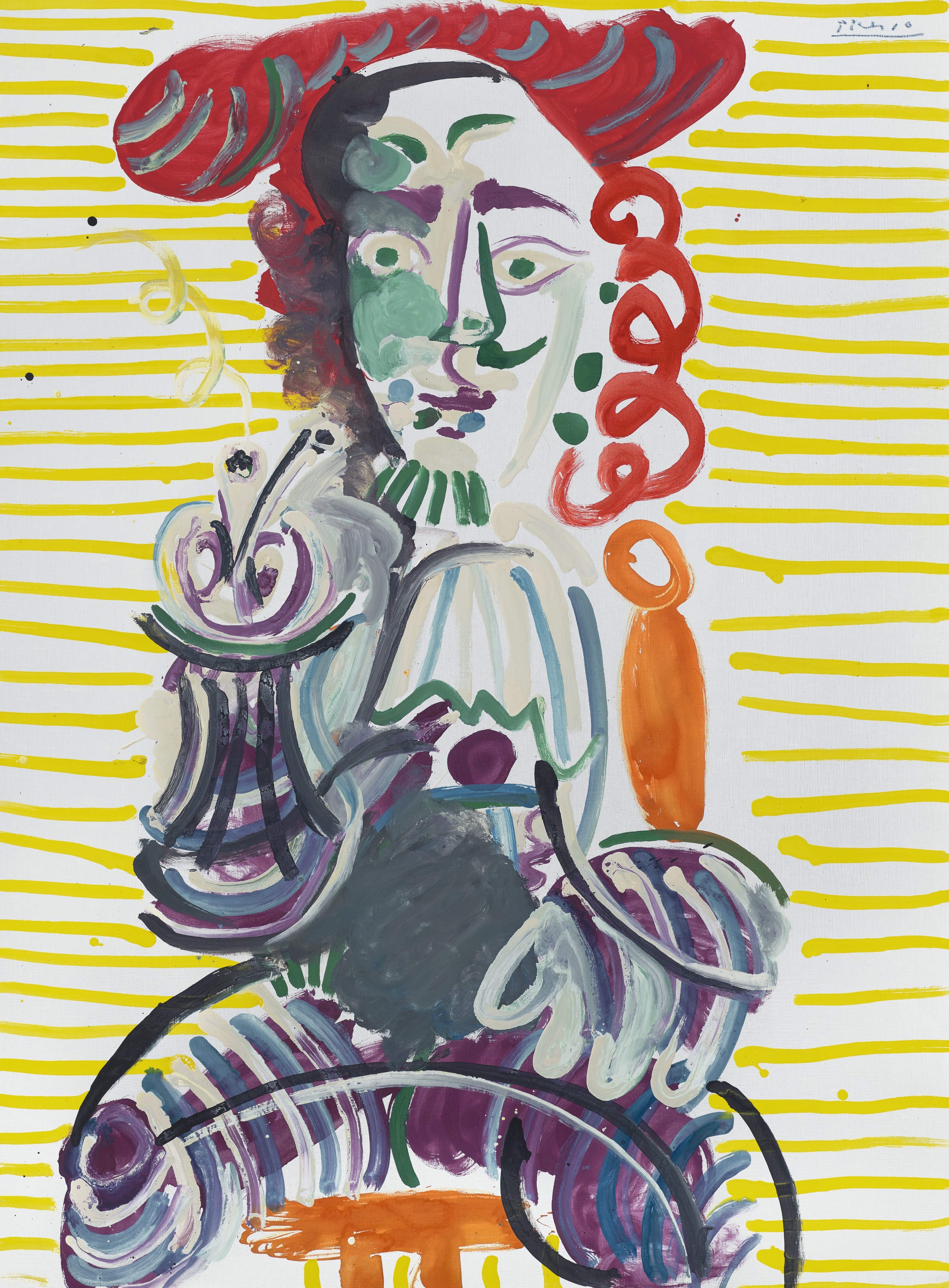
In 2024, more than 3,100 lots by Pablo Picasso came to auction, the highest count for any single artist that year, and the same was true in 2023 with 3,216 lots(1)(4). Picasso has been first or near first by sheer volume of works traded for years, even in seasons when his total dollar value falls. We think that distinction matters more than most headline records do, and it is worth being precise about why.
When we evaluate an artist market, we look first at depth rather than the top price: how many works exist, how often they change hands, and how reliably you could sell one if you needed to. Picasso scores higher on every one of those measures than any artist who has ever lived. That depth, behind the trophy headlines, is what should interest an investor.
Why Picasso trades more than any other artist
The simplest explanation is supply. Picasso produced an estimated 50,000 works across painting, drawing, prints, ceramics, and sculpture over a seventy-year career(7). No other canonical artist comes close. Andy Warhol produced thousands. Claude Monet painted somewhere around 2,000 to 2,500 canvases. Jean-Michel Basquiat left roughly 900 to 1,000 paintings before he died at 27. Gerhard Richter has made a few thousand works in total.
So when we say Picasso is the most-traded name in art, the mechanism is straightforward. There is simply more of him to trade, across more price points, in more salesrooms, in more countries. In 2024 his average lot price was $85,833(1). That tells you the bulk of what sells under his name is not nine-figure paintings but prints, ceramics, and works on paper that change hands at four and five figures, in day sales and regional houses, season after season.
That breadth is the asset. A market with a wide price distribution and constant turnover is a liquid market. Liquidity is what lets a price be discovered, tested, and trusted. The trophy Picasso at the front of the evening sale gets the coverage, but the thousands of smaller lots behind it are what make the whole market legible.
Reading the recent numbers: a down year is still a deep one
Picasso's recent results show why volume and value are different things. In 2023 he was the single most valuable artist at auction, with roughly $597.2 million in sales, led by Femme a la montre (1932), which made $139.4 million at Sotheby's New York in November 2023 from the Emily Fisher Landau estate(1)(2)(3). In 2024 his total fell to roughly $221.6 million, a drop of about 63%, which pushed him to third by value behind Rene Magritte and Monet(1).
That looks alarming until you read it correctly. The number of works that traded barely moved, from 3,216 lots to 3,139(1)(4). What fell was the supply of trophies. Fewer estates sent up the nine-figure canvases that drive a single year's headline total. The everyday market kept running. His top result in 2024 was La Statuaire (1925), which sold for $24.8 million at Sotheby's in November, more than double the $10.75 million it fetched the last time it traded in 1999(5).
We have written before that art runs on its own clock, and the Picasso market is the clearest example. His all-time auction record remains Les Femmes d'Alger (Version O) at about $179.4 million in 2015(6). A market can sit well below its trophy peak and still be the busiest in the world by transaction count. That is the difference between a thin market that spikes and a deep one that breathes.
Picasso remained the world's most traded artist in 2025 with 3,729 auction results and $334.7 million in turnover, up from $221.6 million in 2024, ranking second by value only to Gustav Klimt's $397 million year driven by the $236.4 million Portrait of Elisabeth Lederer.
Why economists treat Picasso as the benchmark
There is a reason academic researchers reach for Picasso when they want to study art as an asset class. Most artworks never sell twice in any record you can observe, which makes it very hard to measure pure price appreciation. To build a repeat-sale index, the same method Robert Shiller used for the Case-Shiller home price index, you need many pairs of transactions for the same object over time. Picasso generates more of those pairs than anyone, because so many mid-priced works re-enter the market across decades and across cycles(5).
One analysis traced Picasso's average return at roughly 5.1% a year before maintenance and transaction costs, with enormous dispersion underneath that average(3). Academic repeat-sales studies put average long-run art returns in the low single digits with wide dispersion across individual works, and Picasso illustrates the dispersion: two works with the same title, Tete d'homme, compounded at roughly 16% and under 4% a year respectively over comparable holds.
This fits a position we hold across every artist market. The artist market is paramount, and within it the example matters enormously. A and B examples tend to appreciate together. C examples, the studio sketches and minor prints, can stay flat for decades. A Picasso napkin drawing is still a Picasso, and it is still liquid, but liquid is not the same as appreciating. The breadth that makes his market so easy to trade also means a buyer has to be disciplined about what, inside it, is actually worth owning.
What Picasso's depth means for an investor
We tend to think about an artist market the way we would think about a stock: appreciation rate divided by volatility, a Sharpe ratio per name. Picasso scores well on the denominator. His decades of cross-cycle trading data, his presence in nearly every major museum, and his constant turnover make his prices less prone to the speculative swings that hit thinner, younger markets. He behaves like a defensive blue chip. During the 2020 to 2021 disruption, the Impressionist and Modern segment that Picasso anchors contracted less severely than the contemporary sector(7).
That said, we have to be honest about the other side of his market. We have found, building our own index across roughly 150,000 transactions, that older art tends to appreciate more slowly. Our rough ladder puts Contemporary art at 12 to 13% a year, Modern at 8 to 9%, Impressionist at 6 to 7%, and Old Masters at 1 to 2% [NEEDS INTERNAL DATA]. Picasso is Modern. His liquidity is unmatched, but his expected appreciation sits in the middle of that ladder, not the top. The depth buys you certainty and the ability to exit. It does not buy you the steepest growth curve.
So the right way to read "most traded name in art" is as a statement about risk, not return. Picasso is the closest thing the art market has to a reserve currency. You can buy a work in New York, put it on a plane, and sell it in Hong Kong, and there will be bidders at the other end. For an investor, that is the foundation you build on, the same way a portfolio holds liquid core positions alongside the names reaching for higher growth.
Sources
- Artnet News, "Magritte Dethroned Picasso, Chinese Art Took a Beating, and Other Takeaways From the 2024 Artist Rankings." https://news.artnet.com/market/2024-artist-auction-rankings-2596803
- Sotheby's, "Pablo Picasso: Paintings & Art for Sale." https://www.sothebys.com/en/artists/pablo-picasso
- Altimetry Daily Authority, "Returns as Coherent as a Picasso Painting." https://altimetry.com/articles/returns-as-coherent-as-a-picasso-painting
- Artsy, "The 10 Most Expensive Works Sold at Auction in 2023." https://www.artsy.net/article/artsy-editorial-10-expensive-works-sold-auction-2023
- HENI News, "Pablo Picasso, La Statuaire (1925) Sold for $24.8M." https://heni.com/news/article/pablo-picasso-la-statuaire-2024-11-18
- Wikipedia, "List of most expensive paintings." https://en.wikipedia.org/wiki/List_of_most_expensive_paintings
- Guy Hepner, "Pablo Picasso: Market Performance 2005-2025." https://guyhepner.com/news/468-pablo-picasso-market-performance-20052025
- Yale Insights, "Shining a Light into the Black Box of the Art Market." https://insights.som.yale.edu/insights/shining-light-into-the-black-box-of-the-art-market