
Masterworks Research · June 2026
What separates a tangible store of value from a paper claim, how the two behave when the dollar weakens, and where art sits on the line.
A hard asset is a tangible thing that carries value in itself: real estate, gold and other metals, commodities, farmland, fine art and collectibles. A financial asset is a paper claim on someone else's promise to pay: stocks, bonds, cash, and the derivatives written on top of them. The distinction matters because the two behave very differently when money loses value and when a counterparty fails. A financial claim can go to zero if the issuer defaults. A tangible asset usually retains some value because the thing itself still exists. For investors deciding how to hold wealth across a long horizon, that difference is the whole argument, and it is worth being precise about where the line runs and what each side costs you to own.
What You Need to Know
- The two categories are defined by what backs them. A hard asset has intrinsic, physical value. A financial asset is a contractual claim on a cash flow or a balance sheet. When the claim fails, the paper can be worth nothing. When a building, an ounce of gold, or a painting changes hands, the buyer still owns a real thing.
- The dollar is a poor long-run store of value. The US dollar has lost roughly 97% of its purchasing power since the Federal Reserve was created in 1913, which means a dollar today buys about what three cents bought then [1][2]. Compounded over decades, that erosion is the case for owning things that are not denominated in dollars.
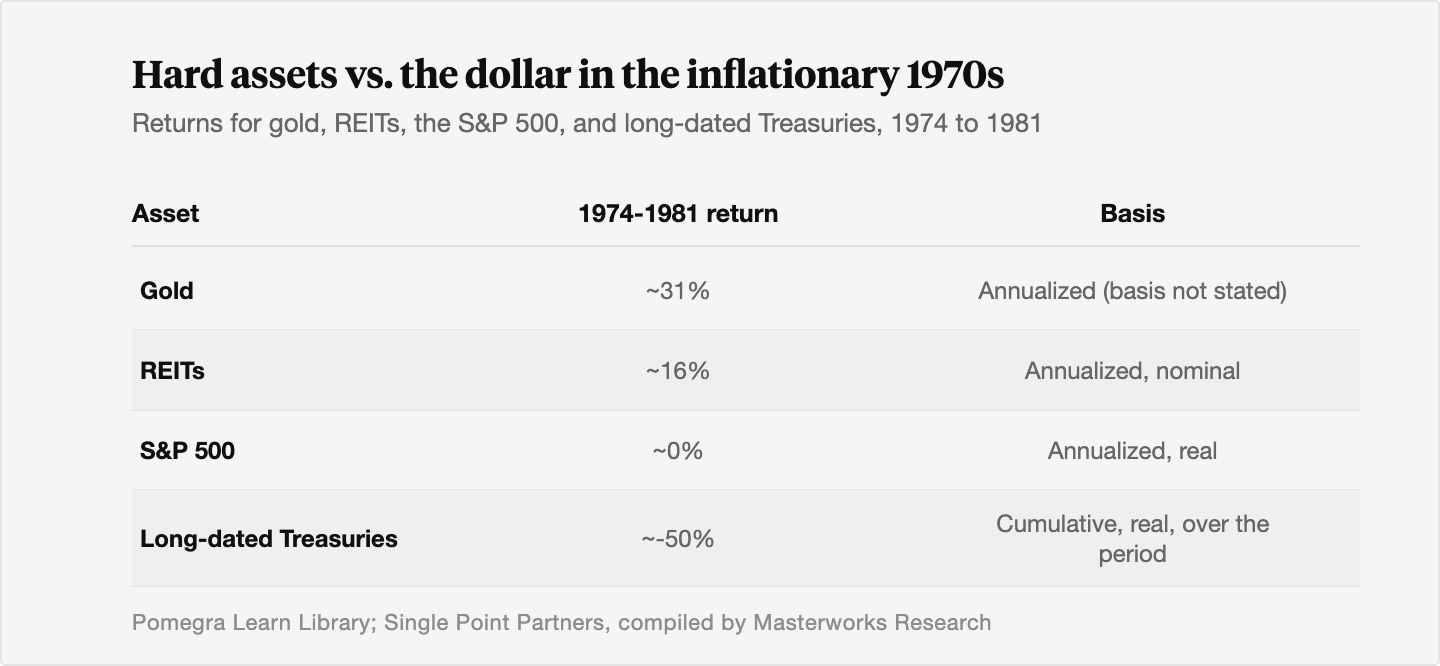
- Hard assets earned their reputation in the 1970s. During that inflationary decade, gold returned about 31% a year while the S&P 500 delivered close to zero real return and long-term bonds lost roughly half their real value [3][4]. The same pattern, milder, repeated after 2020.
- The trade-offs are real and rarely advertised. Hard assets often produce no cash flow, carry storage and insurance costs, and can be slow and expensive to sell. We do not paper over that. The debasement-resistance argument has to be weighed against the carry.
- Art is a hard asset with an unusual profile. It is tangible and scarce, it is no one's liability, and its supply of important works tends to shrink over time. It also pays no yield and is illiquid. We think it belongs in the hard-asset conversation, with both sides stated plainly.
1. What actually separates a hard asset from a financial one
Start with the cleanest test we know. Ask what you are left holding if the other party disappears.
A financial asset is a claim. A share of stock is a claim on a company's residual equity. A corporate bond is a claim on a company's promise to pay interest and return principal. A bank deposit is a claim on the bank. Cash itself is a claim on the issuing government's credit and monetary discipline. Each of these has value only as long as the entity behind it stays solvent and the contract is honored. Remove the issuer and the paper can be worth nothing.
A hard asset is the thing itself. Gold is an element. A building is a building. Farmland grows crops whoever holds the title. A painting hangs on a wall regardless of which institution failed last week. There is no counterparty whose default erases the asset, because the asset is not a promise. It is a physical object with value that other people independently recognize.
This is why the distinction is not academic. In 2008, holders of Lehman Brothers bonds learned that an investment-grade claim can become a recovery proceeding overnight [5]. Holders of Lehman's office furniture did not have the same problem. The furniture is a trivial example, but it makes the point: a tangible asset survives the failure of the party you bought it from. A claim does not.
That feels like a meaningful line to draw.
2. Why owning real things matters when money weakens
The single most important number here is the one most investors never look up. Go check how much purchasing power the dollar has lost over the last century. It is about 97% since 1913 [1][2].
A note on why that figure carries weight. It comes from the Consumer Price Index series the Bureau of Labor Statistics has maintained since 1913, the same data the Federal Reserve Bank of Minneapolis publishes in its long-run inflation calculator [2]. What cost a dollar in 1913 costs somewhere around 32 dollars today. The dollar did its job as a medium of exchange the whole time. As a store of value held over decades, it bled out.
Inflation on an annualized basis does not feel like much. Two or three percent is easy to ignore. Compounded over a working life or across generations, it gets concerning. This is the structural reason allocators hold hard assets at all. They are looking for value that is denominated in something other than the currency, so that when the currency weakens the asset does not weaken with it.
The historical record is direct. In the inflationary 1970s, gold returned roughly 31% a year while equities produced close to zero in real terms and long-dated Treasuries lost about half their real value [3][4]. Real estate investment trusts generated around 16% a year nominal through the most inflationary stretch of 1974 to 1981 [3]. The assets that protected purchasing power were tangible. The conventional safe haven, the long bond, was the most destructive thing an investor could have held.
3. Counterparty risk: the floor under a tangible asset
The second reason to own real things is the one that only shows up in a crisis.
Every financial asset embeds counterparty and default risk. The yield on a corporate bond is higher than the yield on a comparable Treasury precisely because the buyer is being paid to bear the risk that the company does not pay [5][6]. That premium exists for a reason. Companies default. Speculative-grade corporate default rates have run in the low single digits annually in recent years, and they spike in recessions [6]. When a company fails, the equity is usually wiped out first and the bondholders fight over what is left.
A hard asset has a floor that a claim does not. When an artist market corrects, the painting is still a painting. When real estate falls, the land is still land. The value can drop, sometimes sharply, but it rarely goes to zero, because the asset is not contingent on anyone's solvency. Gold has been a recognized store of value for thousands of years across every monetary regime that has come and gone. Art has survived world wars, hyperinflations, and currency collapses across five centuries. Durability of that kind is itself a feature.
To be clear, hard assets are not riskless. They carry price risk, liquidity risk, and the risk of buying the wrong thing. The point is narrower. They do not carry the specific risk that a third party's failure turns the asset into a legal claim on a bankruptcy estate. That is a real and separate protection.
4. The honest costs: no yield, carrying expense, illiquidity
We are not going to sell one side of this and hide the other.
Hard assets give up things that financial assets provide. The most important is cash flow. A stock can pay a dividend and a bond pays a coupon, so you are compensated for holding them through time. Most hard assets pay you nothing while you own them. Gold sits in a vault. A painting hangs on a wall. They produce no income, which means the entire return has to come from price appreciation. If the price goes nowhere, you have earned nothing and you have paid to wait.
The carry is the next cost. Physical things have to be stored, insured, secured, sometimes restored, and often appraised. Gold needs a vault. Real estate needs maintenance and taxes. Art needs climate control, insurance, and condition care. These are real recurring expenses that drag on the net return and have no equivalent for a brokerage entry that holds a stock.
Liquidity is the third. You can sell an S&P 500 position in seconds at a transparent price. Selling a building, a tract of farmland, or a painting can take months, involves meaningful transaction costs, and depends on finding the right buyer at the right moment. For art specifically, auction and dealer fees are high enough that they discourage casual trading, and the right time to sell into the market is not always the time you need the money. Illiquidity is a genuine constraint, and any honest case for hard assets has to hold it in view.
These costs are the reason hard assets are a long-horizon, measured allocation rather than a place to park money you might need next year.
5. How allocators actually blend the two
The useful question is not which category wins. It is how much of each you hold and why.
Financial assets do the work hard assets cannot. They compound through cash flow, they are liquid, and over long stretches equities have been the primary engine of real wealth creation. From 1995 to 2023 the S&P 500 returned roughly 9 to 10% a year [7]. No serious allocator abandons that. The role of hard assets is different. They are there for the scenarios where the paper side struggles: sustained inflation, currency debasement, a loss of confidence in financial counterparties.
The classic 60% stock, 40% bond portfolio is built entirely from financial claims, and it had a miserable decade in the 1970s for exactly that reason [4]. A portion in real assets is the answer to that vulnerability. Many institutional and high-net-worth portfolios carry a meaningful sleeve in real estate, commodities, infrastructure, gold, and increasingly fine art. The size varies, but the logic is constant: hold enough hard assets that a weak-dollar decade does not wreck the whole portfolio, while keeping the financial-asset core that drives long-run compounding.
We have written separately on the building blocks of that hard-asset sleeve in what real assets are and how real estate, infrastructure, and commodities behave, and on the practical question of how an advisor can frame art as an alternative allocation. The recurring theme is balance. Too little real-asset exposure leaves a portfolio fully exposed to the currency. Too much gives up the compounding and the liquidity that financial assets provide. The sensible place is somewhere in the middle.
6. Where art sits on the line
Art is a hard asset, and it sits in an unusual spot even among hard assets.
It is tangible and it is scarce. It is no one's liability, so it carries none of the counterparty or default risk that sits inside every financial claim. In that respect it is like gold. A painting is a real object that other people independently value, and it does not depend on any issuer staying solvent.
What sets it apart from both financial assets and the cash-flowing real assets is the supply side. Real estate and farmland can be built or brought into production. New gold is mined every year. The supply of important works by a given artist tends to move the other way. As collectors donate to museums, those works leave the private market permanently and never come back. There are only so many Pollocks or Basquiats that will ever exist, and the available pool of the best ones tends to shrink over time. That is a different scarcity than gold's fixed-but-stable stock.
We should be just as honest about art as we were about hard assets generally. It pays no yield. It carries real costs to store, insure, and care for. It is illiquid, and selling well takes patience and the right moment. Those are not footnotes. They are the price of the debasement-resistance and the zero-counterparty profile.
On the return side, art has held up against both the dollar and financial assets over long periods. Contemporary art (post-1980) appreciated at roughly 11 to 12.6% a year from 1995 to 2022 by several published estimates, against about 9% for the S&P 500 and around 6% for gold over comparable windows [7][8]. Our own segment work shows the same shape: Contemporary art appreciating fastest, then Modern, then Impressionist, with Old Masters at the bottom [internal Masterworks estimates; treat as illustrative]. Past performance is not predictive, and these figures describe whole works rather than any investment product. The pattern is what matters here. Art has behaved like a hard asset that also appreciated.
7. What a weakening currency does to the comparison
There is a forward reason this distinction is getting more attention, and it is worth stating plainly.
When governments run large deficits and the central bank is pressured to keep financing them, the long-run risk to the currency rises. We have written about that pressure and why hard assets enter the conversation in fiscal dominance and why art belongs in the discussion. In that environment, the value of a financial claim denominated in the currency is exposed twice: once to the issuer's credit, and once to the erosion of the unit it is paid in. A hard asset is exposed to neither in the same way.
The post-2020 episode was a live test. US consumer prices peaked at a 9.1% annual rate in June 2022, the largest 12-month increase in four decades [9]. Gold went on to set dozens of record highs through 2024 and 2025, rising about 26% in the first half of 2025 alone, while central banks bought more than 1,000 tonnes in 2024 for a third straight year [10][11]. Investors were moving toward things that are not paper claims. That behavior is the whole thesis in miniature.
We are not forecasting another inflationary decade. It is always hard to say, and there is never a crystal ball. The point is structural. The case for owning some real things does not depend on predicting the next inflation print. It depends on the long arithmetic of a currency that loses purchasing power over decades and a paper claim that can fail when its issuer does.
The Bottom Line
- A hard asset is a tangible thing with intrinsic value. A financial asset is a paper claim on someone else's promise. The difference becomes decisive when money weakens or a counterparty fails.
- The dollar has lost roughly 97% of its purchasing power since 1913, which is the structural case for holding value in something other than the currency.
- In the inflationary 1970s, tangible assets like gold and real estate protected purchasing power while stocks and especially bonds lost real value. The post-2020 episode rhymed with that history.
- Hard assets cost something to own: no cash flow, storage and insurance carry, and illiquidity. Those trade-offs are why they are a long-horizon, measured allocation rather than the whole portfolio.
- Art is a hard asset that is scarce, tangible, and no one's liability, with a supply of important works that tends to shrink. It pays no yield and is illiquid, and it has historically appreciated alongside its debasement resistance.
Sources
- US Inflation Calculator. "US Dollar Value 1913 to 2026." usinflationcalculator.com, accessed June 2026. https://www.usinflationcalculator.com/
- Federal Reserve Bank of Minneapolis. "Inflation Calculator (CPI, 1913 to present)." minneapolisfed.org, accessed June 2026. https://www.minneapolisfed.org/about-us/monetary-policy/inflation-calculator
- Pomegra Learn Library. "Inflation and Asset Classes: The 1970s Evidence." pomegra.io, 2025. https://pomegra.io/learn/library/track-f-lifecycle/market-history/chapter-08-1973-oil-shock/inflation-asset-classes
- Single Point Partners. "1970s Inflation Redux?" spcfo.com, 2025. https://spcfo.com/1970s-inflation-redux/
- Anderson School of Management, UCLA. "Corporate Bond Default Risk: A 150-Year Perspective." anderson.ucla.edu, accessed June 2026. https://www.anderson.ucla.edu/documents/areas/fac/finance/longstaff_corporate3.10.pdf
- CoinLaw. "Corporate Bond Default Statistics 2025." coinlaw.io, 2025. https://coinlaw.io/corporate-bond-default-statistics/
- ts2.tech. "Global Art Market Report 2024 to 2025." ts2.tech, 2025. https://ts2.tech/en/global-art-market-report-2024-2025/
- World Gold Council. "Gold as a Strategic Inflation Hedge (Beyond CPI)." gold.org, accessed June 2026. https://www.gold.org/goldhub/research/beyond-cpi-gold-as-a-strategic-inflation-hedge
- US Bureau of Labor Statistics. "Consumer prices up 9.1 percent over the year ended June 2022, largest increase in 40 years." bls.gov, July 2022. https://www.bls.gov/opub/ted/2022/consumer-prices-up-9-1-percent-over-the-year-ended-june-2022-largest-increase-in-40-years.htm
- World Gold Council. "Gold Mid-Year Outlook 2025." gold.org, 2025. https://www.gold.org/goldhub/research/gold-mid-year-outlook-2025
- World Gold Council. "Gold Outlook 2026." gold.org, 2025. https://www.gold.org/goldhub/research/gold-outlook-2026
- Art Basel and UBS. "The Art Basel and UBS Global Art Market Report 2026 (Dr. Clare McAndrew)." artbasel.com, 2026. https://www.artbasel.com/stories/the-art-basel-and-ubs-global-art-market-report-2026
Disclosures
Investing involves risk. Past results are not indicative of future outcomes.
Masterworks is providing this communication as an agent for its issuer entities, not Masterworks Advisers. This material is produced by Masterworks for informational purposes only and does not constitute investment advice, a recommendation, or an offer or solicitation to buy or sell any security. Masterworks is not a licensed broker-dealer by the SEC or FINRA.
Masterworks can only make and accept sales after an offering statement has been filed, and "qualified", by the SEC. Any offers may be revoked before notice of qualification. Indications of interest involve no obligation. For further disclosure visit the offering documents filed with the SEC and Important Disclosures at masterworks.com/cd.
Forward-looking statements and internal estimates are based on assumptions that may prove incorrect, and actual outcomes may differ materially. Figures denoted in brackets are subject to confirmation. Investing in art and alternative assets involves risk, including loss of principal.
Art sales price data is comparative only. Each painting is unique and historical data is not a direct proxy for any specific painting or investment. Data represents whole art, not an investment into our offerings which includes fees and expenses. Any comparative images are not currently live offerings and are provided for educational purposes only.
Masterworks, LLC is located at 1 World Trade Center, 57th Floor, New York, NY 10007.


