Masterworks Research · June 2026
What counts as a real asset, why these holdings tend to hold up against inflation, and where art sits on the spectrum between cash-flowing property and scarce stores of value.
A real asset is a tangible thing with intrinsic value that comes from its physical existence and use, rather than a paper claim on someone else's cash flow. Real estate, infrastructure, commodities, farmland, timberland, precious metals, and collectibles such as fine art all qualify. Financial assets, by contrast, are claims: a stock is a claim on a company's earnings, a bond a claim on a stream of payments. Real assets sit at the other end. They are the building, the toll road, the barrel of oil, the bar of gold, the painting on the wall. For investors, the category matters because real assets tend to carry a low correlation to stocks and bonds, and many of them hold their value when inflation erodes the purchasing power of cash. That makes them a structural diversifier, and it is why institutions and endowments have been steadily moving money into them.
What You Need to Know
- Real assets derive value from physical substance, not a contractual claim. Corporate Finance Institute and CFA Institute draw the same line: financial assets like stocks and bonds are claims on future cash flows, while real assets hold value because they can be used, consumed, or held [1][8]. That difference is the source of both the inflation protection and the illiquidity.
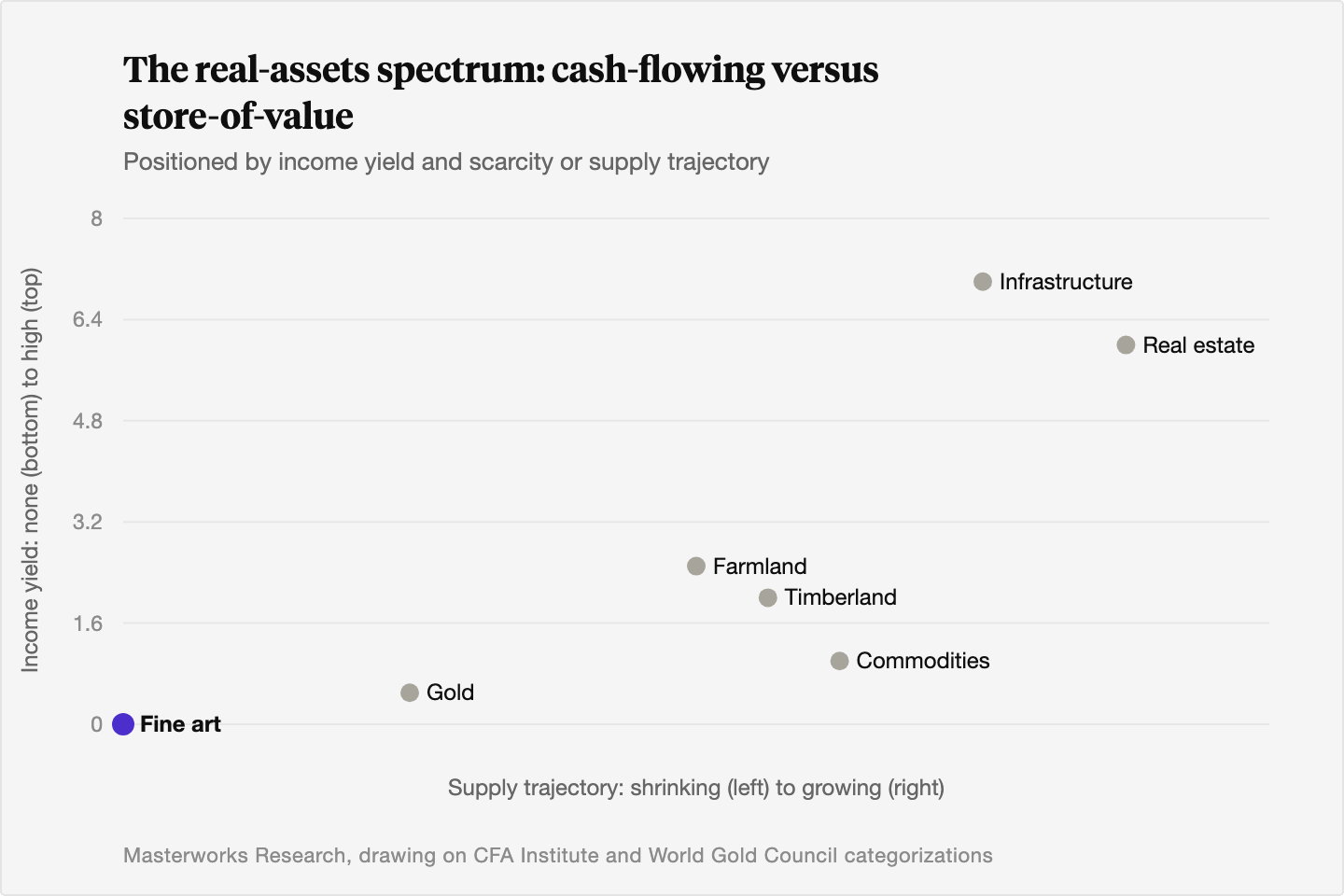
- The category splits cleanly in two. On one side sit cash-flowing real assets, real estate and infrastructure, which throw off rent, tolls, and contracted payments. On the other sit scarcity or store-of-value real assets, gold and fine art, which pay no income and are held for the durability of their value. Knowing which side an asset is on tells you what to expect from it.
- Institutions are allocating more, not less. In Nuveen's 2025 EQuilibrium survey of 800 institutions managing $19 trillion, private infrastructure and real estate saw the largest year-over-year jumps in allocation plans, rising to 50% and 37% of investors planning increases [2]. US college and university endowments held roughly 10.8% in real assets in the most recent NACUBO-Commonfund data [3].
- The inflation linkage is the core reason to own them. CFA Institute research covering Q3 1981 through Q4 2024 found real assets, commodities in particular, show positive performance during unexpected inflation, while bonds and cash show negative correlations [4]. Infrastructure often has CPI escalators written into its contracts [5].
- The trade-offs are real and they do not go away. Illiquidity, opaque valuation from infrequent trades, and ongoing carrying costs are common to the whole category [8]. The NCREIF Farmland Index posted its first negative annual return, down 1.0% for 2024, since the series began in 1991 [6]. Past performance is not predictive of future results.
1. What a real asset is, and what it is not
Start with the definition, because the word gets used loosely. A real asset is tangible. Its value is intrinsic to its physical form: you can occupy it, operate it, refine it, or hang it on a wall. A financial asset is a piece of paper, or more often a line in a database, that entitles you to a share of cash flows produced by something else. The Corporate Finance Institute frames the split directly. Real assets are physical, such as land and infrastructure, while financial assets are paper claims on underlying cash flows [1].
That distinction is not academic. It drives everything that follows. Because a real asset has to physically exist, its supply cannot be created with a keystroke the way new shares or new dollars can. Because it exists in the physical world, it costs money to store, insure, and maintain. And because each parcel of land or each painting is to some degree unique, you cannot price it off a live screen. You have to find a buyer and negotiate.
The standard institutional list of real assets runs: real estate, infrastructure, commodities, farmland and timberland, precious metals, and collectibles, with fine art the dominant collectible by value. CFA Institute groups the core three as commodities, real estate, and global infrastructure, and calls them effective diversifiers for investors worried about inflation [4][9].
So the working definition is simple. If you own the thing itself, it is a real asset. If you own a claim on the thing, or on the income the thing produces, you own a financial asset. A REIT share is a financial asset. The warehouse the REIT owns is a real asset.
2. Real estate: the largest cash-flowing real asset
Real estate is where most investors meet the category first, and it is the clearest example of a cash-flowing real asset. You buy a building, a tenant pays rent, and the rent is your income. The asset can also appreciate. As CFA Institute puts it, as prices rise across the economy, real estate prices tend to rise with them, and the value of existing buildings climbs as it gets more expensive to build new supply [9].
That replacement-cost dynamic is the heart of real estate's inflation linkage. When construction costs go up, the building you already own becomes more valuable, because a competitor would have to spend more to build the same thing today. Leases add a second layer, since many include rent escalators tied to inflation.
The institutional money reflects this. In Nuveen's 2025 survey, 37% of institutions planned to raise real estate allocations, and 65% of those were focused on digital infrastructure, particularly data centers [2]. TIAA's Real Estate Account has been cutting traditional office and regional mall exposure while moving toward industrial, housing, and alternatives like self-storage and medical office [2]. The takeaway for an investor: real estate is not one asset. It is many, and the cash-flowing logic holds across most of them.
3. Infrastructure: contracted cash flows and built-in inflation pass-through
Infrastructure is the other major cash-flowing real asset, and in some ways the purer inflation hedge. These are the physical systems an economy runs on: power plants, renewable energy projects, transmission lines, toll roads, water systems, ports, and airports [9]. What makes them attractive is the structure of their revenue. Many infrastructure assets have an explicit link to inflation through regulation, concession agreements, or long-term contracts, and many of those contracts carry CPI escalators that lift revenue automatically as prices rise [5]. On the cost side, operating and maintenance expenses are often fixed, which gives an implicit hedge as well [5].
The capital flooding into the category is hard to overstate. McKinsey reports that assets under management in dedicated infrastructure funds have roughly tripled, from about $500 billion in 2016 to more than $1.5 trillion today [7]. Infrastructure funds raised over $115 billion in the first half of 2025 alone, against $102 billion for all of 2024 [7][5]. The reason is partly need: McKinsey estimates the world requires roughly $3.2 trillion in annual infrastructure investment through 2040 to keep pace with GDP growth [7].
For an investor, infrastructure behaves like a long-duration bond with an inflation kicker. The cash flows are contracted, often for a decade or more, and they tend to rise with prices. That is a different risk profile from real estate, and a very different one from the store-of-value assets we turn to next.
4. Commodities, farmland, and timberland: the natural-resource layer
Commodities are the most direct inflation play in the whole category, because many commodities are inflation. Oil, copper, wheat, and the rest are inputs to the prices that inflation measures. CFA Institute's analysis found real assets, and commodities specifically, had the strongest performance during periods of higher unexpected inflation across data running from 1981 to 2024 [4]. When prices surprise to the upside, the things being priced tend to lead.
Farmland and timberland are a hybrid. They are real estate that also produces a commodity, so they generate income from crops or harvested timber while the underlying land appreciates. The NCREIF Farmland and Timberland indices, which track pools of US properties held for investment, have measured this for decades [6]. They also show why the category demands patience. For the first time since the Farmland Index began in 1991, it posted a negative annual total return, down 1.0% for the year ending December 31, 2024, with income of 2.5% offset by a 3.5% capital decline [6]. Even the steadiest real assets have down years. Past performance is not indicative of future outcomes.
The lesson is the spectrum again. Farmland sits between pure real estate and pure commodity, drawing a little inflation protection from each. It pays some income, but less than a leased building, and its value can fall.
5. Precious metals and gold: the classic store of value with no yield
Gold is the archetype of a scarcity or store-of-value real asset, and it is the cleanest contrast to everything above. Gold pays no income. It produces no rent, no toll, no dividend, no coupon. As the World Gold Council notes, gold does not produce yield, which is why money tends to flow toward it when interest rates fall and the opportunity cost of holding a non-yielding asset drops [10]. Investors hold gold for one reason: the durability of its value. It is typically uncorrelated with equities, it has served as a hedge against inflation, and it acts as a safe haven in times of stress [10].
The price action of 2025 made the point. Gold broke through $3,000 an ounce in March 2025 for the first time, driven by central bank buying that has roughly doubled since 2022, from about 500 tonnes a year to more than 1,000 [10]. By the close of 2025 it had run well past that level.
Here is the structural feature that matters for the comparison with art. Gold has no cash flow, so its entire return comes from price. You are paid nothing to wait. You are betting that scarcity and demand carry the value forward, and you are paying carrying costs, storage and insurance, the whole time you hold it. That is the store-of-value bargain. It is the same bargain a collector of fine art makes.
6. Where art sits on the real-assets spectrum
Art is a real asset, and a specific kind. It belongs firmly on the scarcity or store-of-value side, next to gold, not on the cash-flowing side with real estate and infrastructure. A painting pays you nothing while you own it. There is no rent, no coupon, no harvest. Its entire return, if there is one, comes from the change in its price between the day you buy and the day you sell. In that respect art is closer to gold than to a leased warehouse, and we think it is important to be honest about that.
What art shares with gold is scarcity, and on scarcity art arguably has the stronger case. The supply of investment-grade art does not just fail to grow. It shrinks. As collectors donate works to museums, those paintings leave the private market permanently. There are only so many major works by any historically important artist, and the count of available ones falls over time. Gold can still be mined. No new Basquiats will ever be painted.
What art does not share with gold is liquidity or pricing transparency. Gold trades on a screen at a single global price. A painting is unique, it sells through auctions and private deals, and a sale can take months. The illiquidity, the valuation uncertainty from infrequent transactions, and the carrying costs of storage and insurance are all present, and they are present in a sharper form than for most other real assets [8].
So where does art fit, and where does it not? It fits as a long-term, store-of-value allocation for an investor who is already comfortable with illiquidity and is not relying on the position for income. It does not fit as a yield substitute, a cash-flow holding, or a short-term trade. We hold the view that art belongs in a portfolio for the same reason gold does, scarcity and low correlation, with the added feature of a supply base that actually contracts over time. The honest caveat is the absence of yield and the illiquidity. Those do not go away.
For a fuller treatment of the gold comparison, see our piece on art versus gold as a hedge asset.
7. The cash-flow versus store-of-value split, and why it matters
The single most useful way to read the real-assets category is to sort every holding onto one of two sides.
On the cash-flow side are real estate, infrastructure, and to a lesser degree farmland and timberland. These produce income while you hold them. Their inflation protection comes through rising rents, contracted CPI escalators, and replacement cost. You can think of them as long-duration, inflation-linked income assets. An investor who needs the position to generate cash while it sits should look here.
On the store-of-value side are gold, the broader precious metals, and fine art and collectibles. These produce no income. Their inflation protection comes from scarcity and the durability of demand, not from a coupon. The entire return is the change in price, and the entire cost of waiting is the carrying cost. An investor who wants a diversifier that moves on its own logic, largely indifferent to what is driving stocks and bonds, should look here.
This split is more useful than the conventional one between liquid and illiquid, because it tells you what economic role the asset plays. A store-of-value real asset that you expect to throw off income will disappoint you. A cash-flowing real asset you treat as a pure scarcity play will confuse you when its value tracks rents rather than rarity. Match the asset to the job.
8. The role and weight of real assets in institutional and endowment portfolios
Institutions treat real assets as a distinct sleeve, and the allocation has been growing. Nuveen's 2025 EQuilibrium survey, covering 800 institutions with $19 trillion in assets, found 66% planning to raise private-market allocations over five years, with private infrastructure and real estate showing the largest year-over-year increases [2]. CFA Institute frames the purpose plainly: an allocation to alternatives, real assets among them, fills one or more of four roles, capital growth, income, diversification, and safety, and real assets are appropriate in most diversified portfolios because of their low correlation to stocks and bonds [8][9].
University endowments give the clearest read on long-horizon allocation, because they invest for perpetuity. The 2025 NACUBO-Commonfund Study, the standard reference, put real assets at roughly 10.8% of endowment portfolios in the prior fiscal year, alongside large positions in private equity at 16.8% and venture capital at 12.2% [3]. The pattern is consistent: the larger and longer-horizon the investor, the more comfortable they are holding illiquid real assets, and the bigger the allocation. Institutions over $5 billion held 62.5% in alternatives broadly [3].
As for sizing a real-assets sleeve, CFA Institute education materials cite adding 10 to 15% in real estate or commodities as a way to hold assets that may appreciate during inflation and reduce overall volatility [9]. We would treat any single store-of-value real asset, gold or art, as a smaller slice within that, a long-term position rather than a core holding. For how art specifically fits an allocation, see our framework for advisors on art as an alternative allocation.
9. The trade-offs: illiquidity, valuation, and carrying costs
Every real asset carries the same three frictions, in different proportions, and an investor should price them in before allocating.
Illiquidity comes first. Real estate, infrastructure, farmland, and art are all hard to sell quickly. Unlike a public security, they require time to find a buyer and close a transaction [8]. That is a feature as much as a cost, since the illiquidity premium is part of why these assets can earn what they earn, but it means the capital is committed.
Valuation is the second friction. Because real assets trade infrequently and each is to some degree unique, there is no continuous market price. Valuation uncertainty arises from infrequent transactions and the lack of standardized pricing, and it is sharpest in private and alternative markets [8]. This is the appraisal-lag problem: a real asset's stated value is always, to some extent, looking backward at the last comparable sale.
Carrying costs are the third. Real assets need maintenance, storage, and insurance, and those costs run whether or not the asset appreciates [8]. A building needs repairs. Gold and art need a vault and a policy. These costs reduce net return and are higher than for financial assets.
And the values can fall. The NCREIF Farmland Index's first-ever negative year in 2024, down 1.0% after three decades of positive returns, is the reminder [6]. Real assets are a diversifier and a long-run inflation hedge. They are not a guarantee, and past performance is not predictive of future results. For the broader context on where these holdings sit among other non-traditional investments, see our complete guide to alternative investments, and for the head-to-head among inflation hedges, our comparison of art, gold, real estate, and crypto.
The Bottom Line
- Real assets are tangible holdings whose value comes from physical substance, which separates them from financial assets like stocks and bonds that are claims on cash flows.
- The category divides into cash-flowing real assets, real estate and infrastructure, which produce income, and store-of-value real assets, gold and fine art, which produce none and are held for scarcity.
- Real assets hedge inflation through replacement cost, contracted CPI escalators, and scarcity, and CFA Institute research finds commodities in particular perform well during unexpected inflation.
- Institutions and endowments hold meaningful and rising allocations, with real assets near 10.8% of endowment portfolios and infrastructure and real estate seeing the largest planned increases in 2025.
- Fine art sits on the store-of-value side, closer to gold than to real estate, deriving value from shrinking supply and demand, with no yield and real illiquidity.
- The trade-offs of illiquidity, opaque valuation, and carrying costs apply across the category, and values can fall, as farmland's first negative year in 2024 showed.
Sources
- Corporate Finance Institute. "Real Assets vs Financial Assets: Difference & Examples." Accessed June 2026. https://corporatefinanceinstitute.com/resources/capital_markets/real-assets-vs-financial-assets/
- Nuveen. "EQuilibrium Global Institutional Investor Survey 2025." 2025, reported via institutional coverage. https://www.nuveen.com/global/insights/equilibrium
- NACUBO and Commonfund. "2025 NACUBO-Commonfund Study of Endowments." February 2026. https://www.nacubo.org/Research/2025/NACUBO-Commonfund-Study-of-Endowments
- Blanchett, David, and Jeremy Stempien. "Mind the Inflation Gap: Hedging with Real Assets." CFA Institute, Enterprising Investor, July 10, 2025. https://rpc.cfainstitute.org/blogs/enterprising-investor/2025/mind-the-inflation-gap-hedging-with-real-assets
- iCapital. "Investment Essentials: Infrastructure." 2025. https://icapital.com/insights/real-assets/investment-essentials-infrastructure/
- NCREIF. "Farmland Property Index and Timberland Property Index." Accessed June 2026. https://user.ncreif.org/data-products/farmland/
- McKinsey & Company. "Investing in the infrastructure of modern society." 2025. https://www.mckinsey.com/industries/infrastructure/our-insights/the-infrastructure-moment
- Finance Strategists. "Real Assets: Definition, Types, Characteristics, Pros and Cons." Accessed June 2026. https://www.financestrategists.com/wealth-management/investments/real-assets/
- CFA Institute. "Asset Allocation to Alternative Investments." 2026 refresher reading. https://www.cfainstitute.org/insights/professional-learning/refresher-readings/2026/asset-allocation-to-alternative-investments
- World Gold Council. "You asked, we answered: Gold hits $3,000, what comes next." March 17, 2025. https://www.gold.org/goldhub/gold-focus/2025/03/you-asked-we-answered-gold-hits-3000-what-comes-next
- Art Basel and UBS. "The Art Basel and UBS Global Art Market Report 2026," authored by Dr. Clare McAndrew. March 2026. https://www.artbasel.com/stories/the-art-basel-and-ubs-global-art-market-report-2026
- BlackRock. "Sizing up inflation." 2025. https://www.blackrock.com/institutions/en-us/insights/thought-leadership/the-path-for-inflation
Disclosures
Investing involves risk. Past results are not indicative of future outcomes.
Masterworks is providing this communication as an agent for its issuer entities, not Masterworks Advisers. This material is produced by Masterworks for informational purposes only and does not constitute investment advice, a recommendation, or an offer or solicitation to buy or sell any security. Masterworks is not a licensed broker-dealer by the SEC or FINRA.
Masterworks can only make and accept sales after an offering statement has been filed, and "qualified", by the SEC. Any offers may be revoked before notice of qualification. Indications of interest involve no obligation. For further disclosure visit the offering documents filed with the SEC and Important Disclosures at masterworks.com/cd.
Forward-looking statements and internal estimates are based on assumptions that may prove incorrect, and actual outcomes may differ materially. Figures denoted in brackets are subject to confirmation. Investing in art and alternative assets involves risk, including loss of principal.
Art sales price data is comparative only. Each painting is unique and historical data is not a direct proxy for any specific painting or investment. Data represents whole art, not an investment into our offerings which includes fees and expenses. Any comparative images are not currently live offerings and are provided for educational purposes only.
Masterworks, LLC is located at 1 World Trade Center, 57th Floor, New York, NY 10007.