One number frames Kerry James Marshall as an investment: in May 2018, his 1997 painting Past Times sold at Sotheby's New York for $21,114,500, against a work first bought for $25,000 in 1997. That made him the most expensive living African American artist at auction at the time. We find Marshall interesting because he is a clean case study in a pattern we see repeat across the art market. Deep institutional backing tends to arrive first. The price follows. Once the validation is in place, the supply of major works tightens and values step up rather than drift. The art world calls this cultural significance. We try to quantify it, because for an investor it is the thing that turns a painter into a market.
This article covers what Marshall actually did to challenge the canon, how his auction prices moved, how museum acquisitions and exhibitions tracked that move, and what the pattern means for anyone weighing art as an asset.
What did Kerry James Marshall do to challenge the Western canon?
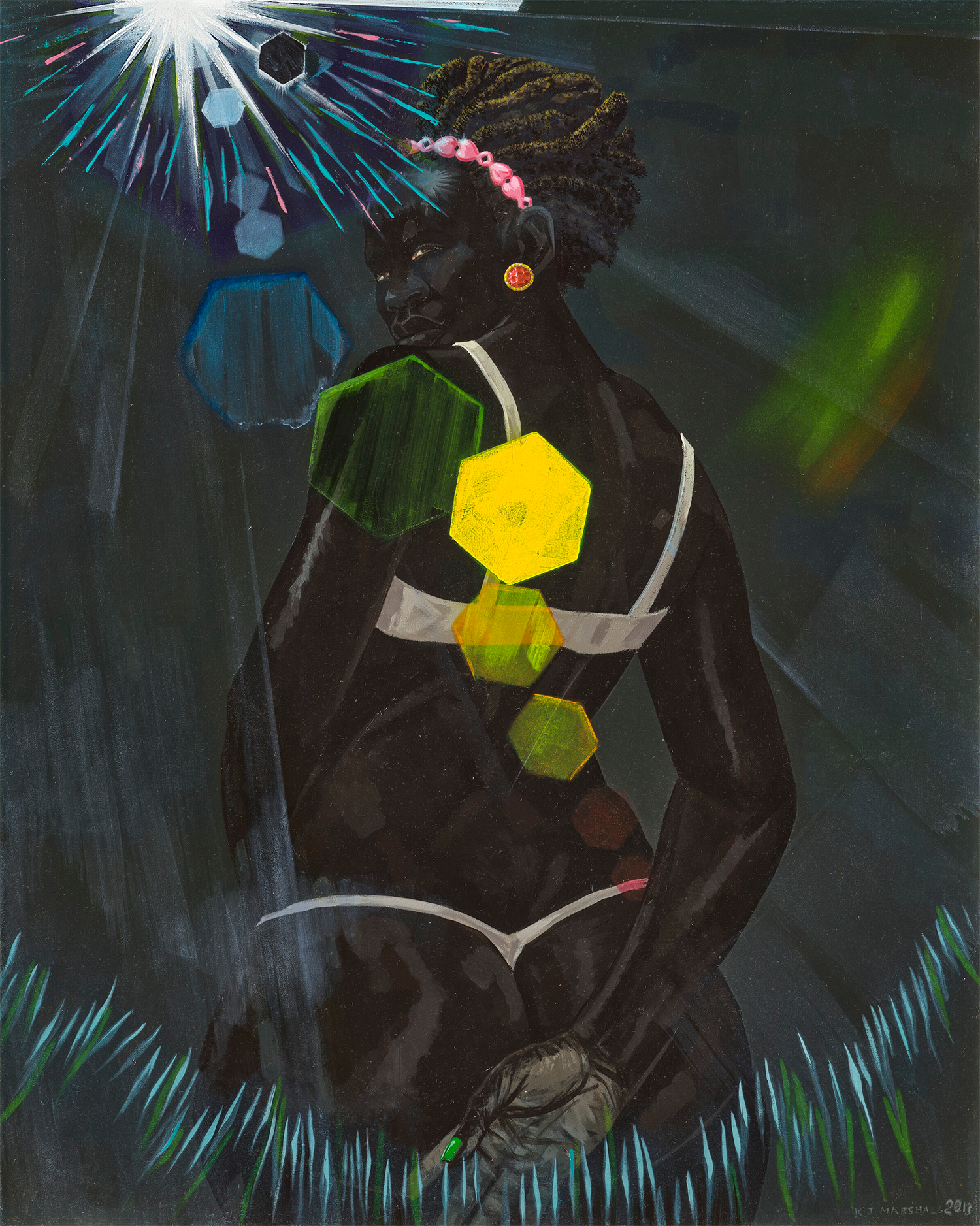
Marshall spent four decades doing one thing with rare discipline. He took the highest-status formats in Western art, the large multi-figure history painting, the formal portrait, the allegory, and he populated them with Black subjects rendered in a deep, almost absolute black built from multiple pigments. He has described the goal as correcting what he calls "the lack in the image bank" of art history, where, in his words, "the privileged body is a white body." This was a rewrite from within the tradition rather than a critique from outside it.
Curators consistently frame this as central rather than niche. Adrian Locke, who curated his 2025 Royal Academy survey, describes the paintings as "deeply rooted in art historical canons, yet they radically shift who and what is centred," placing "the Black figure unapologetically front and centre, occupying a space that was long denied to them." His galleries, Jack Shainman and David Zwirner, describe his work as interrogating Western art history from the Renaissance through twentieth-century abstraction. The recurring claim in the critical literature is that Marshall is measured against the full sweep of Western painting, not against a sub-category of it.
Canon-level framing is what separates a durable blue-chip artist from a trend. Collectors and auction specialists read sustained, serious curatorial attention as a signal that a body of work is likely to stay relevant for decades. That perception lowers the perceived risk of a purchase. Lower perceived risk supports higher prices.
What is Kerry James Marshall's auction record, and how did his market re-rate?
Marshall's market jumped to its peak in one sale.
His previous auction record was $5,037,500, set in November 2017 when Christie's New York sold Still Life with Wedding Portrait (2015). Six months later, on May 16, 2018, Sotheby's offered Past Times (1997), a roughly nine-by-thirteen-foot canvas of Black leisure on a manicured lawn. It carried an estimate of $8 million to $12 million, hammered at $18.5 million, and closed at $21,114,500 with fees. The buyer was identified two days later as Sean Combs. The price more than quadrupled his prior record in a single sale and reset the ceiling for his entire market.
Past Times had been bought directly from Marshall in 1997 for $25,000 by Chicago's Metropolitan Pier and Exposition Authority. The 2018 sale represented an increase of more than 800 times the original price over roughly two decades. That is a return profile that is rare even among blue-chip names, and it drew wide attention to Marshall as an asset and not only as an artist.
One record sale resets the reference point for an entire market. The art world saw a number. We saw a new floor for quality works.
Did the price hold after the record, and what supports the floor?
A common worry with a single landmark sale is that it is a one-off. Marshall's later results suggest the high end held, and the reason is supply.
After 2018, very few large, historically central Marshall paintings were consigned to evening sales. Most had been absorbed into museum collections or into private collections that treat them as long-term holdings rather than trading positions. That scarcity is the defining feature of his market. The most recent strong public result came on May 13, 2024, when Sotheby's sold Vignette #6 (2005) for $7.48 million at its The Now Evening Auction, against a $7 million low estimate, with the lot backed by a guarantee. A mid-seven-figure clearing price for a second-tier work, six years after the record, shows the market consolidating at a high level rather than retreating from it.
Kerry James Marshall's auction record remains the $21.1 million paid for Past Times at Sotheby's in 2018. The November 2025 New York sales showed a selective market: a 2007 portrait brought $7.15 million at Christie's, above estimate, while a larger canvas estimated at $10 million to $15 million went unsold at Sotheby's.
The practical read for an investor is that supply is the constraint on Marshall's market, not demand. When a major early or mid-1990s canvas does appear, dealers expect it to be guided in the high-seven to low-eight figures with Past Times as the reference. Until one does, the record stands by default, because interest has not faded and almost nothing has come to market to test it.
Why did institutions back Marshall before the auction market did?
The sequence in Marshall's career shows how art markets actually work. Museums and curators committed to him years before the auction prices reflected his importance.
The Studio Museum in Harlem gave him a significant solo show in 1997 and 1998. The Metropolitan Museum of Art holds Untitled (Studio) (2014). The Museum of Modern Art lists him as a collection artist, and the Whitney Museum of American Art has both collected and exhibited his work. These commitments accumulated through the 1990s and 2000s while his market prices stayed modest relative to his critical standing. He was, in the common phrase, a painter's painter long before he was a trophy at auction.
The inflection point was the touring retrospective Mastry, organized by the Museum of Contemporary Art Chicago and shown at MCA Chicago, the Met Breuer in New York, and MOCA Los Angeles across 2016 and 2017. A full retrospective at the Met's contemporary branch signaled incorporation into the broader art-historical narrative and not just the contemporary circuit. The record-setting Past Times sale followed within roughly a year of the show closing. We think this is the textbook "retrospective effect." A major survey converts long-standing curatorial esteem into broad collector demand, and prices re-rate to match the perceived historical importance. The museum moved first. The market did the catching up.
How is institutional validation still compounding for Marshall?
The institutional endorsement kept expanding after Mastry, and into the most canon-defining venues in Europe.
In 2024, Marshall was included in The Time Is Always Now: Artists Reframe the Black Figure, a major survey of Black figuration at the National Portrait Gallery in London (February to May 2024). The larger event is Kerry James Marshall: The Histories at the Royal Academy of Arts, the largest exhibition of his work ever staged in the United Kingdom, running September 20, 2025 to January 18, 2026 with more than 70 works across eleven themed rooms. The show then tours to the Kunsthaus Zurich (February 27 to August 16, 2026), promoted as the first major Marshall survey in the German-speaking world, and to the Musee d'Art Moderne in Paris (September 18, 2026 to January 24, 2027).
The location carries its own message. The Royal Academy is an institution that historically excluded Black artists from training and exhibition, and its curator describes the survey as a "monumental re-centring of the Black figure within traditions that had long excluded it." For the market, the European tour deepens Marshall's collector base beyond the United States and Canada into continental Europe, widening the pool of institutions and private buyers who do not yet own a work and may compete for one. There are no plans for the show to travel to the United States, which keeps the current wave of visibility concentrated in markets where his presence was historically thinner.
This is roughly how we think about quantifying cultural significance. You look at the galleries that represent an artist, the museums that own and show the work, and who collects them. On every one of those metrics, the read on Marshall is strong, and it is still building.
How does museum validation turn into higher prices for an artist like Marshall?
The mechanism connecting museum attention to price is not mysterious, and Marshall illustrates each step.
High-status museums acquiring and exhibiting an artist function as certification that the work matters for the long-term story of art. The Met, MoMA, the Whitney, and now the Royal Academy have all made that commitment. That certification reduces perceived risk for buyers, who read institutional backing as evidence the market rests on scholarship rather than speculation. Marshall's measured output means there are few major paintings to go around, so when validation lifts global demand, competition for scarce top-tier works pushes prices up. After each major show, galleries and auction houses reprice works that were once "important contemporary" as "canonical contemporary," which produces a step-change rather than a smooth climb.
We should be honest about the limit, because timing is the real one. Institutional validation is as much a trailing confirmation as a leading indicator. By the time the Met Breuer mounts a retrospective, the case for the artist is largely made, and much of the easy appreciation has already happened. Marshall's record sale came after the institutional consensus was visible to anyone watching the exhibition calendar. The signal is reliable. The entry point it implies is rarely cheap.
Sources
- Art21. "Kerry James Marshall: Correcting the Canon." Art21. https://art21.org/read/kerry-james-marshall-correcting-the-canon/
- Art Africa Magazine. "Reframing the Canon: Adrian Locke on Kerry James Marshall's Monumental Survey at the Royal Academy of Arts." 2025. https://artafricamagazine.org/reframing-the-canon-adrian-locke-on-kerry-james-marshalls-monumental-survey-at-the-royal-academy-of-arts/
- Jack Shainman Gallery. "Kerry James Marshall." https://jackshainman.com/artists/kerry_james_marshall
- Judd Tully. "Kerry James Marshall Painting Sells for Record-Smashing $21.1M in Sotheby's High-Flying $284.5M Contemporary Art Evening Sale." May 2018. https://juddtully.net/auctions/kerry-james-marshall-painting-sells-for-record-smashing-21-1-m-in-sothebys-high-flying-284-5-m-contemporary-art-evening-sale/
- Artsy. "A Kerry James Marshall Painting Sold for $21.1 Million at Sotheby's, Making Him the Most Expensive African American Artist at Auction Alive Today." May 2018. https://www.artsy.net/article/artsy-editorial-kerry-james-marshall-painting-sold-211-million-sothebys-making-expensive-african-american-artist-auction-alive-today
- The Art Newspaper. "Kerry James Marshall Sets $21m Record for a Living African American Artist at Sotheby's Sale." May 17, 2018. https://www.theartnewspaper.com/2018/05/17/kerry-james-marshall-sets-dollar21m-record-for-a-living-african-american-artist-at-sothebys-sale
- Culture Type. "Kerry James Marshall's Past Times Soars to Record-Setting $21.1 Million at Sotheby's." May 17, 2018. https://www.culturetype.com/2018/05/17/kerry-james-marshalls-past-times-soars-to-record-setting-21-1-million-at-sothebys-artist-assumes-mantle-as-most-expensive-living-african-american-artist/
- Phaidon. "The Poignant Truth Behind Kerry James Marshall's New $21 Million Sotheby's Auction Record." 2018. https://www.phaidon.com/en-us/blogs/phaidon-archive/the-poignant-truth-behind-kerry-james-marshalls-new-21-million-sothebys-auction-record
- HENI News. "Kerry James Marshall Leads Sotheby's $32.67m The Now Evening Auction in New York." May 13, 2024. https://heni.com/news/article/kerry-james-marshall-leads-sotheby-s-32-67m-the-now-evening-auction-in-new-york-2024-05-13t18-30-00-04
- Whitney Museum of American Art. "Kerry James Marshall." https://whitney.org/artists/4817
- The Metropolitan Museum of Art. "Untitled (Studio), Kerry James Marshall." https://www.metmuseum.org/art/collection/search/669451
- Museum of Modern Art. "Kerry James Marshall." https://www.moma.org/collection/artists/8285
- Studio Museum in Harlem. "Kerry James Marshall." https://www.studiomuseum.org/exhibitions/kerry-james-marshall
- Culture Type. "Kerry James Marshall: The Histories, Largest-Ever UK Exhibition of the American Artist." September 22, 2025. https://www.culturetype.com/2025/09/22/kerry-james-marshall-the-histories-largest-ever-uk-exhibition-of-the-american-artist-includes-new-paintings-exploring-role-of-black-africans-in-transatlantic-slave-trade/
- Kunsthaus Zurich. "Kerry James Marshall." https://www.kunsthaus.ch/en/besuch-planen/ausstellungen/kerry-james-marshall/
- The Art Newspaper. "More Than a Moment: Major Survey of Black Figuration Opens at National Portrait Gallery London." February 19, 2024. https://www.theartnewspaper.com/2024/02/19/major-survey-of-black-figuration-opens-at-national-portrait-gallery-london