Masterworks Research · June 2026
Why the headline art-return number you read is almost always too high, by how much, and how to adjust for it.
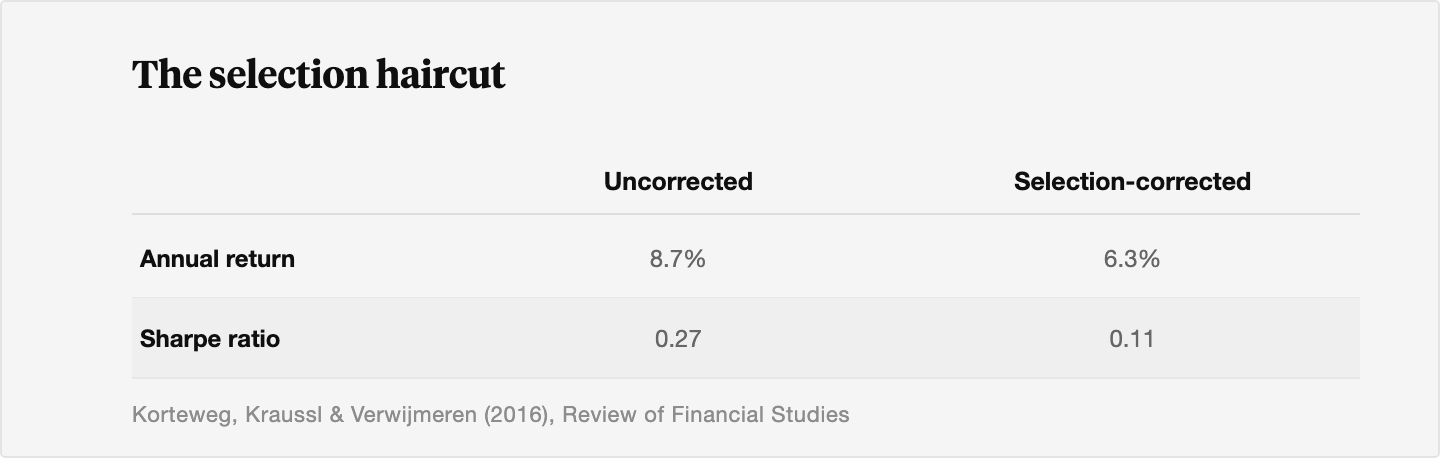
Most published art returns are measured from works that came back to auction, and the decision to bring a work back is not random: owners tend to resell their winners and hold or quietly shed their losers. That tilts the measured sample toward success and pushes reported returns above what a typical buyer actually earned. The best estimate of the size of the distortion comes from a 2016 study that corrected for it and watched the annual art return fall from 8.7% to 6.3% and the Sharpe ratio drop from 0.27 to about 0.11 [1]. Understanding this one bias is the difference between reading an art-return headline and understanding it.
What You Need to Know
- The sample is self-selected. An art index can only measure works that resell, and works resell partly because they did well. That makes the data a sample of winners, not a sample of all art bought.
- The correction is large. Korteweg, Kraussl and Verwijmeren found that adjusting for selection cut measured annual returns by about 2.4 points (8.7% to 6.3%) and roughly halved the Sharpe ratio (0.27 to 0.11). An earlier version of the work put the risk-adjusted drop even steeper, from 0.24 to 0.04 [1][2].
- Survivorship works the same way. Indices that quietly drop thinly traded artists, or that study only "investment-grade" names, inherit an upward bias for the same reason a surviving-funds list overstates mutual-fund returns.
- It is correctable, and it does not mean art is a bad asset. It means the honest number is lower than the brochure number, and that broad, selection-aware measurement and disciplined selection matter more than the headline.
1. What sample selection bias actually is
Sample selection bias is what happens when the data you can see is not a fair draw from the data you care about. The classic example is studying returns of mutual funds that still exist today. The failed funds closed and dropped out, so the survivors you can measure look better than the full field ever did. You are not measuring "fund returns." You are measuring "the returns of funds that survived," which is a different and flattering thing.
Art has the same structure, with a twist. The works you can measure are the ones that came back to auction, and a work comes back partly because of how it performed. The visible sample is shaped by the very outcome you are trying to estimate. Economists call the general fix a selection correction, and applying it to art produces the numbers in the next section.
2. Why art is especially exposed
Resale in the art market is a deliberate, infrequent choice. A share of stock trades thousands of times a day with no human deciding each time. A painting might change hands twice in fifty years, and a person chooses each time. That person is more inclined to sell a work that has appreciated, to realize the gain, and to hold a work that has lagged rather than crystallize a loss. The works that show up in the data are therefore tilted toward the ones that did well.
Only a sliver of art ever trades publicly at all. Many works sit permanently in museums or private collections, and within the works that do sell, only those that sell again enter a repeat-sales index. Each filter, coming to market and then coming back, selects for the more liquid and more commercially successful end of the spectrum. We described the mechanics of that index in how reliable are repeat-sales indices for art; this piece is about how much the selection it relies on bends the result.
3. The headline correction: how much returns shrink
The cleanest measurement of the effect comes from Arthur Korteweg, Roman Kraussl, and Patrick Verwijmeren, published in the Review of Financial Studies in 2016. They studied 32,928 paintings that sold at least twice at auction between 1960 and 2013, then modeled the resale decision itself and corrected the return estimate for it [1].
The result was a large haircut:
- Average annual return fell from 8.7% (uncorrected) to 6.3% (selection-corrected).
- The Sharpe ratio, return per unit of risk, fell from 0.27 to roughly 0.11 [1].
An earlier working-paper version, built on a different sample of about 20,500 paintings from 1972 to 2010, found an even sharper risk-adjusted drop, from a Sharpe of 0.24 down to 0.04 [2]. Either way, the message holds: a large part of the return that uncorrected indices attribute to art is really an artifact of which works chose to reappear.
The authors modeled this with a Heckman-style correction, estimating the probability that a work gets resold as a function of its return, then feeding that into the price equation [1]. They found that resale probability rises with appreciation, which is exactly the channel that biases naive returns upward. Their sober conclusion was that a broad, passive basket of paintings is less attractive on a risk-adjusted basis than uncorrected indices imply, though targeted strategies focused on specific artists or segments might still add value [1].
4. Survivorship and the masterpiece effect
Survivorship bias, a cousin of selection bias, shows up when an index drops artists or categories that stop trading, or when a study restricts itself to established "blue-chip" names from the start. Both choices quietly remove the failures and lift the average, the same way the surviving-funds list does. We discuss how this and other limits affect different indices in what indices track art market performance.
The masterpiece effect is a subtler relative. Mei and Moses, in the 2002 paper that built the best-known commercial art index, found that the most expensive works actually tended to underperform cheaper ones on a return basis [3]. Part of that pattern is a selection story: trophy works are the most visible, the most likely to be re-auctioned, and the most likely to dominate a repeat-sales sample, so an index can end up tracking a high-end segment whose behavior is not the market's. The lesson is that even the direction of a bias can flip depending on which works the sample over-represents.
5. What honest measurement does about it
None of this means art returns are fiction. It means the credible number is lower than the marketing number, and that how you measure determines whether you are fooling yourself.
Use the broadest sample you can, so the index reflects the market rather than a curated set of winners. Build on repeat-sales rather than average prices, so you are at least comparing each work to itself. And, where the data supports it, apply an explicit selection correction of the kind Korteweg and his coauthors used, or at minimum read uncorrected returns as an optimistic ceiling. We build the Masterworks index on repeat-sales for the first two reasons, and we treat its returns with the third in mind. An index is only worth citing if its builder is candid about the bias baked into it.
6. What it means when you read an art-return claim
For an investor, the practical translation is short. When you see a figure like "art has returned X% a year," ask what sample it came from and whether it was corrected for selection. If the answer is "repeat sales, uncorrected," mentally shave a couple of points off the return and treat the risk-adjusted figure as softer still. Compare asset classes on the same basis: a selection-corrected art return next to a clean equity return is a fair fight, while an uncorrected art return next to the S&P is not. We make that comparison carefully in art vs stocks over the last 30 years. The point is not to distrust art. It is to hold it to the same evidentiary standard you would hold any other asset, and to be unsurprised when the honest number is more modest than the headline.
The Bottom Line
- Published art returns are usually measured from works that resold, and works resell partly because they appreciated, so the sample skews toward winners and overstates the typical result.
- Correcting for this is not a rounding adjustment. One peer-reviewed study cut the measured annual art return from 8.7% to 6.3% and the Sharpe ratio from 0.27 to about 0.11; an earlier version put the risk-adjusted figure as low as 0.04.
- Survivorship bias and the masterpiece effect are related distortions, both driven by which works an index over-represents.
- The bias is correctable through broad sampling, repeat-sales construction, and explicit selection adjustments, and a credible index discloses how it handles them.
- Treat any uncorrected art-return headline as an optimistic ceiling, and compare asset classes on a like-for-like basis. Past performance is not predictive.
Sources
- Korteweg, Arthur, Roman Kraussl, and Patrick Verwijmeren. "Does It Pay to Invest in Art? A Selection-Corrected Returns Perspective." Review of Financial Studies 29, no. 4 (2016): 1007 to 1038. https://academic.oup.com/rfs/article-abstract/29/4/1007/1896045
- Korteweg, Arthur, Roman Kraussl, and Patrick Verwijmeren. "Does It Pay to Invest in Art?" Stanford GSB working paper, 2013. https://www.gsb.stanford.edu/faculty-research/working-papers/does-it-pay-invest-art-selection-corrected-returns-perspective
- Mei, Jianping, and Michael Moses. "Art as an Investment and the Underperformance of Masterpieces." American Economic Review 92, no. 5 (2002): 1656 to 1668. https://www.aeaweb.org/articles?id=10.1257/000282802762024719
- Korteweg, Kraussl, and Verwijmeren. Tinbergen Institute discussion paper version (20,538 paintings, 1972 to 2010). https://papers.tinbergen.nl/13152.pdf
- Goetzmann, William N. "Accounting for Taste: Art and the Financial Markets Over Three Centuries." American Economic Review 83, no. 5 (1993): 1370 to 1376. https://www.jstor.org/stable/2117574
- Heckman, James J. "Sample Selection Bias as a Specification Error." Econometrica 47, no. 1 (1979): 153 to 161. https://www.jstor.org/stable/1912352
- Review of Financial Studies (Oxford) abstract, Korteweg et al. 2016. https://academic.oup.com/rfs/article/29/4/1007/1896045
- Art Basel and UBS. "The Art Market 2025." Art Basel, 2025. https://theartmarket.artbasel.com/the-art-market-2025/global-market
- Renneboog, Luc, and Christophe Spaenjers. "Buying Beauty: On Prices and Returns in the Art Market." Management Science 59, no. 1 (2013): 36 to 53. https://pubsonline.informs.org/doi/10.1287/mnsc.1120.1580
- Stanford Graduate School of Business. "Does It Pay to Invest in Art?" research summary. https://www.gsb.stanford.edu/insights/does-it-pay-invest-art
Disclosures
Investing involves risk. Past results are not indicative of future outcomes.
Masterworks is providing this communication as an agent for its issuer entities, not Masterworks Advisers. This material is produced by Masterworks for informational purposes only and does not constitute investment advice, a recommendation, or an offer or solicitation to buy or sell any security. Masterworks is not a licensed broker-dealer by the SEC or FINRA.
Masterworks can only make and accept sales after an offering statement has been filed, and "qualified", by the SEC. Any offers may be revoked before notice of qualification. Indications of interest involve no obligation. For further disclosure visit the offering documents filed with the SEC and Important Disclosures at masterworks.com/cd.
Forward-looking statements and internal estimates are based on assumptions that may prove incorrect, and actual outcomes may differ materially. Figures denoted in brackets are subject to confirmation. Investing in art and alternative assets involves risk, including loss of principal.
Art sales price data is comparative only. Each painting is unique and historical data is not a direct proxy for any specific painting or investment. Data represents whole art, not an investment into our offerings which includes fees and expenses. Any comparative images are not currently live offerings and are provided for educational purposes only.
Masterworks, LLC is located at 1 World Trade Center, 57th Floor, New York, NY 10007.


