Masterworks Research · June 2026
What the data lets a model predict, where it breaks down, and why the hardest part of valuing art is the part no model can see.
Machine learning can predict art prices reasonably well when three conditions hold: the work sits in a market with a deep record of comparable sales, its value is driven by observable traits like artist, size, medium and date, and the price falls in the broad middle of the distribution. In the best published academic test, a neural network reading both the image and the catalog facts of a lot explained about 70% of the variation in hammer prices out of sample, against roughly 60% for the same model without the image [1]. Where the model struggles is exactly where the money is made: thinly traded artists, shifts in taste, market regime changes, and the top of the market, where a small number of trophy lots sell for prices no model trained on the past would have called. For an investor, a model is a fast, consistent, scalable second opinion on what a work is probably worth given everything that has traded before. It is not a forecast of demand, and it is least reliable in the segments that matter most for returns. We use these tools ourselves, with full awareness of that line. Below we walk through what models read, what they get right, and the four places they break.
What You Need to Know
- The best academic model explains about 70% of price variation, not 100%. Aubry, Kraussl, Manso and Spaenjers, writing in the Journal of Finance in 2023, built a neural network on images plus characteristics and reached an out-of-sample R-squared near 0.70, against about 0.60 for characteristics alone [1]. The image adds real information. It does not close the gap to certainty.
- The auction house estimate already does most of the work. In one student replication, presale low-and-high estimates alone explained roughly 94% of the variation in log hammer price, and machine learning added only a little on top [2]. A model that beats expert estimates does so at the margins, not by a wide gap.
- Models are most useful in the middle of the market, least useful at the top. Documented results show errors widen sharply for the highest-priced lots, where bidding wars and trophy demand drive prices the data never saw [3].
- Thin data is structural, not a software problem. A 2026 working paper tested decision trees, random forests, gradient boosting, neural networks and image models on about 20,900 works and reported consistently weak prediction, because the factors that move price are mostly not in the data [4].
- A model predicts a past price, not future demand. It learns the relationship between traits and what sold. When taste, fashion or the macro regime shifts, that relationship moves, and the model has no way to know it has [5].
1. What a machine learning model actually reads when it values a painting
Start with what goes into the model, because the inputs decide the ceiling on what comes out. A modern art-pricing model reads two kinds of information. The first is structured data, the catalog facts: the artist, the medium, the height and width, the year the work was made, the auction house, the sale date and location. This is the same set of variables that hedonic regression has used for decades, and it does most of the work. For more on how this characteristic-by-characteristic approach prices a work, see our piece on hedonic regression in art pricing.
The second input is the image itself. A convolutional neural network, the same family of model used in face recognition, reads the painting as pixels and learns to extract features at rising levels of abstraction: edges and color patches at the bottom, shapes and motifs in the middle, and at the top something close to style, the visual signature that separates an Impressionist canvas from a contemporary one [6]. The network turns the picture into a list of a few thousand numbers, an embedding, that can sit alongside the catalog facts in the final price equation [1].
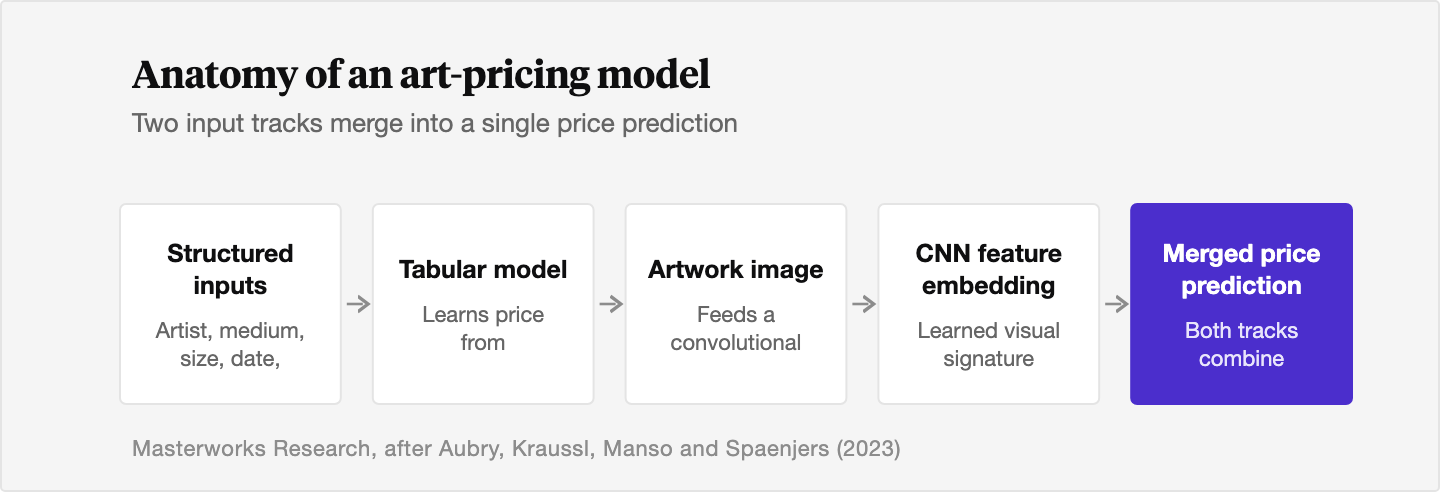
This is the sense in which machine learning extends hedonic regression rather than replacing it. A classic hedonic model assumes price is a linear, additive function of traits. A tree-based model or a neural network drops that assumption and learns the non-linear interactions on its own, how size and artist multiply together, how medium interacts with period, without anyone writing those interactions in by hand [5]. The image track then adds a channel of information a tabular model never had. The architecture is more capable. The question is how much that capability buys you, and the honest answer is: a moderate amount, in the right conditions.
2. Where the models predict well: deep data, observable traits, the middle of the market
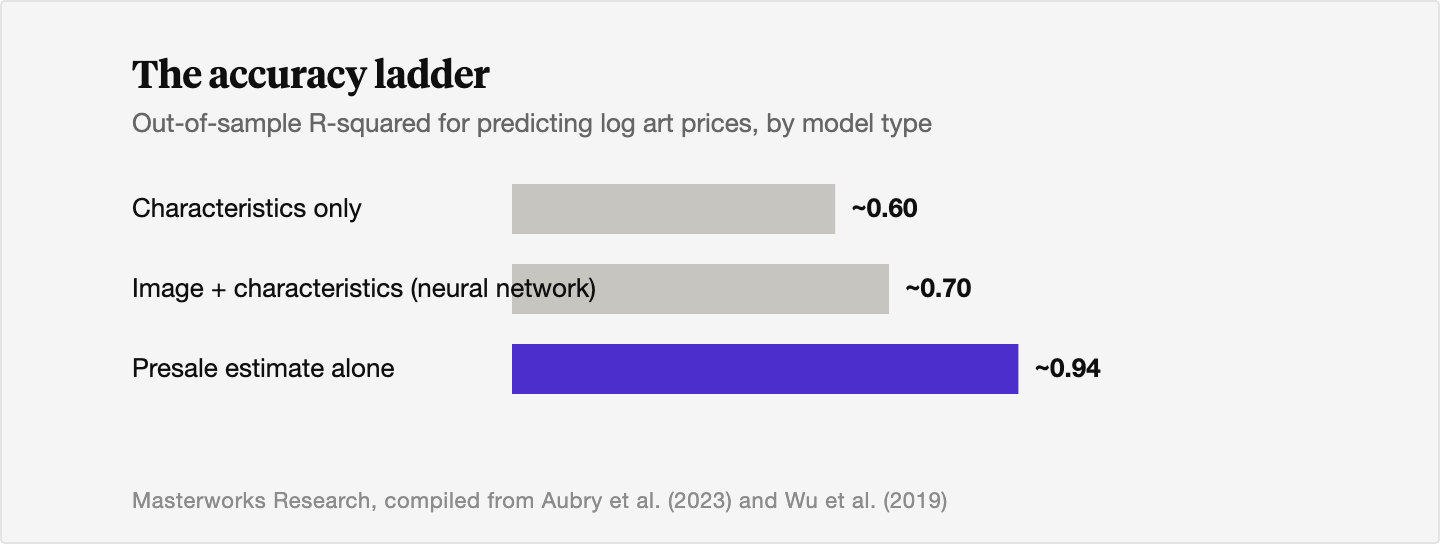
When the conditions are right, the predictions are genuinely useful. The clearest evidence comes from "Biased Auctioneers," published in the Journal of Finance in 2023 by Mathieu Aubry, Roman Kraussl, Gustavo Manso and Christophe Spaenjers, the most rigorous public study of machine learning applied to art prices [7]. They built a neural network on both images and catalog characteristics and tested it out of sample, meaning on lots the model had never seen. The model using characteristics alone reached an out-of-sample R-squared of about 0.60. Adding the image lifted that to about 0.70 [1]. Roughly ten percentage points of explanatory power came from the picture, which is real and was not obvious in advance.
Two things drive good predictions. The first is a deep record of comparable sales. A model learns the price of "a mid-size oil by this artist" by seeing many of them trade. The blue-chip names with hundreds of auction records, the Warhols and Picassos, are exactly where the model has the most to learn from. The second is that the value is carried by observable traits. Where price tracks artist, size, medium and date, the model can read it. Studies consistently find that the single most powerful variable, or group of variables, is artist identity and reputation, which the catalog hands the model directly [5]. For the related human process of building a value from comparable transactions, see our piece on comparable sales analysis for art.
The third condition is staying in the middle of the price distribution. This is where errors are smallest and the model's consistency is most valuable. A scalable, even-handed second opinion across thousands of mid-market works is something no individual appraiser can produce by hand, and it is the strongest practical use of these tools today.
The "Biased Auctioneers" result is not that the model crushed the auction houses. The authors found that when their model's valuation came in higher than the house's presale estimate, those lots went on to sell at higher price-to-estimate ratios and were less likely to fail to sell [1]. In other words, the model carried information the estimates were leaving on the table, and auctioneers' errors were persistent and predictable at both the artist and the house level [7]. The edge is in the relationship between the two numbers, not a blowout on raw accuracy.
3. What the published numbers really say about accuracy
Now the cold water, because the accuracy figures get rounded up in casual retelling. The headline R-squared near 0.70 is for log prices, which compresses the scale. On the actual dollar amount, the residual spread is wide. Image-only models perform badly: one widely cited project that fed only the painting's pixels to a network reported a mean absolute percentage error near 1,841%, which is another way of saying the picture alone tells you almost nothing about the price [8]. Even sophisticated multi-modal architectures, combining image, text and recent comparable sales, have landed around 100% mean absolute percentage error on test data [8].
The most sobering single number comes from a 2019 study that asked a plain question: how much does the auction house's own presale estimate already explain? The answer was about 94% of the variation in log hammer price, with machine learning adding only a slim margin on top [2]. It means much of what a model "predicts" is a reconstruction of what expert appraisers already concluded, because the estimate is itself the auction house's best read of demand. The model is largely learning to approximate human judgment, then improving on it at the edges. That is valuable. It is a long way from replacing the appraiser.
The R-squared figures above are mostly from random train-and-test splits, where past and future lots are shuffled together. That design flatters a model, because it lets it peek at the same market conditions on both sides of the split. The harder and more honest test, training only on the past and predicting the future, is rarer in the literature and tends to show weaker performance [5]. When you see a clean accuracy number, the first question is always whether the test respected the arrow of time. Most do not. The same survivorship and construction questions dog the indices these models lean on, which we cover in our pieces on what indices track art market performance and their limits and how reliable repeat-sales indices are for art.
4. The four things models cannot predict
There are four places where the models break, and they are not random. They are the same four places where the largest gains and losses in art investing actually happen.
Thin-data artists. A model learns from repetition. For an artist with a handful of auction records, there is nothing to repeat. A 2026 working paper ran decision trees, random forests, gradient boosting, neural networks and image-fusion models on about 20,900 works across more than 3,500 artists and reported consistently weak prediction across every method [4]. The authors traced the weakness to the data rather than the algorithms. The factors driving price, an artist's critical reputation and narrative standing, are mostly absent from it, so adding more of the same observations will not fix it [4]. Fine art is, in the words of a Harvard Data Science Review survey, "a small data problem": even the largest houses sell only tens of thousands of lots a year, fragmented across thousands of artists [5].
Shifts in taste and fashion. This is the limit we feel most directly, because the central finding from our own work is that appreciation follows fashion, and fashion moves generationally. Contemporary art has historically appreciated faster than older work, in our estimate roughly 12 to 13% a year for post-1970 work against 1 to 2% for Old Masters, because the demand is for what this generation of collectors wants on the wall. A model trained on the prices of the last twenty years has no way to know that the next twenty will reward a different taste. The relationship between traits and price is not fixed. When it moves, the model is the last to find out.
Regime change. Art prices move with the wealth and liquidity of the people who buy at the top. The art market has been down over the past several years, and a model trained across a long, unsegmented stretch quietly averages a boom and a correction into one blurred relationship that fits neither [5]. Most published models have never been tested across a crisis boundary like 2008 or 2020, which is precisely when a valuation tool is most likely to be wrong and most likely to be trusted [5].
The masterpiece premium. The top of the market is dominated by a few extraordinary works whose prices come from competition between a tiny number of bidders, demand a model never observes. In November 2025, Klimt's "Portrait of Elisabeth Lederer" hammered at $205 million and reached $236.4 million with fees, the second-highest auction price ever recorded. No model trained on the prior record would have predicted that number. Documented results confirm the pattern: prediction errors widen sharply in the top decile of prices, where models systematically under-predict the trophy outcomes [3]. As one practitioner who built these systems put it, at the highest levels of the market it is not clear we will ever get good at predicting those values [3]. For investment returns, that under-predicted tail is often where the upside lives.
5. Price is not demand, and a model only sees price
There is a deeper limit underneath the four above. A model is trained on hammer prices, the single number a work sold for on a given day. That number hides almost everything about the demand that produced it. A lot that scraped past its low estimate with one bidder and a lot that drew a fierce bidding war both enter the training data as the same realized price, even though the underlying demand was completely different [5]. The model cannot tell them apart.
The training data is also selected. Most datasets record only works that sold. Lots that failed to find a buyer, the buy-ins, often do not appear at all [5]. That means the model learns the price of a work conditional on it having sold, which tilts the picture toward desirable, in-fashion works and away from the over-estimated and the unfashionable. The Harvard survey calls this a major outstanding methodological issue, and notes that most models do not correct for it [5]. The practical read is that a model's number can run optimistic relative to what would have happened if the work had actually been put up for sale. It is estimating one slice of demand, the part that cleared, and presenting it as the whole.
This is why we treat a model output as an input to judgment, not a substitute for it. It answers "what have similar works sold for, adjusted for everything we can measure." It does not answer "what will someone pay for this one, next year, in a market that may have moved."
6. How we use machine learning, and where judgment takes over
Machine learning is part of how we work. We maintain a proprietary database of private-market and auction transactions, and our internal valuation framework uses that data to estimate fair value for the works we evaluate. Over the last four years, on lots with a low estimate at or above $100,000, that framework has been an estimated [~5%] more accurate than auction-house presale estimates, measured by how often the realized price landed inside the estimated range. [That ~5% figure is subject to confirmation; methodology: in-range hit rate, our valuation versus the auction house low-to-high band, same lots, same period.]
We will not publish the features, the weights, or how the output feeds an investment decision, for the same reason no firm publishes its alpha. What we will say is where the model stops and people start. The model is strongest at the task it was built for: a fast, consistent read across many works on what the data implies a fair price should be. It flags when a work looks cheap or rich against its comparables. It does not pick the artist market, which our research says is the decision that matters most, and it does not judge the cultural standing that drives the next generation's taste. To quantify that standing we look at the galleries that represent an artist, the museums that hold the work, and who collects it, signals that sit largely outside any single price model. The model narrows the field. Judgment makes the call.
The honest framing is the one we apply to every quantitative tool. A model is a disciplined way to process the past. The art market's returns come disproportionately from the parts of the future the past did not contain. Holding both of those ideas at once is the job.
The Bottom Line
- Machine learning predicts art prices well where comparable sales are deep, value is driven by observable traits, and the work sits in the middle of the price distribution. The best public academic model explained about 70% of price variation out of sample with images and characteristics together [1].
- Much of a model's accuracy is a reconstruction of expert judgment. In one replication, presale estimates alone explained about 94% of price variation, and machine learning added only a thin margin [2].
- Models break in four predictable places: thinly traded artists, shifts in taste, market regime changes, and the masterpiece premium at the top of the market [3][4][5].
- A model is trained on realized prices, not demand, and usually only on works that sold, which can tilt its valuations optimistically [5].
- We use machine learning as a scalable second opinion inside a broader valuation framework, with the artist-market judgment and the cultural read left to people. Past model accuracy is not a guarantee of future accuracy, and past performance is not predictive of future results.
Sources
- Aubry, Mathieu; Kraussl, Roman; Manso, Gustavo; Spaenjers, Christophe. "Biased Auctioneers." The Journal of Finance, Vol. 78, No. 2, pp. 795-833, 2023 (working-paper PDF). https://faculty.haas.berkeley.edu/manso/biasedauctioneers.pdf
- Wu, et al. "The Art of Predicting Art Auction Prices." Stanford CS230 Project Report, 2019. https://cs230.stanford.edu/projects_fall_2019/reports/26261328.pdf
- Bailey, Jason. "Can Machine Learning Predict the Price of Art at Auction?" Artnome, May 5, 2020. https://www.artnome.com/news/2020/5/5/can-machine-learning-predict-the-price-of-art-at-auction
- Renyi, et al. "Painting Price: A Machine Learning Approach to Art Valuation." University of Warsaw Working Paper No. 2026-18, 2026. https://ideas.repec.org/p/war/wpaper/2026-18.html
- Hong; Kim; Li. "Can Machine Learning Predict the Price of Art at Auction?" Harvard Data Science Review, 2020. https://hdsr.mitpress.mit.edu/pub/1vdc2z91
- "An Analysis of Multi-Modal Deep Learning for Art Price Appraisal." 2021 IEEE ISPA/BDCloud/SocialCom/SustainCom, 2021. https://www.cloud-conf.net/ispa2021/proc/pdfs/ISPA-BDCloud-SocialCom-SustainCom2021-3mkuIWCJVSdKJpBYM7KEKW/264600b509/264600b509.pdf
- Aubry, Mathieu; Kraussl, Roman; Manso, Gustavo; Spaenjers, Christophe. "Biased Auctioneers." The Journal of Finance, 78(2), 795-833, published online February 2, 2023. https://onlinelibrary.wiley.com/doi/abs/10.1111/jofi.13203
- Stanford CS230. "Painting2Auction: Art Price Prediction with a Siamese CNN and LSTM." Project Report, Stanford, 2020. http://cs230.stanford.edu/projects_fall_2020/reports/55539436.pdf
- Hansen, et al. "Social signals predict contemporary art prices better than visual features." Scientific Reports, Vol. 14, 2024. https://www.nature.com/articles/s41598-024-60957-z
- "Deep Learning for Art Market Valuation." arXiv preprint 2512.23078, 2025. https://arxiv.org/abs/2512.23078
- "Machine Learning Algorithms and Fine Art Pricing." Expert Systems with Applications, 2025. https://www.sciencedirect.com/science/article/abs/pii/S0957417425000909
- McAndrew, Clare. "The Art Basel and UBS Global Art Market Report 2026." Art Basel and UBS, March 2026. https://www.artbasel.com/stories/the-art-basel-and-ubs-global-art-market-report-2026
Disclosures
Investing involves risk. Past results are not indicative of future outcomes.
Masterworks is providing this communication as an agent for its issuer entities, not Masterworks Advisers. This material is produced by Masterworks for informational purposes only and does not constitute investment advice, a recommendation, or an offer or solicitation to buy or sell any security. Masterworks is not a licensed broker-dealer by the SEC or FINRA.
Masterworks can only make and accept sales after an offering statement has been filed, and "qualified", by the SEC. Any offers may be revoked before notice of qualification. Indications of interest involve no obligation. For further disclosure visit the offering documents filed with the SEC and Important Disclosures at masterworks.com/cd.
Forward-looking statements and internal estimates are based on assumptions that may prove incorrect, and actual outcomes may differ materially. Figures denoted in brackets are subject to confirmation. Investing in art and alternative assets involves risk, including loss of principal.
Art sales price data is comparative only. Each painting is unique and historical data is not a direct proxy for any specific painting or investment. Data represents whole art, not an investment into our offerings which includes fees and expenses. Any comparative images are not currently live offerings and are provided for educational purposes only.
Masterworks, LLC is located at 1 World Trade Center, 57th Floor, New York, NY 10007.