
Masterworks Research · June 2026
Private credit grew from roughly $2 trillion to about $3 trillion in five years. Here is what direct lending is, why banks ceded the ground, what investors are paid to bear, and where fine art fits as collateral.
Private credit, also called private debt, is lending done outside the banking system. Non-bank lenders such as credit funds, asset managers, and insurers make loans directly to companies, negotiate the terms one on one, and usually hold those loans to maturity rather than trading them on a public market [1]. The global market reached roughly $3 trillion at the start of 2025, up from about $2 trillion in 2020, and is projected to grow to around $5 trillion by 2029 [1]. For investors, the appeal is income: senior secured loans that paid yields in the low double digits through the recent rate cycle, with returns that move with short-term rates rather than against them. The cost is everything that comes with a private market. The capital is locked up, the loans rarely trade, and the marks are based on models rather than a live price.
What You Need to Know
- Private credit is non-bank lending, and it is large. The market sits at roughly $3 trillion as of early 2025, up from about $2 trillion in 2020, and direct lending is its biggest strategy [1].
- Banks created the opening. After the 2023 regional bank failures and tighter capital rules, banks pulled back from middle-market lending, and non-bank lenders filled the gap [1][2].
- The yields have been high because the loans float. Most private credit is floating-rate, priced at a benchmark like SOFR plus a spread of roughly 600 to 800 basis points, which pushed all-in yields into the 10 to 14% range during the hiking cycle [2].
- The risks are real and often understated. Capital is illiquid, the loans rarely trade in a deep secondary market, and the Financial Stability Board warned in May 2026 that leverage, opacity, and model-based valuations could amplify a downturn the sector has not yet been tested through [3].
- Art-secured lending is a niche of the same idea. Loans made against fine art as collateral, typically at 50 to 60% loan-to-value, sit inside the broader private credit world, in a market estimated at roughly $29 to $34 billion [4][5].
1. What private credit actually is
Private credit is a private-market lending asset class, and the term gets used loosely. Non-bank institutions extend loans to companies, the loans are privately negotiated rather than sold to the public, and they generally do not trade on an exchange [1]. The Financial Stability Board describes it as a form of non-bank credit intermediation, where loans are originated and held by funds and other non-bank financial institutions instead of banks [3]. Morgan Stanley puts it more plainly: lending outside the traditional banking system, where lenders work directly with borrowers to structure the loan [1].
The category covers several strategies. Direct lending is the largest by far. The rest includes mezzanine debt, distressed debt, special situations, venture debt, and asset-backed or specialty finance [1][3]. When most people say private credit, they mean direct lending, so that is where we will spend the most time.
Direct lending is the origination of senior secured loans, usually first-lien or unitranche, made directly to private middle-market companies and held to maturity by the lender [1][6]. Cambridge Associates frames the structural point that matters for an investor: these loans have a contractual maturity, often carry collateral, and sit senior to the equity in the borrower's capital structure [6]. If the company runs into trouble, the lender gets paid before the owners do. That seniority is the first line of defense.
A middle-market company, often defined as one with $25 million to $75 million in EBITDA, used to fund itself with a syndicated bank loan or a high-yield bond [6]. Increasingly it borrows from a single credit fund or a small club of them instead. The loan never touches the public market.
2. Why private credit boomed after 2022
Two forces arrived at the same time. Banks stepped back, and the loans on offer suddenly paid more.
On the supply side, banks retreated from the kind of lending that private credit now does. The 2023 failures of Silicon Valley Bank, First Republic, and other regional banks squeezed funding and tightened lending standards at exactly the lenders that had served middle-market borrowers [2]. Lord Abbett's read is direct: COVID-19 and the 2023 regional banking stress "supercharged growth in private credit," as banks and public markets pulled back and borrowers turned to private lenders [2]. Behind the cyclical stress sits a structural one. Post-crisis capital rules, including the Basel III endgame proposals advanced in 2023 and 2024, raise the capital banks must hold against leveraged and non-investment-grade loans, which makes those loans less attractive to keep on a bank balance sheet [2]. The capital that banks no longer wanted to commit had to come from somewhere. It came from credit funds.
On the demand side, the loans got better for the lender. Most private credit is floating-rate, priced as a benchmark plus a spread, with the rate resetting every quarter [1]. When the Federal Reserve lifted its policy rate from near zero in 2021 to above 5% by mid-2023, the income on these loans rose right along with it. Morgan Stanley notes that floating-rate structure gives "real-time interest rate protection compared to fixed-rate bonds," and calculates that across seven periods of rising rates since 2008, direct lending returned an average of about 11.6%, roughly two percentage points above its long-term average [1]. Even as cuts began, the income held: direct lending posted an annualized return of about 10.5% in the fourth quarter of 2024 [1].
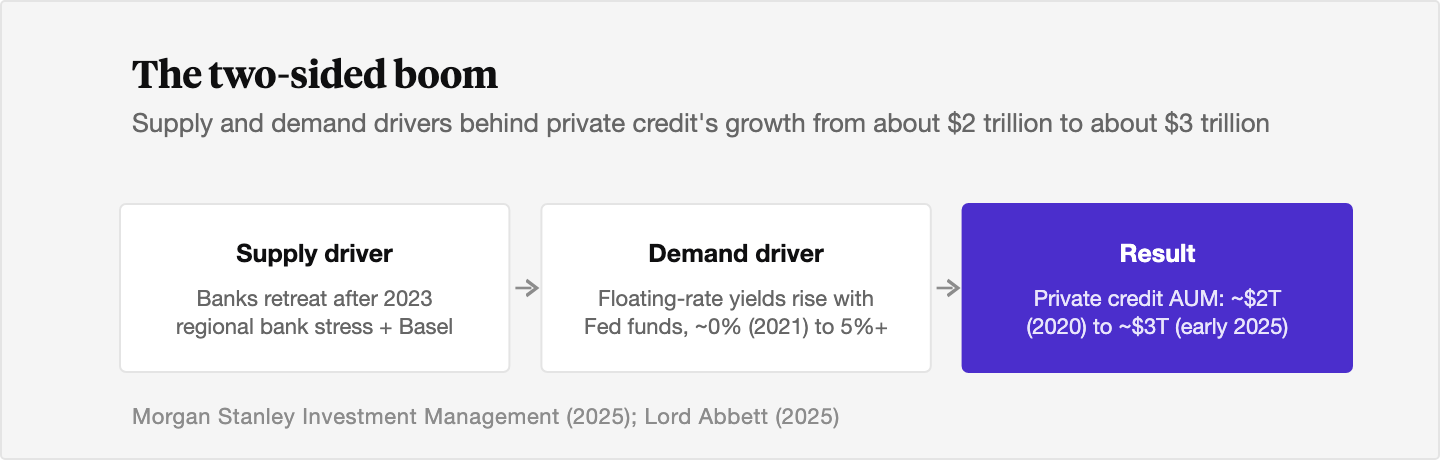
The result was not a passing cycle. Large managers built platforms able to originate, underwrite, and hold loans of more than a billion dollars, which let borrowers skip the syndicated market entirely [2]. The plumbing is now in place, and that is why the growth looks structural rather than temporary.
3. What investors get paid, and how the loans are priced
A typical post-2022 senior or unitranche direct loan to a private equity-backed company was priced at roughly SOFR plus 600 to 800 basis points, often with an original issue discount of one to three points and arrangement fees on top [2]. With SOFR sitting around 4 to 5%, that produced all-in cash coupons in the 10 to 12% area and all-in yields, counting fees, that could reach 11 to 14% on new money [2].
Those are gross figures. After a manager takes a fee, usually around 1 to 1.5% plus a performance share, net yields to a fund investor in a diversified senior strategy have run closer to 8 to 11%, depending on leverage and the fee structure [2]. JPMorgan's private bank described direct lending income through this period as "near cycle highs" [2]. These are historical figures from a specific rate environment, and past performance is not predictive of future results. Floating-rate income that rose when the Fed hiked will fall when the Fed cuts. The same mechanism that made the yields attractive on the way up works in reverse on the way down.
The structure also gives the lender more than just a coupon. Private loans often keep maintenance covenants, the financial tests that let a lender step in early if a borrower deteriorates, where many broadly syndicated loans had gone covenant-light [3][6]. The trade an investor is making is yield and control in exchange for liquidity. That second half is where the discipline comes in.
4. The risks the yield is paying you for
A high yield is compensation for something. In private credit, it is compensation for four things, and they tend to show up together.
Illiquidity comes first. A classic closed-end private credit fund runs an 8 to 10 year life with no right to redeem; an investor is locked in unless a buyer can be found in a thin secondary market [3]. The Financial Stability Board is blunt that these loans "typically do not trade in deep and liquid secondary markets," which means a position can be hard to exit when conditions turn [3]. Newer semi-liquid funds promise quarterly redemptions, but they hold the same illiquid loans, and the FSB flags that gap between the liquidity a fund offers and the liquidity its assets actually have as a real vulnerability [3].
Credit and default risk comes next. Private credit often finances more leveraged borrowers than a bank would, frequently to back private equity buyouts [3]. The benign loss numbers of recent years can mislead. Fitch reported that US private credit defaults, counting distressed restructurings, reached a record 9.2% in 2025 [3]. Part of what can mask deterioration is payment-in-kind, or PIK, where a borrower pays interest by adding it to the loan balance instead of in cash. PIK lifts reported yield without producing any cash, and if the borrower is later restructured, that accrued principal can be written off. The FSB warns that PIK and amend-and-extend features "can mask underlying borrower weakness" and delay the recognition of losses [3].
Leverage is stacked at several levels. Borrowers are leveraged. Funds borrow against their own portfolios through NAV facilities and subscription lines. And some end investors use leverage to buy in [3]. Each layer magnifies both the gains and the losses.
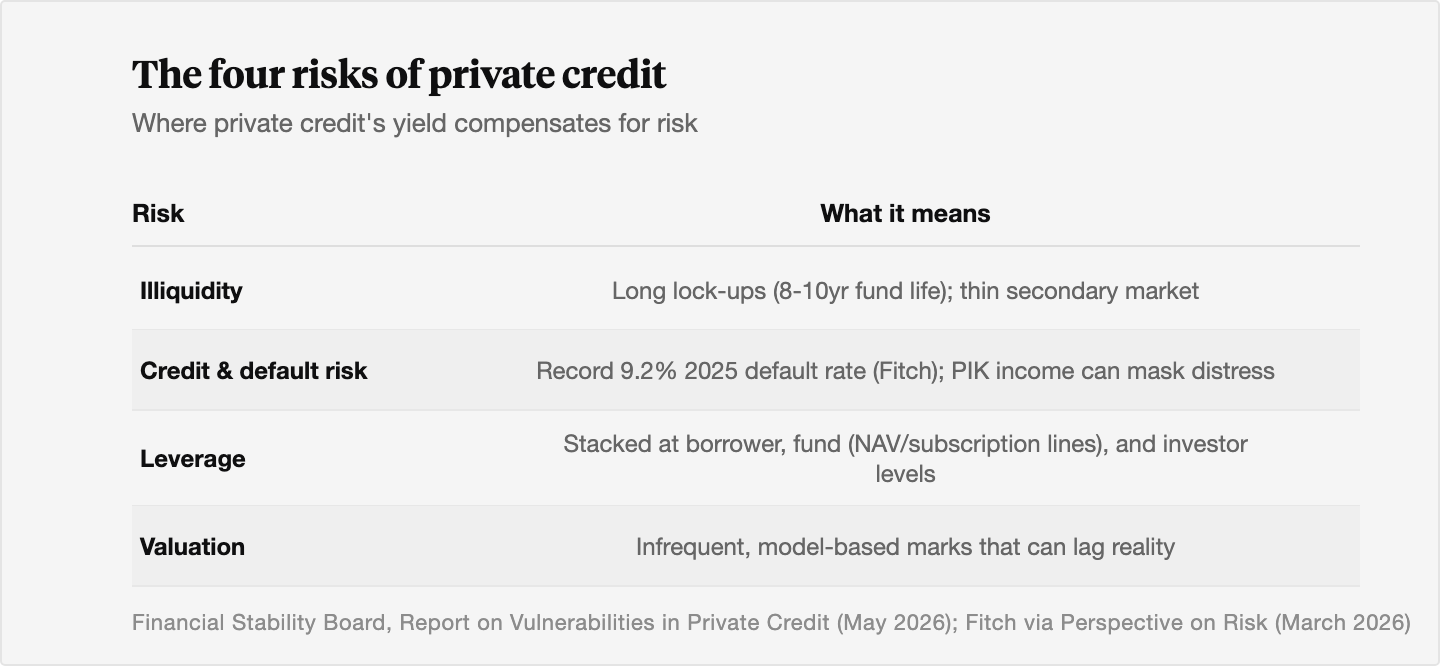
Valuation is the one investors notice last. Private loans are not quoted on an exchange. They are marked, usually quarterly, using discounted cash-flow models, internal credit ratings, and broker quotes where any exist [3]. The FSB highlights the "valuation uncertainty" this creates, because the marks lean heavily on models and management judgment [3]. The practical effect is that a private credit portfolio can look smoother than the public credit market right up until a credit event forces the marks down in a jump. Smooth is not the same as safe. The IMF and FSB have both warned that the sector's growth, opacity, and links to banks, insurers, and private equity could amplify a shock, and the FSB notes plainly that the asset class at its current scale "has not been tested during a severe economic downturn" [3].
5. How investors access it
There are four main doors, and they are not equally open.
The institutional closed-end fund is the classic limited partnership. An investor commits capital, the manager draws it down over a three to five year investment period, and the fund runs a seven to ten year life [7]. Minimums at flagship funds run from $5 million to $20 million for direct institutional access, with feeder classes through private banks sometimes cutting the ticket to $250,000 or $1 million [7]. These are limited to accredited investors and often to qualified purchasers, who must hold $5 million in investments [7].
The business development company, or BDC, is a vehicle that holds private loans and trades like a fund. Publicly traded BDCs are open to anyone with a brokerage account, with no accreditation requirement and a practical minimum of a few hundred to a few thousand dollars; the trade-off is that the share price can swing away from net asset value [7]. Non-traded BDCs sit between the two, with retail minimums often in the $2,500 to $25,000 range and quarterly repurchases that are capped [7].
The interval fund or evergreen vehicle is the door that opened widest for ordinary investors. Interval funds are registered funds that take subscriptions continuously and allow redemptions only periodically, usually a capped share each quarter [7]. They are generally open to all investors with minimums often between $1,000 and $25,000 [7]. Morgan Stanley notes that semi-liquid vehicles now command almost a third of the roughly $1 trillion US direct lending market, driven largely by the individual investor channel [7]. The most recent door is the push to put small private credit sleeves inside diversified retirement vehicles such as target-date funds, where a 401(k) participant holds the exposure at the plan level without needing to be accredited [7]. Adoption is growing but still modest [7].
6. Where fine art fits: art-secured lending as a private credit niche
Art-secured lending is the same idea applied to a different kind of collateral. A loan is underwritten primarily on the value of fine art rather than on a company's cash flow, and the art is pledged as security [4][5]. It belongs to the asset-based corner of private credit, alongside other specialty-finance strategies, and it serves a specific borrower: the collector, family office, or dealer who wants liquidity from a collection without selling it.
The market is meaningful but small next to corporate direct lending. The Deloitte Private and ArtTactic Art & Finance Report put the art-secured lending market at roughly $29 billion to $34.1 billion in outstanding loans, growing at about 11% a year [4][5]. Within that, the auction-house lenders alone held an estimated $3.5 to $5 billion in art-loan portfolios in 2025 [5]. The lenders fall into three groups: private banks such as JPMorgan, UBS, Citi, and Bank of America serving wealth clients; auction-house finance arms, where Sotheby's Financial Services reports more than $12 billion of loans originated since inception; and boutique specialist lenders [5].
The discipline shows up in the loan-to-value ratio. Because art is illiquid and idiosyncratic, lenders advance a conservative fraction of value, commonly around 50 to 60% for blue-chip collateral, and they typically calculate against the low auction estimate rather than the high one [4][5]. That conservatism is the lender's margin of safety, and it is the reverse image of the investor's case for owning art in the first place. The same work can be a long-term holding that diversifies a portfolio and, separately, collateral that unlocks cash. Art functions as both an alternative asset and a form of security.
This is where the art investor's lens and the private credit lens meet. The two are different uses of the same object, and an investor evaluating art should understand both. For the mechanics of how a loan against a painting is structured, see our piece on whether art can be used as collateral for loans and how art-backed lending works (/academy/posts/can-art-be-used-as-collateral-for-loans-how-art-backed-lending-works). For the size and trajectory of that specific market, see where the art-lending industry stands in 2026 (/academy/posts/art-lending-market-size-and-growth-where-the-industry-stands-in-2026). For how art sits inside a broader allocation, see our framework for advisors on art as an alternative allocation (/academy/posts/art-as-an-alternative-allocation-a-framework-for-advisors). And for the macro case behind owning hard assets at all, see why art belongs in the conversation on fiscal dominance and hard assets (/academy/posts/fiscal-dominance-and-hard-assets-why-art-belongs-in-the-conversation).
Art and private credit are both private-market alternatives, and both ask an investor to give up liquidity for something else, but they are not substitutes. Private credit pays a contractual coupon and returns principal at maturity. Art pays nothing along the way and returns whatever the next buyer will pay. The return engines differ; the discipline required of the investor is similar. Past performance, in either, is not predictive of future results.
The Bottom Line
- Private credit is non-bank lending to companies, a roughly $3 trillion market as of early 2025, with direct lending as its largest strategy [1].
- It grew because banks retreated from middle-market lending after the 2023 regional bank stress and tighter capital rules, and because floating-rate loans paid more as the Fed raised rates [1][2].
- Gross yields on senior direct lending ran in the 10 to 14% range through the recent cycle, with net yields to fund investors closer to 8 to 11%, though that income falls as rates fall and past performance is not predictive [2].
- The yield compensates for illiquidity, credit and default risk, layered leverage, and model-based valuations, and the FSB warned in May 2026 that the sector has not been tested through a severe downturn [3].
- Art-secured lending is a private credit niche where loans are made against fine art at roughly 50 to 60% loan-to-value, in a market estimated at $29 to $34 billion, so art can serve as both an alternative asset and loan collateral [4][5].
Sources
- Morgan Stanley. "Understanding Private Credit's Rapid Growth." Morgan Stanley, October 3, 2025. https://www.morganstanley.com/ideas/private-credit-outlook-considerations
- Lord Abbett. "A Closer Look at the Growth of Private Credit Markets." Lord Abbett, November 7, 2025. https://www.lordabbett.com/en-us/financial-advisor/insights/investment-objectives/2025/a-closer-look-at-the-growth-of-private-credit-markets.html
- Financial Stability Board. "Report on Vulnerabilities in Private Credit." FSB, May 6, 2026. https://www.fsb.org/2026/05/report-on-vulnerabilities-in-private-credit/
- WealthBriefing. "Art Lending Market's Potential Is Large; Requires Expert Guidance." WealthBriefing, June 13, 2025. https://www.wealthbriefing.com/html/article.php/art-lending-markets-potential-is-large;-requires-expert-guidance--
- Sotheby's. "Art-Backed Lending 101: Unlocking the Value of Your Fine Art Collection." Sotheby's, December 2, 2025. https://www.sothebys.com/en/articles/art-backed-lending-101-unlocking-the-value-of-your-fine-art-collection
- Cambridge Associates. "Private Credit Strategies: An Introduction." Cambridge Associates, May 3, 2024. https://www.cambridgeassociates.com/insight/private-credit-strategies-introduction/
- Morgan Stanley Investment Management. "Private Credit 2026 Outlook." Morgan Stanley, December 16, 2025. https://www.morganstanley.com/im/en-us/institutional-investor/insights/outlooks/private-credit-2026-outlook.html
- McKinsey & Company. "Global Private Markets Report 2026." McKinsey, January 5, 2026. https://www.mckinsey.com/industries/private-capital/our-insights/global-private-markets-report
- JPMorgan Private Bank. "Why Private Credit Remains a Strong Opportunity." JPMorgan, July 31, 2025. https://privatebank.jpmorgan.com/nam/en/insights/markets-and-investing/why-private-credit-remains-a-strong-opportunity
- BlackRock. "2026 Private Markets Outlook." BlackRock, May 10, 2026. https://www.blackrock.com/institutions/en-global/institutional-insights/thought-leadership/private-markets-outlook
- Deloitte Private and ArtTactic. "Art & Finance Report (9th edition)." Deloitte, 2025. https://www.deloitte.com/lu/en/services/consulting-financial/research/art-finance-report.html
- MoMAA. "Art-Backed Lending and Liquidity Solutions." MoMAA, June 24, 2025. https://momaa.org/art-backed-lending/
- Wellington Management. "Private credit outlook for 2026: 5 key trends." Wellington, December 4, 2025. https://www.wellington.com/en-us/institutional/insights/private-credit-outlook
- Georgetown Institute of International Economic Law. "The Explosive Growth of Private Credit." Georgetown, June 2025. https://finpolicy.georgetown.edu/wp-content/uploads/2025/06/The-Explosive-Growth-of-Private-Credit.pdf
Disclosures
Investing involves risk. Past results are not indicative of future outcomes.
Masterworks is providing this communication as an agent for its issuer entities, not Masterworks Advisers. This material is produced by Masterworks for informational purposes only and does not constitute investment advice, a recommendation, or an offer or solicitation to buy or sell any security. Masterworks is not a licensed broker-dealer by the SEC or FINRA.
Masterworks can only make and accept sales after an offering statement has been filed, and "qualified", by the SEC. Any offers may be revoked before notice of qualification. Indications of interest involve no obligation. For further disclosure visit the offering documents filed with the SEC and Important Disclosures at masterworks.com/cd.
Forward-looking statements and internal estimates are based on assumptions that may prove incorrect, and actual outcomes may differ materially. Figures denoted in brackets are subject to confirmation. Investing in art and alternative assets involves risk, including loss of principal.
Art sales price data is comparative only. Each painting is unique and historical data is not a direct proxy for any specific painting or investment. Data represents whole art, not an investment into our offerings which includes fees and expenses. Any comparative images are not currently live offerings and are provided for educational purposes only.
Masterworks, LLC is located at 1 World Trade Center, 57th Floor, New York, NY 10007.


