
Masterworks Research · June 2026
How third party funders turn lawsuits into a non-recourse asset, why a verdict does not care about the S&P 500, and where the binary risk hides.
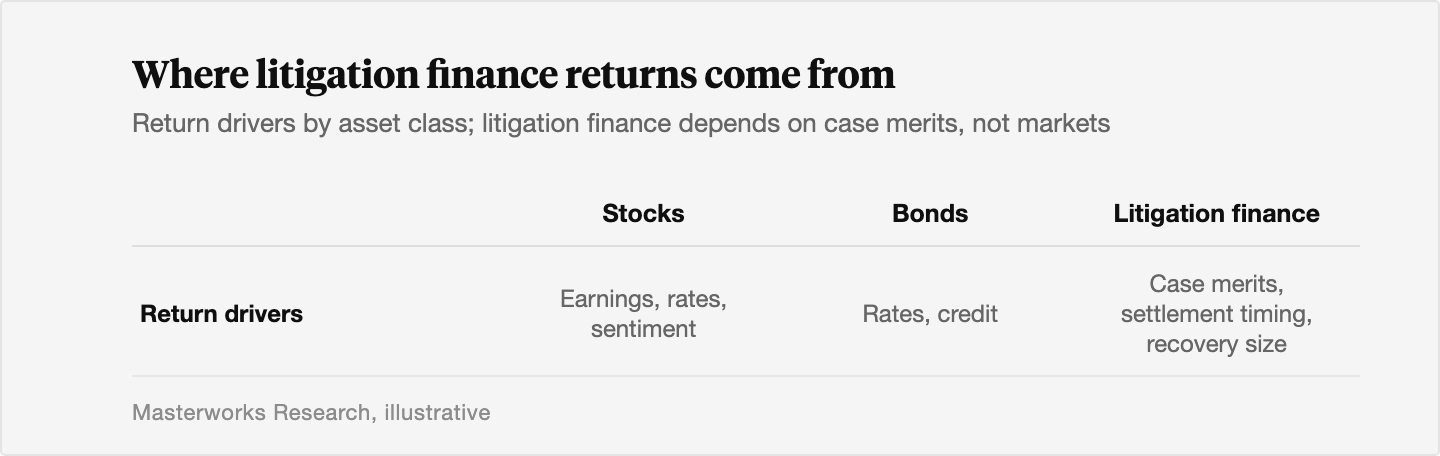
Litigation finance is the practice of a third party funding a plaintiff's legal costs in exchange for a share of any money the case recovers, with the funding structured as non-recourse, so if the case loses the funder loses its capital and the plaintiff owes nothing. The appeal to investors is straightforward. A jury verdict or an arbitration award is decided by the facts of the case and the law, so the outcome has almost no connection to interest rates, equity multiples, or the business cycle. That is what allocators mean when they call litigation finance an uncorrelated asset. For an investor building a portfolio, the question is whether that uncorrelated return is worth the binary risk of any single case and the years it can take to resolve.
What You Need to Know
- It is non-recourse capital priced for risk. A funder pays a plaintiff's legal fees and expenses and takes a share of the recovery. If the case loses, the funder is wiped out on that position, which is why historical returns in the asset class have run high. Burford Capital, the largest listed funder, reports a cumulative return on invested capital of roughly 82% and an internal rate of return near 27% on concluded direct matters since inception [1].
- The uncorrelation is real, not a marketing line. A patent verdict does not depend on Federal Reserve policy or the S&P 500. The courts stay open in a bull market and a bear market, so case outcomes track legal merits rather than macro conditions [4].
- Single cases are binary; portfolios spread the risk. Any one lawsuit can return a multiple or go to zero. Funders manage this by financing many unrelated cases at once. In 2024, portfolio deals were roughly 64% to 67% of new US commitments, with portfolio transactions averaging about $16.5 million versus $6.6 million for single cases [2][6].
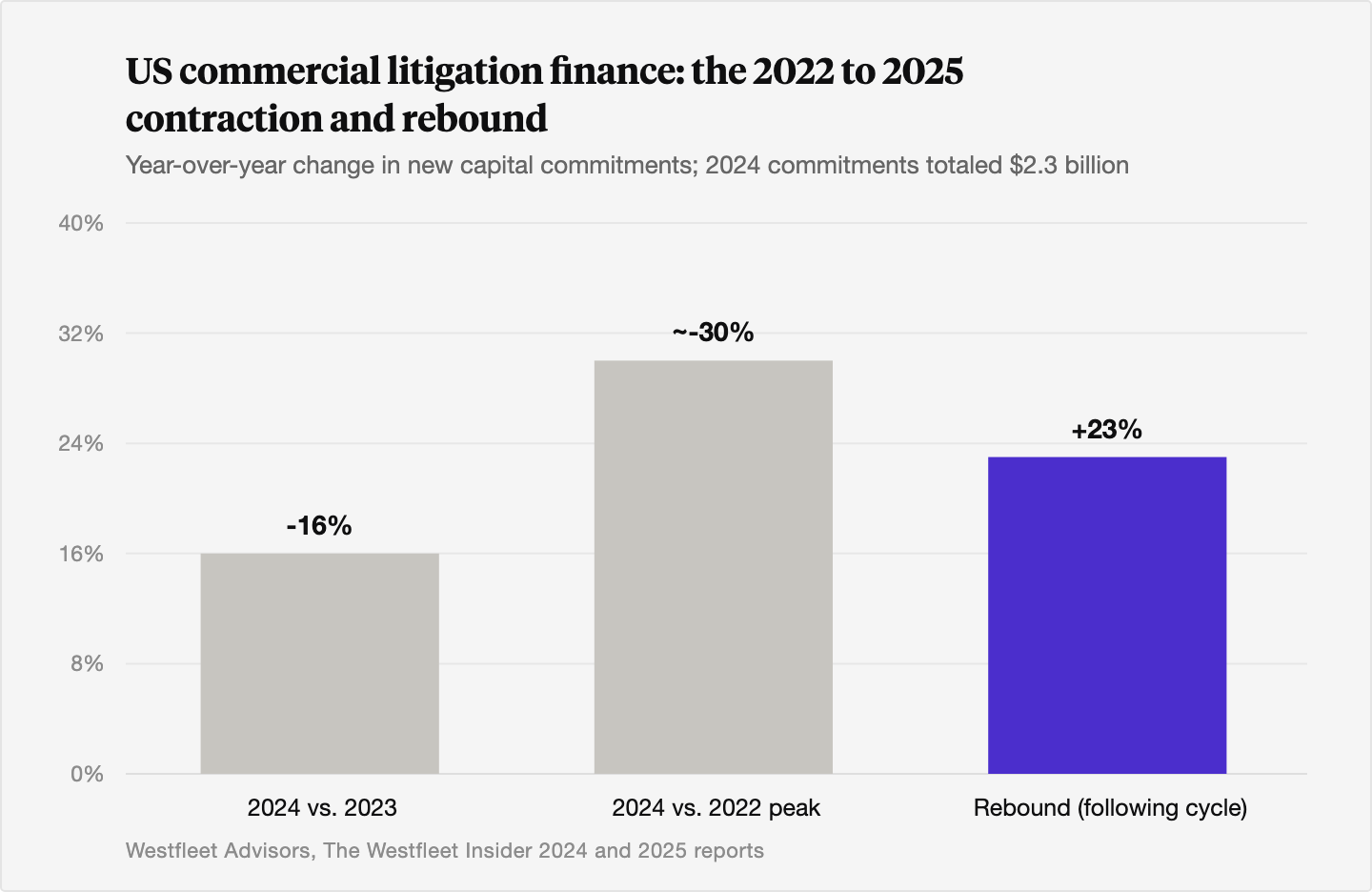
- The US market is sizable but tightened recently. US funders had an estimated $16.1 billion in assets under management in the 2024 Westfleet report, with $2.3 billion in new commitments that year, down about 16% from 2023 before commitments rebounded roughly 23% in the following cycle [2][3].
- Access is mostly institutional. The cleanest route for an individual is buying shares of a listed funder such as Burford Capital (NYSE: BUR). Most direct fund exposure is reserved for accredited and institutional investors [5].
1. How litigation finance works
Imagine you run a mid-sized company with a strong breach-of-contract claim against a much larger counterparty. The claim could be worth $40 million, but your litigation budget would run into the millions and the case might take four years. You can spend your own cash and carry the risk, or you can bring in a funder.
In a single-case deal, the funder agrees to pay your legal fees and expenses. In exchange, the funder takes an agreed share of any recovery, often structured as a multiple of the capital it deployed or a percentage of the award, whichever is greater. The defining feature is that the funding is non-recourse. If the case loses, you owe the funder nothing, and the funder absorbs the loss [4]. That structure is the whole reason the returns are priced where they are. The funder is not a lender collecting interest. It is an equity-like investor in the outcome of a lawsuit.
There are two broad shapes. A single-matter deal funds one case. A portfolio deal funds a basket of unrelated cases for one law firm or one company, cross-collateralized so that wins in some matters cover losses in others. Portfolio funding has become the larger share of the market because it dampens the binary risk that defines any individual claim [2][6].
2. Why the returns are genuinely uncorrelated with markets
The case for litigation finance in a portfolio rests on one property. The outcome of a lawsuit is decided inside a courtroom, on the merits, by a judge, jury, or arbitral panel. A patent infringement verdict is not influenced by where the S&P 500 closed or what the Federal Reserve did at its last meeting [4].
This matters because true diversification means owning something largely indifferent to the forces moving everything else. An asset that simply rises when stocks fall would be a lucky hedge. Litigation finance is closer to the real thing, because the variable that determines its payoff, the resolution of a legal dispute, sits outside the macro economy almost entirely. Institutional allocators including pension funds and university endowments have moved into the asset class for exactly this reason [4].
We make the same argument about fine art. Correlation, not direction, is the point. An asset earns its place in a portfolio when its returns answer to their own drivers, so that a drawdown in equities does not automatically pull it down too.
3. The binary risk of any single case
The flip side of the uncorrelation is the shape of the risk. A single lawsuit is close to a binary outcome. It can settle or win at trial and return a strong multiple, or it can be dismissed, lose at trial, lose on appeal, or settle for a sum too small to repay the capital, in which case the funder takes a total or near-total loss on that position [7].
This is idiosyncratic risk in its purest form. There is no diversification inside a single case. The valuation of a litigation asset is hard precisely because it combines case-specific risk with the binary nature of a verdict [7]. A funder can underwrite the legal merits carefully and still lose, because juries are uncertain, judges make rulings, and appellate courts reverse.
For an investor, the lesson is that a single-case position is not an investment in the ordinary sense. It is a concentrated bet on one event. The returns reported by the large funders are blended across many such bets, and the average hides a wide dispersion between the winners and the zeros.
4. Duration uncertainty: cases take years
The second risk that is easy to underestimate is time. A commercial case can take years to resolve, and the funder's capital is locked up for the duration with no income along the way. Estimates of duration vary by venue and case type. One analysis cited roughly 35.5 months for a US District Court matter to move through appeals, and there is a general pattern that larger financings tend to carry longer durations [7].
Duration matters in two ways. First, it stretches the holding period, so even a strong gross return compresses into a lower annualized figure the longer the case runs. Second, it interacts with the binary risk. The longer a case proceeds toward a contested judgment, the more it enters the phase where the outcome is decided by a third party rather than negotiated in a settlement [7].
The practical effect is that litigation finance is a long-term, illiquid allocation. An investor cannot mark a case to market every quarter and cannot exit a single position at will. That illiquidity is the price of the uncorrelated return, and it is a feature the asset shares with most genuine alternatives.
5. Why portfolio diversification is the core discipline
The answer to binary risk is the same answer that applies to any concentrated, idiosyncratic asset. Spread the bets. A portfolio of many unrelated cases turns a series of binary outcomes into a distribution, so the wins in some matters cover the losses in others.
The market has moved decisively this way. Portfolio deals made up roughly 64% to 67% of new US commitments in recent years, and the average portfolio transaction ran about $16.5 million against $6.6 million for a single matter in the 2024 data [2][6]. Funders cross-collateralize the cases in a portfolio, which means an investor's capital is exposed to the blended result rather than to any one verdict.
This is the same reason an investor would buy a low-cost basket of equities rather than a single stock, and the same reason we build art exposure across many works and artist markets rather than betting on one canvas. Diversification does not raise the expected return. It narrows the range of outcomes, which is what makes an idiosyncratic asset usable in a portfolio at all.
6. Market size, growth, and the recent contraction
Litigation finance has grown from a niche into a recognized alternative asset class, though the headline market-size figures vary widely by methodology and should be read with care.
The most reliable US-specific data comes from Westfleet Advisors, whose annual report tracks the commercial market directly. In its 2024 report, Westfleet counted 42 active capital providers managing an estimated $16.1 billion in assets, with $2.3 billion in new capital committed to deals that year [2][3]. That 2024 figure was about 16% below 2023 and nearly 30% below the 2022 peak, the first consecutive annual declines Westfleet had recorded, attributed by founder Charles Agee to a tighter capital market [3]. New commitments then rebounded by roughly 23% in the following cycle, ending the two-year contraction [6].
Broader global estimates run higher and looser. Third party market researchers have put the global litigation funding market somewhere in the range of $17 billion to $25 billion in 2025, with projected growth rates near 9% to 11% a year over the following decade [8]. We would treat the precise global figure as soft. The US AUM number from Westfleet is the firmer data point.
7. The main players
The asset class is concentrated among a handful of large funders. Burford Capital is the largest and the only one with a liquid public-equity proxy, listed on the New York Stock Exchange and the London Stock Exchange under the ticker BUR [5]. Burford's reported track record is the most-cited evidence for the asset class: a cumulative return on invested capital of roughly 82% and an internal rate of return near 27% on concluded direct matters since inception, with FY2024 concluded matters reported at an 87% ROIC [1].
Those figures deserve a caveat. Burford has noted that its long-run track record includes outlier mega-cases and reflects a 15-year period that benefited from first-mover advantage, so future returns may be lower or lumpier, and the firm disclosed an unremediated internal control weakness over fair value measurement as of the end of 2024 [1]. The headline returns are real and audited, and they are not a promise about what the asset class delivers from here.
Omni Bridgeway, listed in Australia, is the other large publicly accessible funder, with a global book across litigation and arbitration [5]. Beyond the listed names, the market includes dozens of private funds and specialist managers. Westfleet identified 39 to 42 active US providers across its recent reports, though several deployed little new capital and some entered wind-down [2][6].
8. Regulatory and disclosure debates
The fastest-moving part of the story is policy. The central fight is over disclosure: whether parties must reveal that a lawsuit is being funded by a third party, and on what terms.
In the US Congress, Senators Grassley, Tillis, Kennedy, and Cornyn introduced the Litigation Funding Transparency Act of 2026, which would require parties to disclose third party funding, including foreign funding, in class actions and multidistrict litigation, and would bar funders from controlling litigation strategy or settlement [9][10]. The bill is backed by the US Chamber of Commerce and insurance-industry groups [9]. Separately, Senator Tillis proposed a tax on litigation funding profits, initially pitched near a 40.8% rate and later trimmed toward 31.8%, which funders warned could undercut the business model. That tax provision was cut from a larger legislative package, and it split Republicans over concerns that smaller plaintiffs could be priced out of court [10].
The disclosure debate is the one to watch for the asset class. More transparency raises compliance costs and could shift bargaining dynamics in funded cases, while supporters argue it protects defendants from hidden interests steering litigation. The outcome will shape how the industry operates rather than whether it survives.
9. How individual investors can access it
For most individuals, direct access is limited. Underwriting a single case requires legal expertise, and direct fund exposure is generally reserved for accredited and institutional investors through private litigation finance funds with their own minimums and lockups [5].
The cleanest route for a retail investor is the public market. Buying shares of Burford Capital (NYSE: BUR) gives broad exposure to a diversified book of funded cases through a standard brokerage account, with no accreditation requirement and the daily liquidity of a listed equity [5]. The tradeoff is that a listed funder carries equity-market volatility and company-specific risk on top of the underlying case risk, so the share price will not track the uncorrelated asset cleanly. Omni Bridgeway offers similar exposure on the Australian exchange [5].
A small number of platforms have experimented with fractional or crowdfunded stakes in individual lawsuits, but these are early, thin, and carry the full binary risk of a single case without the smoothing of a portfolio [5]. For an individual seeking the diversification benefit that makes the asset class attractive, a diversified vehicle, listed or private, is the sounder path than a single-case bet.
How litigation finance compares with blue chip art
The reason litigation finance belongs in a conversation about alternatives is the same reason blue chip art does. Both are prized for low correlation to public markets, the property allocators reach for when they want a return that answers to its own drivers rather than to the equity cycle. Both are illiquid, both are idiosyncratic, and both ask an investor to hold for years.
The risk shapes differ. A litigation finance position is exposed to a binary event. A case wins or loses, and a single position can go to zero. A work of art is a scarce physical asset with a long price history, and its value can fall, but it rarely goes to zero the way a lost verdict does. One asset diversifies through a portfolio of independent legal outcomes. The other diversifies through a portfolio of works across artist markets, where supply tends to shrink as pieces move into museums. We compare the diversification logic here, not the returns, which depend on entirely different mechanics.
For the broader case on why uncorrelated assets earn a place in a portfolio, see our guide to what alternative investments are, the framework for treating art as an alternative allocation, the data on art's behavior during portfolio drawdowns, and the long-run comparison of art and stocks over 30 years.
The Bottom Line
- Litigation finance funds a plaintiff's legal costs on a non-recourse basis in exchange for a share of any recovery, which makes the funder an equity-like investor in the outcome of a case.
- The returns are genuinely uncorrelated with public markets because a verdict is decided on legal merits, not on interest rates or the S&P 500.
- Any single case is a binary, idiosyncratic bet that can return a multiple or go to zero, and cases can take years to resolve, locking up capital with no income along the way.
- Funders manage the binary risk by financing diversified portfolios of unrelated cases, which is why portfolio deals make up the majority of new commitments.
- The US market held an estimated $16.1 billion in assets under management with $2.3 billion in new 2024 commitments, dominated by a few large funders led by Burford Capital and Omni Bridgeway.
- Individual access is mostly through listed funder shares; direct fund exposure is largely reserved for accredited and institutional investors, and disclosure rules are the main regulatory question in play.
Sources
- Burford Capital. "Burford Capital Reports First Quarter 2024 Results" and "Annual Results for Year Ended December 31, 2024." Burford Capital Investor Relations / SEC Form 10-K, March 2025. https://investors.burfordcapital.com/news/news-details/2024/Burford-Capital-Reports-First-Quarter-2024-Results/default.aspx
- Westfleet Advisors. "The Westfleet Insider: 2024 Litigation Finance Market Report." March 2025. https://www.westfleetadvisors.com/wp-content/uploads/2025/03/WestfleetInsider-2024-Litigation-Finance-Report.pdf
- PR Newswire / Westfleet Advisors. "$2.3 Billion Committed in U.S. Commercial Litigation Finance Amid Capital Contraction in 2024." March 26, 2025. https://www.prnewswire.com/news-releases/2-3-billion-committed-in-us-commercial-litigation-finance-amid-capital-contraction-in-2024--302411359.html
- Kelly Park Capital. "Unlocking Uncorrelated Opportunities: The Hidden Benefits of Investing in Litigation Finance." 2025. https://blog.kellyparkcapital.com/alternative-investments/unlocking-uncorrelated-opportunities-the-hidden-benefits-of-investing-in-litigation-finance
- AltStreet. "Burford Capital Review: Commercial Litigation & Arbitration Platform Analysis." 2025. https://altstreet.investments/platforms/reviews/burford-capital
- Risk & Insurance. "Litigation Finance Capital Commitments Rebound 23% After Two-Year Contraction." 2025. https://riskandinsurance.com/litigation-finance-capital-commitments-rebound-23-after-two-year-contraction/
- Litigation Finance Journal. "Managing Duration Risk in Litigation Finance (Part 2 of 2)." 2025. https://litigationfinancejournal.com/managing-duration-risk-in-litigation-finance-part-2-of-2/
- Decimal Point Analytics. "From Niche to $67B: The Rise of Litigation Finance as a Global Asset Class." 2025. https://decimalpointanalytics.com/insights/articles/from-niche-to-67-b-the-rise-of-litigation-finance-as-a-global-asset-class
- Institute for Legal Reform / U.S. Chamber of Commerce. "Sens. Grassley, Tillis, Kennedy, Cornyn Introduce Litigation Funding Transparency Act of 2026." 2026. https://instituteforlegalreform.com/press-release/sens-grassley-tillis-kennedy-cornyn-introduce-litigation-funding-transparency-act-of-2026/
- U.S. Congress. "S.3826 - Litigation Funding Transparency Act of 2026." Congress.gov, introduced February 11, 2026. https://www.congress.gov/bill/119th-congress/senate-bill/3826/history
- Bloomberg Law. "Litigation Finance's New Money Fades in 'Tight' Capital Market." 2025. https://news.bloomberglaw.com/business-and-practice/litigation-finances-new-money-fades-in-tight-capital-market
- Legal Funding Journal. "Key Findings from Westfleet's 2024 Litigation Finance Market Report." 2025. https://legalfundingjournal.com/key-findings-from-westfleets-2024-litigation-finance-market-report/
- Tillis Senate Office. "Tillis Introduces Legislation to Target Predatory Litigation Funding Practices." May 2025. https://www.tillis.senate.gov/2025/5/tillis-introduces-legislation-to-target-predatory-litigation-funding-practices
- Omni Bridgeway. "Litigation Finance." 2025. https://omnibridgeway.com/litigation-finance
Disclosures
Investing involves risk. Past results are not indicative of future outcomes.
Masterworks is providing this communication as an agent for its issuer entities, not Masterworks Advisers. This material is produced by Masterworks for informational purposes only and does not constitute investment advice, a recommendation, or an offer or solicitation to buy or sell any security. Masterworks is not a licensed broker-dealer by the SEC or FINRA.
Masterworks can only make and accept sales after an offering statement has been filed, and "qualified", by the SEC. Any offers may be revoked before notice of qualification. Indications of interest involve no obligation. For further disclosure visit the offering documents filed with the SEC and Important Disclosures at masterworks.com/cd.
Forward-looking statements and internal estimates are based on assumptions that may prove incorrect, and actual outcomes may differ materially. Figures denoted in brackets are subject to confirmation. Investing in art and alternative assets involves risk, including loss of principal.
Art sales price data is comparative only. Each painting is unique and historical data is not a direct proxy for any specific painting or investment. Data represents whole art, not an investment into our offerings which includes fees and expenses. Any comparative images are not currently live offerings and are provided for educational purposes only.
Masterworks, LLC is located at 1 World Trade Center, 57th Floor, New York, NY 10007.


