
Masterworks Research · June 2026
Thematic Research | Fine Art Market Strategy
What a structured note actually is, how the buffers and barriers are engineered, the issuer credit you are quietly underwriting, and how that decision space overlaps with owning a real asset.
A structured product, most often sold as a structured note, is a single security that packages a bond together with an embedded derivative, so that its payoff is tied to the performance of a reference asset like the S&P 500 rather than to a fixed coupon. The bond piece is meant to return your money; the derivative piece is what creates the buffer, the cap, or the enhanced upside that the brochure is selling. For an investor, the appeal is a shaped payoff, often described as equity-like return with a measure of downside protection, and the catch is that every dollar of that promise sits on the unsecured credit of the bank that issued it.
We spend our days valuing a different kind of asset, but the question that sends investors toward structured notes is one we hear constantly: how do you get exposure to growth while taking less of the drawdown? What follows is what these instruments are, what you give up to get the protection, and where the real risk lives, before deciding they are the answer.
What You Need to Know
- A structured note is a bond plus a derivative, not a bond. The U.S. Securities and Exchange Commission defines these as securities whose returns are based on equity indexes, single stocks, rates, commodities, or currencies, containing "a bond component and an embedded derivative." [3] The shape of the payoff comes entirely from the derivative.
- You hold the issuer's unsecured credit. Principal protection "is only as good as the financial strength of the company making that promise," per FINRA, and in a bankruptcy holders are "typically considered unsecured creditors and might recover little, if any, of their original investment." [1] Lehman Brothers proved this is not hypothetical.
- The U.S. market is large and growing fast. U.S. structured note sales reached a record $149.4 billion in 2024, up 46% year over year, with $139.9 billion registered with the SEC. [7]
- They are built to be held to maturity. A liquid secondary market does not exist; sold early, a note "might have to" go "at a price less than the amount you paid for it," or may not sell at all. [3]
- Fees are real and hard to see. The price at issuance "will likely be higher than the fair value of the structured note on the date of issuance," and costs "can be relatively high and sometimes difficult to determine or understand." [1][3]
1. What a structured product actually is
The marketing names obscure it, but a structured note is a debt security. You lend money to a bank. Instead of paying you a fixed coupon, the bank uses options it buys and sells in the background to engineer a return tied to something else, usually an equity index. The SEC puts it simply: these instruments contain "a bond component and an embedded derivative." [3]
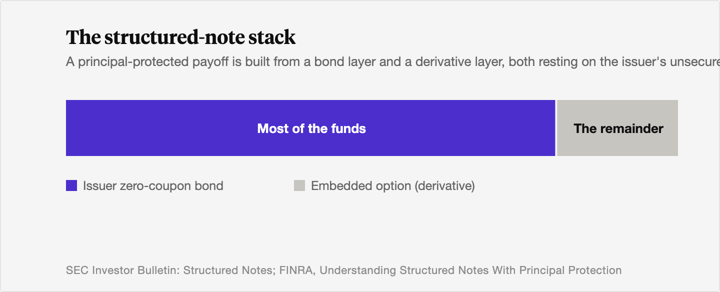
Imagine you hand a bank $10,000 for a two-year note linked to the S&P 500. Internally, the bank might set aside most of that money in a zero-coupon bond that grows back to roughly $10,000 by maturity, then spend the rest buying call options on the index. The bond is what lets the issuer promise your principal back. The options are what give you the upside. That two-part construction is the entire product. Everything else, the buffers and caps and coupons, is a different way of slicing those same two pieces.
The reference asset can be almost anything. The SEC lists "equity indexes, a single equity security, a basket of equity securities, interest rates, commodities, and/or foreign currencies." [3] The bank is not buying that asset for you. It is promising a formula.
2. The main payoff types, in plain terms
Structured notes come in a handful of recurring shapes. The names vary by issuer, but the engineering reduces to a few patterns.
Principal-protected notes (PPNs). These promise to return some or all of your principal at maturity "regardless of how the underlying assets perform," in exchange for capped or reduced upside. [1] A note might give you "100% of all funds invested at the end of two years, plus an enhancement of any rise in the performance of the S&P 500 up to 20%." [3] You are trading away the tail of the upside to protect the downside. The protection only applies if you hold to maturity, and only if the issuer is solvent.
Participation rates. Many notes do not give you the full move of the reference asset. A 50% participation rate means a 20% gain in the index pays you 10%. [3] You are buying a fraction of the exposure.
Buffered and barrier notes. A buffer absorbs the first slice of a loss. A 10% buffer means the index can fall 10% before you lose anything; below that, you take losses beyond the buffer. A barrier (or knock-in) is harsher and binary. As the SEC describes it, if the reference asset "falls below a pre-specified level during the term of the note, you may lose some or all of your principal investment at maturity." [3] Above the barrier you are protected; one tick below and the protection can vanish entirely.
Autocallables. These pay an above-market coupon as long as the reference index stays above a coupon barrier on each observation date, and they can be "automatically called" early if the index is at or above a call threshold, returning your principal and ending the note. [9] The appeal is the coupon. The risks are that a severe drop past the barrier exposes your principal to the full decline, and that an early call forces you to reinvest, possibly at lower rates. [9]
3. The risk that matters most: you are an unsecured creditor
The safe-sounding names tend to bury this: when you buy a structured note, you are lending money to the issuing bank. Your principal protection, your buffer, your coupon, all of it is a promise from that bank, backed by nothing but the bank's own balance sheet.
FINRA states it directly: any guarantee "is only as good as the financial strength of the company making that promise," and "you could lose all of your investment if the issuer of your note is unable to pay its obligations or goes bankrupt." [1] These are "unsecured debt obligations of the issuer." [3] No collateral. No segregated account. In a bankruptcy, you stand in line with the other unsecured creditors.
4. Lehman Brothers, and why the credit risk is not theoretical
The cleanest illustration of this risk has a date attached: September 15, 2008. In the months before Lehman Brothers filed for bankruptcy, its notes were sold to retail investors under the name "100% Principal Protection Notes." The protection was real on paper and worthless in practice, because it was Lehman's promise, and Lehman went to zero.
In April 2011, FINRA fined UBS Financial Services $2.5 million and ordered $8.25 million in restitution over the sale of these notes. [8] FINRA found that UBS "presented the investments in a way that caused clients to think that the notes came with 100% principal protection" and made omissions that "did not stress that the PPNs were unsecured obligations of Lehman Brothers." [8] Investors, FINRA concluded, were unaware "the notes were only protected to the extent that Lehman Brothers was capable of paying." [8] The same year, the SEC and FINRA issued a joint warning to retail investors about structured notes carrying principal-protection labels. [5]
The lesson is not that structured notes are a scam. It is that the word "protection" describes a claim on a specific company, and companies fail. The protection and the credit are the same thing.
5. The market is large, and regulators are watching it
This is not a niche corner. U.S. structured note sales hit a record $149.4 billion in 2024, a 46% jump from the prior year, with $139.9 billion registered with the SEC and $9.5 billion sold under private programs. [7] Registered note volume alone had first crossed $100 billion only in 2023. [7] Higher rates made the bond component cheaper to build, which let issuers offer more attractive terms, and demand followed.
Regulators have noticed. In May 2026, FINRA announced a review of firm practices around "higher-risk structured products, specifically non-principal protected worst-of structured notes," focused on how firms supervise client concentrations in them and comply with Regulation Best Interest. [6] FINRA noted that these notes "can expose investors to losses not correlated with overall market conditions" and that "some investors have lost significant portions of their portfolios." [6] When the rule-maker is studying how a product is being sold, that is a signal worth reading.
6. Fees, opacity, and the issuance-price problem
Structured notes carry costs, and the costs are designed to be hard to find. FINRA notes the fees "can be relatively high and sometimes difficult to determine or understand." [1] The mechanism is built into the price. The SEC warns that the price you pay at issuance "will likely be higher than the fair value of the structured note on the date of issuance." [3]
In practice, that gap covers the dealer's selling concession, the bank's structuring margin, and hedging costs, all embedded in the headline price rather than billed separately. You do not see a line item. You see a note priced at 100 that may be worth 96 or 97 on day one. Over a two- or three-year hold, a few points of upfront drag is a meaningful bite out of a capped return, and it is the reason a buffer is rarely as cheap as it looks.
7. Liquidity: built to hold, hard to sell
A structured note is engineered around a maturity date, and its protections generally only apply if you reach it. The trouble comes if you need out early. The SEC is blunt: "A liquid market for structured notes does not exist." [3] Notes are not listed on an exchange, and "there's no guarantee of a secondary market." [1]
If you must sell before maturity, the issuer or a dealer may make a bid, but it can be "at a significant discount to its face value." [1] You are exposed to the issuer's own pricing, the embedded fees coming back out of your proceeds, and whatever the market has done to the embedded derivative. This is the same illiquidity trade familiar from other private and semi-liquid vehicles. We have written about that dynamic in interval funds and across the broader alternatives universe. The discipline is the same: do not put money into a structured note that you may need before the maturity date.
8. Tax treatment is complicated, sometimes uncertain
The tax picture is its own reason for caution. The SEC states plainly that "the tax treatment of structured notes is complicated and in some cases uncertain." [3] Because a note bundles a debt instrument with a derivative, the IRS treatment of the coupon, the embedded option, and the final payoff does not always map cleanly onto ordinary income, capital gains, or original-issue-discount rules.
Different note structures can be taxed in different ways, and the issuer's own view of the tax treatment, disclosed in the offering documents, is not binding on the IRS. For a taxable account, that uncertainty is a cost. Anyone considering a note in size should price in a conversation with a tax adviser, not just read the term sheet.
9. When and for whom structured products make sense
We are not in the business of selling notes, so take this as the read of an outside analyst. Structured products can fit a specific investor with a specific view. The Financial Planning Association's journal has described them as a tool for shaping equity exposure through volatile periods, and that is a fair frame. [11] A buffered note can suit someone who wants index exposure but cannot stomach the full drawdown, who has a defined holding period, and who is comfortable underwriting the issuer's credit for that term.
They fit poorly for an investor who needs liquidity, who is reaching for the coupon without reading the barrier, or who is concentrating a large share of a portfolio in the notes of one or two banks. That last case is exactly what FINRA flagged in 2026. [6] The honest summary: a structured note is a credit-and-derivatives package wearing the costume of a bond, and it should be sized and held like the credit instrument it is.
10. The art-relevance bridge: shaped payoffs versus real assets
Why does any of this appear on an art-investing platform? Because the investor reaching for a structured note is usually trying to solve the problem we hear most often: how to get equity-like return with less of the drawdown. That is the same decision space that leads people to low-correlation real assets.
The two routes are genuinely different, and we will be honest about both. A structured note engineers its payoff by layering an issuer's credit under an embedded derivative. You trade away upside to buy a buffer, and the buffer is only as sound as the bank behind it. A real, scarce asset like blue-chip art carries no issuer or counterparty credit on the asset itself. No bank's solvency stands between you and the painting on the wall. What art does not offer is principal protection of any kind. Art is illiquid, it can lose value, and there is no maturity date that hands your money back.
So the contrast is not protection versus no protection. It is engineered protection backed by credit versus an unengineered asset whose value comes from scarcity and demand. Art's correlation to equities has historically run near zero, with its highest correlation to gold around 0.1 to 0.2, which is the property an investor is usually after when they consider a buffered note in the first place. We size art as a long-term, illiquid allocation, typically a single-digit percentage of a portfolio, for the same reason a note should be sized as a credit position. For the fuller version of that argument, see our work on art as an alternative allocation and what the data shows about art and portfolio drawdowns. Neither art nor a structured note is a free lunch. Knowing precisely what you are underwriting in each is the entire point.
Sources
- FINRA. "Understanding Structured Notes With Principal Protection." FINRA.org. https://www.finra.org/investors/insights/structured-notes-principal-protection
- U.S. Securities and Exchange Commission. "Structured Notes with Principal Protection: Note the Terms of Your Investment." SEC.gov. https://www.sec.gov/investor/alerts/structurednotes.htm
- U.S. Securities and Exchange Commission, Office of Investor Education and Advocacy. "Investor Bulletin: Structured Notes." Investor.gov. https://www.investor.gov/introduction-investing/general-resources/news-alerts/alerts-bulletins/investor-bulletins-76
- U.S. Securities and Exchange Commission. "Structured Notes with Principal Protection." Investor.gov alert. https://www.investor.gov/introduction-investing/general-resources/news-alerts/alerts-bulletins/investor-bulletins/structured
- U.S. Securities and Exchange Commission and FINRA. "SEC, FINRA Warn Retail Investors About Investing in Structured Notes with Principal Protection." Press release 2011-118, June 2, 2011. https://www.sec.gov/news/press/2011/2011-118.htm
- FINRA. "FINRA Announces Review of Higher-Risk Structured Products." News release, May 2026. https://www.finra.org/media-center/newsreleases/2026/finra-announces-review-higher-risk-structured-products
- Structured Retail Products. "US Market Review 2024: market size and issuers breakdown." StructuredRetailProducts.com, 2025. https://www.structuredretailproducts.com/insights/80658/us-market-review-2024-market-size-and-issuers-breakdown
- InvestorLawyers. "FINRA Orders UBS Financial Services to Pay $8.25M for Misleading Investors About Security of Lehman Brothers Principal Protected Notes." https://www.investorlawyers.com/blog/finra-orders-ubs-financial-ser/
- CIBC Investor's Edge. "How Autocallable Coupon Buffer Notes Work." https://www.investorsedge.cibc.com/en/learn/investing/structured-notes/autocallable-coupon-buffer-notes.html
- CAIS. "An Introduction to Structured Notes." CAISGroup.com. https://www.caisgroup.com/articles/an-introduction-to-structured-notes
- Financial Planning Association. "Structured Notes as a Tool for Navigating Market Volatility." FPA Journal, December 2025. https://www.financialplanningassociation.org/learning/publications/journal/DEC25-structured-notes-tool-navigating-market-volatility-OPEN
- Mintz. "Structured Notes, Unstructured Compliance Risks: FINRA Wants to Know If Your Firm Has a Plan." Mintz.com, May 26, 2026. https://www.mintz.com/insights-center/viewpoints/54751/2026-05-26-structured-notes-unstructured-compliance-risks-finra
- Art Basel and UBS. "The Art Basel and UBS Global Art Market Report 2026," authored by Dr. Clare McAndrew, Arts Economics. https://www.artbasel.com/stories/the-art-basel-and-ubs-global-art-market-report-2026
Disclosures
Investing involves risk. Past results are not indicative of future outcomes.
Masterworks is providing this communication as an agent for its issuer entities, not Masterworks Advisers. This material is produced by Masterworks for informational purposes only and does not constitute investment advice, a recommendation, or an offer or solicitation to buy or sell any security. Masterworks is not a licensed broker-dealer by the SEC or FINRA.
Masterworks can only make and accept sales after an offering statement has been filed, and "qualified", by the SEC. Any offers may be revoked before notice of qualification. Indications of interest involve no obligation. For further disclosure visit the offering documents filed with the SEC and Important Disclosures at masterworks.com/cd.
Forward-looking statements and internal estimates are based on assumptions that may prove incorrect, and actual outcomes may differ materially. Figures denoted in brackets are subject to confirmation. Investing in art and alternative assets involves risk, including loss of principal.
Art sales price data is comparative only. Each painting is unique and historical data is not a direct proxy for any specific painting or investment. Data represents whole art, not an investment into our offerings which includes fees and expenses. Any comparative images are not currently live offerings and are provided for educational purposes only.
Masterworks, LLC is located at 1 World Trade Center, 57th Floor, New York, NY 10007.


