
Masterworks Research · June 2026
How a 1980 amendment to the 1940 Act turned lending to private companies into a yield product retail investors can buy, what the high distributions actually pay for, and where the structure carries risk.
A business development company, or BDC, is a closed-end fund regulated under the Investment Company Act of 1940 that lends to and invests in small and mid-size private U.S. companies. Congress created the structure in 1980 to channel capital to businesses too small to tap public debt markets, and in exchange for distributing at least 90% of taxable income to shareholders, a BDC pays no corporate-level tax. For retail investors, the appeal is simple to state: a BDC packages private credit, an asset class that for decades was the preserve of pension funds and insurers, into a security an ordinary investor can buy, often at distribution yields of 9% to 11%. The structure deserves attention because it is the clearest example yet of how a once-institutional alternative reached the retail market, and because the yield comes attached to real credit and leverage risk that the headline number does not show.
What You Need to Know
- A BDC is a tax-advantaged lender, not a stock fund. It is a closed-end '40 Act vehicle that must hold at least 70% of assets in "qualifying" investments, mostly loans to private U.S. companies, and must distribute at least 90% of taxable income, which is why yields run high [1][2].
- The yields come mostly from floating-rate senior loans. BDC portfolios are concentrated in senior secured, floating-rate debt, so distributions track short-term base rates. Listed BDC portfolio yields have held around 9% to 11% [3].
- The publicly traded and non-traded versions are very different products. Public BDCs trade on exchanges and recently changed hands near 0.94x net asset value (NAV), a discount. Non-traded "perpetual" BDCs price at NAV but offer only limited quarterly redemptions, capped and subject to board discretion [4].
- A 2018 law doubled how much they can borrow. The Small Business Credit Availability Act let BDCs cut required asset coverage from 200% to 150%, raising the leverage ceiling from 1:1 to 2:1 debt-to-equity. More leverage lifts yield and magnifies loss [5].
- The market has grown fast, and so has the risk it carries. BDC assets rose from roughly $127 billion in 2020 to about $451 billion in 2025, riding the broader private-credit boom toward an estimated $1.75 trillion. The IMF flagged in 2025 that around 40% of private-credit borrowers have negative free cash flow [6][7][12].
1. What a business development company actually is
A BDC is a closed-end investment company, the same legal family as a closed-end mutual fund, but built for a single job: lending to and taking equity stakes in private companies. Congress created the category in 1980 by amending the Investment Company Act of 1940, after deciding that the '40 Act's normal restrictions made it too hard for funds to finance small, growing businesses [1][2].
Three rules define the structure. A BDC must invest at least 70% of its assets in "qualifying assets," which in practice means debt and equity of private or thinly traded U.S. companies. It must offer "managerial assistance" to the companies it backs, a nod to the original development-finance purpose. And to qualify as a regulated investment company for tax, it must distribute at least 90% of its taxable income to shareholders each year, which lets it avoid corporate-level tax much the way a REIT does [1][2].
That last rule is the engine behind the yield. A BDC keeps very little of what it earns, so the interest it collects on its loans flows out to investors as distributions. The high payout is a feature of the tax structure before it is a sign of investment skill.
2. How a BDC gives retail investors access to private credit
Private credit, lending by non-bank institutions directly to companies, was for most of its history an institutional asset class. The minimums ran into the millions, the funds locked capital for years, and access was gated by relationships. A retail investor with a brokerage account had no practical way in.
The BDC changes the access question. Because a BDC is a registered security, its shares can list on an exchange like any stock, and a perpetual non-traded BDC can be sold through advisers in much smaller increments than a traditional private-credit fund. The underlying exposure is the same institutional asset: senior loans to middle-market companies. The wrapper is what is new.
This is the same access innovation we have written about across the alternatives market. A BDC does for private credit roughly what an interval fund does for other private-market strategies: it takes an illiquid institutional asset and fits it into a regulated, retail-purchasable structure with defined liquidity terms. For the asset class itself, see our explainer on what private credit is and why it has grown so fast.
3. Where the high distribution yields come from
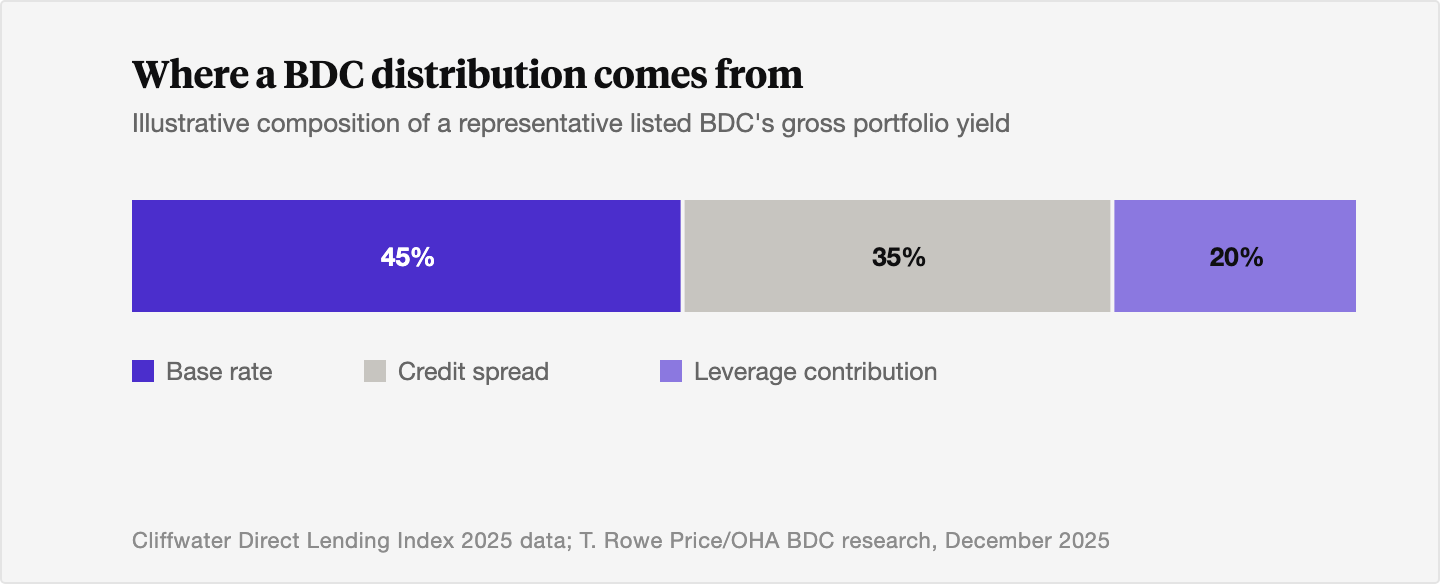
The honest answer is base rates and leverage, not alpha. BDC portfolios are concentrated in senior secured, floating-rate loans, debt that sits at the top of a borrower's capital structure and resets its coupon with a short-term reference rate. When base rates are high, the coupons are high, and so are the distributions. Listed BDC portfolio yields have held in the 9% to 11% range, a level set largely by where short rates sit [3].
The floating-rate feature cuts both ways. It protected BDC income while rates climbed, because the loans repriced upward. It also means distributions fall when base rates fall, a point an investor reaching for a 10% headline yield should price in now rather than later.
Leverage adds the second layer. A BDC borrows to fund more loans than its equity alone could support, so the spread between what it earns on assets and what it pays on its own borrowing accrues to shareholders. That lifts the yield in good periods. It also means a wave of borrower defaults hits a leveraged book harder than an unleveraged one.
4. Publicly traded BDCs versus non-traded perpetual BDCs
For a retail buyer, liquidity, pricing, and fees are where the two products diverge sharply.
A publicly traded BDC lists on an exchange. You can buy and sell it any trading day at the market price, which is the highest liquidity the structure offers. The catch is that the market price floats free of the fund's NAV. After a sell-off that began in mid-2025, public BDCs traded at an average of about 0.94x NAV as of early December 2025, a discount to the roughly 1.03x five-year average, and well below the dollar-for-dollar value of the underlying loans [4].
A non-traded, or perpetual, BDC does not list. It continuously offers and redeems shares at NAV, so the price is not buffeted by daily market sentiment. The trade-off is liquidity: these funds typically repurchase only a limited share count each quarter, commonly capped near 5% of shares outstanding, and the board can cut or suspend redemptions in stressed markets [3][8]. An investor in a perpetual BDC accepts a soft lock-up in exchange for NAV pricing and lower visible volatility.
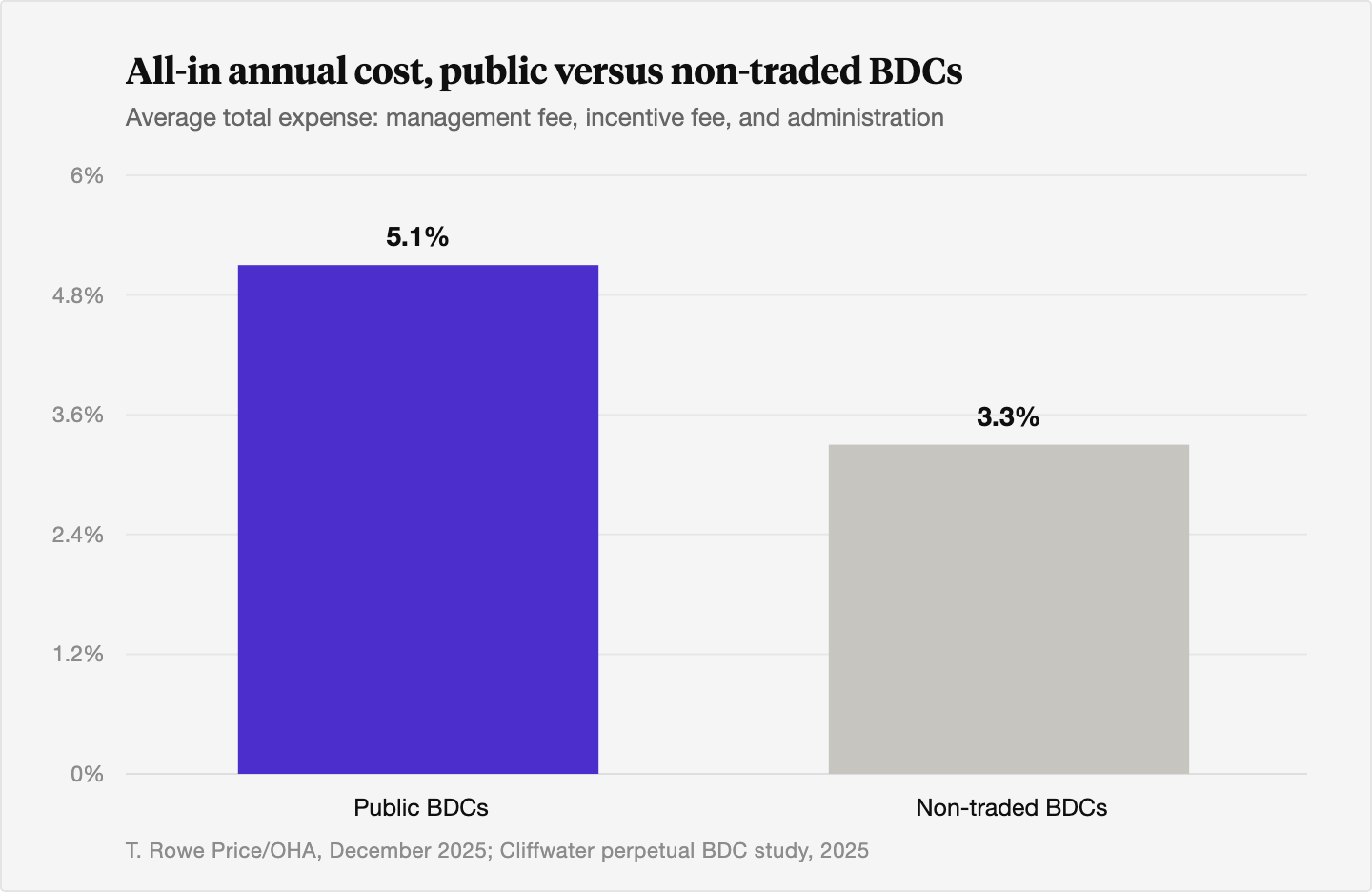
Fees diverge too, in the non-traded vehicle's favor. A 2025 Cliffwater study found perpetual BDCs charged all-in fees averaging 3.31% of NAV, against 5.15% for other BDCs, a structure roughly 36% cheaper [8][9]. We would not over-read the difference. Cliffwater also found perpetual BDCs had yet to show a clear performance edge over their roughly four-year history, returning 9.95% on a net-asset-weighted basis versus 10.18% for non-perpetuals [8].
5. The 2018 leverage change and why it matters
For most of the BDC's history, the 1940 Act required 200% asset coverage, which is a 1:1 debt-to-equity limit. A BDC could borrow $100 for every $100 of equity, and no more [5].
The Small Business Credit Availability Act, signed in March 2018, cut the required asset coverage to 150%, which lifts the ceiling to 2:1 debt-to-equity. A BDC may now borrow up to $200 for every $100 of equity, double the prior cap. The change is not automatic: a BDC must get approval from either its shareholders or a majority of its independent directors, and disclose it publicly [5].
The effect on an investor is direct. More leverage raises the distribution yield in normal conditions, because the spread is earned on a larger loan book. It also raises the loss given a downturn, because borrowings sit ahead of equity and must be repaid first. A 2:1 BDC is a more aggressive instrument than the 1:1 BDC of a decade ago, and the higher yields available today partly reflect that.
6. The double layer of fees
BDCs are externally managed in most cases, and the manager is paid the way a private-equity or hedge-fund manager is paid: a management fee on assets plus an incentive fee on income and gains. All-in costs run high. Public BDCs average roughly 5.1% a year and non-traded BDCs roughly 3.3%, on the figures above [4][9].
The incentive fee is the part that surprises people. A typical BDC charges a base management fee on gross assets, then an additional incentive fee, often around 17.5% to 20%, on net investment income above a hurdle, plus a cut of realized capital gains. Because the management fee is usually charged on gross assets rather than equity, leverage increases the fee base as well as the yield.
The compounding problem worsens when BDCs are bought through a fund-of-funds or a multi-manager platform, where the platform's fee stacks on top of the BDC's own. We have written about this stacking directly in our piece on fund-of-funds and the double layer of fees. The lesson is the same wherever it appears: read the all-in cost, not the headline yield, because the fees are quoted gross and the distribution arrives net.
7. Credit risk and rate risk, the two real exposures
The yield is the reward for credit risk and rate risk.
Credit risk comes first. A BDC's borrowers are private middle-market companies, often leveraged buyouts, that could not raise debt as cheaply in public markets. In a recession, some default. The IMF's 2025 Global Financial Stability Report found that around 40% of private-credit borrowers had negative free cash flow, up from about 25% in 2021, a sign of how far underwriting standards have stretched in the boom [12]. BDC credit quality has held up so far. The Cliffwater Direct Lending Index, covering about $549 billion across roughly 21,000 middle-market loans, returned 9.3% in 2025 with non-accruals and realized losses described as below historical averages, and has posted only one negative year (2008) in two decades [10]. That record was built largely in a benign credit environment, and we would not assume it predicts the next downturn.
Rate risk is the second exposure, and it points the other way. The floating-rate loans that boosted income while rates rose will see their coupons fall when base rates fall, dragging distributions down with them. An investor buying a 10% yield today is buying a number that moves with monetary policy.
Past performance, here as everywhere, is not predictive. A 20-year index with one down year describes the era it covers, not the one ahead.
8. The growth of private credit and the BDC market
The BDC's expansion is a slice of a larger story. After the 2008 crisis, banks pulled back from middle-market lending under tighter capital rules, and non-bank lenders filled the gap. Private credit grew into an estimated $1.75 trillion asset class in 2025, with forecasts from Moody's and others pointing toward $2 trillion to $3 trillion by the late 2020s [7][11].
BDCs grew with it. Total BDC assets rose from roughly $127 billion in 2020 to about $451 billion in 2025, a compound growth rate above 28% a year [6]. The rise of the perpetual non-traded BDC, marketed through wealth platforms, has been a large part of that, and it is the most direct channel through which retail capital has reached private credit. For the wider context, see our overview of what alternative investments are and how they fit a portfolio.
The speed of the inflow is itself a caution. An asset class that quadrupled in five years has not been tested by a full credit cycle in its current, larger, more retail-funded form.
9. The art-relevance bridge: one access innovation among several
We cover BDCs because they are the clearest case study in what is sometimes called the democratization of alternatives. The structure took an institutional asset, private credit, and packaged it into a security an ordinary investor can buy. That is the same move, in a different asset, that a Regulation A+ fractional art platform makes for blue-chip art.
The comparison is about access, not returns, and the honesty is in keeping it there. A BDC pays a contractual yield from interest on senior loans. Fractional art pays no yield at all. Its return, if any, comes from price appreciation in a scarce, illiquid asset whose supply tends to shrink as works enter museums. One is a credit instrument with a coupon and a place in the capital structure. The other is an equity-like claim on cultural scarcity, with a different risk profile and no income.
What the two share is the wrapper, a regulated structure that lets a retail investor hold an asset that used to require an institution's balance sheet. We think that access innovation is the genuinely interesting development. The right way to judge any such product is the same in both cases: read the structure, the fees, and the liquidity terms before the headline number, and size the position to the risk you can actually see.
The Bottom Line
- A BDC is a closed-end '40 Act fund that lends to private U.S. companies, holds at least 70% of assets in qualifying investments, and distributes at least 90% of taxable income, which is why its yields run high.
- The 9% to 11% distribution yields come mainly from floating-rate senior loans and balance-sheet leverage, so they rise and fall with base rates rather than reflecting manager skill.
- Publicly traded BDCs offer daily liquidity but trade away from NAV, recently near a 0.94x discount. Non-traded perpetual BDCs price at NAV but cap redemptions, commonly near 5% of shares a quarter, at the board's discretion.
- A 2018 law doubled the leverage ceiling to 2:1 debt-to-equity, which raises both yield and loss potential, and the fee load is heavy: roughly 5.1% all-in for public BDCs and 3.3% for non-traded ones.
- BDC assets grew from about $127 billion in 2020 to roughly $451 billion in 2025 inside a $1.75 trillion private-credit market, an expansion that has not yet been tested by a full credit downturn.
- BDCs are one model for bringing an institutional alternative to retail. Fractional art is another, with no yield and an equity-like, scarcity-driven return. Compare the access, not the outcomes.
Sources
- U.S. Securities and Exchange Commission. "Business Development Company (BDC)." Investor.gov. https://www.investor.gov/introduction-investing/investing-basics/glossary/business-development-company-bdc
- T. Rowe Price / OHA. "An Introduction to Business Development Companies." https://www.troweprice.com/content/dam/public/enterprise/cobrand/oha/files/Introduction_to_Business_Development_Companies.pdf
- Donnelley Financial Solutions (DFIN). "2025 BDC Market Overview and 2026 Future Outlook." 2025. https://www.dfinsolutions.com/knowledge-hub/blog/2025-bdc-market-overview-and-future-outlook
- T. Rowe Price / OHA. "After Sell-off, Are Public BDCs More Attractive than Non-Traded BDCs?" December 2025. https://www.troweprice.com/en/us/ocredit/insights/after-sell-off-are-public-bdcs-more-attractive-than-non-traded-bdcs
- Simpson Thacher & Bartlett LLP. "BDCs Receive Long-Awaited Regulatory Relief: How Does It Work and Is It Enough?" June 2018. https://www.stblaw.com/about-us/publications/view/2018/06/26/bdcs-receive-long-awaited-regulatory-relief-how-does-it-work-and-is-it-enough
- Mayer Brown. "BDC Facts & Stats." June 2025. https://www.mayerbrown.com/en/insights/publications/2025/06/bdc-facts-stats
- Mordor Intelligence. "Private Credit Market Size & Share Outlook." 2025. https://www.mordorintelligence.com/industry-reports/private-credit-market
- Larry Swedroe. "The Rise and Challenges of Non-Traded Perpetual BDCs." 2025. https://larryswedroe.substack.com/p/the-rise-and-challenges-of-non-traded
- Cliffwater / Larry Swedroe. "Perpetual BDCs Dominate Market Performance in Q2 2025." 2025. https://larryswedroe.substack.com/p/perpetual-bdcs-dominate-market-performance
- PR Newswire / Cliffwater. "Cliffwater Direct Lending Index Data Supports Strength of Private Credit." March 31, 2026. https://www.prnewswire.com/news-releases/cliffwater-direct-lending-index-data-supports-strength-of-private-credit-302730370.html
- Pensions & Investments. "Moody's: private credit to hit $3 trillion by 2028." 2025. https://www.pionline.com/alternative-investments/private-credit/daily-9-3-news-pi-moodys-private-credit-three-trillion-growth-deglobalization-privatization/
- Creative Planning. "The Rise of Private Credit: 2026 Market Trends and Growth Outlook." 2026. https://creativeplanning.com/insights/high-net-worth/rising-popularity-private-credit/
- Kroll. "Mastering Business Development Companies." 2025. https://www.kroll.com/en/publications/financial-compliance-regulation/mastering-business-development-companies
- Dechert LLP. "Small Business Credit Availability Act: Increasing Capital and Flexibility for Business Development Companies." 2018. https://www.dechert.com/knowledge/onpoint/2018/3/small-business-credit-availability-act--increasing-capital-and-f.html
Disclosures
Investing involves risk. Past results are not indicative of future outcomes.
Masterworks is providing this communication as an agent for its issuer entities, not Masterworks Advisers. This material is produced by Masterworks for informational purposes only and does not constitute investment advice, a recommendation, or an offer or solicitation to buy or sell any security. Masterworks is not a licensed broker-dealer by the SEC or FINRA.
Masterworks can only make and accept sales after an offering statement has been filed, and "qualified", by the SEC. Any offers may be revoked before notice of qualification. Indications of interest involve no obligation. For further disclosure visit the offering documents filed with the SEC and Important Disclosures at masterworks.com/cd.
Forward-looking statements and internal estimates are based on assumptions that may prove incorrect, and actual outcomes may differ materially. Figures denoted in brackets are subject to confirmation. Investing in art and alternative assets involves risk, including loss of principal.
Art sales price data is comparative only. Each painting is unique and historical data is not a direct proxy for any specific painting or investment. Data represents whole art, not an investment into our offerings which includes fees and expenses. Any comparative images are not currently live offerings and are provided for educational purposes only.
Masterworks, LLC is located at 1 World Trade Center, 57th Floor, New York, NY 10007.


