
Masterworks Research · June 2026
What you actually pay for diversification and manager access in a fund of funds, why the second fee layer is the catch, and how the same fee stacking shows up in art.
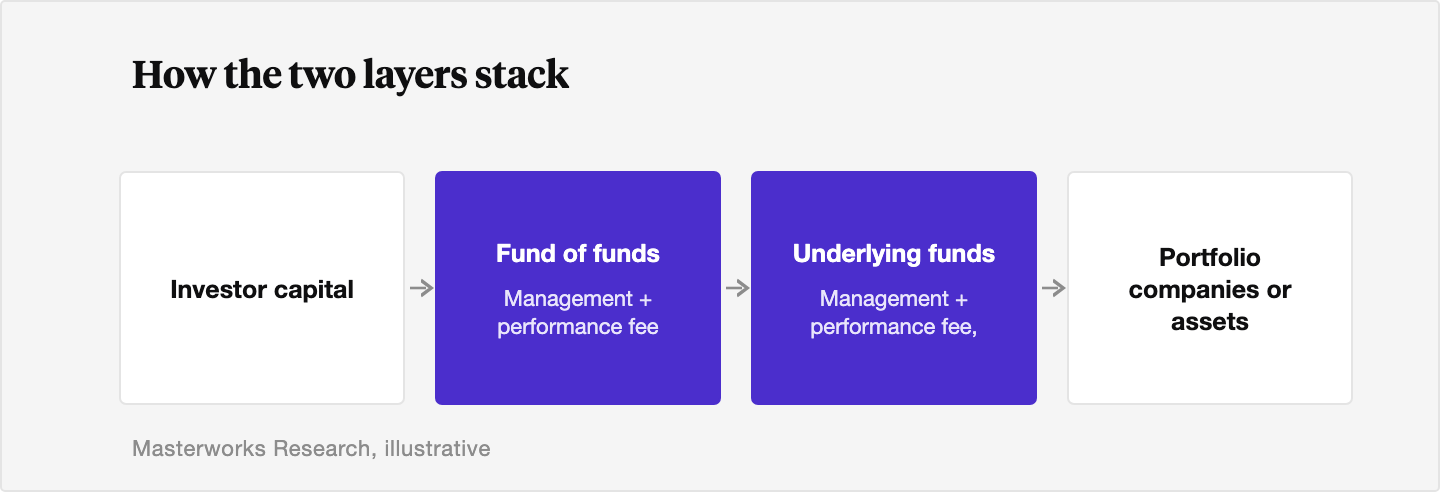
A fund of funds is a fund that buys other funds instead of buying securities directly. You hand your money to one manager, who spreads it across a roster of underlying funds, so a single ticket buys diversification across dozens of strategies and access to managers that are often closed to new investors [1][2]. The catch is fees. You pay the underlying funds their management and performance fees, and you pay the fund of funds a second set on top, which is the double layer that gives the structure its reputation [3][4]. For an investor weighing one, does the diversification and manager selection you are buying clear the extra fee drag. The honest answer is that it depends on the asset class, and the evidence is mixed.
What You Need to Know
- A fund of funds adds a second fee layer. The underlying funds charge their own fees, commonly 2% management and 20% of profits in private markets, and the fund of funds charges its own on top, often around 1% management plus 5% to 10% of gains [3][5]. You pay carry twice on the same dollar of profit.
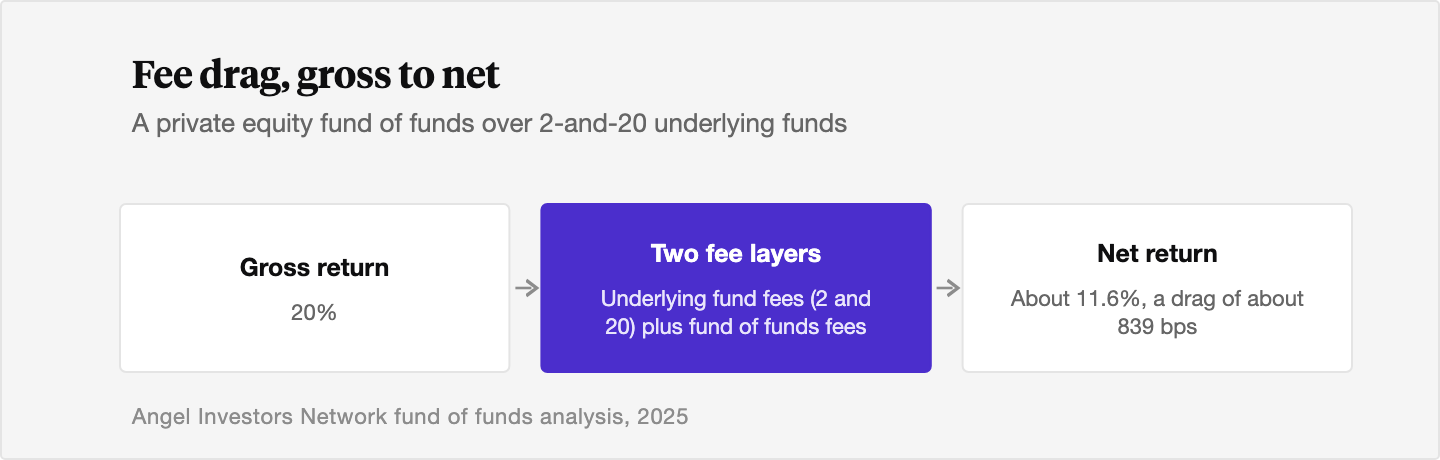
- The fee drag is large and compounds. One worked example puts a 2-and-20 private equity fund under a 1.5-and-10 fund of funds at roughly 11.6% net from a 20% gross return, a drag of about 839 basis points [4]. Over a ten-year fund life the stacked management fees alone can consume on the order of 27% to 30% of committed capital [4].
- The benefit is real but uneven. A study of nearly 300 funds of funds found that venture capital funds of funds matched direct venture investing net of all fees, while buyout funds of funds underperformed direct buyout investing [6]. Manager selection paid for itself in one corner of private equity and did not in another.
- The same stacking appears in art. Closed-end art funds have historically charged private-equity-style fees, roughly 1.5% to 2.5% a year plus 15% to 25% of gains above a 6% to 8% preferred return [7]. Layer a fund of funds over them and the underlying transaction costs of buying and selling paintings sit underneath both [8].
- Transparency is the test. The decision turns on knowing the all-in cost. Read the fee table and the offering documents, total every layer, and judge whether the access you are buying is worth what it costs. Past performance is not predictive.
1. What a fund of funds actually is
A fund of funds, sometimes shortened to FoF, holds a portfolio of other investment funds rather than buying stocks, bonds, or, in private markets, individual companies and assets directly [1]. The industry term for this is multi-manager investing. It exists across the fund universe, from retail mutual funds and target-date funds to private equity, venture capital, and hedge funds, and the logic is the same at every level. One manager, the fund of funds manager, decides which underlying funds to back, sizes each position, and handles the diligence, leaving the investor with a single relationship and a single statement.
Imagine you want exposure to venture capital. Doing it directly means picking funds yourself, meeting minimum commitments at each one, and getting accepted into funds that are frequently oversubscribed and closed to newcomers. A venture fund of funds does that work for you, spreading a single commitment across many underlying funds, and on average a venture fund of funds in one large study held 28 underlying funds [6]. That is the pitch in one line. You buy diversification and access through one door.
2. The case for it: diversification and manager access
The strongest argument for a fund of funds is structural risk management. By spreading capital across dozens of underlying funds and, beneath them, hundreds of companies or assets, the structure makes any single failure close to irrelevant to the whole [2]. For an investor who cannot write enough checks to build that breadth alone, a fund of funds delivers it in one transaction, across vintage years, geographies, and strategies.
Access is the second argument, and in some markets it matters more than diversification. The best private funds are often closed. They raise from a fixed roster of long-standing limited partners and do not take new money. A fund of funds manager who already sits on those rosters can get an allocation that an individual investor cannot [2][4]. You are paying, in part, for a seat that is otherwise unavailable.
The third argument is selection. The premise of any active manager is that skill at picking the underlying funds adds enough return to cover the cost of the picking. Section 4 takes up whether that premise holds. Selection only earns its keep where there is something durable to select on. In markets where past performance carries forward, a good picker has an edge. In markets where it does not, the picking is closer to a coin flip with a fee attached.
3. The double layer of fees, with the math
In private markets, the underlying funds commonly charge what the industry calls 2 and 20: a 2% annual management fee on committed capital, paid regardless of performance, plus 20% of profits above a hurdle, known as carried interest [5][9]. A fund of funds charges its own fees on top. A common structure is roughly 1% management plus 5% to 10% of gains [3][6]. The investor pays both layers, which means carry comes out twice on the same profit, once at the underlying fund and again at the fund of funds.
The arithmetic is unforgiving because fees compound. Take a private equity fund of funds at 1.5% management and 10% carry sitting over underlying funds at the standard 2 and 20. A 20% gross return falls to roughly 11.6% net after both layers, a drag of about 839 basis points [4]. The same source estimates that over a ten-year fund life the stacked management fees alone, before any carry is taken, can consume on the order of 27% to 30% of committed capital [4].
The hedge fund version is the same problem in a different number. If the underlying funds return 12% gross and net 7.6% after their own 2 and 20, a fund of funds layered on top at 1% and 10% can leave the end investor with roughly 5.8% [3]. Almost two full points of the 7.6% you would have kept in a direct allocation goes to the second layer.
Disclosure is the thing most investors miss. For US registered funds, the regulators now require the underlying fees to be shown. Since January 2007 the SEC has required a fund of funds to report the cost of the funds it owns on a line called Acquired Fund Fees and Expenses, so the headline expense ratio reflects the full stack rather than just the top layer [1]. The SEC's own investor guidance is blunt about why this matters: fees are deducted from fund assets and lower your returns, and even small differences compound into large differences over time [10]. In private placements the disclosure lives in the offering documents rather than a standardized table, which puts more of the work on the investor.
4. When it is worth it: the evidence is split by asset class
The cleanest evidence on whether a fund of funds earns its fees comes from a study by Robert Harris, Tim Jenkinson, Steve Kaplan, and Rüdiger Stucke, which examined nearly 300 funds of funds formed between 1987 and 2007 [6]. Both buyout and venture funds of funds beat public equity benchmarks net of all fees, a specific and useful finding. The difference shows up when you compare them to investing directly in the underlying funds.
Venture capital funds of funds matched direct venture fund investing, net of the extra fee layer [6]. Buyout funds of funds did not. They underperformed direct buyout investing, because the fee drag was not offset by enough selection skill [6]. The authors point to two reasons venture works where buyout does not. Venture has more performance persistence, meaning top managers tend to stay top managers, so a skilled picker has something real to pick on. And venture funds of funds were more diversified, holding 28 underlying funds on average versus 21 for buyout [6].
The lesson translates cleanly into investing terms. A fund of funds is worth its second fee layer where two things hold at once: the underlying market has persistence that rewards selection, and the fund of funds buys you access you genuinely could not get alone. Where past performance does not carry forward, you are paying an active fee for an outcome that may not beat a broad, cheaper basket. This is the same reason we have long preferred a low-cost basket of an asset class to a single expensive position. The S&P 500 exists because most investors do better owning the index than guessing the one stock.
5. How fee layering shows up in art
Art funds tell the same fee story, and the bridge is worth drawing because the structure is identical. Closed-end art funds have historically charged private-equity-style economics: roughly 1.5% to 2.5% in annual management fees, plus a performance fee of 15% to 25% of gains above a preferred return commonly set at 6% to 8%, over fund lives of seven to ten years with minimums frequently between $250,000 and $1 million [7]. The carry mechanics here are the same as the private equity carry we cover in our explainer on how carried interest works. The manager takes a slice of the upside once a hurdle is cleared.
Now layer a fund of funds over a set of art funds, and the stacking returns. You pay the art funds their management and performance fees, you pay the fund of funds its own, and underneath all of it sit the transaction costs of buying and selling the paintings themselves: auction buyer's premiums, seller's commissions, insurance, storage, and restoration. Those underlying costs do not appear in either fee layer. They are absorbed inside the funds before any return reaches you. The Deloitte Private and ArtTactic Art and Finance Report, the standard reference for the sector, has tracked rising interest in art funds and fractional structures among family offices and younger collectors, which makes the fee question more relevant rather than less [8].
History supplies the most cited art-fund example. The British Rail Pension Fund put about 40 million pounds, around 3% of its assets, into roughly 2,400 works starting in 1974, using Sotheby's for advice, and earned an annualized return of about 11.3% over the holding period to the late 1990s [11][12]. That is a real, credible art return. It also came with the same caveat every layered structure carries: the fund's equities returned considerably more over the same window, and the art result was measured before you stack a second manager's fees on top [11]. Past performance is not predictive, and a single historical fund is not a forecast.
We will not state Masterworks-specific fees here, because the all-in economics of any offering live in its filed offering documents, where they belong. The general point stands regardless of platform. Whenever you invest in art through a managed structure, total every layer before you judge the return, the same discipline you would apply to a private equity fund of funds. For the broader question of where art fits in a portfolio at all, see our framework for advisors on art as an alternative allocation.
6. The transparency test
The decision on any fund of funds reduces to a single question you can answer with the documents in front of you: what is the all-in cost, and is the access and selection you are buying worth it. That requires totaling every layer. The fund of funds management fee, its performance fee, the underlying funds' management fees, their carry, and, in private and art markets, the transaction costs sitting beneath all of it.
Fee transparency is not a nicety here. It is the whole analysis. A structure that looks like a 1% fund can carry an effective cost several times that once the underlying layers are added, which is exactly why the SEC forced the Acquired Fund Fees and Expenses disclosure for registered funds [1][10]. In private placements, where that standardized line does not exist, the burden falls on you to read the offering documents and do the addition. The fund of funds that earns its fees is the one where a manager with genuine access and a market with real performance persistence justifies the second layer. The one that does not is a more expensive way to buy something you could have bought for less. The same logic applies whether the underlying funds hold companies or paintings. For a direct comparison of art's risk and return against the private fund world, see our piece on art versus venture capital and our explainer on how private equity works.
The Bottom Line
- A fund of funds buys diversification and manager access through a single commitment, which has real value where the best underlying funds are closed to individual investors.
- The cost is a second fee layer stacked on top of the underlying funds, so management and performance fees are charged twice, and the drag compounds over a fund's life.
- A worked private equity example shows roughly 839 basis points of drag, cutting a 20% gross return to about 11.6% net, with stacked management fees alone consuming on the order of 27% to 30% of committed capital over ten years.
- The evidence is split by asset class. Venture capital funds of funds have matched direct investing net of fees, while buyout funds of funds underperformed it, because selection skill pays off only where performance persists.
- Art funds carry the same private-equity-style economics, and a fund of funds over them stacks fees on top of the underlying costs of buying and selling paintings, which makes totaling every layer the step that matters most.
- Read the fee table or the offering documents, add up the full cost, and judge the access against it. Past performance is not predictive.
Sources
- Wikipedia. "Fund of funds." Accessed June 2026. https://en.wikipedia.org/wiki/Fund_of_funds
- Moonfare. "What is a Fund of Funds: Definition, Benefits and Structure." Accessed June 2026. https://www.moonfare.com/glossary/fund-of-funds-fof
- Ryan O'Connell, CFA. "Hedge Fund Fee Structures: 2-and-20, High-Water Marks, and Hurdle Rates." RyanOConnellFinance.com, 2024. https://ryanoconnellfinance.com/hedge-fund-fee-structures/
- Angel Investors Network. "Fund of Funds: Double Fees, Returns and When It Makes Sense." Accessed June 2026. https://angelinvestorsnetwork.com/alternative-investments/fund-of-funds-investing-guide
- Carta. "Management Fees: A Guide to Fee Structures in Private Funds." Accessed June 2026. https://carta.com/learn/private-funds/management/management-fees/
- Chicago Booth Review. "Only One Type of Private-Equity Fund of Funds Earns Its Fees." Citing Harris, Jenkinson, Kaplan, and Stucke, working paper, May 2017. Accessed June 2026. https://www.chicagobooth.edu/review/only-one-type-private-equity-fund-funds-earns-its-fees
- MOMAA. "Art Investment Funds and Institutional Vehicles." Accessed June 2026. https://momaa.org/art-investment-funds/
- Deloitte Luxembourg. "A snapshot of the last Deloitte Private and ArtTactic Art and Finance Report." Performance Magazine, 2024. https://www.deloitte.com/lu/en/Industries/investment-management/blogs/snapshot-last-deloitte-private-arttactic-art-finance-report.html
- U.S. News and World Report. "Fund-of-Funds Fees: 3 Things You Need to Know." Accessed June 2026. https://money.usnews.com/investing/articles/fund-of-funds-fees
- U.S. Securities and Exchange Commission. "Mutual Fund and ETF Fees and Expenses, Investor Bulletin." Investor.gov. https://www.investor.gov/introduction-investing/general-resources/news-alerts/alerts-bulletins/investor-bulletins/mutual-fund-and-etf-fees-and-expenses-investor-bulletin
- The Actuary. "How art helped British Rail beat inflation." March 7, 2025. https://www.theactuary.com/2025/03/07/how-art-helped-british-rail-beat-inflation
- Britannica. "British Rail Pension Fund." Accessed June 2026. https://www.britannica.com/topic/British-Rail-Pension-Fund
- CAIS. "What's Behind the Continued Growth in Private Markets Secondaries?" Accessed June 2026. https://www.caisgroup.com/articles/whats-behind-the-recent-growth-in-private-markets-secondaries
- Moonfare. "Private equity secondaries in 2025: market in motion." Accessed June 2026. https://www.moonfare.com/white-papers/private-equity-secondaries-in-2024
Disclosures
Investing involves risk. Past results are not indicative of future outcomes.
Masterworks is providing this communication as an agent for its issuer entities, not Masterworks Advisers. This material is produced by Masterworks for informational purposes only and does not constitute investment advice, a recommendation, or an offer or solicitation to buy or sell any security. Masterworks is not a licensed broker-dealer by the SEC or FINRA.
Masterworks can only make and accept sales after an offering statement has been filed, and "qualified", by the SEC. Any offers may be revoked before notice of qualification. Indications of interest involve no obligation. For further disclosure visit the offering documents filed with the SEC and Important Disclosures at masterworks.com/cd.
Forward-looking statements and internal estimates are based on assumptions that may prove incorrect, and actual outcomes may differ materially. Figures denoted in brackets are subject to confirmation. Investing in art and alternative assets involves risk, including loss of principal.
Art sales price data is comparative only. Each painting is unique and historical data is not a direct proxy for any specific painting or investment. Data represents whole art, not an investment into our offerings which includes fees and expenses. Any comparative images are not currently live offerings and are provided for educational purposes only.
Masterworks, LLC is located at 1 World Trade Center, 57th Floor, New York, NY 10007.


