
Masterworks Research · June 2026
Why most family fortunes fade within three generations, and the structures, governance, and durable assets that let a few of them last.
Generational wealth is family capital that survives past the person who created it, usually defined as wealth that lasts into a third generation and beyond. Building the fortune is the easy part. Keeping it is where most families come undone. The most cited study on the subject, a 20 year review of more than 3,200 affluent families by the Williams Group, found that roughly 70% of families lose their wealth by the second generation and about 90% by the third [1]. This matters now more than at any point in living memory, because Cerulli Associates projects that $124 trillion will change hands in the United States through 2048, with more than $62 trillion of it coming from the roughly 2% of households that are high net worth or ultra high net worth [2]. The families who keep their wealth tend to get three things right: they prepare the next generation, they govern the money like an institution, and they own durable, low correlation assets that can be passed down rather than spent down.
What You Need to Know
- The three generation pattern is real, even if the exact numbers are folklore. The 70% and 90% failure figures trace to the Williams Group and a 1987 study that critics, including commentary published by the CFA Institute, call methodologically thin [3]. The direction holds: most families do not keep a concentrated fortune past the third generation.
- The cause is almost never investing. In the adviser summaries of the Williams Group work, more than 60% of failures trace to a breakdown of trust and communication, about 25% to heirs who were never prepared, and under 5% to investment or tax mistakes [1].
- The transfer ahead is the largest in history. Cerulli puts the U.S. number at $124 trillion through 2048; UBS puts the global figure at about $83 trillion over 20 to 25 years [2][4]. Roughly $46 trillion of the U.S. total is expected to reach Millennials over 25 years [2].
- The 2026 tax window is unusually wide. The One Big Beautiful Bill Act set the federal estate, gift, and generation skipping exemption at $15 million per person, $30 million per married couple, effective January 1, 2026, with no sunset and inflation indexing thereafter. The top estate tax rate stays at 40% [5][6].
- Durable real assets are a tool for the transfer, not just the return. Art is a case study in low turnover and low correlation. In the Art Basel and UBS collecting survey, 72% of collectors who inherited art kept at least some of it, and among ultra high net worth collectors art accounts for about a quarter of total wealth [7].
1. The build phase: concentration creates wealth, and then becomes the risk
Almost every large fortune starts the same way. Someone took a concentrated, often leveraged bet and was right. A founder held most of their net worth in one company. A family ran one operating business for decades. Concentration is how wealth gets made, and the people who made it usually know it in their bones.
The problem is that the same concentration that built the fortune is the single largest threat to keeping it. Whittier Trust, the family office, makes the point plainly: once wealth is established, diversification is the one reliable way to limit the risk of total loss, and the concentrated position that created the wealth should be rebalanced over time rather than held out of sentiment [8]. A single business can become obsolete in a generation. A single stock can fall 80% and never recover. The first job of wealth preservation is to convert a winning bet into a portfolio that can survive being wrong.
This is where most build stage families stall. They are excellent at the thing that made them rich and reluctant to diversify away from it. We see the investing version of this constantly in art, where a collector owns one artist deeply and treats the position as identity rather than allocation. The discipline that matters is boring: take some chips off the table, spread the risk across asset classes, industries, and geographies, and accept a lower ceiling in exchange for a much higher floor.
2. The preserve phase: why diversification and real assets do the heavy lifting
Preservation is a different sport from accumulation. The goal shifts from maximizing growth to surviving every environment, including the bad ones that arrive on no schedule.
Diversification is the core of it, and the point of diversification is correlation. True diversification means owning assets that move to their own rhythm, largely indifferent to the forces driving everything else. An asset that simply rises when stocks fall is a lucky hedge. An asset that is structurally indifferent to the equity cycle is real diversification, and it is far more valuable over a multi decade hold.
This is why family offices reach for real assets. Real estate, farmland, infrastructure, gold, and fine art share a few properties that financial claims do not. They are tangible, they tend to hold purchasing power through inflation, and they cannot be issued in unlimited quantity. U.S. Money Reserve and others describe gold and real estate as classic inflation hedges for exactly this reason [9]. The macro case for owning hard assets is straightforward and uncomfortable: the dollar has lost roughly 97% of its purchasing power over the past century, and the inflation that matters most to wealthy families, in real estate, education, and healthcare, has often run at multiples of the headline rate. On an annual basis that erosion looks small. Compounded over the decades a generational plan actually spans, it becomes the main event.
3. The transfer phase: structures move money across generations
Once a family has built and diversified, the question becomes mechanical. How does the capital move to the next generation without being cut in half by tax or torn apart by conflict?
The 2026 backdrop is favorable. The One Big Beautiful Bill Act, signed in July 2025, set the federal estate, gift, and generation skipping transfer tax exemption at $15 million per person and $30 million per married couple beginning January 1, 2026, made it permanent with no scheduled sunset, and indexed it for inflation [5][6]. The IRS confirms the $15 million basic exclusion for 2026 [10]. Above the exemption, the top federal estate tax rate stays at 40% [6]. Every dollar moved out of a taxable estate cleanly is effectively a 40% saving relative to an unplanned transfer, which is why structure matters so much at scale.
The tools are well worn. Dynasty trusts are irrevocable trusts built to last for many generations, in some states effectively forever, funded with the exemption and the generation skipping allocation so that future appreciation grows outside the taxable estate and can reach grandchildren and beyond with little or no further transfer tax [11]. Spousal lifetime access trusts, intentionally defective grantor trusts, and irrevocable life insurance trusts each solve a narrower version of the same problem. Family limited partnerships let the senior generation keep control as general partners while gifting limited interests at valuation discounts that appraisers often support in the 15% to 40% range, depending on the facts [8]. Each of these is a way to pass economic value forward while keeping control, protecting against creditors, and shrinking the estate.
These structures move money efficiently. They do not make the recipients capable of handling it, and that is the part families skip.
4. The real cause of failure: heirs, communication, and governance
When the Williams Group studied why fortunes disappear, the failures were overwhelmingly human. In the adviser summaries of that work, more than 60% traced to a breakdown of trust and communication inside the family, about 25% to heirs who were not prepared to receive the wealth, and roughly 10% to the absence of a shared mission. Under 5% came from investment or tax problems [1].
The thing families spend almost all of their planning energy on, the trusts and the tax structure, accounts for the smallest slice of the failures. The thing they spend almost none of it on, preparing the people, accounts for nearly all of it.
The behavioral pattern behind the curse is consistent. The first generation builds through frugality and risk taking, with vivid memories of scarcity. The second grows up near the struggle and tends to stay responsible. The third grows up with wealth as the baseline, no memory of its creation, and the weakest financial discipline of the three [3]. Many wealth creators make it worse by shielding their children from the money entirely, which protects them right up until the day they inherit a complex portfolio and a family business they were never taught to run [3].
The families who beat the pattern treat the money like an institution. They adopt a family constitution that sets out shared values, spending and employment policies, and rules on who can sell what [12]. They hold regular family council meetings to review the portfolio and the philanthropy. And they prepare heirs deliberately, with real financial education, time spent inside the family business or family office, and supervised pools of capital that let the next generation learn diversification and risk before they are handed the whole thing [13][12]. Governance and education are not soft. On the data, they are the part that decides whether the wealth lasts.
5. The transfer ahead, and why it raises the stakes
This is not an abstract exercise. The largest intergenerational transfer in history is underway. Cerulli projects $124 trillion changing hands in the United States through 2048, with nearly $100 trillion, about 81% of the total, coming from Baby Boomers and older generations [2]. More than $62 trillion is concentrated in the roughly 2% of households that are high net worth or ultra high net worth [2]. Millennials are projected to inherit about $46 trillion over 25 years [2]. Globally, UBS puts the figure near $83 trillion over 20 to 25 years, split into roughly $9 trillion of transfers between spouses and $74 trillion between generations [4].
A number that large guarantees one thing: the three generation pattern is about to run at a scale we have never observed. If the Williams Group ratios even roughly hold, tens of trillions of dollars will be dispersed or consumed rather than preserved as family capital. That is the structural backdrop, and it is the reason families and the advisers who serve them are paying new attention to durable, transferable assets that are designed to be held rather than spent. We cover the art specific side of this shift in our piece on how the $84 trillion wealth transfer is changing art demand, and the family office response in the rise of family offices and why they are allocating to art.
6. Where durable real assets like art fit a multigenerational plan
A multigenerational plan needs assets that are easy to hold for decades, hard to spend on impulse, and likely to keep their value across very different macro environments. Fine art is one of the clearer examples of how a real asset can play that role, even for families who never buy a painting.
Art has unusually low turnover because of what the market calls the 3 D's: most works change hands on death, divorce, or debt, and otherwise sit in families for decades, sometimes across multiple generations. The collecting data shows the same pattern. In the Art Basel and UBS collecting survey, 72% of collectors who inherited art kept at least some of it, even pieces that did not suit their own taste, and a large majority of collectors reported inherited works in their collections [7]. Among ultra high net worth collectors, those above $50 million, art accounts for roughly a quarter of total wealth [7]. These are assets families choose to keep.
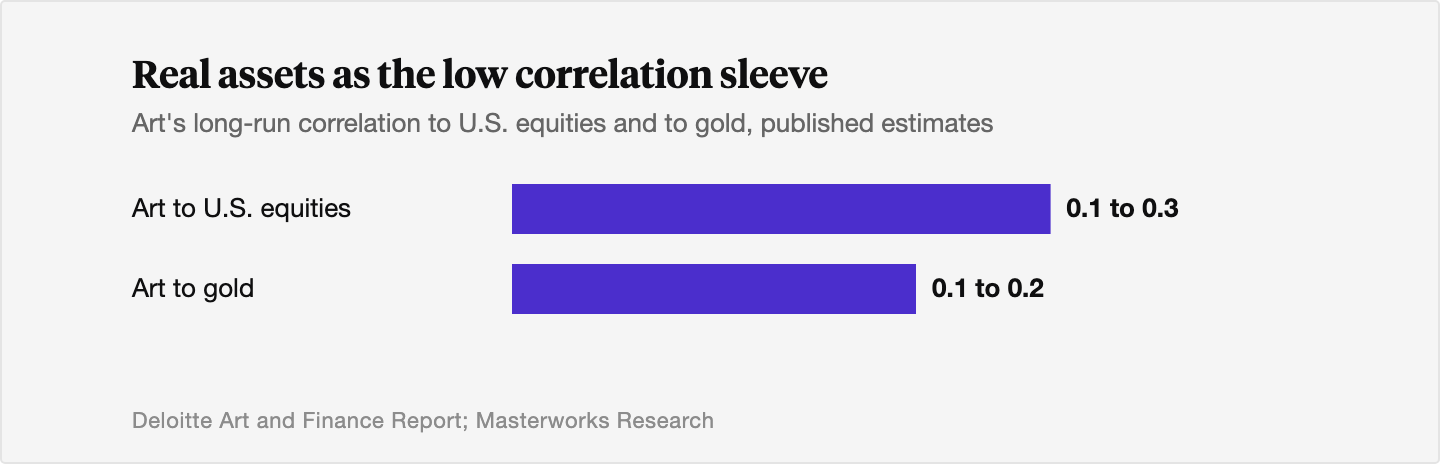
Published estimates put art's long run correlation to equities in a low band, often cited around 0.1 to 0.3, with its highest correlation to gold rather than to stocks [9][14]. Part of the reason is structural. A painting is a portable, almost neutral store of value. You can buy it in New York, put it on a plane, and sell it in Hong Kong. Its price is set by demand at the very top of the wealth distribution, which moves on a different clock from the equity market.
For the top tier of artists, available supply shrinks over time as museums and foundations acquire works and hold them indefinitely. No new Basquiats will ever be painted. There are only so many Pollocks left in private hands. That is a different property from financial claims, which can be issued without limit, and it is the same logic that draws families to gold, with one twist: the supply of museum quality art tends to fall over long holding periods rather than stay fixed.
The investing translation is simple. Art behaves like illiquid, inflation resilient capital with low correlation to the rest of a portfolio, which is exactly the profile a generational plan wants in its real asset sleeve. The market itself is large and institutionally tracked. Global art sales were about $59.6 billion in 2025, up 4% after two years of decline, with public auction sales up 9% to $20.7 billion [15]. The Knight Frank Luxury Investment Index, which tracks art alongside other collectibles, returned about 72.6% over the past decade, modestly ahead of the S&P 500 over the comparable window on Knight Frank's own figures, and fine art auction sales rose 11% in 2025 even as the broader collectibles index was roughly flat [16].
Two honest caveats belong here. Art is illiquid, it carries real holding costs in insurance and storage, and published art indices can overstate returns through survivorship and selection effects. And the foundational rule applies to every figure above: past performance is not predictive of future results. Art is a long term, illiquid allocation, typically a small slice of a portfolio rather than the core of it. Held that way, inside the right structure and passed down rather than sold, it is the kind of asset a multigenerational plan is built around. We lay out the allocation thinking for advisers in art as an alternative allocation, a framework for advisors, and the current data on how family offices size the position in art in multi family office portfolios, current allocation trends.
The Bottom Line
- Building wealth rewards concentration. Keeping it rewards diversification. The first job of a preservation plan is to convert a winning concentrated bet into a portfolio that can survive being wrong.
- Most fortunes fade within three generations, and the cause is human. Trust, communication, and unprepared heirs drive the great majority of failures, while investment and tax mistakes drive under 5%.
- The 2026 tax window is wide. The federal estate, gift, and GST exemption is $15 million per person and $30 million per couple, permanent and inflation indexed, with a 40% top rate above it.
- The structures move the money. Dynasty trusts, family limited partnerships, and related vehicles pass value forward while keeping control, but they do nothing to prepare the people who receive it.
- Governance and heir education are the deciding variables. Families that treat the money like an institution, with a constitution, a council, and real preparation, are the ones that keep it.
- Durable, low correlation real assets like art are tools for the transfer, not just the return. Their low turnover, low correlation, and shrinking supply suit a plan meant to be held across generations. Past performance is not predictive, and art is a small, long term, illiquid allocation.
Sources
- LRM Mauck Mitchell. "Family Wealth Preservation: Reverse the Third Generation Curse." LRM, 2024. https://www.lrmmt.com/family-wealth-preservation-reverse-the-third-generation-curse/
- Cerulli Associates. "Cerulli Anticipates $124 Trillion in Wealth Will Transfer Through 2048." Cerulli, December 2024. https://www.cerulli.com/press-releases/cerulli-anticipates-124-trillion-in-wealth-will-transfer-through-2048
- CFA Institute. "The Third-Generation Wealth Curse: Advisor Solutions." CFA Institute, 2024. https://www.cfainstitute.org/insights/articles/third-generation-wealth-curse-advisor-solutions
- UBS. "Global Wealth Report 2025." UBS, June 2025. https://www.ubs.com/global/en/wealthmanagement/insights/global-wealth-report.html
- Haynes and Boone. "Federal Estate, Gift, and GST Tax Highlights from the One Big Beautiful Bill Act." Haynes Boone, July 2025. https://www.haynesboone.com/news/alerts/federal-estate-gift-and-gst-tax-highlights-from-the-one-big-beautiful-bill-act
- Venable. "Estate Planning in the OBBBA Era: What the $15 Million Exemption Means." Venable, September 2025. https://www.venable.com/insights/publications/2025/09/estate-planning-in-the-obbba-era-what-the-15
- Art Basel and UBS. "The Great Wealth Transfer and the Survey of Global Collecting." Art Basel, 2024. https://www.artbasel.com/stories/great-wealth-transfer-survey-global-collecting-art-market-2024
- Whittier Trust. "Four Strategies for Wealth Preservation." Whittier Trust, 2024. https://www.whittiertrust.com/four-strategies-for-wealth-preservation/
- U.S. Money Reserve. "Wealth Preservation Strategies." U.S. Money Reserve, 2024. https://www.usmoneyreserve.com/news/executive-insights/wealth-preservation-strategies/
- Internal Revenue Service. "What's New, Estate and Gift Tax." IRS, 2025. https://www.irs.gov/businesses/small-businesses-self-employed/whats-new-estate-and-gift-tax
- Frankfurt Kurnit Klein and Selz. "2025-2026 Estate Tax Planning Update: One Big Beautiful Bill Act." FKKS, July 2025. https://fkks.com/news/2025-2026-estate-tax-planning-update-one-big-beautiful-bill-act
- Legal Journeys. "How to Keep Wealth in Your Family for Generations." Legal Journeys, 2024. https://legaljourneys.com/how-to-keep-wealth-in-your-family-for-generations/
- Kelly Partners. "Preserving Family Wealth." Kelly Partners, 2024. https://www.kellypartners.com.au/blog/preserving-family-wealth
- Berkley One. "Art and the Great Wealth Transfer." Berkley One, March 2025. https://www.berkleyone.com/2025/03/10/art-and-the-great-wealth-transfer/
- Art Basel and UBS. "The Art Basel and UBS Global Art Market Report 2026: Global art sales rose 4% to USD 59.6 billion in 2025." Art Basel, March 2026. https://www.artbasel.com/stories/the-art-basel-and-ubs-global-art-market-report-2026
- Knight Frank. "The Wealth Report: Our Luxury Investment Index Results 2026." Knight Frank, April 2026. https://www.knightfrank.com/research/article/2026/4/knight-frank-luxury-investment-index-luxury-holds-steady
Disclosures
Investing involves risk. Past results are not indicative of future outcomes.
Masterworks is providing this communication as an agent for its issuer entities, not Masterworks Advisers. This material is produced by Masterworks for informational purposes only and does not constitute investment advice, a recommendation, or an offer or solicitation to buy or sell any security. Masterworks is not a licensed broker-dealer by the SEC or FINRA.
Masterworks can only make and accept sales after an offering statement has been filed, and "qualified", by the SEC. Any offers may be revoked before notice of qualification. Indications of interest involve no obligation. For further disclosure visit the offering documents filed with the SEC and Important Disclosures at masterworks.com/cd.
Forward-looking statements and internal estimates are based on assumptions that may prove incorrect, and actual outcomes may differ materially. Figures denoted in brackets are subject to confirmation. Investing in art and alternative assets involves risk, including loss of principal.
Art sales price data is comparative only. Each painting is unique and historical data is not a direct proxy for any specific painting or investment. Data represents whole art, not an investment into our offerings which includes fees and expenses. Any comparative images are not currently live offerings and are provided for educational purposes only.
Masterworks, LLC is located at 1 World Trade Center, 57th Floor, New York, NY 10007.


