
Masterworks Research · June 2026
What revocable, irrevocable, and dynasty trusts actually do, the tax-for-control trade each one asks you to make, and why families increasingly use them to hold appreciating art across generations.
A trust is a legal arrangement where one party, the trustee, holds and manages assets for the benefit of others, the beneficiaries, under terms the grantor sets when funding it. The three types most families encounter sit on a spectrum of control: a revocable living trust keeps you fully in command and changes nothing about your taxes, an irrevocable trust asks you to give up control in exchange for moving assets out of your taxable estate, and a dynasty trust extends that bargain across many generations so wealth can compound for decades without being taxed again at each death. For investors holding assets that appreciate over long horizons, including fine art, the choice of trust shapes how much of that growth actually reaches the next generation. This is general education, not legal or tax advice, and the right structure depends on facts only an estate attorney can assess for you.
What You Need to Know
- A trust trades control for tax efficiency, and the three main types sit at different points on that line. Revocable trusts keep control and offer no estate-tax benefit. Irrevocable trusts give up control and can remove assets from the taxable estate. Dynasty trusts do the same across generations.
- The 2026 federal estate, gift, and GST exemption is $15 million per person, made permanent. The One Big Beautiful Bill Act, signed July 4, 2025, raised the exemption to $15 million for 2026 (roughly $30 million for a married couple) and removed the scheduled cut that would have halved it after 2025 [1][2].
- The generation-skipping transfer tax is a flat 40%, and a dynasty trust is built to avoid paying it repeatedly. The GST tax hits transfers to grandchildren and later generations at the top estate-tax rate of 40% [3][4]. Allocate the GST exemption once when the trust is funded, and all later growth stays sheltered.
- Appreciation moved into a trust early can shelter far more than the exemption you spend. A $3 million asset that grows to $18 million inside a dynasty trust uses only $3 million of exemption, and the $15 million of growth moves forward free of GST tax [5].
- Art is one of the harder assets to plan for, because it is illiquid and taxed at 28% on sale. Long-term gains on art and collectibles are taxed at 28%, above the 20% top rate for stocks, plus a possible 3.8% surtax, and a qualified appraisal is required at $5,000 or more [6][7].
1. What a trust is, and the one tradeoff that defines every type
Start with the mechanics, because the jargon hides a simple structure. A trust has three roles. The grantor (also called the settlor) creates and funds it. The trustee holds legal title and manages the assets under the trust's terms. The beneficiaries receive the benefit, whether income, distributions, or the assets themselves over time. Those three roles can overlap. In a revocable trust, the same person is often grantor, trustee, and primary beneficiary at the same time.
The single question that separates one trust from another is how much control the grantor keeps. Control and tax efficiency pull in opposite directions. The more power you retain to change the trust, take assets back, or benefit from them, the more the IRS still treats those assets as yours, and the less the trust does to lower your estate tax. The more control you give up, the more the assets can move outside your taxable estate. The distinctions between trust types are different answers to that one tradeoff.
Two motives push families toward trusts in the first place. The first is avoiding probate, the public court process that settles a will, which can be slow and is a matter of public record. Assets titled in a trust pass to beneficiaries privately, under the trust's terms, without probate. The second is tax: keeping more of an estate out of reach of the federal estate tax and the generation-skipping transfer tax. Revocable trusts deliver the first. Irrevocable and dynasty trusts are built for the second.
2. Revocable living trusts: control kept, taxes unchanged
A revocable living trust is the most common starting point, and the easiest to understand. You create it during your life, you can change or cancel it whenever you want, and you typically name yourself as trustee so you keep managing your own assets exactly as before. When you die, a successor trustee you named distributes the assets under your instructions, privately, without probate.
A revocable trust gives you no estate-tax advantage and no asset protection during your life [8]. Because you keep the power to revoke it, the IRS still counts everything in it as yours. You report the trust's income on your personal return, and the full value is included in your taxable estate at death [8]. Creditors and lawsuits can still reach the assets, because the law still treats them as belonging to you [9].
Its job is probate avoidance, privacy, and continuity. If you own property in more than one state, a revocable trust can spare your heirs multiple probate proceedings. If you become incapacitated, your successor trustee can step in without a court-appointed guardian. For many people the revocable trust is the backbone of a plan, with the tax-saving work done by other tools layered on top. It does one job well. Tax reduction is not that job.
3. Irrevocable trusts: control given up, estate reduced
An irrevocable trust is the mirror image. Once you fund it, you generally cannot amend it, revoke it, or take the assets back. You have given them away. In exchange, those assets, and their future growth, can sit outside your taxable estate [9].
The bargain is permanent loss of control for a permanent reduction in what the estate tax can touch. For families whose wealth is approaching or past the exemption, that can be the difference that moves millions out from under a 40% top estate-tax rate. Irrevocable trusts also offer real asset protection, since assets you no longer own are harder for your future creditors to reach [9].
An irrevocable trust is usually its own taxpayer, filing its own return, and trust income tax brackets are compressed sharply. A trust can reach the top 37% federal bracket at only about $15,650 of retained taxable income, a level an individual would not hit until several hundred thousand dollars [9]. Many irrevocable trusts are deliberately drafted as "grantor trusts," where the grantor still pays the income tax personally, which lets the trust assets grow untaxed by income tax and effectively passes more to beneficiaries.
One tradeoff cuts the other way and matters a great deal for appreciated assets like art. Assets you transfer into an irrevocable trust during life generally keep your original cost basis (carryover basis), so heirs inherit the built-in gain. The IRS confirmed in Revenue Ruling 2023-2 that assets in an irrevocable grantor trust that are not included in your taxable estate do not get the step-up in basis at death [10]. Assets you hold until death and pass through your estate generally do get that step-up, erasing the built-in gain. The planning question becomes whether the estate-tax savings of moving an asset out now outweigh the capital-gains cost of losing the step-up later. For a low-basis work of art expected to keep appreciating, that is a real calculation, and it is exactly the kind of question to put to an estate professional.
4. The estate tax and GST context: what changed for 2026
None of these trusts make sense without the numbers they are built around, and those numbers just moved.
For deaths in 2026, the federal basic exclusion (the estate and gift tax exemption) is $15 million per person, confirmed directly by the IRS. The One Big Beautiful Bill Act, signed into law July 4, 2025, amended the tax code to set the exclusion at $15,000,000 for 2026 and indexed it to inflation thereafter [1]. A married couple can shield roughly $30 million combined. The annual gift tax exclusion, the amount you can give any number of people each year with no effect on your lifetime exemption, is $19,000 per recipient in 2026 [1].
The headline for planners is what did not happen. Under prior law the elevated exemption was scheduled to be cut roughly in half at the end of 2025. The OBBBA removed that sunset and made the higher exemption permanent, so the use-it-or-lose-it pressure that drove a wave of 2024 and 2025 gifting has eased [2]. Permanent is a word the tax code uses loosely. A future Congress can change it. For now, the cliff is gone.
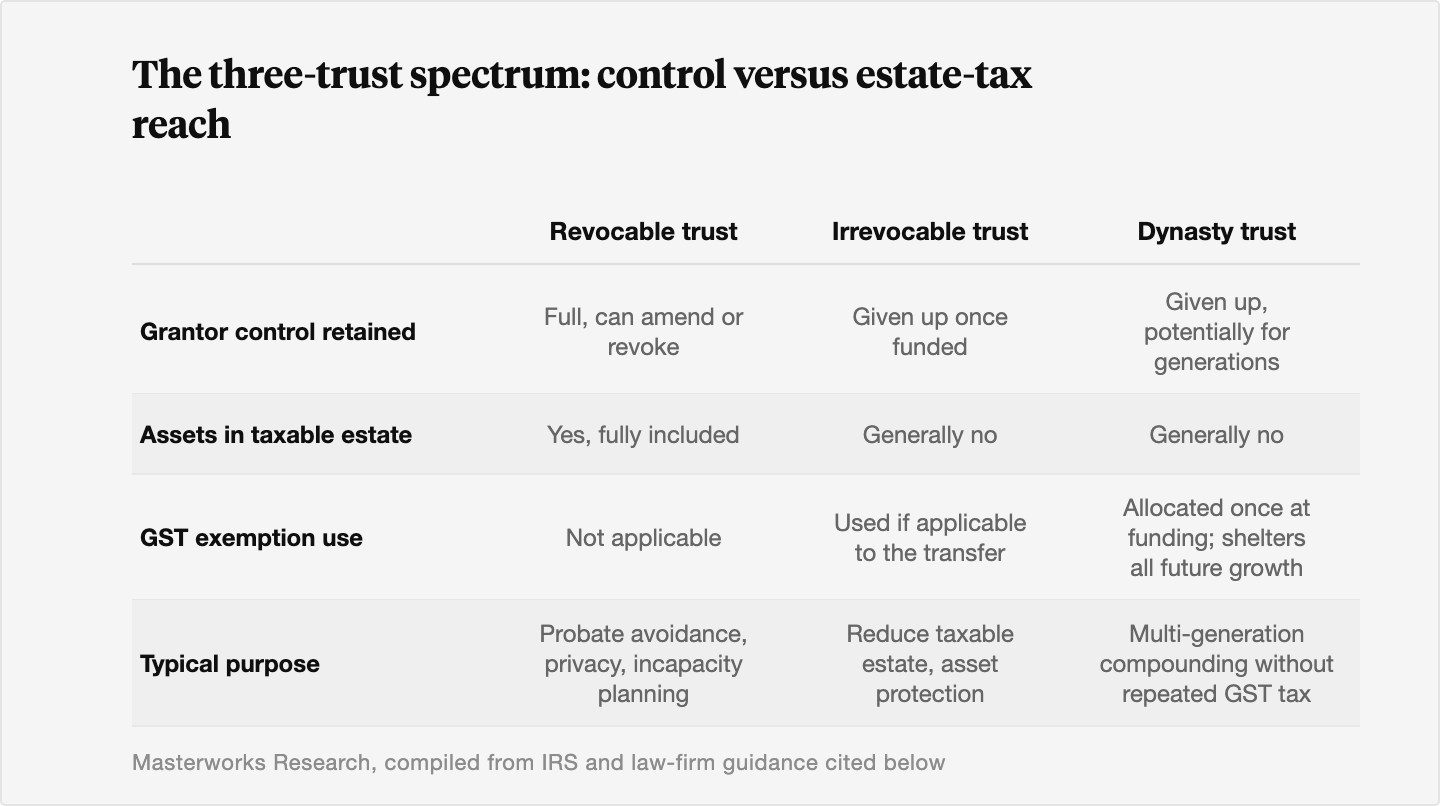
Above the exemption, the top federal estate tax rate is 40% [4]. Sitting alongside it is the generation-skipping transfer (GST) tax, introduced in 1986 to stop families from skipping a layer of estate tax by leaving wealth directly to grandchildren [3]. The GST tax applies to transfers to a "skip person," generally someone two or more generations below you, such as a grandchild, or any unrelated person more than 37.5 years younger [3]. The GST rate is a flat 40%, matching the top estate rate, and it stacks on top of any gift or estate tax already due [3]. There is a separate $15 million GST exemption for 2026, and unlike the estate exemption it is not portable between spouses, so each spouse must use their own [3]. The three trusts answer these numbers differently, as Exhibit 1 lays out.
5. Dynasty trusts: compounding across generations without taxing each one
A dynasty trust is an irrevocable trust built to last as long as the law allows, holding wealth for children, grandchildren, great-grandchildren, and beyond without that wealth being taxed again at each generation's death [5][11].
When you fund the trust, you allocate your GST exemption to it. If you put in $15 million and allocate $15 million of exemption, the trust has a "zero inclusion ratio," meaning it is fully sheltered from the GST tax. From that point on, every dollar of growth, and every distribution to descendants for the entire life of the trust, stays free of estate and GST tax regardless of how large the trust becomes [4]. You spend the exemption once, at funding. The shelter then covers all future appreciation.
That is why dynasty trusts reward early funding of assets you expect to grow. A business interest worth $3 million today that grows to $18 million inside the trust over 20 years has used only $3 million of exemption, and the entire $15 million of growth moves forward free of GST tax [5]. Compare that to leaving the same asset to be taxed at each generation. Across three or four generations, a 40% bite at each death compounds against you. The dynasty trust removes that recurring drag, and the tax-free compounding is the whole point [11].
The duration depends on where the trust is set up. An old common-law doctrine, the rule against perpetuities, historically barred trusts from running much beyond about 21 years past the life of someone alive when the trust was created. A number of states have abolished or sharply extended that rule, letting trusts run for centuries or forever. South Dakota, Nevada, Delaware, Alaska, Wyoming, and New Hampshire are among the jurisdictions most often used for perpetual trusts, and South Dakota and Nevada are widely regarded as the leading dynasty-trust jurisdictions in 2026 [12][13]. You do not have to live in those states to use their trust law, which is why so many dynasty trusts are sited there.
The tradeoff scales with the ambition. A dynasty trust is irrevocable and long-lived by design, so you are giving up control not for years but potentially for generations. The terms you write today govern people not yet born. Good drafting builds in flexibility, through trustee discretion, trust protectors, and decanting provisions, but the core trade is the same one from Section 3, taken to its extreme. Most families who use them have estates large enough that the recurring 40% transfer-tax savings clearly outweigh the loss of control.
6. Common use cases, and where each trust fits
The types map to needs more than to net worth alone.
A revocable living trust fits almost anyone who wants to avoid probate, keep an estate private, own property across several states cleanly, or plan for possible incapacity. It is the default container for a plan.
An irrevocable trust fits families with estates approaching or above the $15 million exemption, owners of rapidly appreciating assets they want to freeze in their estate at today's value, and people in high-liability professions who want assets shielded from future creditors [9]. Specialized versions handle specific jobs: an irrevocable life insurance trust keeps a policy's payout out of the estate, a grantor retained annuity trust transfers appreciation on an asset with little gift-tax cost, and a charitable remainder trust converts an appreciated asset into a lifetime income stream while benefiting charity, covered in our companion piece on charitable remainder trusts and other giving vehicles.
A dynasty trust fits families thinking in generations rather than years, who want a single appreciating pool, often a business, a securities portfolio, or a collection, to compound for descendants without the 40% transfer tax recurring at each death [11]. It is the structural backbone of the kind of multi-generational planning we describe in how families build and keep generational wealth.
In practice these are layered. A typical plan might pair a revocable trust for probate avoidance with one or more irrevocable trusts for the tax work, and a dynasty trust for the assets meant to stay in the family longest. The right combination is specific to a family's assets, state, and goals, which is why this is work for an estate attorney and tax advisor, not a template.
7. Holding and transferring art and collections through trusts
Art is one of the harder assets to plan around, and one of the most rewarding to get right, because the works families most want to keep are often the ones that have appreciated the most. The same trust structures apply, but art adds three complications worth understanding before you sit down with an advisor.
The first is valuation. Unlike a public stock, a painting has no daily price, and the IRS knows it. A qualified appraisal by a qualified appraiser is required when art is gifted or reported for tax at $5,000 or more, and works valued at $50,000 or above can be referred to the IRS Art Advisory Panel for review [7][6]. Because value is a matter of expert judgment within a range, art held in a properly structured entity can sometimes support valuation discounts for lack of control and lack of marketability, which can reduce the transfer-tax cost of moving it into a trust, though only when there is a genuine purpose behind the structure [6]. This is technical ground. It is where good and bad planning diverge.
The second is illiquidity and the tax on sale. Art does not trade on demand, and a forced sale to raise cash, say to pay an estate-tax bill, can mean selling into a soft market at a poor price. When art is sold, the gain is taxed as a collectible at a top federal rate of 28%, above the 20% top rate that applies to stocks, and it can also draw the 3.8% net investment income surtax [6][7]. Holding the work rather than selling it, inside a trust built to last, sidesteps that sale entirely and lets the asset keep compounding. This connects directly to the case for treating fine art as a long-term, low-correlation holding that we lay out in art as an alternative allocation for advisors. Past performance is not predictive, and art carries real risks, including illiquidity and loss of principal, but the long hold period that frustrates a seller is exactly what a dynasty trust is designed to accommodate.
The third is the basis tradeoff from Section 3, which bites hardest on art. A low-basis work moved into an irrevocable trust during life keeps its carryover basis, so a future sale carries the full built-in gain at the 28% collectibles rate [10]. The same work held until death and passed through the estate generally gets a step-up that erases that gain. For a piece expected to keep appreciating, the family has to weigh the estate-tax savings of moving it out now against the capital-gains cost of losing the step-up. There is no single right answer, and it turns on the size of the estate, the basis in the work, and how long the family intends to hold.
For families with collections substantial enough to plan around, trusts also coordinate with charitable vehicles. A work donated to a museum or a private foundation can generate an income-tax deduction and remove the asset from the estate, while a charitable remainder trust can convert a single appreciating work into a lifetime income stream, again, see our piece on charitable remainder trusts. The interest in keeping appreciating works inside families is itself a demand force in the market, part of the broader generational shift we cover in how the 84 trillion dollar wealth transfer is changing art demand.
Structuring art into a trust is among the more specialized corners of estate planning, touching valuation, basis, illiquidity, insurance, and state trust law all at once. Treat this as background for a better conversation with an estate attorney and tax advisor, not a substitute for one.
The Bottom Line
- A trust is a tradeoff between control and tax efficiency, and the three main types sit at different points on that line: revocable keeps control and saves no estate tax, irrevocable gives up control to shrink the taxable estate, and dynasty extends that bargain across generations.
- The 2026 federal estate, gift, and GST exemption is $15 million per person, made permanent by the One Big Beautiful Bill Act, which removed the cut that had been scheduled for the end of 2025.
- The generation-skipping transfer tax is a flat 40%, and a dynasty trust is built to pay it once at funding rather than at each generation's death, letting growth compound tax-free for the life of the trust.
- Art adds three complications inside any trust: it requires a qualified appraisal, it is illiquid and taxed at 28% on sale, and moving it in during life can cost the heirs the step-up in basis.
- The right structure is specific to a family's assets, state, and goals. This is education, not advice, and the work belongs with a qualified estate attorney and tax advisor.
Sources
- Internal Revenue Service. "What's new, Estate and gift tax." IRS.gov, accessed June 2026. https://www.irs.gov/businesses/small-businesses-self-employed/whats-new-estate-and-gift-tax
- Haynes Boone. "Federal Estate, Gift and GST Tax Highlights from the One Big Beautiful Bill Act." Haynes Boone Alerts, 2025. https://www.haynesboone.com/news/alerts/federal-estate-gift-and-gst-tax-highlights-from-the-one-big-beautiful-bill-act
- Fidelity. "Generation-skipping transfer tax (GSTT) explained." Fidelity Viewpoints, 2026. https://www.fidelity.com/viewpoints/wealth-management/insights/generation-skipping-transfer-tax
- Charles Schwab. "The Case for Establishing a Dynasty Trust." Schwab Learn, 2026. https://www.schwab.com/learn/story/case-establishing-dynasty-trust
- Uncle Kam. "How Wealthy Families Are Using the $15M GST Exemption to Protect Generational Wealth in 2026." Uncle Kam Tax Strategy Blog, 2026. https://unclekam.com/tax-strategy-blog/wealthy-individual-generation-skipping-strategies-2026/
- Hailey-Petty Law Firm. "Estate Planning Tips for Art Collections and Valuation." Hailey-Petty Law Firm, 2025. https://haileypettylaw.com/estate-planning-tips-for-art-collections-and-valuation/
- Fiduciary Trust. "Estate Planning for Art and Personal Property." Fiduciary Trust Insights, accessed June 2026. https://www.fiduciary-trust.com/insights/estate-planning-for-art/
- Gentreo. "Living (Revocable) Trusts versus Irrevocable Trusts and Taxes: What You Need to Know." Gentreo, 2025. https://www.gentreo.com/living-revocable-trusts-versus-irrevocable-trusts-and-taxes-what-you-need-to-know
- MetLife. "Revocable vs. Irrevocable Trust: What's the Difference?" MetLife Stories, 2025. https://www.metlife.com/stories/legal/revocable-vs-irrevocable-trust/
- National Law Review. "IRS Disallows Step-Up in Tax Cost Basis for Assets Held by an Irrevocable Grantor Trust." The National Law Review, accessed June 2026. https://natlawreview.com/article/irs-disallows-step-tax-cost-basis-assets-held-irrevocable-grantor-trust
- Creative Planning. "How Dynasty Trusts Help Preserve Wealth." Creative Planning Insights, 2026. https://creativeplanning.com/insights/estate-planning/dynasty-trusts-help-preserve-wealth/
- Wealth.com. "Location, Location, Legacy: The Top Trust Jurisdictions You Need to Know in 2026." Wealth.com Resources, 2026. https://www.wealth.com/resources/articles/location-location-legacy-the-top-trust-jurisdictions-you-need-to-know-in-2026/
- Aaron Hall. "How Long Can a Dynasty Trust Last by State?" Attorney Aaron Hall, 2025. https://aaronhall.com/dynasty-trust-perpetuity-period-by-state/
- Nelson Mullins. "2026 Estate and Gift Tax Update." Nelson Mullins Tax Reports, 2026. https://www.nelsonmullins.com/insights/blogs/tax-reports/all/2026-estate-and-gift-tax-update
Disclosures
Investing involves risk. Past results are not indicative of future outcomes.
Masterworks is providing this communication as an agent for its issuer entities, not Masterworks Advisers. This material is produced by Masterworks for informational purposes only and does not constitute investment advice, a recommendation, or an offer or solicitation to buy or sell any security. Masterworks is not a licensed broker-dealer by the SEC or FINRA.
Masterworks can only make and accept sales after an offering statement has been filed, and "qualified", by the SEC. Any offers may be revoked before notice of qualification. Indications of interest involve no obligation. For further disclosure visit the offering documents filed with the SEC and Important Disclosures at masterworks.com/cd.
Forward-looking statements and internal estimates are based on assumptions that may prove incorrect, and actual outcomes may differ materially. Figures denoted in brackets are subject to confirmation. Investing in art and alternative assets involves risk, including loss of principal.
Art sales price data is comparative only. Each painting is unique and historical data is not a direct proxy for any specific painting or investment. Data represents whole art, not an investment into our offerings which includes fees and expenses. Any comparative images are not currently live offerings and are provided for educational purposes only.
Masterworks, LLC is located at 1 World Trade Center, 57th Floor, New York, NY 10007.


