
Masterworks Research · June 2026
How a charitable remainder trust turns a low-basis asset into an income stream plus a deduction, where the other giving vehicles fit, and why highly appreciated art is a classic candidate.
A charitable remainder trust (CRT) is an irrevocable trust under Internal Revenue Code Section 664 that pays an income stream to one or more individual beneficiaries for life or up to 20 years, then passes whatever remains to charity. Because the trust itself is generally exempt from income tax, it can sell an appreciated asset without paying capital gains at the time of sale, and the donor takes a partial income tax deduction up front equal to the present value of the charitable remainder. [1][2] For an investor sitting on a low-basis, highly appreciated holding, that combination of deferred gain, an income stream, and a current deduction is the reason CRTs exist. Highly appreciated fine art, taxed at a federal collectibles rate of up to 28%, is one of the assets these strategies were built around. [3]
What You Need to Know
- A CRT splits one gift into two interests. You (or named individuals) keep an income stream for a term of life or up to 20 years, and a charity gets the remainder. The trust is tax-exempt, so it can sell a contributed asset without an immediate capital gains hit, and you take a current deduction equal to the present value of the remainder. [1][2]
- The payout has hard limits. Annual payouts must run between 5% and 50%, and the present value of the charitable remainder must be at least 10% of the contributed value, or the trust fails to qualify under Section 664. [1][2]
- A charitable lead trust is the mirror image. The charity is paid first, for a term of years, and the remainder passes to heirs at a reduced transfer-tax cost. CRTs pay you first. CLTs pay charity first. [4]
- Donor-advised funds and private foundations are simpler levers. A DAF gives an immediate fair-market-value deduction (up to 30% of AGI for long-term appreciated property) with low administration. A private foundation gives control, at the cost of lower deduction limits and a 1.39% excise tax. [4][5]
- Appreciated art is a textbook candidate, with one rule that decides the deduction. Under the related-use rule, art used by the charity in its exempt purpose can support a fair-market-value deduction. Art the charity will simply sell is generally limited to your cost basis. [3][6] This is general education, not tax or legal advice; consult a qualified professional.
1. What a charitable remainder trust actually does
A CRT is what tax law calls a split-interest trust, and the tax result follows from that structure. You contribute an asset to an irrevocable trust, the trust pays an income stream to one or more individual (non-charitable) beneficiaries, and at the end of the term the remaining principal goes to one or more qualified charities. [1][2]
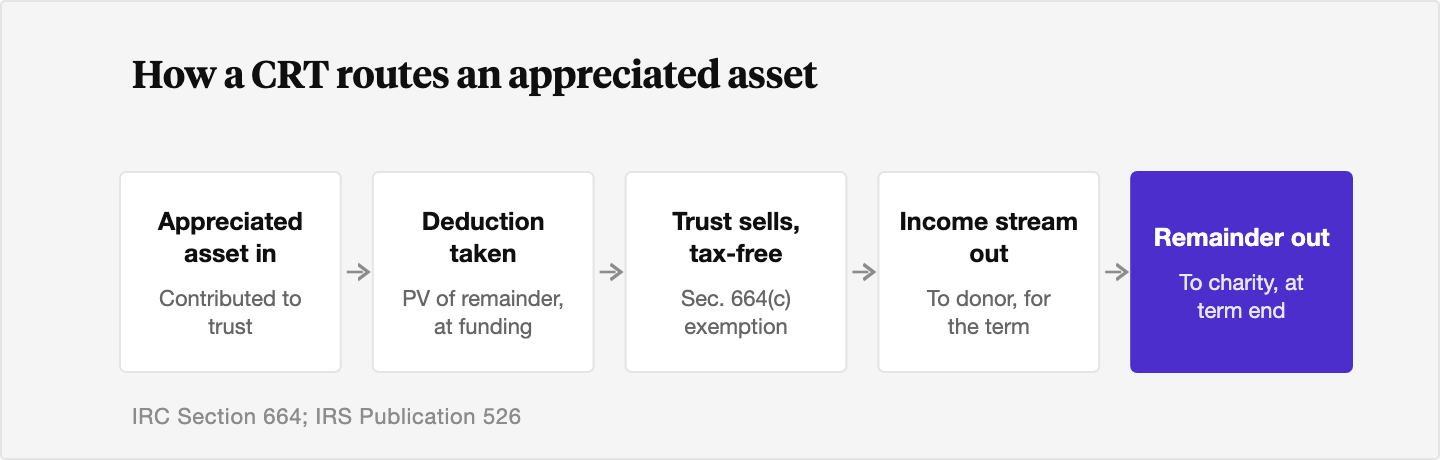
The mechanism that makes this attractive is the trust's tax status. Under Section 664(c), a qualifying CRT is generally exempt from federal income tax. [2] So when the trust sells an asset you contributed, the trust does not pay capital gains tax at the moment of sale. The full pre-tax proceeds stay inside the trust and can be reinvested to support the payout.
The gain is deferred rather than erased. Distributions to you carry out income under a four-tier ordering system in Section 664(b): ordinary income first, then capital gain, then tax-exempt income, then a tax-free return of principal. [1][2] So the capital gain is recognized over time as you draw the income stream, rather than all at once at the sale. For a low-basis asset, spreading a large gain across many years can be meaningful on its own.
You also get a partial charitable income tax deduction in the year you fund the trust. It equals the present value of the charitable remainder interest, calculated under Section 170 using the Section 7520 rate and the IRS actuarial tables. [1][2] You are not deducting the full value of the asset, because you kept the income interest. You are deducting the slice the charity will eventually receive. Exhibit 1 traces the full path of a contributed asset through the trust.
2. CRAT or CRUT: the two ways to set the payout
A CRT comes in two forms, and the difference is how the annual payout is calculated.
A charitable remainder annuity trust (CRAT) pays a fixed dollar amount every year, set as a percentage of the asset value at funding. The dollar figure never changes, no matter how the trust's investments perform. You cannot add to a CRAT after it is funded. [1][2]
A charitable remainder unitrust (CRUT) pays a fixed percentage of the trust's assets, revalued each year. The dollar amount moves with the trust: higher in strong years, lower in weak ones. A CRUT also lets you make additional contributions over time. [1][2]
Both forms share the same statutory guardrails. The annual payout must be at least 5% and no more than 50% of the relevant value. [1][2] And both must satisfy a separate test: the present value of the charitable remainder must be at least 10% of the value you put in. [1][2] A payout set too high, or a term set too long for a young beneficiary, can push the remainder below 10% and disqualify the trust. The arithmetic depends on the beneficiary's age, the term, the payout rate, and the Section 7520 rate in the month of the gift.
The practical read: a CRAT suits someone who wants a predictable, fixed income. A CRUT suits someone who wants the income to track the portfolio, with the option to add assets later.
3. The charitable lead trust: the same idea, reversed
A charitable lead trust (CLT) takes the CRT structure and flips the order of who gets paid. The charity receives the lead interest, a stream of payments for a term of years, and the remainder passes to non-charitable beneficiaries, usually the donor's heirs, at the end. [4]
Like a CRT, a CLT comes in annuity and unitrust flavors. A charitable lead annuity trust (CLAT) pays the charity a fixed amount each year. A charitable lead unitrust pays a fixed percentage of trust value, revalued annually. [4]
The reason a family reaches for a CLT is usually estate and gift tax planning rather than income. When the trust is funded, the value of the charity's lead interest is subtracted from the taxable gift of the remainder under Sections 2522 and 2055. [4] If the assets in the trust grow faster than the Section 7520 rate used to value the lead interest, that excess appreciation passes to heirs at a reduced, sometimes negligible, transfer-tax cost. The tradeoff is the same as any irrevocable trust: the assets are committed, the drafting is complex, and you typically need both an attorney and an accountant to run it. CRTs and CLTs are mirror images. You take the income and charity waits in a CRT. Charity takes the income and your heirs wait in a CLT.
4. Donor-advised funds and private foundations: the simpler levers
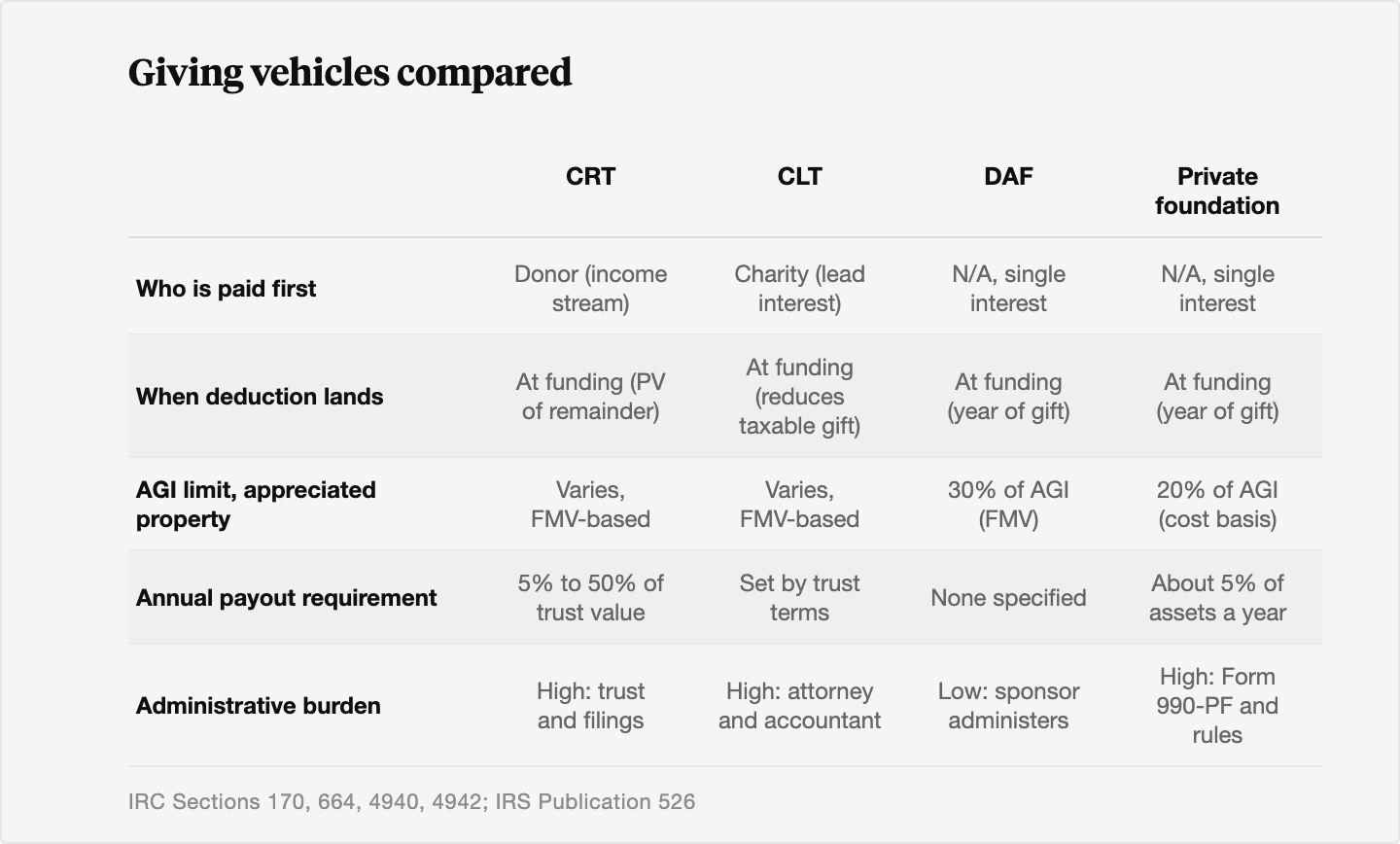
Not every giving plan needs a trust. Two vehicles do most of the work for most donors, and they sit at opposite ends of a control-versus-simplicity range. Exhibit 2 sets all four vehicles side by side.
A donor-advised fund (DAF) is an account held at a sponsoring public charity. You make an irrevocable gift to the sponsor, take a full deduction in the year of the contribution, and then recommend grants to qualified charities over time. [4][5] For long-term appreciated property, the deduction is the fair market value, deductible up to 30% of adjusted gross income, with a five-year carryforward for the excess; cash gifts are deductible up to 60% of AGI. [5] You avoid capital gains on the contributed asset, the sponsor handles the administration, and there is no separate tax return to file. The cost is control: you can advise grants, but the sponsor holds legal title.
A private foundation gives you the opposite trade. You and your family can keep substantial control through the board, run programs, and build a multi-generation legacy. [4] The deduction limits are lower (generally 30% of AGI for cash and, for most appreciated property, your cost basis subject to a 20%-of-AGI ceiling), the foundation must distribute roughly 5% of its assets each year under Section 4942, and it pays a 1.39% excise tax on net investment income under Section 4940. [5] It also carries an annual Form 990-PF filing and strict self-dealing rules.
For scale, US charitable giving reached about $592.5 billion in 2024, up 6.3% in current dollars, with individuals supplying roughly two-thirds of the total. [7] Donor-advised funds remain one of the fastest-growing channels inside that figure. [8]
5. Why appreciated assets are the efficient ones to give
The case for funding any of these vehicles with appreciated property, rather than cash, rests on two stacked benefits.
The first is avoiding the capital gains tax. If you sell a low-basis asset and donate the cash, you recognize the gain and pay tax on it first. If you contribute the appreciated asset directly to a qualifying charity (or to a tax-exempt CRT that sells it), the built-in gain generally escapes tax at the donor level under Section 170 and the related regulations. [7] The charity, being tax-exempt, can usually sell without paying income tax either.
The second is the deduction. For long-term capital gain property given to a public charity and used in a way related to its exempt purpose, you generally deduct the full fair market value, not your cost basis. [3][7]
Put together, no capital gains tax plus a fair-market-value deduction is the reason advisors steer clients toward gifting their most appreciated, lowest-basis holdings. The benefit is largest exactly where the embedded gain is largest and the basis is smallest.
6. Where art fits, and the rules that decide the outcome
Highly appreciated fine art is a classic candidate for these strategies, for a reason rooted in the tax code. Long-term gains on collectibles, a category that includes art, are taxed at a federal rate of up to 28%, against the 20% top rate on most stock, before the 3.8% net investment income tax that can apply to either. [3] The higher the rate you would otherwise pay on a sale, the more a charitable strategy that defers or avoids that tax is worth. A piece bought decades ago that has appreciated many times over is the textbook profile.
One rule decides the size of the deduction: the related-use rule under Section 170(e)(1)(B). If the charity uses the donated art in a way related to its exempt purpose, for example a museum that displays it in its collection, you can generally claim a fair-market-value deduction. If the use is unrelated, for example a charity that simply sells the work, the deduction is generally reduced to your cost basis. [3][6] Donating a painting to a museum that will hang it points toward a fair-market-value deduction. Contributing the same painting to a vehicle that will liquidate it often points toward a basis-only deduction. A CRT or DAF that sells art to fund its payout or its grants raises exactly this question, and it is one to work through with a professional before funding.
The substantiation rules are strict and specific to property. A qualified appraisal by a qualified appraiser is required for any noncash gift valued over $5,000, reported on Form 8283. [9][10] For art, if your claimed deduction is $20,000 or more, you must attach a complete copy of the signed appraisal to your return. [11] And for any single item of art appraised at $50,000 or more, you can request a Statement of Value from the IRS Art Appraisal Services unit, whose Art Advisory Panel reviews the valuation, before you file. [12]
These are general rules, and they interact. A CRT funded with art carries unrelated-business and step-transaction questions if a sale is effectively pre-arranged. The related-use analysis turns on the specific charity and what it does with the work. Valuation of unique objects is genuinely hard, which is why the appraisal apparatus exists. None of this is tax or legal advice. Anyone weighing a charitable gift of art should consult a qualified tax and estate professional who can model the specific facts. Past performance of the art market is not predictive of any individual work's value, and art remains an illiquid, long-term holding.
The Bottom Line
- A charitable remainder trust pays you an income stream for life or up to 20 years, then leaves the remainder to charity, and the trust's tax-exempt status lets it sell an appreciated asset without an immediate capital gains tax.
- CRATs pay a fixed dollar amount; CRUTs pay a fixed percentage of assets revalued each year. Both require a 5% to 50% payout and a charitable remainder worth at least 10% of the contribution.
- A charitable lead trust reverses the order, paying charity first and passing the remainder to heirs at reduced transfer-tax cost, which makes it an estate-planning tool more than an income one.
- Donor-advised funds offer simplicity and a fair-market-value deduction up to 30% of AGI for appreciated property; private foundations offer control at the cost of lower deduction limits, a 5% payout rule, and a 1.39% excise tax.
- Highly appreciated art, taxed at a federal collectibles rate of up to 28%, is a strong candidate for charitable strategies, but the related-use rule and qualified-appraisal requirements shape the result, so the work belongs with a qualified tax and estate professional.
Sources
- The Tax Adviser. "Planning with charitable remainder trusts." AICPA, September 2025. https://www.thetaxadviser.com/issues/2025/sep/planning-with-charitable-remainder-trusts/
- Internal Revenue Service. "Charitable remainder trusts." IRS.gov, accessed June 2026. https://www.irs.gov/charities-non-profits/charitable-remainder-trusts
- DAFgiving360. "Fine art and collectibles." DAFgiving360, accessed June 2026. https://www.dafgiving360.org/non-cash-assets/fine-art-and-collectibles
- DAFgiving360. "Choosing your philanthropic vehicles." DAFgiving360, accessed June 2026. https://www.dafgiving360.org/content/choosing-your-philanthropic-vehicles
- Internal Revenue Service. "Publication 526, Charitable Contributions." IRS.gov, 2025. https://www.irs.gov/publications/p526
- Internal Revenue Service. "Charitable contribution deductions." IRS.gov, accessed June 2026. https://www.irs.gov/charities-non-profits/charitable-organizations/charitable-contribution-deductions
- Indiana University Lilly Family School of Philanthropy. "Giving USA 2025: U.S. charitable giving totaled $592.50 billion in 2024." IU Philanthropy, June 2025. https://philanthropy.indianapolis.iu.edu/news-events/news/_news/2025/giving-usa-2025.html
- National Philanthropic Trust. "Charitable Giving Statistics." NPTrust.org, updated February 2026. https://www.nptrust.org/philanthropic-resources/charitable-giving-statistics/
- Internal Revenue Service. "Instructions for Form 8283 (12/2025)." IRS.gov, December 2025. https://www.irs.gov/instructions/i8283
- Internal Revenue Service. "Form 8283, Noncash Charitable Contributions (Rev. December 2025)." IRS.gov, December 2025. https://www.irs.gov/pub/irs-pdf/f8283.pdf
- Internal Revenue Service. "Publication 561, Determining the Value of Donated Property (12/2025)." IRS.gov, December 2025. https://www.irs.gov/publications/p561
- Internal Revenue Service. "Art Appraisal Services." IRS.gov, accessed June 2026. https://www.irs.gov/appeals/art-appraisal-services
- National Philanthropic Trust. "Navigating charitable giving in the wake of new tax reform." NPTrust.org, 2025. https://www.nptrust.org/philanthropic-resources/philanthropist/navigating-charitable-giving-in-the-wake-of-new-tax-reform/
- Fidelity Charitable. "Charitable remainder trusts." FidelityCharitable.org, accessed June 2026. https://www.fidelitycharitable.org/guidance/philanthropy/charitable-remainder-trusts.html
Related Reading
- Art as an Alternative Allocation: A Framework for Advisors
- What Happens When Masterworks Sells a Work
- Art and 1031 Exchanges: What Changed and What Options Remain
- Tax-Loss Harvesting: Turning Losses Into After-Tax Returns
Disclosures
Investing involves risk. Past results are not indicative of future outcomes.
Masterworks is providing this communication as an agent for its issuer entities, not Masterworks Advisers. This material is produced by Masterworks for informational purposes only and does not constitute investment advice, a recommendation, or an offer or solicitation to buy or sell any security. Masterworks is not a licensed broker-dealer by the SEC or FINRA.
Masterworks can only make and accept sales after an offering statement has been filed, and "qualified", by the SEC. Any offers may be revoked before notice of qualification. Indications of interest involve no obligation. For further disclosure visit the offering documents filed with the SEC and Important Disclosures at masterworks.com/cd.
Forward-looking statements and internal estimates are based on assumptions that may prove incorrect, and actual outcomes may differ materially. Figures denoted in brackets are subject to confirmation. Investing in art and alternative assets involves risk, including loss of principal.
Art sales price data is comparative only. Each painting is unique and historical data is not a direct proxy for any specific painting or investment. Data represents whole art, not an investment into our offerings which includes fees and expenses. Any comparative images are not currently live offerings and are provided for educational purposes only.
This material does not constitute tax, legal, or estate-planning advice. Charitable, trust, and tax rules are complex, fact-specific, and subject to change. Consult a qualified tax, legal, or estate professional before acting.
Masterworks, LLC is located at 1 World Trade Center, 57th Floor, New York, NY 10007.


