Masterworks Research · June 2026
How to tell a fiduciary from a salesperson, what the fee model is really costing you, and the short list of questions that surfaces both.
Choosing a financial advisor comes down to three questions you can answer before you sign anything: is this person a fiduciary to you at all times, how exactly do they get paid, and who actually holds your money. A fiduciary registered investment adviser (RIA) owes you a duty of loyalty and care across the whole relationship under the Investment Advisers Act of 1940. A broker working under Regulation Best Interest owes you a best-interest standard only at the moment of a securities recommendation [1][7]. The two are not the same thing, and the gap between them is where most of the cost and most of the conflict live. For an investor deciding who manages real money, getting this right is worth more over a few decades than almost any single investment call.
What You Need to Know
- Fiduciary status is the first filter, and it is verifiable. An SEC-registered RIA owes a continuous fiduciary duty of loyalty and care under the Advisers Act of 1940. A broker-dealer owes the narrower best-interest standard of Regulation Best Interest, in force since June 30, 2020, and only when recommending a security [1][7]. Ask for the fiduciary commitment in writing, then check it on the regulator's own database.
- The fee model decides whose interests get served. Roughly 1% of assets per year is the common starting rate, dropping at breakpoints as the account grows [3]. Fee-only advisers take no third-party commissions; fee-based and commission advisers can. BlackRock reported that more than 72% of advisor revenue came from asset-based fees in 2024 [4].
- Fees compound against you. On a stylized $1,000,000 portfolio earning 7% a year for 30 years, a 1% annual fee cuts the ending balance from roughly $7.6M to roughly $5.7M, a drag of close to $1.9M [3]. Past performance is not predictive, and the point holds regardless of the return assumption: the percentage compounds.
- Custody is the fraud control. Your assets should sit at an independent third-party custodian such as Schwab, Fidelity, or Pershing, and you should get statements straight from that custodian, not only from the advisor. The Madoff investors had no independent custodian verifying their holdings.
- Advisors are adding alternatives fast, and that now includes art. In the CAIS and Mercer 2025 survey, 92% of advisors already allocate to alternatives and 91% plan to increase that exposure over the next two years [5]. Family offices already hold roughly 29% of portfolios in private markets and commonly carry 5% to 10% of total wealth in art and other passion assets [6].
1. Fiduciary RIA versus broker: the distinction that matters most
Start with the legal duty, because everything else follows from it.
A registered investment adviser is regulated under the Investment Advisers Act of 1940. The SEC reads that statute to impose a federal fiduciary duty, made of a duty of loyalty and a duty of care, that applies across the entire advisory relationship: the account monitoring, the asset allocation, the rollover advice, all of it [1][7]. The adviser has to put your interests ahead of its own, avoid conflicts where it can, and disclose the ones it cannot avoid so you can consent with eyes open.
A broker-dealer operates under the Securities Exchange Act of 1934. Since June 30, 2020, brokers recommending securities to retail customers have been held to Regulation Best Interest, adopted as Exchange Act Rule 15l-1 [1][7]. Reg BI is a real improvement on the old suitability standard, which only required a recommendation to be appropriate rather than the best available option. Reg BI requires the broker to act in your best interest and bars putting its own interests ahead of yours. The catch is scope. The duty attaches at the point of a securities recommendation and does not run continuously between recommendations the way an adviser's duty does [1][7].
Both registrations are public. RIAs and their representatives show up on the SEC's Investment Adviser Public Disclosure system at adviserinfo.sec.gov, which carries the firm's Form ADV with its fee schedule, conflicts, and disciplinary history [8]. Brokers show up on FINRA BrokerCheck at brokercheck.finra.org, with employment history, exams, and any customer disputes or regulatory actions [8]. The SEC's own investor guidance is blunt about this: do not rely on what the professional tells you about their status or record, check the databases yourself [8].
Many advisors are dually registered, an RIA representative and a registered broker at once. The same person can switch hats between fiduciary advice and a commissioned product sale, and the standard that applies depends on which hat is on at that moment [1]. The clean question is whether they will act as your fiduciary at all times, in writing.
2. Fee-only, fee-based, commission: how the pay structure shapes the advice
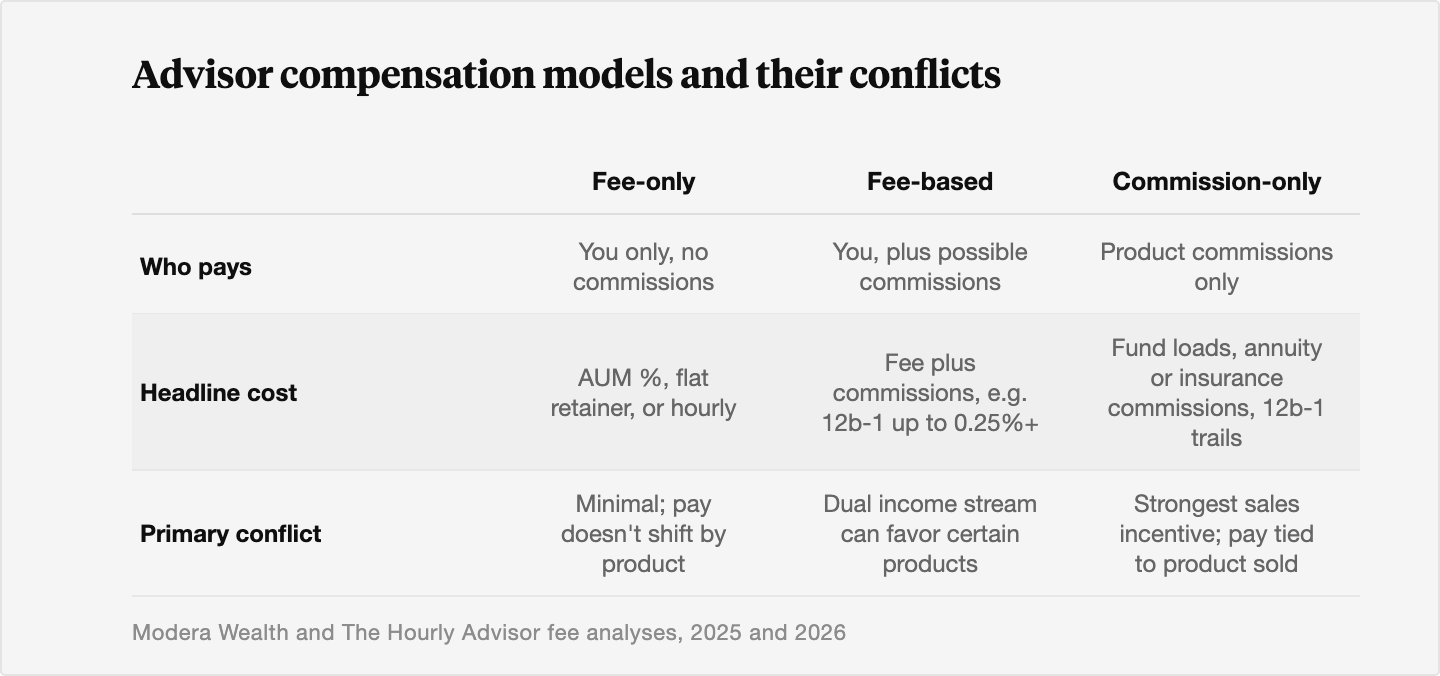
There are three compensation models, and the labels are close enough to be confusing on purpose.
A fee-only advisor is paid only by you, through an assets-under-management percentage, a flat retainer, or an hourly rate, and takes no commissions or third-party compensation from fund companies or insurers [3]. NAPFA and many CFP professionals hold to that definition: to call yourself fee-only, all of your pay has to come from clients. The product conflict largely drops out, because the advisor's income does not change based on which product you end up in.
A fee-based advisor charges you a fee and can also collect commissions on products they sell [3]. The word sits one syllable away from fee-only and means something materially different. The advisor has more than one income stream, and at least one of them rewards recommending a particular product.
A commission-only advisor is paid entirely through product commissions: fund loads, annuity and insurance commissions, and the 12b-1 marketing fees embedded in a fund's expense ratio [3]. It can feel free because there is no line-item advisory fee, but you are paying inside the products, and the sales incentive is at its strongest here.
The 12b-1 fee is an ongoing charge baked into a mutual fund's expense ratio, often up to 0.25% and sometimes higher, frequently shared back to the broker as a trailing commission [3]. A fund paying a 0.75% trail can pay your advisor more than a cheaper, better fund paying nothing, which is exactly the conflict you are trying to see.
3. What the fee actually costs you over time
The headline AUM number sounds small and is not.
The common starting point is around 1% a year on the first $1,000,000, with breakpoints that lower the marginal rate as the account grows: roughly 0.75% on the next million, dropping toward 0.40% to 0.60% at higher balances [3]. Add the expense ratios of the underlying funds, often 0.20% to 0.60%, and the all-in cost for many investors lands somewhere between about 1.3% and 1.8% a year [3].
Because the fee comes out every year and the portfolio compounds on the smaller base, the long-run effect multiplies. Take a stylized $1,000,000 portfolio earning 7% a year before fees over 30 years. With no advisory fee it grows to roughly $7.6M. With a 1% annual fee the net return is about 6% and it grows to roughly $5.7M, a difference of close to $1.9M, all of it fee drag [3]. Past performance is not predictive and the 7% is an assumption, not a forecast. The math holds for any return number you plug in, because the 1% compounds against you no matter what the market does.
This is not an argument that AUM is wrong and flat fees are right. For a large, simple portfolio a flat or hourly arrangement can cost a fraction of 1% of assets [3]. For a smaller, more complex situation, percentage pricing can be the better deal. The discipline is to ask for your total cost in dollars, first year and over ten years, and compare models on that number rather than on the headline rate.
4. Credentials: which letters carry weight and which are decoration
Designations range from rigorous to nearly meaningless, and the difference is checkable.
The CFP, Certified Financial Planner, is the baseline credential for full-scope planning. The CFP Board requires a bachelor's degree, registered coursework across insurance, tax, retirement, investments, and estate planning, a single exam covering the full body of knowledge, and either 6,000 hours of relevant experience or 4,000 hours through an apprenticeship, plus a background check and agreement to the Board's standards [9]. CFP professionals provide planning under a fiduciary standard of care, and the Board can investigate complaints and discipline holders [9].
The CFA, Chartered Financial Analyst, is the deep investment credential: three sequential exams and at least 4,000 hours of qualifying work over a minimum of three years [9]. It signals portfolio and security-analysis expertise rather than holistic planning, so it is the one to want if in-house investment management is the priority.
Then there is the alphabet soup. FINRA warns that some titles are marketing tools more than qualifications, and that you should look up any designation you do not recognize [8]. The tells of a weak one are familiar: no degree or experience required, no proctored exam, no continuing education or ethics code, issued by a small commercial outfit. FINRA keeps a public Professional Designations database at finra.org/investors/professional-designations that shows, for each set of letters, what training and oversight stand behind it, if any [8].
5. The questions to ask, and the answers you want
A first meeting is a screening interview. Ask for direct, written answers. Exhibit 2 is the checklist.
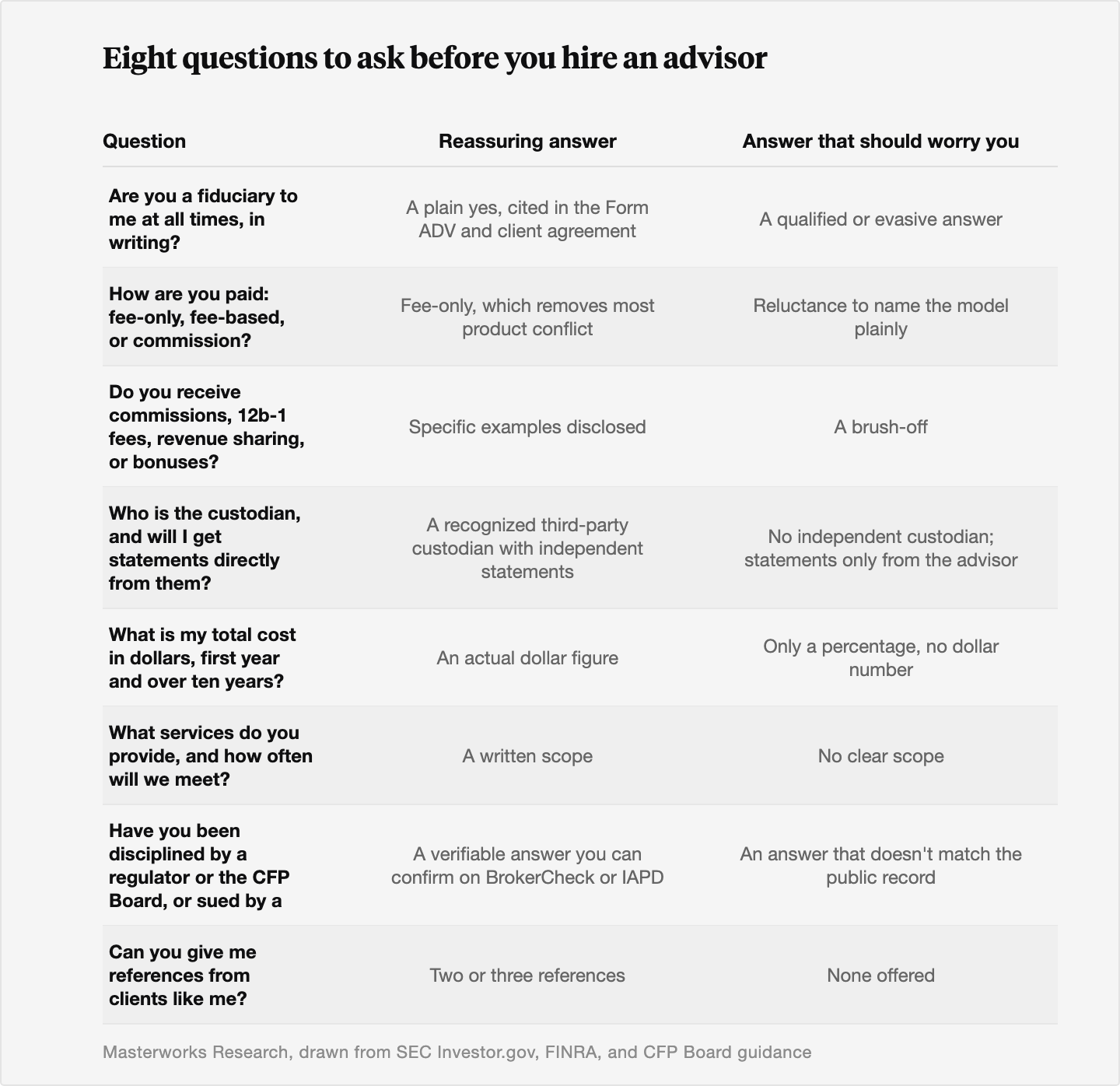
The eight questions, with the answer you are listening for:
- Are you a fiduciary to me at all times, in writing? You want a plain yes, with the citation in the Form ADV and the client agreement.
- How are you paid: fee-only, fee-based, or commission? Fee-only removes the most product conflict.
- Do you receive any commissions, 12b-1 fees, revenue sharing, or bonuses for recommending specific products? You want examples, not a brush-off.
- Who is the custodian of my assets, and will I get statements directly from them? You want a recognized third-party custodian and independent statements.
- What is my total cost in dollars, first year and over ten years? You want a number, not a percentage.
- What services do you provide, and how often will we meet? You want a written scope.
- Have you ever been disciplined by a regulator or the CFP Board, or sued by a client? Then verify the answer on BrokerCheck and IAPD [8].
- Can you give me references from clients like me? You want two or three.
The SEC and FINRA converge on the same three-step process: confirm registration and background, understand the services and the standard of conduct, and understand the costs and conflicts [8].
6. Red flags that should end the conversation
Some signals are reasons to dig deeper. A few are reasons to walk.
The clearest one is custody. If an advisor wants you to write checks to them personally or to an entity they control, or if the only account statements you ever see are the ones they produce, that is the structure that made Bernie Madoff possible. Legitimate advisors route your money to an independent custodian, and you get statements straight from that custodian to check against [8].
Guaranteed or unrealistically high returns are a second. Market investments carry risk and volatility, and an advisor who promises a number with no downside is either confused or selling something. Only instruments like insured CDs or Treasury bills carry genuine guarantees, and those come with clear limits [8].
The rest of the list is the familiar one regulators publish: high-pressure tactics and "decide today" deadlines, an inability or refusal to explain in plain language how they are paid, complex high-commission products pushed for most of your assets, and anyone who cannot be found on BrokerCheck or IAPD and cannot point to a clear exemption [8]. The FBI's IC3 and the FTC's Consumer Sentinel reports both rank investment fraud among the largest loss categories year after year, and a large share of those losses involve unregistered or fraudulent "advisers" first met online [8].
7. Asking your advisor about alternatives and art
Once the advisor clears the fiduciary, fee, and custody bars, the next question for many investors is what that advisor can actually access. Alternatives have moved from the edge of the portfolio toward the center.
In the CAIS and Mercer State of Alternative Investments in Wealth Management 2025 survey, 92% of advisors already allocate client portfolios to alternatives, and 91% plan to increase that exposure over the following two years [5]. The most-used sleeves are private credit at 89% of advisors, private equity at 86%, and real estate at 85% [5]. KKR's 2025 RIA survey found the share of RIAs planning to raise private credit allocations jumped from 15% to 53% [4]. The traditional 60/40 split is giving way to portfolios that, for high-net-worth and family-office mandates, often target 20% to 30% in alternatives [5][6].
Family offices are further along. RBC reported that private markets now make up about 29% of the average family office portfolio, the single most popular destination for new money [6]. And the passion-asset sleeve is where art sits. Across the UBS, Deloitte, and Knight Frank wealth surveys, art and collectibles run roughly 5% to 10% of total wealth for many ultra-high-net-worth families, and higher for dedicated collectors [6]. We cover that pattern in more detail in The rise of family offices and why they are allocating to art and in our look at art in multi-family-office portfolios. The generational handoff behind much of this demand is the subject of our piece on how the $84 trillion wealth transfer is changing art demand.
Art has historically been hard for an ordinary advisor to touch. The asset is illiquid and indivisible, a single work can run into the millions, valuation is periodic and subjective, and physical art does not sit on the custodial and reporting platforms advisors are built around [6]. Those constraints kept art as off-balance-sheet personal wealth rather than a managed allocation. What has changed is the arrival of fractional and fund structures, third-party appraisal and audit, and platforms that let alternative exposure show up alongside traditional holdings on a client statement [6].
So if alternatives or art matter to you, the questions get specific. Can you access alternatives at all, and through which platforms or vehicles? What is your view on an alternatives allocation for someone in my situation, and how would you size it? How would art or collectibles I already own, or might add, fit into the plan, the reporting, and the risk picture? A fiduciary advisor should be able to talk through the illiquidity, the long holding period, and the correlation properties of art without overpromising. For advisors approaching this for the first time, we lay out the case and the cautions in art as an alternative allocation, a framework for advisors. Art's long-run correlation to equities is roughly zero and its highest correlation is with gold, around 0.1 to 0.2, which is the actual case for holding a small, long-term, illiquid slice. We would treat it as a 3 to 10 year position, usually under 5% of a portfolio to start, and we would expect an advisor to frame it the same way. Past performance is not predictive, and any historical art-market figure is comparative context, not a promise.
The Bottom Line
- The first filter is fiduciary status, and it is public: an SEC-registered RIA owes a continuous fiduciary duty, while a broker under Reg BI owes a narrower best-interest duty only at the point of a securities recommendation.
- Fee-only compensation removes the most product conflict; fee-based and commission models keep at least one income stream that rewards selling you a particular product.
- The headline 1% fee compounds into a large dollar drag over decades, so compare advisors on total cost in dollars rather than on the percentage.
- Your assets belong at an independent third-party custodian, and you should receive statements directly from that custodian.
- Verify everything on FINRA BrokerCheck and the SEC's IAPD, and treat guaranteed returns, direct custody, and high-pressure sales as reasons to walk.
- Advisors and family offices are allocating heavily to alternatives, and art is becoming accessible through fractional and fund structures, so a capable advisor should be able to discuss an alternatives allocation, sizing, and the illiquidity and correlation tradeoffs without overpromising.
Sources
- Securities and Exchange Commission. "Frequently Asked Questions on Regulation Best Interest." SEC.gov, last updated February 11, 2026. https://www.sec.gov/rules-regulations/staff-guidance/trading-markets-frequently-asked-questions/faq-regulation-best
- Charles Schwab. "Broker-Dealers vs. Investment Advisors." Schwab.com, January 27, 2026. https://www.schwab.com/learn/story/broker-dealers-vs-investment-advisors
- Modera Wealth. "How Much Do Fee-Only Financial Planners Charge?" Modera Wealth Management, April 6, 2026. https://moderawealth.com/how-much-do-fee-only-financial-planners-charge/
- The Hourly Advisor. "Fee-Only vs. AUM vs. Commission: Which Advisor Model Saves You More?" The Hourly Advisor, August 16, 2025. https://thehourlyadvisor.com/fee-only-vs-aum-vs-commission/
- BlackRock. "Why and how financial advisors move to fee-based from brokerage." BlackRock, last updated March 25, 2026. https://www.blackrock.com/us/financial-professionals/insights/why-financial-advisors-move-to-fee-based-from-brokerage
- Mercer. "The State of Alternative Investments in Wealth Management 2025." Mercer (CAIS and Mercer survey), December 29, 2025. https://www.mercer.com/en-us/insights/investments/financial-intermediaries/the-state-of-alternative-investments-in-wealth-management-2025/
- KKR. "No Longer Alternative: How RIAs Are Investing in Private Markets." KKR 2025 RIA Survey, 2025. https://www.kkr.com/insights/2025-ria-survey
- RBC Wealth Management. "Family offices reset following volatility in early 2025." RBC Wealth Management, October 15, 2025. https://www.rbcwealthmanagement.com/en-us/insights/family-offices-reset-following-volatility-in-early-2025
- InnReg. "Reg BI and the Fiduciary Standard: Compliance Guide for RIAs and Broker-Dealers." InnReg, last updated June 20, 2026. https://www.innreg.com/blog/reg-bi-fiduciary-standard-compliance-rias-and-broker-dealers
- Wealthspire Advisors. "Advisor Designations and What They Mean." Wealthspire, last updated June 19, 2026. https://www.wealthspire.com/blog/advisor-designations-and-what-they-mean/
- Boston Institute of Finance. "CFP vs CFA Credentials: Two Roads Diverge." BostonIFI, July 25, 2025. https://www.bostonifi.com/resources/blog/cfp-vs-cfa
- FINRA. "Professional Designations." FINRA.org, last updated May 27, 2026. https://www.finra.org/investors/professional-designations
- Consumer Financial Protection Bureau and SEC Office of Investor Education. "Choosing a financial professional." ConsumerFinance.gov, last updated June 21, 2026. https://files.consumerfinance.gov/f/documents/cfpb_servicemembers_choosing-a-financial-professional.pdf
- Cresset Capital. "RIA vs. Broker-Dealer: What's the Difference?" Cresset, October 15, 2025. https://cressetcapital.com/articles/advisors/ria-vs-broker-dealer-whats-the-difference/
Disclosures
Investing involves risk. Past results are not indicative of future outcomes.
Masterworks is providing this communication as an agent for its issuer entities, not Masterworks Advisers. This material is produced by Masterworks for informational purposes only and does not constitute investment advice, a recommendation, or an offer or solicitation to buy or sell any security. Masterworks is not a licensed broker-dealer by the SEC or FINRA.
Masterworks can only make and accept sales after an offering statement has been filed, and "qualified", by the SEC. Any offers may be revoked before notice of qualification. Indications of interest involve no obligation. For further disclosure visit the offering documents filed with the SEC and Important Disclosures at masterworks.com/cd.
Forward-looking statements and internal estimates are based on assumptions that may prove incorrect, and actual outcomes may differ materially. Figures denoted in brackets are subject to confirmation. Investing in art and alternative assets involves risk, including loss of principal.
Art sales price data is comparative only. Each painting is unique and historical data is not a direct proxy for any specific painting or investment. Data represents whole art, not an investment into our offerings which includes fees and expenses. Any comparative images are not currently live offerings and are provided for educational purposes only.
Masterworks, LLC is located at 1 World Trade Center, 57th Floor, New York, NY 10007.