
Masterworks Research · June 2026
Art Movements | Fine Art Market Strategy
Why a movement the Nazis tried to erase became one of the most durable corners of the Modern market, and why its ownership history now drives both price and risk.
German Expressionism is the early 20th-century German movement, roughly 1905 to the early 1930s, that traded naturalistic representation for raw subjective feeling, using bold non-naturalistic color, distorted form, and a revival of the woodcut. [1] Its two anchor groups, Die Brucke in Dresden (1905) and Der Blaue Reiter in Munich (1911), produced artists who now sell in the eight figures: Ernst Ludwig Kirchner, Franz Marc, Emil Nolde, Max Beckmann, Erich Heckel, Karl Schmidt-Rottluff, and the early Wassily Kandinsky. [1][2] For investors, one fact sets the category apart from almost every other Modern segment. The Nazi seizure of "degenerate art" in 1937 and the decades of restitution that followed shaped the history of these works, and they still shape what the works are worth today and whether they can be sold at all.
What You Need to Know
- It is a genuine blue-chip Modern category. The top works trade in the eight figures and the market clears through the major houses and through German specialists like Ketterer and Grisebach. Franz Marc's Die Fuchse (The Foxes) sold for $56.67 million at Christie's London in March 2022, the artist's record. [3][4]
- Nazi-era history is the defining provenance fact of the category. In 1937 the regime confiscated a documented total near 15,550 works from German public museums, with broader estimates around 16,000 to 21,000, and Expressionism was singled out. [5][6] That single event created the ownership gaps that provenance researchers still untangle.
- Restitution can add value, and an unresolved gap can destroy it. Kirchner's Berliner Strassenszene (Berlin Street Scene, 1913) was restituted to a Hess heir and then sold at Christie's in November 2006 for approximately [$38 million], setting his auction record. [7][8] A work with a clean, settled title commands a premium. A work with an open 1933 to 1945 question can become unsaleable.
- The buyer pool is narrow by design. Prices in this category, as across blue-chip art, depend on a small number of very wealthy collectors and a handful of museums. Demand is real but it is concentrated, which is part of why we treat art as a long-term, illiquid allocation.
- The broader market is recovering. Global art sales rose about 4% to roughly $59.6 billion in 2025 after two down years, and Impressionist and Modern art was the most-improved auction category. [9][10] Past performance is not predictive, but the cyclical backdrop matters for any Modern segment.
1. What German Expressionism is, and why investors should care
German Expressionism is a movement built on the idea that a painting should record the feeling a scene provokes rather than the scene itself. [1] The palettes are loud, the drawing is angular, the mood runs from anxious to spiritual. As an art-historical category it sits inside the broader Modern field, between Post-Impressionism and the abstraction that followed.
For an investor the relevant facts are commercial, not stylistic. This is a named, catalogued, century-old movement with a fixed and shrinking supply of major works, a stable cast of artists whose markets are tracked across decades, and active sale rooms in New York, London, and Germany. [3][11] Those are the same structural traits we look for in any investment-grade segment. The art market is large and inefficient. Categories like this one, where pricing turns on documentation most buyers cannot easily assess, are where careful underwriting earns its keep.
The category also illustrates one of our core findings about how art appreciates. We have long argued that older art tends to appreciate more slowly than newer art, because appreciation follows fashion and fashion moves with each generation. German Expressionism is roughly a century old, which places it in the Modern band rather than the faster-moving post-1970 contemporary band. We would expect its long-run appreciation to behave like Modern art, not like a Basquiat. That is a feature for the investor who wants a steadier, lower-beta exposure inside a portfolio, and a limit for the investor chasing the steepest curve. To understand why that distinction matters, see our explainer on why contemporary art and Old Masters do not move together.
2. Die Brucke and Der Blaue Reiter: the two markets inside one movement
The movement has two centers of gravity, and they behave like two related but distinct artist markets.
Die Brucke (The Bridge) formed in Dresden in 1905 around four architecture students: Kirchner, Heckel, Schmidt-Rottluff, and Fritz Bleyl, with Nolde and Max Pechstein joining as associates. [1] Their work is the visceral, earthy wing of the movement: city streets, cabarets, nudes, bohemian life, rendered in harsh color with thick black outlines. They consciously revived the woodcut as a modern expressive medium, which is part of why prints carry real weight in this market alongside the paintings. [1] The group worked in Dresden, shifted to Berlin around 1911, and dissolved in 1913. [1]
Der Blaue Reiter (The Blue Rider) formed in Munich in 1911 around Kandinsky and Marc, with Macke, Klee, and Gabriele Munter in the circle. [1] This is the spiritual, intellectual wing, pushing color and form toward abstraction. Marc's blue horses, Kandinsky's near-abstract Compositions, Macke's lyrical figures. The group lasted only until World War I, which killed Marc in 1916 and Macke in 1914. [1]
The investing takeaway is that "German Expressionism" is not one price. Kirchner is the deepest and most active market in the category, with his strongest Brucke and early Berlin works (roughly 1910 to 1914) consistently reaching high seven and low eight figures over the past two decades. [11] Marc's record sits higher on a single masterwork. Nolde, Beckmann, Heckel, and Schmidt-Rottluff each trade as their own markets with their own supply and demand. When we underwrite anything, the first step is choosing the artist market, because the best example by a thin or fading name can still go nowhere. The same discipline applies here, one artist at a time.
3. Degenerate art: the 1937 seizure that defines the category
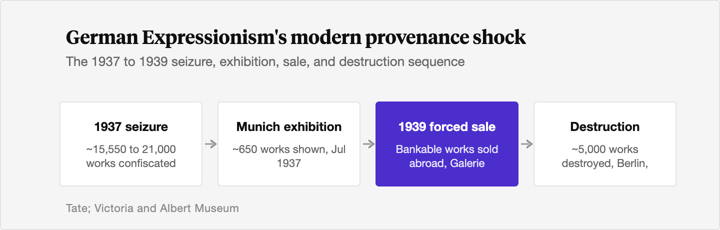
In 1937 the Nazi regime ran a state purge of modern art from German public museums under the banner of Entartete Kunst, or "degenerate art," the event that sets German Expressionism apart from every other Modern segment. [5][6] The numbers are large. The Victoria and Albert Museum holds the only surviving full inventory of the seizures, and the Tate cites a consolidated figure of some 15,550 works removed from German museums in 1937 alone, with broader scholarly estimates running to roughly 16,000 and as high as about 21,000 once later confiscations are counted. [5][6]
Expressionism was singled out. [5] The regime mounted the Entartete Kunst exhibition in Munich in July 1937, hanging about 650 works by 112 artists in deliberately chaotic, mocking displays meant to inflame public opinion against modernism. [5][12] The roster of targeted artists reads like a checklist of the category: Kirchner, Nolde, Beckmann, Heckel, Schmidt-Rottluff, Marc, Kandinsky. [5][6] Nolde, who was himself a Nazi sympathizer, became the single most-confiscated artist, with a reported 1,052 works removed from German museums. [12] Kirchner, expelled from the Prussian Academy in 1933 and stripped from museum walls, took his own life in Switzerland in 1938. [6]
Then came the disposal. In 1939 the regime sold the most bankable confiscated works abroad to raise foreign currency, most visibly at the Galerie Fischer auction in Lucerne, and burned thousands of others, with the Tate noting roughly 5,000 items secretly destroyed in Berlin later that year. [5] That single sequence, seizure then forced sale then destruction, scattered the surviving corpus across Switzerland, Britain, and the United States and stamped a 1933 to 1945 question mark onto a large share of the works that remain.
4. Why restitution history drives both price and risk
For most collecting categories, provenance is a quality signal. For German Expressionism it is closer to a title search on a house. The 1937 to 1939 events created exactly the kind of ownership gap that turns into a legal claim two or three generations later, and the stakes are high because the post-war market for these artists is strong.
Provenance is one of the strongest price signals in any art market, and we have written separately on how an artwork's history drives its value. German Expressionism is where that principle bites hardest, in both directions.
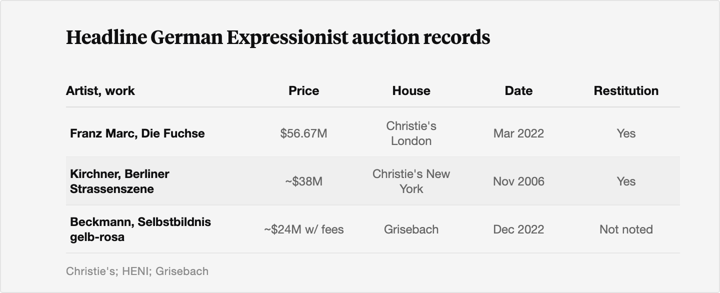
On the upside, a settled restitution can unlock value. When a work is returned to the rightful heirs and then brought to market with clean title, the cloud lifts and the buyer pool widens to include the museums and major collectors who will not touch a contested work. Both of the category's headline records came to auction this way. Kirchner's Berliner Strassenszene was restituted to the granddaughter of Jewish industrialist Alfred Hess and sold at Christie's New York in November 2006 for approximately [$38 million], a figure widely cited that reconciles the hammer with premium and currency conversion. [7][8] Marc's Die Fuchse was restituted to the heirs of German-Jewish banker Kurt Grawi by the city of Dusseldorf in 2021 and sold at Christie's London in March 2022 for $56.67 million. [3][4] In both cases, the restitution was the thing that made the sale possible at a record price.
On the downside, an unresolved gap is a direct financial risk. A work with an open 1933 to 1945 question can sit unsaleable until the dispute resolves, and even the shadow of a claim prices in litigation risk that can knock a meaningful share off market value. We treat a contested work as carrying a permanent haircut until title is clean. The 1998 Washington Principles on Nazi-Confiscated Art, endorsed by 44 states, pushed museums and governments toward provenance research and "fair and just solutions," which is why restitution claims keep surfacing and resolving decades on. [5][6] Germany also created an arbitration court in 2024 that can issue binding decisions, raising the odds that an open claim eventually gets adjudicated rather than ignored.
The Art Loss Register screens works against a database of stolen and looted items. The German Lost Art Foundation maintains the public Lost Art database (lostart.de). The V&A inventory ties specific works to the 1937 to 1938 confiscations. For this category, that research is the difference between an asset and a lawsuit.
5. How deep and liquid is the market?
German Expressionism is a deep category by the standards of Modern art and a thin one by the standards of equities or even contemporary art. The supply of major Brucke and Blaue Reiter paintings is fixed and shrinking, because the best works are concentrated in museums in Germany, Switzerland, and the United States and rarely come back to market.
That scarcity is the bull case and the constraint at once. When a masterwork does surface with clean title, the result can be a record, as the Marc and Kirchner sales show. Beckmann's Selbstbildnis gelb-rosa (Self-Portrait Yellow-Pink), painted during his Amsterdam exile, sold at Grisebach in Berlin in December 2022 for about $20 million at hammer, roughly $24 million with fees, the highest price for any work sold at auction in Germany. [13] But the flow of such works is episodic. An investor cannot assume a quick exit. This is why we frame art generally as a long-term, illiquid allocation, usually held for years rather than quarters, and German Expressionism sits firmly in that bucket.
It is also a category that depends on a narrow buyer pool. Prices in blue-chip art are effectively a call option on the wealth of a small number of collectors, and that is doubly true for a museum-quality segment like this one. For a fuller treatment of what separates a deep, institutionally-collected market from a shallow one, see our piece on what blue-chip art actually means.
6. Where the category sits in the cycle
Like every art segment, German Expressionism moves with the broader market cycle, and the broader market is turning. After two down years, global art sales rose about 4% to roughly $59.6 billion in 2025, with public auction sales up 9% to about $20.7 billion. [9] Within auctions, Impressionist and Modern art was the most-improved category in 2025, and the U.S. auction market posted a double-digit rebound. [10] For a Modern segment like this one, a recovering Impressionist and Modern field is the relevant tide.
We would caution against reading any single season as a trend. The recovery so far looks like a return to discipline rather than a return to speculation, with buyers paying up for quality and fresh-to-market works while passing on the rest. [10] That environment tends to reward exactly what this category offers at its best: a small number of museum-quality works with clean, well-documented title. For how these cycles tend to play out from peak through correction to recovery, see our overview of how art market cycles work. Past performance is not predictive, and a thin category can stay quiet for years between its marquee moments.
Sources
- Britannica; Tate; The Art Story; MoMA. "Die Brucke, Der Blaue Reiter, and German Expressionism." (overview of movement, groups, founding dates, aesthetics). https://www.britannica.com/topic/Die-Brucke ; https://www.tate.org.uk/art/art-terms/b/brucke ; https://www.theartstory.org/movement/die-brucke/
- Encyclopaedia Britannica. "Expressionism." https://www.britannica.com/art/Expressionism
- The Art Newspaper. "Franz Marc's GBP 42.6m Foxes leads Christie's marathon Shanghai-London auction." March 1, 2022. https://www.theartnewspaper.com/2022/03/01/franz-marcs-foxes-leads-christies-marathon-shanghai-london-auction
- HENI. "The Smuggled Foxes That Set Franz Marc's Auction Record." March 1, 2022. https://heni.com/news/article/franz-marc-the-foxes-die-fuchse-2022-03-01
- Tate. "Degenerate Art." (art term entry; 15,550 works, 1939 Swiss sales, ~5,000 destroyed). https://www.tate.org.uk/art/art-terms/d/degenerate-art
- Wikipedia; Victoria and Albert Museum. "Degenerate art" and "Entartete Kunst: the Nazis' inventory of degenerate art." https://en.wikipedia.org/wiki/Degenerate_art ; https://www.vam.ac.uk/articles/entartete-kunst-the-nazis-inventory-of-degenerate-art
- Wikipedia. "Berlin Street Scene (Kirchner)." (restitution to Anita Halpin, Christie's New York, November 8, 2006). https://en.wikipedia.org/wiki/Berlin_Street_Scene
- HENI. "The Berlin Painting That Set Ernst Ludwig Kirchner's Auction Record." November 8, 2006 (sale). https://heni.com/news/article/ernst-ludwig-kirchner-berliner-strassenszene-berlin-street-scene-baume-trees-2006-11-08
- Art Basel and UBS. "Global sales rise 4% to $59.6 billion in 2025, amid ongoing market recalibration." March 2026. https://www.artbasel.com/stories/the-art-basel-and-ubs-global-art-market-report-2026
- ARTnews. "New Report Shows a Rebounding Auction Market in 2025, With Impressionist and Modern Art Most Improved." 2026. https://www.artnews.com/art-news/market/report-rebounding-art-auction-market-2025-arttactic-1234767509/
- MyArtBroker. "Ernst Ludwig Kirchner Value: Top Prices Paid at Auction." (top-ten results; Berliner Strassenszene record; Tanz im Variete, Ketterer, June 2024). https://www.myartbroker.com/artist-ernst-ludwig-kirchner/record-prices/ernst-ludwig-kirchner-record-prices
- University of Cambridge. "Exposing a Nazi." (Munich 1937 exhibition: ~650 works, 112 artists; Nolde figures). https://www.cam.ac.uk/stories/exposing-a-nazi
- Artnet News; The Local. "A $22 Million Max Beckmann Painting Sets a Staggering Record at a German Auction House" and "Beckmann self-portrait breaks German auction record." December 2022. https://news.artnet.com/market/grisebach-sale-2220661 ; https://www.thelocal.de/20221202/beckmann-self-portrait-breaks-german-auction-record/
- Van Ham. "Collecting Guide: German Expressionism." https://www.van-ham.com/en/discover/collecting-guide/expressionism.html
Disclosures
Investing involves risk. Past results are not indicative of future outcomes.
Masterworks is providing this communication as an agent for its issuer entities, not Masterworks Advisers. This material is produced by Masterworks for informational purposes only and does not constitute investment advice, a recommendation, or an offer or solicitation to buy or sell any security. Masterworks is not a licensed broker-dealer by the SEC or FINRA.
Masterworks can only make and accept sales after an offering statement has been filed, and "qualified", by the SEC. Any offers may be revoked before notice of qualification. Indications of interest involve no obligation. For further disclosure visit the offering documents filed with the SEC and Important Disclosures at masterworks.com/cd.
Forward-looking statements and internal estimates are based on assumptions that may prove incorrect, and actual outcomes may differ materially. Figures denoted in brackets are subject to confirmation. Investing in art and alternative assets involves risk, including loss of principal.
Art sales price data is comparative only. Each painting is unique and historical data is not a direct proxy for any specific painting or investment. Data represents whole art, not an investment into our offerings which includes fees and expenses. Any comparative images are not currently live offerings and are provided for educational purposes only.
Masterworks, LLC is located at 1 World Trade Center, 57th Floor, New York, NY 10007.


