
Masterworks Research · June 2026
How to own gold and precious metals, what they hedge, what they cost to hold, and where they sit alongside other scarce real assets in a portfolio.
Investing in gold usually means buying exposure to the metal through one of a few vehicles: physical bullion bars and sovereign coins, low-cost gold ETFs such as SPDR Gold Shares (GLD) or iShares Gold Trust (IAU), gold mining equities, or COMEX futures. Most investors hold gold for one reason, to own a scarce real asset that tends to hold its value when currencies weaken, real rates fall, or markets enter a crisis. The case rests on a long record: gold pays no income, but over long horizons it has preserved purchasing power and moved on its own clock, with low correlation to stocks and bonds. For investors evaluating where gold fits, the practical questions are which vehicle to use, what it costs to hold, and how much of a portfolio it deserves.
We spend most of our time studying a different scarce real asset, fine art. We come to gold with respect. It is the oldest store of value humans have, it trades in one of the deepest markets on earth, and it has just finished one of its strongest two-year runs in modern history. Near the end of this piece we compare the two assets directly, because they answer the same question in very different ways.
What You Need to Know
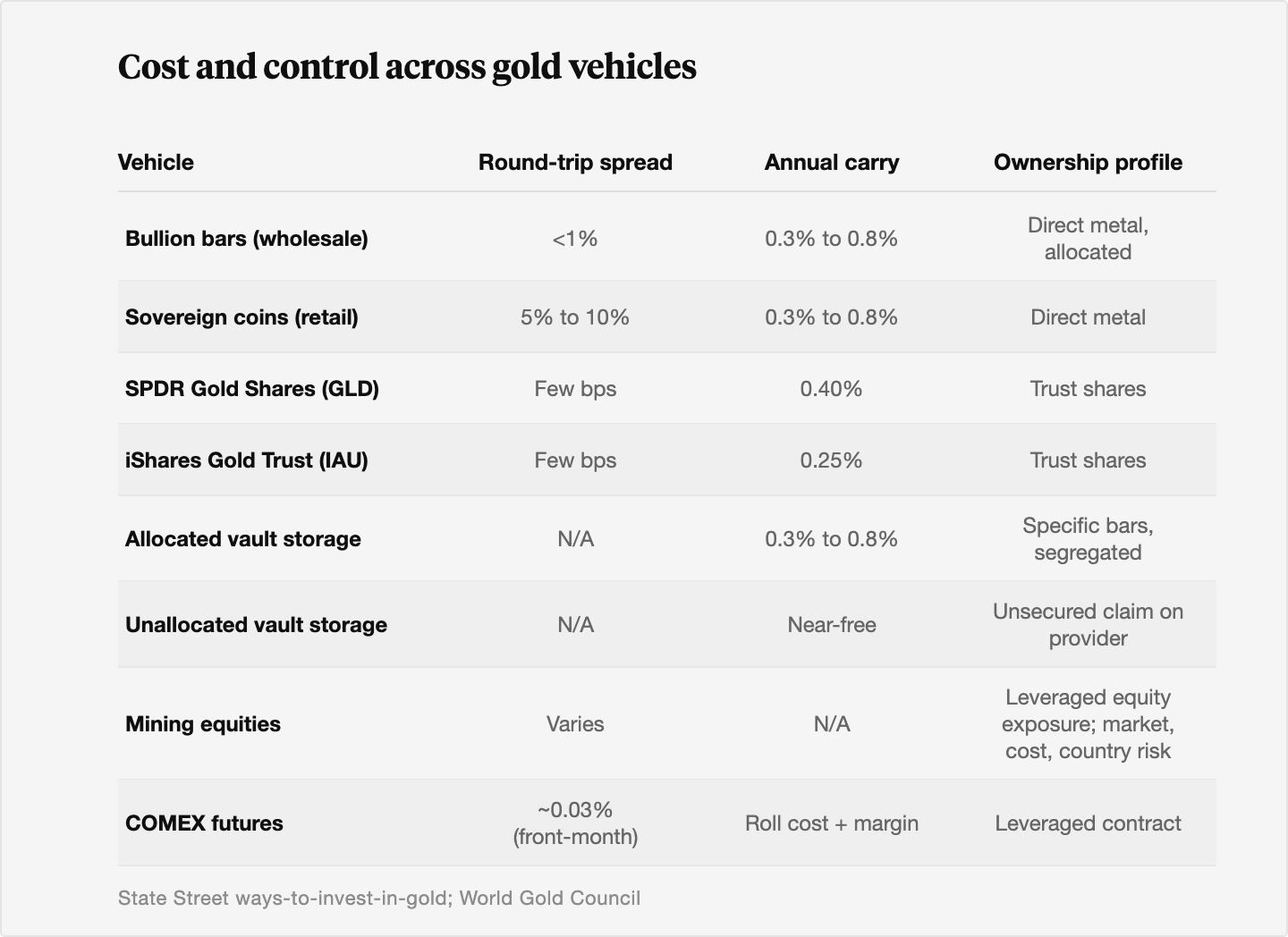
- There are four main ways to own gold, and they trade off cost against control. Physical bullion and coins give you direct ownership but carry the widest spreads, with retail coin round-trip costs often 5% to 10% and storage near 0.3% to 0.8% a year. Gold ETFs like IAU (0.25% expense ratio) and GLD (0.40%) give cheap, liquid exposure with no storage hassle, at the cost of holding a fund rather than metal.
- Gold has just had an exceptional run. The World Gold Council reports an average price of US$3,431 an ounce in 2025, up 44% year over year, with the LBMA benchmark setting 53 all-time highs during the year [1]. Prices pushed above US$4,000 by late 2025 and traded near US$4,150 an ounce in June 2026 after a peak earlier that year [2][3].
- The rally was driven by structural demand. Total 2025 demand topped 5,000 tonnes for the first time, worth roughly US$555 billion, with investment demand of about 2,175 tonnes and central banks buying a net 863 tonnes on top of more than 1,000 tonnes in each of the prior three years [1]. This was sticky official-sector and investment money, well beyond a retail spike.
- Gold is a long-horizon hedge with real limits. It has delivered a real return of roughly 2.1% a year over the past century, well below US equities near 7.3%, and it lost most of its real value across the 1980 to 1999 stretch [4]. It pays no yield, so the entire return comes from price.
- Gold and art are complementary scarce assets. Gold wins on liquidity, divisibility, and transparency. Art offers supply that can shrink over time and a correlation to equities near zero. The two have historically moved close to independently of each other, which is why some investors hold both.
1. How do you actually invest in gold?
There are four practical routes into gold, and they trade off cost against control.
Physical bullion and coins give you direct ownership of metal. Good-delivery and kilobar gold bought wholesale through a vault can change hands at spreads under 1% in and out, but most retail buyers pay more. Sovereign coins, the American Eagle, the Krugerrand, the Maple Leaf, the Britannia, commonly carry a 3% to 8% premium over spot to buy and sell back at a small discount, so the round-trip cost on small lots often runs 5% to 10% [5]. Then there is carry. Professional allocated storage with insurance typically runs 0.3% to 0.8% of value a year [5]. The appeal is that you hold the metal itself, with no fund structure and, if it is properly allocated, no counterparty between you and the gold.
Allocated storage means specific bars are held in your name, segregated from the custodian's balance sheet. Unallocated storage means you hold a claim on a quantity of gold rather than specific bars, which is cheaper, often near-free to store, but makes you an unsecured creditor of the provider if it fails [5].
Gold ETFs are how most investors get exposure today. iShares Gold Trust (IAU) charges a 0.25% expense ratio and SPDR Gold Shares (GLD) charges 0.40%, both physically backed by London good-delivery bars and both trading with bid-ask spreads of a few basis points in normal markets [5]. Storage, insurance, and audit are embedded in the fee. The trade-off is that you own shares in a trust rather than a specific bar, so an ETF is not the right tool if your goal is metal you can hold outside the financial system.
Gold mining equities, single names like Newmont or Barrick or a mining-sector ETF, give leveraged exposure to the gold price because a miner's margins can expand faster than the metal when prices rise. They also carry equity-market risk, cost inflation, and country risk, which means they can lag bullion even in a rising gold market [5]. They are a bet on companies that mine gold, with all the operating risk that implies.
COMEX futures are 100-ounce contracts that offer efficient leverage and deep institutional liquidity, with front-month spreads around 0.03% of notional [5]. To stay long over time you have to roll expiring contracts, paying the spread between months, and you face margin calls. This is a tool for sophisticated hedgers and traders, more than for buy-and-hold investors.
2. Why has gold run so hard in 2024 and 2025?
The recent move has been large and broad. The World Gold Council reports a 2025 average price of US$3,431 an ounce, a 44% increase year over year, with the LBMA benchmark setting 53 separate all-time highs during the year and a fourth-quarter average near US$4,135 an ounce, up 55% from the prior year [1]. By mid-2026 spot traded around US$4,150 an ounce after a sharper spike earlier in the year [2][3]. The 2024 gain on a spot basis was on the order of 18% to 20%, so investors have seen two strong years back to back [3].
What is striking is the demand mix behind it. Total gold demand in 2025 topped 5,000 tonnes for the first time, roughly 5,002 tonnes worth about US$555 billion, a 45% jump in value [1]. The growth came from the parts of the market that tend to be sticky rather than speculative.
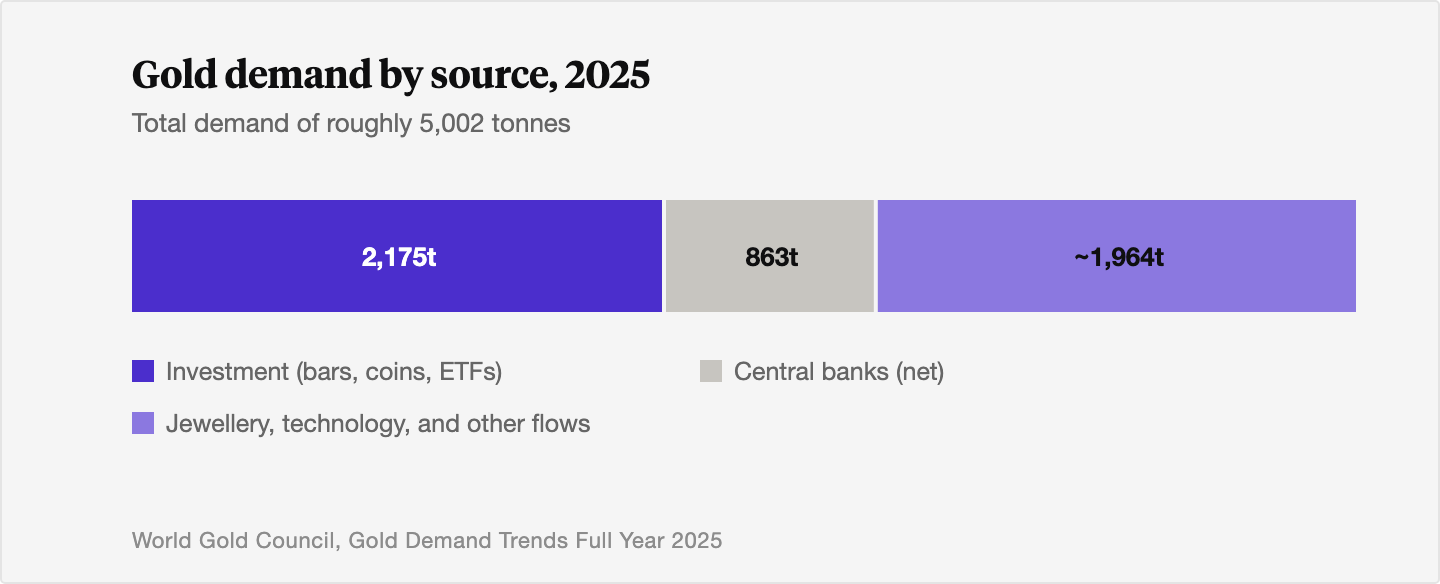
Three drivers stand out. First, investment demand reached about 2,175 tonnes in 2025, split between roughly 1,374 tonnes of bars and coins and 801 tonnes of ETF and similar inflows, as falling real-rate expectations cut the opportunity cost of holding a non-yielding asset [1]. Second, central-bank buying stayed historically heavy. Official institutions bought a net 863 tonnes in 2025, down from 1,092 tonnes in 2024 but still far above the 2010 to 2021 average near 473 tonnes, the fourth straight year of very strong official-sector demand [1][6]. Third, macro and geopolitical risk: a weaker dollar, sticky inflation, and elevated fiscal and geopolitical uncertainty kept safe-haven flows high [2].
Two years of gains do not promise a third. Past performance is not predictive, and gold has a long history of giving back fast. We will come to that.
3. What does gold actually hedge, and how well?
Gold gets called an inflation hedge and a crisis hedge. The evidence supports both labels, with caveats on each.
On inflation, the honest summary is that gold is a long-horizon, imperfect hedge rather than a precise one. Over the past century gold has delivered a real return of roughly 2.1% a year, which preserves purchasing power and then some, but the short-run link to any given inflation print is unstable [4]. In 2022, for example, gold held up early as inflation fears peaked, then struggled once real yields and the dollar jumped [4]. The case for gold against inflation is really a case about decades, not quarters. The dollar has lost a large share of its purchasing power over the past hundred years, and gold is one of the assets that has historically tracked through that erosion.
On crisis, the record is stronger. Academic work going back to Baur and Lucey and Baur and McDermott documents gold acting as a safe haven during severe equity stress [4]. The episodes bear it out. Gold rose modestly in 2008 while the S&P 500 fell about 37%, and it climbed for years afterward [4]. During the 2020 COVID shock gold dipped briefly in the March dash for cash, then rallied roughly 30% by August to new highs [7]. Over 1925 to 2015, gold outperformed US equities in 43% of years, concentrated in recessions and crises [4].
The reason this matters for a portfolio is correlation. Gold's long-run correlation to the S&P 500 sits roughly in the 0.0 to 0.2 range and turns negative in acute crises, with a similarly low or mildly negative correlation to bonds [4]. That is what lets a modest gold position lower portfolio volatility and improve drawdown behavior without dragging on it much in normal times.
How much is appropriate? World Gold Council-style portfolio work and academic replications generally land on a strategic allocation around 5% to 10%, with the higher end for investors most worried about inflation, currency debasement, or tail risk [4]. We would treat that as a reasonable starting range rather than a target, and we make no claim about what gold will return from here.
4. What is the bear case against gold?
There are three real objections.
Gold pays no yield. It produces no coupon and no dividend, so the entire return has to come from price appreciation, and the opportunity cost rises when bonds and cash pay well [7]. An investor who needs income, or who can earn an attractive real yield elsewhere, pays a real price to hold metal that just sits there.
Gold has had long flat and negative stretches. After the 1980 peak, real gold prices fell for close to two decades. UK data show gold losing nearly four-fifths of its real value between 1980 and 1999 [4][8]. Anyone who bought near a mania has waited a very long time to break even. The 2024 to 2025 run is impressive, and it is also the kind of move that has historically preceded multi-year digestion.
The long-run opportunity cost versus equities is steep. Gold's roughly 2.1% real annual return over a century compares with about 7.3% for US equities over the same span [4]. A long-horizon investor focused purely on terminal wealth, with no special inflation or crisis concern, would historically have done far better in stocks. Gold's edge is in risk management, lower volatility and better behavior in drawdowns, rather than in maximizing return.
None of this is a reason to avoid gold. It is a reason to size it as a hedge and a diversifier, a satellite holding rather than a core growth engine.
5. Where do silver and platinum fit?
The same vehicles, bullion, coins, ETFs, mining shares, and futures, exist for the white metals. Silver and platinum are smaller, more volatile, and more industrial than gold. Roughly half of silver demand and the bulk of platinum demand comes from industry, which ties them to the economic cycle in a way gold avoids. That gives them higher beta. In 2025, silver reportedly rose far more than gold on a start-to-end basis, in the range of [~140%], while platinum gained on the order of [~45% to 55%], both magnifying the precious-metals move with sharper swings [3]. We bracket those figures pending a clean benchmark source. The other difference is fabrication cost. Because the metal is cheaper per ounce, the premium on small silver coins can run 10% to 25% over spot, materially higher in percentage terms than gold, and silver's bulk makes storage relatively more expensive per dollar held [5].
In practice, investors who want this exposure tend to treat gold as the core store-of-value anchor and use silver and platinum as higher-volatility, more cyclical satellites. The store-of-value case is strongest and best documented for gold.
6. How does gold compare with fine art as a store of value?
Both gold and art are scarce, real, low-equity-correlation assets that investors hold for the same underlying reason, to own something largely indifferent to the forces driving the rest of a portfolio. They get to that property by opposite routes.
Gold wins decisively on liquidity, divisibility, and transparency. It trades nearly around the clock in one of the deepest markets on earth, prices off a single global spot rate, settles in days, and divides down to a single gram or a single ETF share [5][9]. Fine art is the mirror image: indivisible at the object level, priced by appraisal rather than a continuous quote, and sold through auction or private sale cycles that often run months, with round-trip costs at auction commonly reaching a quarter to a third of value. If you need to move quickly or rebalance in small increments, gold is the better tool by a wide margin.
Art has one property gold structurally cannot match: supply that can shrink. Gold's above-ground stock stood at about 219,891 tonnes at the end of 2025 and grows roughly 1.5% to 2% a year through mining, and because almost no gold is ever consumed, the stock only rises [9][10]. The float of major works by a given artist runs the other way. No new works by a deceased artist will ever be made, and the tradable supply shrinks as pieces enter museums and leave the market permanently. By our count, there are only 21 Jackson Pollocks left in private collections. That is a different kind of scarcity than a stock that compounds upward every year.
On correlation, both assets sit near zero against equities over long horizons, and the more interesting figure is the correlation between art and gold, which empirical work tends to put near zero as well, roughly in the minus 0.1 to plus 0.1 band [4]. The reason is that they run on different engines. Gold tracks real rates, the dollar, and a structural central-bank bid. Art tracks wealth creation at the very top of the distribution. Two assets driven by different forces will not move together, which is precisely what makes holding both potentially useful.
The scale is not remotely comparable, and that is part of the point. The total above-ground gold stock is worth somewhere in the tens of trillions of dollars depending on the price used, while the entire global art market turns over on the order of US$60 billion to US$70 billion a year [9][11]. Gold is a vast, liquid monetary asset. Fine art is a small, illiquid, idiosyncratic one. They are complements, not substitutes.
We have written a dedicated comparison that goes deeper on the hedge mechanics and the trade-offs, Art vs. Gold as a Hedge Asset: Performance, Correlation, and Trade-Offs. For how each asset behaved through the recent inflation cycle alongside real estate and crypto, see Inflation Hedging: Art vs. Gold vs. Real Estate vs. Crypto. For the macro backdrop that drives demand for hard assets generally, see Fiscal Dominance and Hard Assets: Why Art Belongs in the Conversation. And for a different scarcity story, the comparison with Bitcoin, see Art vs. Bitcoin: Store-of-Value Narratives, Volatility Profiles, and Correlation Data. As always, past performance is not predictive, and none of this is a recommendation to buy any asset.
The Bottom Line
- Investing in gold comes down to four vehicles: physical bullion and coins for direct ownership, ETFs like IAU and GLD for cheap liquid exposure, mining equities for leverage, and futures for hedging. ETFs are the lowest-cost route for most investors.
- Gold's 2024 to 2025 run was exceptional, with a 2025 average price of US$3,431 an ounce, up 44%, and prices near US$4,150 in June 2026, driven by record investment demand and heavy central-bank buying rather than retail speculation.
- Gold is a long-horizon inflation hedge and a reliable crisis hedge, with low correlation to stocks and bonds, but it pays no yield and has gone through multi-decade stretches of negative real returns.
- A strategic allocation around 5% to 10% is the range most portfolio research supports, sized as a hedge and diversifier rather than a growth engine. Past performance is not predictive.
- Gold and fine art are complementary scarce assets. Gold offers liquidity, divisibility, and a transparent global price; art offers supply that can shrink and a correlation to equities near zero. The two have historically moved close to independently of each other.
Sources
- World Gold Council. "Gold Demand Trends: Full Year 2025." World Gold Council Goldhub, February 2026. https://www.gold.org/goldhub/research/gold-demand-trends/gold-demand-trends-full-year-2025
- StoneX Bullion. "What Was the Highest Price for Gold?" StoneX Bullion, January 2026. https://stonexbullion.com/en/blog/what-was-the-highest-price-for-gold/
- J.P. Morgan Global Research. "Gold Price Predictions for 2026 and 2027." J.P. Morgan, February 2026. https://www.jpmorgan.com/insights/global-research/commodities/gold-prices
- Economics Observatory. "Is Gold a Safe Haven for Investors?" Economics Observatory, 2025. https://www.economicsobservatory.com/is-gold-a-safe-haven-for-investors
- State Street Global Advisors. "Ways to Invest in Gold." State Street, 2025. https://www.ssga.com/us/en/intermediary/insights/ways-to-invest-in-gold
- World Gold Council. "Central Banks Gold Reserves by Country." World Gold Council Goldhub, 2026. https://www.gold.org/goldhub/data/gold-reserves-by-country
- Julius Baer. "The Allure of Gold: A Hedge Against Inflation and Market Volatility." Julius Baer Insights, 2025. https://www.juliusbaer.com/en/insights/market-insights/how-to-invest/the-allure-of-gold-a-hedge-against-inflation-and-market-volatility/
- BullionVault. "Gold as an Inflation Hedge." BullionVault Gold Guide, 2025. https://www.bullionvault.com/gold-guide/gold-inflation-hedge
- World Gold Council. "How Much Gold Has Been Mined?" World Gold Council Goldhub, February 2026. https://www.gold.org/goldhub/data/how-much-gold
- World Gold Council. "Gold Price Performance and Data." World Gold Council Goldhub, 2026. https://www.gold.org/goldhub/data
- Art Basel and UBS. "The Art Market 2025." Art Basel and UBS Global Art Market Report, 2025. https://www.artbasel.com/about/initiatives/the-art-market
- JM Bullion. "History of Gold Prices." JM Bullion Investing Guide, 2026. https://www.jmbullion.com/investing-guide/facts/history-of-gold-prices/
- iShares by BlackRock. "iShares Gold Trust (IAU) Fund Overview." BlackRock, 2026. https://www.ishares.com/us/products/239561/ishares-gold-trust-fund
- State Street Global Advisors. "SPDR Gold Shares (GLD) Fund Overview." State Street, 2026. https://www.spdrgoldshares.com/
Disclosures
Investing involves risk. Past results are not indicative of future outcomes.
Masterworks is providing this communication as an agent for its issuer entities, not Masterworks Advisers. This material is produced by Masterworks for informational purposes only and does not constitute investment advice, a recommendation, or an offer or solicitation to buy or sell any security. Masterworks is not a licensed broker-dealer by the SEC or FINRA.
Masterworks can only make and accept sales after an offering statement has been filed, and "qualified", by the SEC. Any offers may be revoked before notice of qualification. Indications of interest involve no obligation. For further disclosure visit the offering documents filed with the SEC and Important Disclosures at masterworks.com/cd.
Forward-looking statements and internal estimates are based on assumptions that may prove incorrect, and actual outcomes may differ materially. Figures denoted in brackets are subject to confirmation. Investing in art and alternative assets involves risk, including loss of principal.
Art sales price data is comparative only. Each painting is unique and historical data is not a direct proxy for any specific painting or investment. Data represents whole art, not an investment into our offerings which includes fees and expenses. Any comparative images are not currently live offerings and are provided for educational purposes only.
Masterworks, LLC is located at 1 World Trade Center, 57th Floor, New York, NY 10007.


