Masterworks Research · June 2026
The four types of value, why the purpose of an appraisal changes the number, how to find a credentialed appraiser, and what the report can and cannot tell you.
To get art appraised, hire a credentialed appraiser who follows the Uniform Standards of Professional Appraisal Practice (USPAP), tell them the purpose of the appraisal (insurance, estate or gift tax, charitable donation, division of property, or a pre-sale estimate), and pay an hourly or flat fee that is never tied to the value they assign. The single most important thing to understand before you start: the same painting has more than one correct value at the same moment, and which one applies depends entirely on why you are asking. An appraisal is a documented, defensible opinion of value for a stated purpose on a stated date. For an investor, this matters because it makes the limits clear. An appraisal is one expert's view of one object, it carries a fee, and it has a use-by date.
What You Need to Know
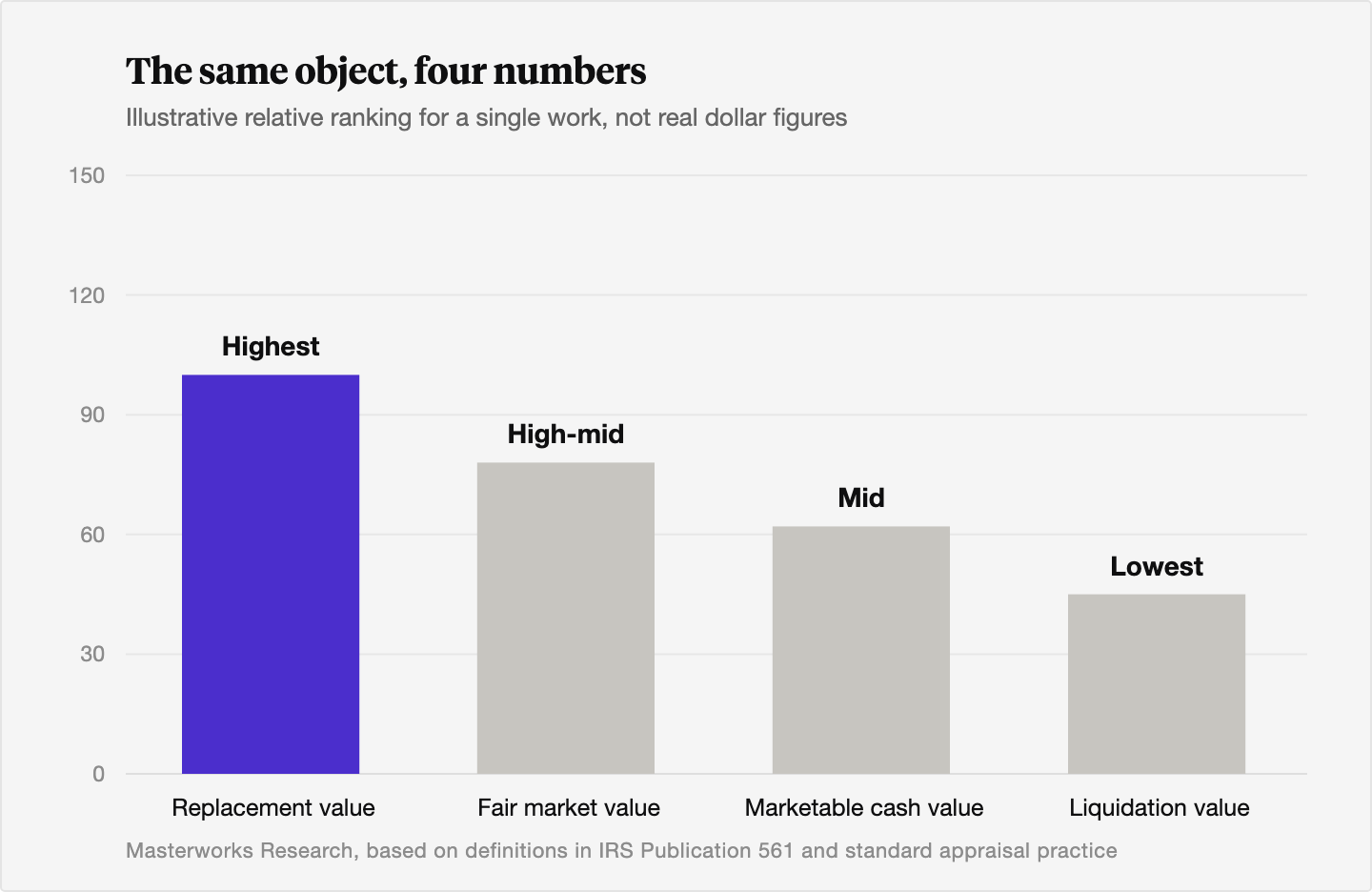
- A single artwork has several correct values at once. Fair market value, replacement value, marketable cash value, and liquidation value can differ widely for the same object, because each answers a different question for a different market and timeframe.
- The purpose drives the number, and the IRS sets hard thresholds. A noncash charitable donation of art over $5,000 requires a "qualified appraisal" and IRS Form 8283. Claim a deduction of $20,000 or more for donated art and you must attach the full appraisal to your return.
- Credentials are real but voluntary. There is no federal license for personal property appraisers. The signal of competence is a designation from the American Society of Appraisers (ASA), the Appraisers Association of America (AAA), or the International Society of Appraisers (ISA), all of which require USPAP compliance.
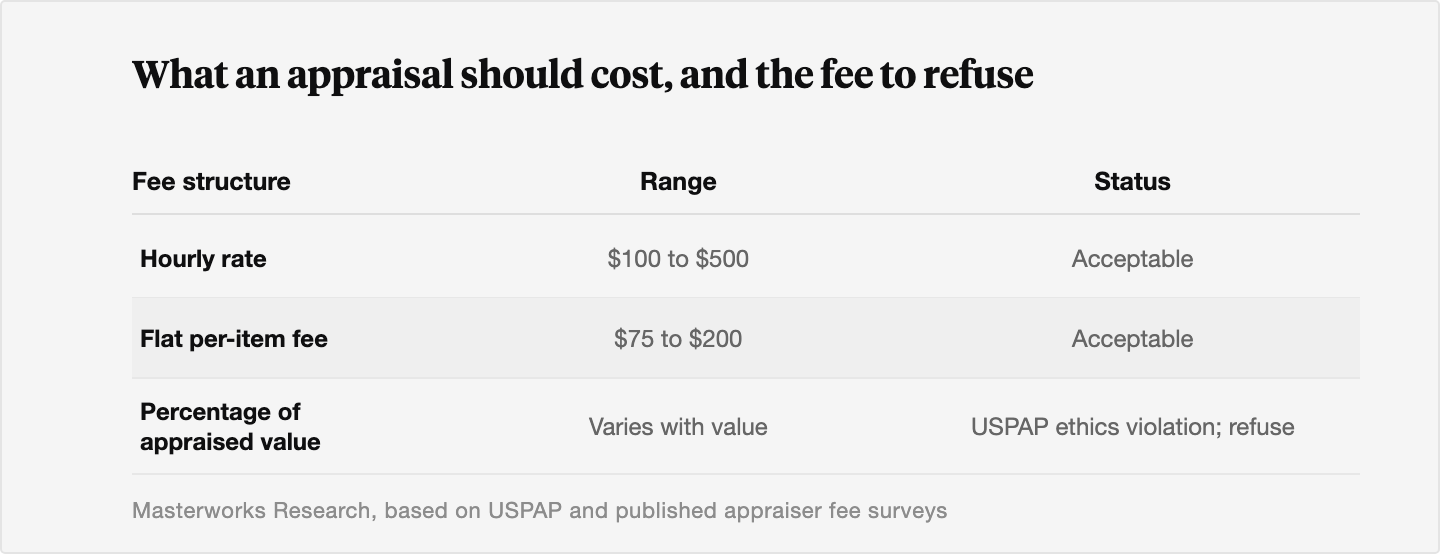
- A fee based on a percentage of the appraised value is an ethics violation. USPAP and every major appraisal organization prohibit contingent fees, because paying more when the number is higher gives the appraiser a reason to inflate it. Expect an hourly rate of roughly $100 to $500 or a flat per-item fee.
- An appraisal is not an authentication. The appraiser assumes the work is by the artist named and values it on that premise. Confirming authorship is a separate, evidentiary process.
1. The four types of value, and why they differ
The first question a good appraiser asks is not "what is it worth." It is "worth what, to whom, and for what purpose." There are four levels of value in common use, and the gap between them on the same object can be large.
Fair market value (FMV) is the price a work would change hands for between a willing buyer and a willing seller, neither under compulsion to act, both reasonably informed. The IRS uses this definition for charitable contributions and for estate and gift tax.[1] FMV is the open-market, arm's-length number.
Replacement value, also called retail replacement value or insurance value, is the cost to replace the work with a comparable example, in similar condition, bought in the appropriate retail market within a limited time. This is typically the highest of the four numbers, because it assumes you are buying at retail under time pressure rather than selling patiently. Insurers schedule coverage on this basis.[2]
Marketable cash value is what a seller would net after the costs of a sale, such as commissions and fees. It sits below FMV because it backs out transaction friction.[3]
Liquidation value is the price in a forced or time-constrained sale. The defining feature is that there is no willing seller in the picture. Someone is being compelled to sell by circumstance, so the number is the lowest of the four.[3]
A Warhol scheduled for insurance at its retail replacement value will carry a higher figure than the FMV an estate would report, and a far higher figure than the liquidation value in a forced sale. None of these is wrong. They answer different questions. That is the whole reason you tell the appraiser the purpose before they begin.
2. Why you are getting the appraisal: the common purposes
The purpose dictates the type of value, the level of documentation, and in some cases whether the IRS will even accept the report. There are five common reasons.
Insurance coverage. You schedule a valuable item on a policy at replacement value so that a covered loss pays out enough to buy a comparable work. Insurers generally want the schedule refreshed periodically because values move.[2]
Estate and gift tax. When art passes through an estate or is gifted, the IRS values it at fair market value as of the relevant date.[1] This is where the dollar thresholds start to bite, covered in the next section.
Charitable donation substantiation. Donate art to a museum or charity and claim a deduction, and the IRS requires specific paperwork tied to the amount. This is the most rule-bound purpose, and the rules are worth getting right the first time.
Equitable distribution. Dividing a collection in a divorce, an estate split among heirs, or the dissolution of a partnership usually calls for fair market value or marketable cash value, so each party is treated on a consistent basis.
Pre-sale estimates. Before consigning to auction or selling privately, a seller wants a realistic view of what the market will bear. Note that an auction house's presale estimate is a marketing range, not an independent appraisal, and the disciplined way to read either one is to understand how characteristics drive value.
3. The charitable-donation rules: Form 8283 and the "qualified appraisal"
This is the part most often gotten wrong, so we will be precise. The thresholds below come straight from the IRS instructions for Form 8283.[4]
For a noncash charitable contribution where you claim a deduction of more than $5,000 for an item or group of similar items, you must obtain a "qualified appraisal" and complete Section B of Form 8283.[4] Below that, lighter documentation applies.
For donated art specifically, if you claim a deduction of $20,000 or more, you must attach the complete signed appraisal to your return, and the IRS may request an 8 by 10 photograph or a high-resolution image.[4] For any noncash donation where the deduction exceeds $500,000, you generally must attach the qualified appraisal regardless of property type.[4]
A "qualified appraisal" is not just any appraisal. It must follow the substance and principles of USPAP, satisfy the requirements of Treasury Regulation section 1.170A-17, be signed no earlier than 60 days before the date of the contribution, and be received before you file the return claiming the deduction.[4]
A "qualified appraiser" must hold a recognized professional appraisal designation or meet minimum education and experience requirements for that property type, regularly perform appraisals for pay, and declare their qualifications in the report.[4] The donee organization cannot serve as the appraiser. And, importantly, the appraisal fee cannot be percentage-based.[4]
There is a further layer for higher-value work. Artwork an appraiser values at $50,000 or more that is claimed for income, estate, or gift tax can be referred to the IRS Commissioner's Art Advisory Panel, a group of up to 25 art experts who serve without pay and review the claimed fair market value.[5] A taxpayer can also request an advance Statement of Value from the IRS before filing, under Revenue Procedure 96-15, for art appraised at $50,000 or more. As of the IRS guidance, the fee is $8,400 for one to three items, plus $800 for each additional item.[5] These figures are public IRS fees, not Masterworks figures.
4. How to find a credentialed appraiser
Here is a fact that surprises people. There is no federal license to be a personal property appraiser. The Appraisal Foundation, which Congress authorized as the source of appraisal standards and appraiser qualifications, sets the criteria and publishes USPAP, but it does not itself issue credentials, and no law requires a personal property appraiser to hold one.[6]
So competence is signaled by a designation from a recognized professional body. Three are the main ones, and all require their members to comply with USPAP.[7]
The American Society of Appraisers (ASA) confers the Accredited Member (AM) and Accredited Senior Appraiser (ASA) designations. The senior designation generally requires a four-year degree or equivalent and five years of documented appraisal experience, and members re-accredit every five years with updated USPAP coursework.[7]
The Appraisers Association of America (AAA), founded in 1949, focuses specifically on fine and decorative arts. Its Certified Members are the top tier, requiring a minimum of ten years of experience, 120 hours of qualifying education including a 15-hour USPAP course and exam, three sample appraisals, and a specialization exam.[8]
The International Society of Appraisers (ISA) offers focused study in fine and decorative arts, with the Certified Appraiser of Personal Property (CAPP) as its top credential.[7]
Why does USPAP keep coming up. Because there is no national license, USPAP compliance is the working credential, and the IRS uses USPAP as its measure of whether an appraisal is acceptable for tax purposes.[8] When you interview an appraiser, ask which designation they hold, when they last completed USPAP, and whether they specialize in the right category. A jewelry specialist is the wrong person to value a contemporary painting.
5. What an appraisal costs, and the fee structure that should make you walk away
Credentialed appraisers charge in one of two honest ways: an hourly rate or a flat fee per item. Hourly rates commonly run from about $100 to $300 in many U.S. markets, and $250 to $500 or more in major art centers or for specialized expertise. Flat per-item fees of roughly $75 to $200 are common for lower-complexity objects, and many appraisers set a minimum assignment fee of a few hundred dollars to cover intake and report preparation.[9]
There is a third structure you should refuse. A fee set as a percentage of the appraised value is an ethics violation under USPAP and under the codes of every major appraisal organization.[9] The reason is a plain conflict of interest. If the appraiser is paid more when the number is bigger, the appraiser has a financial reason to make the number bigger, which is exactly the bias an independent valuation is supposed to remove. The IRS reinforces this directly: a fee based on a percentage of the appraised value disqualifies the appraisal for tax purposes.[4] If an appraiser quotes you a percentage, that alone tells you not to hire them.
6. The process: provenance, condition, comparables, and the limit of the report
A competent appraisal is a research project, not a glance. The appraiser examines the object and builds a documented opinion from several inputs.
Provenance, the ownership history of the work, supports both value and credibility. A clean chain of ownership, exhibition history, and prior sale records strengthens a valuation. Gaps weaken it.
Condition is assessed directly. Tears, restoration, fading, and overpainting all move value, sometimes sharply.
Comparables are the heart of the number. The appraiser looks at recent sales of similar works by the same artist, adjusting for size, period, subject, and quality, the same logic that underlies any market-comparison method of valuation. This is where an appraiser's access to sales data and their judgment about which sales are truly comparable earns the fee.
Then comes the limit. An appraisal is not an authentication. The appraiser values the work on the assumption that it is by the artist named, an assumption usually supplied by the owner or by prior documentation.[10] Confirming authorship is a separate, evidentiary process that draws on provenance research, archival records, material analysis, and scholarly or institutional consensus. As the trade puts it, appraisal answers to the market, authentication answers to history.[10] If authorship is in doubt, resolve that first, because a confident value built on a wrong attribution is worth nothing.
7. How often to re-appraise
A value is a snapshot. The date on the report is part of the opinion, and the market moves underneath it. For a stable, traditional collection, updating every three to five years is generally enough to keep insurance coverage in line with the market.[11] For categories that move faster, the interval shortens. Some appraisers suggest revaluing fast-moving contemporary work as often as every two years, because a living artist's prices can change quickly, and an old policy value can fall well short of what it would now cost to replace the piece.[11]
This is the practical seam between an appraisal and an investment. An appraisal is accurate on its date and for its purpose, and then it begins to age. That is a real and recurring cost. We will come back to what that means for an investor.
8. What this means for an investor
Step back and the picture is clear. An appraisal is one credentialed expert's documented opinion of the value of a single object, for one stated purpose, on one date. It costs money, the right fee structure is hourly or flat and never a percentage, and the number has a use-by date that forces you to pay again. For insurance, estate planning, donations, and dividing property, that is exactly the tool you need, and you should use a USPAP-compliant appraiser and get it right.
As a way to know what an asset is worth for investing, an appraisal has structural limits. It is one opinion, not a transaction. It is purpose-specific, so the insurance number and the resale number are different. And it is stale the moment the market moves.
Market-priced and fractional structures answer the value question differently. Rather than commissioning an opinion, they let the market set the price through actual transactions, the same arm's-length, willing-buyer-willing-seller logic that defines fair market value in the first place. The same forces an appraiser studies (the artist's market, the quality of the example, provenance, condition, and recent comparable sales) are the forces that drive value in any sale, a point we develop in how characteristics drive art prices. And when a work is sold, price is discovered by buyers competing, not assigned by a single report, which is the process we describe in detail in what happens when Masterworks sells a work. The same comparable-sales discipline also sits at the center of what institutional due diligence looks like before an acquisition.
We think both tools have their place. If you own a painting outright, you will need appraisals, repeatedly, for the practical purposes above. If your interest is in art as an investment, transaction-set pricing removes the cost, the staleness, and the single-opinion risk that come with relying on an appraisal to tell you what something is worth. Either way, knowing what your assets are worth and why is part of building a collection with investment discipline.
The Bottom Line
- The same artwork has several correct values at once. Replacement value (for insurance) is usually the highest, fair market value (for tax and most sales) sits in the middle, and liquidation value (a forced sale) is the lowest.
- The IRS sets hard thresholds for donated art: a qualified appraisal and Form 8283 above a $5,000 deduction, the appraisal attached at $20,000 or more, and potential referral to the Art Advisory Panel at $50,000 or more.
- There is no federal appraiser license, so a designation from the ASA, AAA, or ISA, backed by USPAP compliance, is the signal of competence to look for.
- Pay an hourly or flat fee. A fee tied to a percentage of the appraised value is an ethics violation and disqualifies the appraisal for IRS purposes.
- An appraisal assumes the work is authentic and values it on that basis. Authentication is a separate process, and you should settle authorship before relying on a value.
- A value ages. Re-appraise every three to five years for stable work, more often for fast-moving contemporary work, and remember that this recurring cost is part of what owning art outright entails.
Sources
- Internal Revenue Service. "Publication 561 (12/2025), Determining the Value of Donated Property." IRS, December 2025. https://www.irs.gov/publications/p561
- Chubb. "A Collector's Guide to Appraisals." Chubb, accessed June 2026. https://www.chubb.com/us-en/individuals-families/resources/a-collectors-guide-to-appraisals.html
- Artwork Archive. "Art Collector Chatter: Four Different Types of Appraisals." Artwork Archive, accessed June 2026. https://www.artworkarchive.com/blog/art-collector-chatter-four-different-types-of-appraisals
- Internal Revenue Service. "Instructions for Form 8283 (12/2025)." IRS, December 2025. https://www.irs.gov/instructions/i8283
- Internal Revenue Service. "Art Appraisal Services." IRS, accessed June 2026. https://www.irs.gov/appeals/art-appraisal-services
- The Appraisal Foundation. "Personal Property Appraisal." The Appraisal Foundation, accessed June 2026. https://appraisalfoundation.org/pages/personal-property-appraisal
- American Society of Appraisers. "Start Here: ASA's Professional Credentials." ASA, accessed June 2026. https://www.appraisers.org/credentials/start-here-asa's-professional-credentials
- Appraisers Association of America. "About USPAP." Appraisers Association of America, accessed June 2026. https://www.appraisersassociation.org/education/uspap/about-uspap
- Appraisily. "Art Appraisal Cost Guide: Fees, Scope and Value Purpose." Appraisily, September 21, 2025. https://appraisily.com/articles/art-appraisal-cost/
- VW Art Conservation. "Difference Between an Art Appraisal and an Art Authentication." VW Art, accessed June 2026. https://www.vwart.com/post/difference-between-an-art-appraisal-and-an-art-authentication
- IFO Global. "How to Have a Work of Art Appraised for Insurance: Methods, Frequency and Mistakes to Avoid." IFO Global, accessed June 2026. https://ifo-global.com/art-appraisal-for-insurance/
- Internal Revenue Service. "Form 8283 (Rev. December 2025)." IRS, December 2025. https://www.irs.gov/pub/irs-pdf/f8283.pdf
- ARTEFACT Fine Art. "How Appraisers Determine Their Fees." ARTEFACT Fine Art, accessed June 2026. https://www.artefactfineart.com/blog/how-appraisers-determine-their-fees
- Museum Exchange. "Appraisal Valuation Types." Museum Exchange, accessed June 2026. https://www.museumexchange.com/appraisal-valuation-types
Disclosures
Investing involves risk. Past results are not indicative of future outcomes.
Masterworks is providing this communication as an agent for its issuer entities, not Masterworks Advisers. This material is produced by Masterworks for informational purposes only and does not constitute investment advice, a recommendation, or an offer or solicitation to buy or sell any security. Masterworks is not a licensed broker-dealer by the SEC or FINRA.
Masterworks can only make and accept sales after an offering statement has been filed, and "qualified", by the SEC. Any offers may be revoked before notice of qualification. Indications of interest involve no obligation. For further disclosure visit the offering documents filed with the SEC and Important Disclosures at masterworks.com/cd.
Forward-looking statements and internal estimates are based on assumptions that may prove incorrect, and actual outcomes may differ materially. Figures denoted in brackets are subject to confirmation. Investing in art and alternative assets involves risk, including loss of principal.
Art sales price data is comparative only. Each painting is unique and historical data is not a direct proxy for any specific painting or investment. Data represents whole art, not an investment into our offerings which includes fees and expenses. Any comparative images are not currently live offerings and are provided for educational purposes only.
Masterworks, LLC is located at 1 World Trade Center, 57th Floor, New York, NY 10007.