
Masterworks Research · June 2026
How existing private fund stakes change hands before a fund winds down, why they trade at a discount, and what the same liquidity problem looks like in art.
The secondaries market is where existing private fund interests and portfolios change hands before a fund reaches its natural end. A private equity or venture fund usually locks up an investor's capital for ten years or more. Secondaries give that investor a way out early by selling the stake to a buyer who steps into the original commitment. The market does this through two channels: LP-led deals, where a limited partner sells its fund stake for cash, and GP-led deals, where a fund manager moves assets into a new vehicle and offers existing investors the choice to cash out or roll over. For an investor weighing any illiquid allocation, secondaries matter because they are the closest thing the private markets have to an exit door before the building empties on its own schedule.
What You Need to Know
- The market set a record in 2025. Secondary transaction volume reached about $240 billion, a 48% jump over 2024 and the largest year on record, per Jefferies. Lazard put the figure at $233 billion, up 53%. Both are roughly double the level of three years earlier.
- There are two kinds of secondaries. LP-led deals (an investor selling its fund stake) made up roughly $125 billion, about 52% of 2025 volume. GP-led deals, mostly continuation vehicles, made up the other $115 billion, about 48%, up from a small fraction of the market a decade ago.
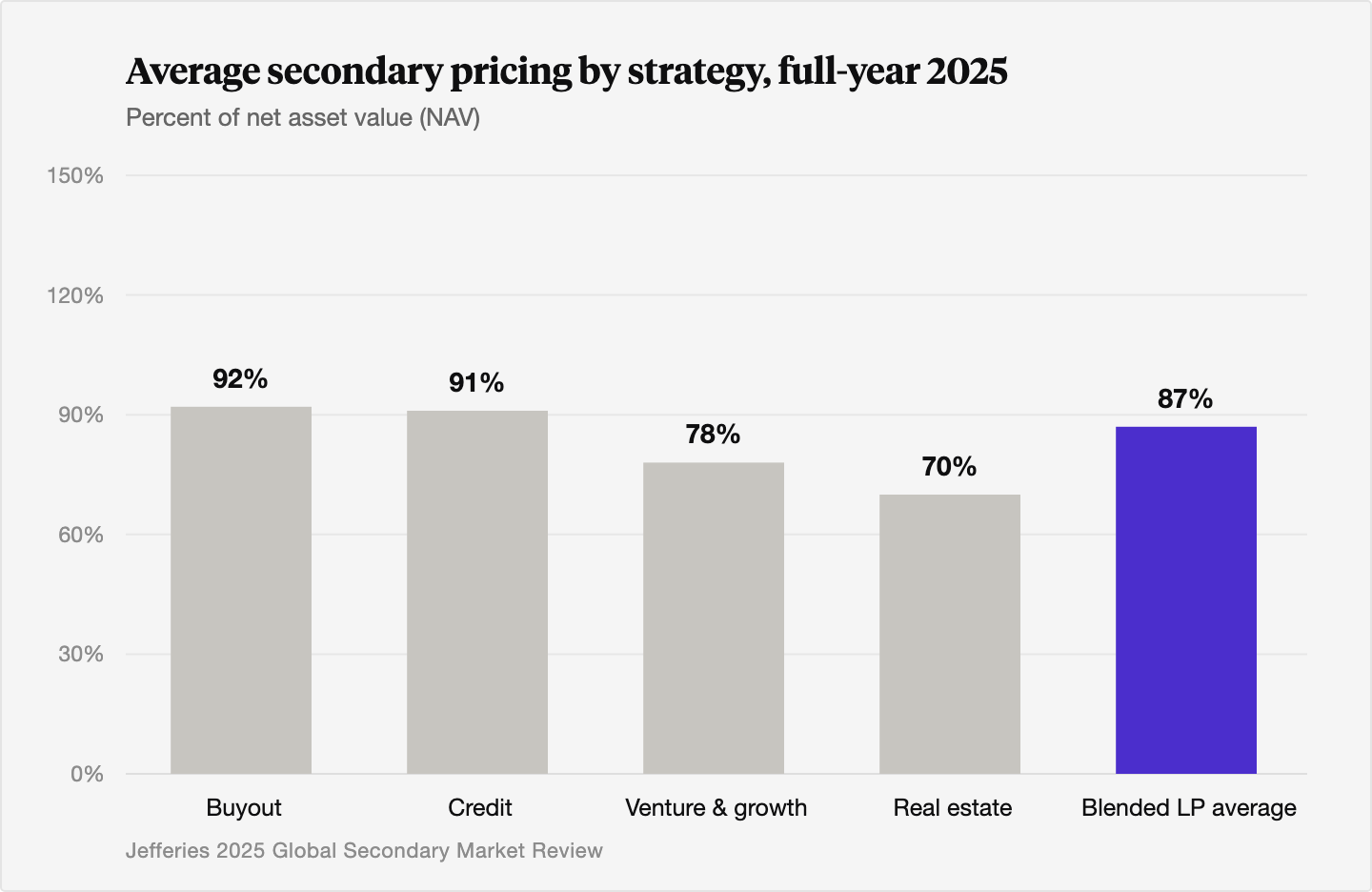
- Stakes usually trade below stated value. Average LP portfolio pricing finished 2025 at about 87% of net asset value (NAV). Buyout portfolios fetched around 92%, venture and growth around 78%. The discount is the price of liquidity in an asset class that is built to be illiquid.
- Dedicated buyers now hold record capital. Specialist secondary funds had about $327 billion of dry powder at the end of 2025, up 14% on the year, which is why the market has kept clearing at scale.
- Individuals mostly get in through funds. A direct secondary purchase is an institutional transaction. Retail access runs through semi-liquid evergreen funds, many registered under the Investment Company Act of 1940, some with minimums near $25,000.
1. What a secondary actually is
Start with the lockup, because it is the reason the market exists. When you commit to a traditional private equity, venture, or private credit fund, you are signing up for a closed-end structure with a life of ten to twelve years. The general partner (GP, the manager) calls your capital over the first few years, invests it in private companies, and returns proceeds as those companies are sold. You are a limited partner (LP, the passive investor). Until those exits happen, your money is committed and broadly stuck.
A secondary transaction is the resale of that commitment before the fund winds down. Imagine you are a pension fund that committed $50 million to a 2018-vintage buyout fund. It is 2026, the fund still holds eight companies, and you need cash now rather than in 2029. You can sell your stake to a buyer who pays you today and inherits both your remaining position in those eight companies and any unfunded commitment that comes with it. The fund itself does not change. The name on the LP register does.
That is the whole mechanism. A primary investment puts new money into a fund that then buys assets. A secondary buys an existing position in a fund that already owns the assets. The buyer skips the blind pool, sees the actual portfolio, and often buys it below its carried value.
2. LP-led secondaries: selling your seat early
The original form of the market is the LP-led deal. A limited partner that wants liquidity sells one fund stake or a whole portfolio of them to a secondary buyer. In 2025 LP-led transactions totaled roughly $125 billion, about 52% of all secondary volume, per Jefferies [1].
LPs sell for ordinary portfolio reasons, not distress. The most common driver is the denominator effect: when public markets fall, an investor's private allocation becomes a larger share of a smaller total portfolio, pushing it over policy limits, so the LP trims private exposure to rebalance [2]. Others sell to meet near-term cash needs, to exit a manager they no longer back, or to clean up a tail of small aging positions. Barclays describes the typical seller as motivated by the denominator effect, liquidity needs, and changes in strategy [3].
The price is set by negotiation against the fund's reported NAV, the manager's stated value of the holdings. Most LP stakes change hands a little below that mark. Across 2025, average LP portfolio pricing landed near 87% of NAV, down about 200 basis points from 2024 [1]. The discount is not a verdict that the manager is wrong about value. It compensates the buyer for taking an illiquid position, for the lag between a stale NAV and current conditions, and for the age and quality of the underlying companies.
3. GP-led secondaries and the continuation vehicle
The faster-growing half of the market is GP-led. Here the manager, not the LP, initiates the deal. The most common form is the continuation vehicle (CV), sometimes called a continuation fund.
The setup works like this. A GP holds one or a few companies it does not want to sell yet, often the best assets in an aging fund whose clock is running out. Rather than dump them into a soft M&A market, the manager moves those assets into a new fund it also runs. A secondary buyer provides fresh capital to that new vehicle. Existing LPs then choose: cash out at the agreed price, or roll their stake into the continuation fund and stay invested. The GP keeps managing assets it knows well, the company gets more time, and LPs who want liquidity get it.
GP-led volume reached about $115 billion in 2025, roughly 48% of the market, per Jefferies [1]. A decade ago it was a rounding error. Continuation vehicles drove the surge, and for the first time single-asset CVs, where the new fund holds just one company, made up more than half of CV volume [1]. The structure has become a core exit route. CAIA notes that GP-led deals now account for a meaningful share of all private equity exits, which raises a fair question about whether managers are using them to defer reckonings rather than realize them [4].
Pricing runs differently here. Because GP-led deals usually involve a manager's favored assets with current diligence attached, they often clear at or near NAV, sometimes above it, rather than at the discounts common in LP portfolios [3]. The buyer is paying for visibility and asset quality.
4. Why stakes trade at a discount, or sometimes a premium
The pricing question sits at the center of the whole market, so it is worth being precise about what moves it.
A reported NAV is the manager's estimate of what the portfolio is worth. It is updated quarterly and can lag real conditions. A secondary buyer is not obligated to accept that number. The gap between the price paid and NAV reflects a few forces:
- The cost of liquidity. The seller wants cash now and the buyer is providing it into an illiquid position. That service has a price, and it usually shows up as a discount [3].
- Portfolio age and quality. A fund full of older companies with uncertain exits trades cheaper than one holding fresh, healthy assets. In 2025, buyout portfolios brought to market skewed older, with an average vintage around 2016, which helped pull average pricing down [1].
- Strategy mix. Different assets clear at different levels. In 2025 buyout traded near 92% of NAV, credit near 91%, venture and growth near 78%, and real estate near 70% [1]. Venture trades cheaper because its values are harder to verify and its exits are further out.
- The J-curve and blind-pool risk. A new primary fund spends years drawing capital and paying fees before returns show, the early dip known as the J-curve. A secondary buyer skips that, buying assets already marked at NAV, often at a discount, which can lift returns from day one [5].
Premiums happen too, mostly in GP-led deals on prized single assets where buyers compete for visibility. The point is that the discount or premium is a real-time read on liquidity, quality, and risk, not a fixed feature.
5. The liquidity solution for a locked-up asset class
The reason this market grew from niche to mainstream is simple. Private assets are illiquid by design, and investors periodically need an exit before the design allows one. Secondaries are the release valve.
Global private capital is heading toward roughly $30 trillion in assets under management later this decade, per Preqin [6]. A pool that large, with capital locked for a decade at a time, generates constant demand from investors who need to move before their funds mature. Distributions have been slow across the private markets as exits stalled, which left LPs short of the cash they expected and sent more of them to the secondary market to manufacture their own liquidity [4]. J.P. Morgan Asset Management frames the appeal plainly: secondaries offer immediate exposure to mature assets, shorter holding periods, and entry below NAV [7].
It is worth being honest about the limits. Secondary liquidity is real but partial. A seller takes whatever the market will pay on the day, which in 2025 averaged 87 cents on the stated dollar and less for harder-to-value strategies [1]. There is no guaranteed price and no guaranteed buyer. The market clears because dedicated capital is standing by, and that standby capital hit a record. Jefferies counted about $327 billion of dedicated secondary dry powder at the end of 2025, up 14%, and closer to $477 billion once traditional LP capital and leverage are included [1]. That depth is what lets a $240 billion year clear without prices collapsing.
6. Who the buyers are
The buyers are overwhelmingly specialists. Dedicated secondary funds run by firms built for this work raise large pools of capital with a single mandate: buy existing private positions at attractive prices. They have the analytical machinery to value a portfolio of dozens of underlying companies and the relationships to source deals at scale.
These funds are the engine of the market, and their record $327 billion of dry powder is the clearest sign of how institutional the strategy has become [1]. Capital has also broadened beyond the original specialists. Lazard notes growing participation from new entrants, including managers who historically focused only on primary commitments [8]. The result is a deeper, more competitive bid, which is generally good for sellers and helps explain why pricing held near NAV even as volume doubled.
7. How individual investors access secondaries
A direct secondary purchase is an institutional transaction. Buying a $125 million LP portfolio is not something a person does from a brokerage account. For individuals, access runs almost entirely through funds.
The main door is the semi-liquid evergreen fund. These are open-ended structures, often registered with the SEC as tender offer or interval funds under the Investment Company Act of 1940, that hold a diversified book of secondary positions and let investors subscribe and redeem on a set schedule, usually quarterly [9]. Several large managers now run secondaries-focused evergreen funds aimed at private wealth, some with minimums near $25,000, a level that opens an institutional strategy to a far wider group of investors [10]. The U.S. semi-liquid evergreen universe grew to about $457 billion across nearly 500 funds by the end of 2025, with more than half launched in the past four years [10].
The tradeoff is the same one that runs through this entire piece. Evergreen funds offer periodic liquidity, not daily liquidity. Redemptions are typically capped, often around a few percent of fund assets per quarter, and a manager can gate or suspend them when too many investors head for the exit at once [11]. The structure smooths access to an illiquid asset. It does not make the asset liquid.
8. The same liquidity problem, in art
Secondaries exist because primary private investments are illiquid and investors sometimes need to exit before the natural end. That is also the core problem in fine art, and it is the problem a secondary market for art shares is meant to address.
When an investor buys a share of a securitized artwork on a fractional platform like Masterworks, the natural exit is the eventual sale of the painting itself, and no one can say in advance when that will be. A secondary market lets shareholders sell to one another before that sale happens, the same way an LP sells a fund stake before the fund winds down. In both cases the goal is the same: turn a long-dated, illiquid position into something an investor can step out of early.
At Masterworks that route is closing. Effective around December 14, 2026, Masterworks' shares will no longer be tradable on the North Capital ATS. We're planning to look into an alternative secondary liquidity option going forward, but at this stage it's uncertain whether that alternative will be developed, what form it would take, or whether it would provide meaningful or reliable liquidity. Investors should consider the shares to be illiquid investments and be prepared to hold their shares for an indefinite period as there's no guarantee of an efficient liquidity avenue at any time in the future.
We think the honest comparison is the useful one, so here are the limits, which both markets share.
- Both can trade at a discount. A private fund stake averaged about 87% of NAV in 2025. An art share can trade above or below the platform's last marked value depending on demand. Neither is a redemption at par.
- Both depend on a willing buyer. Secondaries clear because dedicated funds hold hundreds of billions in standby capital. A fractional art secondary clears only if another investor wants the shares at a price the seller will take. Thinner demand means a wider spread or no trade at all.
- Both are partial liquidity, not full liquidity. A secondary trade is a real exit when it happens. It is not a guarantee that it will happen on your timeline or at your price.
We would not oversell the parallel. The private secondary market is a $240 billion institutional machine with specialist buyers and standardized pricing. A fractional art secondary market is smaller, younger, and less deep. The mechanism is the same. The scale is not. For an investor, the lesson carries across both: a secondary market is a genuine improvement over a strict lockup, and it is still a market, which means it pays what it pays on the day.
The Bottom Line
- Secondaries are the resale market for private fund interests, letting investors exit before a fund reaches its ten-year-plus natural end.
- The market split in 2025 between LP-led deals (an investor selling its stake, about 52% of volume) and GP-led deals (managers moving assets into continuation vehicles, about 48%).
- Stakes usually trade below stated NAV, around 87% on average in 2025, because the buyer is being paid to provide liquidity into an illiquid position and to take on portfolio age and risk.
- The market hit a record near $240 billion in 2025 and clears at scale because dedicated secondary funds hold record dry powder, about $327 billion.
- Individuals reach secondaries mostly through semi-liquid evergreen funds with periodic, capped liquidity, not through direct purchases.
- The same illiquidity problem drives the secondary market for fractional art shares. Both offer partial liquidity, both can trade at a discount, and both depend on a willing buyer. Past performance is not predictive of future results in either market.
Sources
- Jefferies. "2025 Global Secondary Market Review: Another Record-Breaking Year." Jefferies, February 10, 2026. https://www.jefferies.com/insights/the-big-picture/2025-global-secondary-market-review-another-record-breaking-year/
- Commonfund. "What Factors Influence Pricing in the LP-led Secondaries Market?" Commonfund Capital, 2025. https://www.commonfund.org/cf-private-equity/what-factors-influence-pricing-in-the-lp-led-secondaries-market
- Barclays Private Bank. "Spotlight on private equity secondaries." Barclays Market Perspectives, September 9, 2025. https://privatebank.barclays.com/insights/market-perspectives-september-09-2025/spotlight-on-private-equity-secondaries/
- CAIA Association. "The Continuation Vehicle Boom: Structural Shift or Liquidity Patch?" Portfolio for the Future, February 11, 2026. https://caia.org/blog/2026/02/11/continuation-vehicle-boom-structural-shift-or-liquidity-patch
- Hamilton Lane. "Secondary Investments: An Introduction." Hamilton Lane Knowledge Center, 2025. https://www.hamiltonlane.com/en-us/knowledge-center/secondaries
- Preqin. "Preqin 2025 Global Report: Private Equity." Preqin, 2025. https://www.preqin.com/insights/global-reports/2025-private-equity
- J.P. Morgan Asset Management. "The growing opportunity in private equity secondaries and co-investments." J.P. Morgan Asset Management, 2025. https://am.jpmorgan.com/us/en/asset-management/adv/insights/portfolio-insights/alternatives/the-growing-opportunity-in-private-equity-secondaries-and-co-investments/
- Lazard. "Lazard 2025 Secondary Market Report." Lazard, February 23, 2026. https://www.lazard.com/research-insights/lazard-2025-secondary-market-report/
- Moonfare. "Fund structures by liquidity: open-ended, semi-liquid and evergreen explained." Moonfare Glossary, 2025. https://www.moonfare.com/glossary/fund-structures-by-liquidity
- Morgan Stanley Investment Management. "The Compelling Case for an Allocation to Semi-Liquid Evergreen Private Equity." Morgan Stanley, 2025. https://www.morganstanley.com/im/en-us/individual-investor/insights/articles/evergreen-private-equity-funds.html
- Hartford Funds. "Liquidity in Open-Ended Evergreen Funds Explained." Hartford Funds Market Perspectives, 2025. https://www.hartfordfunds.com/insights/market-perspectives/equity/liquidity-in-open-ended-evergreen-funds-explained.html
- Chief Investment Officer. "LP-, GP-Led Secondaries Grow to Record Volumes in 2025." ai-CIO, 2026. https://www.ai-cio.com/news/lp-gp-led-secondaries-grow-to-record-volumes-in-2025/
- CAIS. "What's Behind the Continued Growth in Private Markets Secondaries?" CAIS Group, 2025. https://www.caisgroup.com/articles/whats-behind-the-recent-growth-in-private-markets-secondaries
See also our explainers on what private equity is and how it works, how to invest in private equity as an individual, interval funds and limited liquidity, and what happens when Masterworks sells a work.
Disclosures
Investing involves risk. Past results are not indicative of future outcomes.
Masterworks is providing this communication as an agent for its issuer entities, not Masterworks Advisers. This material is produced by Masterworks for informational purposes only and does not constitute investment advice, a recommendation, or an offer or solicitation to buy or sell any security. Masterworks is not a licensed broker-dealer by the SEC or FINRA.
Masterworks can only make and accept sales after an offering statement has been filed, and "qualified", by the SEC. Any offers may be revoked before notice of qualification. Indications of interest involve no obligation. For further disclosure visit the offering documents filed with the SEC and Important Disclosures at masterworks.com/cd.
Forward-looking statements and internal estimates are based on assumptions that may prove incorrect, and actual outcomes may differ materially. Figures denoted in brackets are subject to confirmation. Investing in art and alternative assets involves risk, including loss of principal.
Art sales price data is comparative only. Each painting is unique and historical data is not a direct proxy for any specific painting or investment. Data represents whole art, not an investment into our offerings which includes fees and expenses. Any comparative images are not currently live offerings and are provided for educational purposes only.
Masterworks, LLC is located at 1 World Trade Center, 57th Floor, New York, NY 10007.


