
Masterworks Research · June 2026
What private equity is, how a fund actually moves money from commitment to exit, why returns arrive on a J-curve, and the routes an individual investor can use to get in.
Private equity is ownership in companies that do not trade on a public exchange, pooled through funds that a professional firm raises, deploys, and eventually sells out of over roughly ten to twelve years. Investors commit capital, the manager calls it in pieces to buy and improve businesses, and returns come back later through sales, recapitalizations, and the occasional IPO. The asset class now sits above [10 trillion dollars] in assets under management, up from about 600 billion in 2000, which makes it one of the largest pools of private capital in the world [5][6]. For an investor weighing where to put money outside public stocks and bonds, private equity is one of the two big illiquid alternatives that a portfolio can use to diversify beyond public markets. Fine art is the other, and the two have more in common than most people assume.
What You Need to Know
- Private equity is a closed-end, long-hold structure, not a stock you can sell on a Tuesday. Capital is locked for about 10 to 12 years, called in installments and returned only as companies are sold [1][3][4].
- The two main strategies are buyouts and growth equity. Buyouts take majority control of mature, cash-generating companies using significant debt. Growth equity takes minority stakes in faster-growing, less-levered businesses [1][2].
- Returns follow a J-curve. Fees and early costs push net returns negative in the first few years, then exits bend the line up. IRR measures the annualized return and is sensitive to timing. MOIC measures the simple multiple of money back and ignores time [1][7].
- Manager selection is decisive. The spread between top and bottom decile ten-year IRRs in private equity runs past [50 percentage points], versus roughly 10 points for public-equity fund managers [5]. A median manager may not beat an index fund.
- Access used to require millions. It no longer always does. Feeder funds, fund-of-funds, and newer interval and evergreen vehicles have pulled some minimums into the [10,000 to 50,000 dollar] range, and policy work in 2025 and 2026 is pushing private equity toward 401(k) plans [4][8].
1. What private equity actually is
Private equity is equity, meaning ownership, in companies that are not listed on a public market [2][7]. A private equity firm raises a fund, buys stakes in private businesses, works to make them more valuable through operational changes, add-on acquisitions, and debt paydown, and then sells those businesses at a profit and returns the cash to its investors [1][2][4].
Three features define how it behaves as an investment. It is illiquid: investors generally cannot redeem at will, and capital is locked for roughly 10 to 12 years [3][4]. It involves active ownership: the firm usually takes board seats and real control rather than a passive position [1][2]. And it underwrites to high targets: buyout funds commonly aim for a gross internal rate of return in the mid-teens to north of 20 percent and a multiple of invested capital around 2 to 3 times over a fund's life. Those targets are market practice, and we want to be clear that a target is an assumption, not a result. Past performance is not predictive.
To size the inefficiency the way we size every asset class: private equity is a roughly [10 trillion dollar] pool with thousands of firms competing to allocate capital into it [5][6]. The art market, by comparison, is a much smaller and far less institutionalized opportunity. We will come back to that contrast at the end.
2. Buyouts versus growth equity: the two main strategies
Most private equity money runs through one of two strategies, and they work differently enough that lumping them together hides the risk.
A buyout, often called a leveraged buyout or LBO, is the purchase of a majority stake or all of an established, cash-generating company, usually with a large slug of debt [1][3][5]. The debt sits on the acquired company's balance sheet and gets repaid out of its own cash flow. A fund buys an industrial business with 50 million dollars of EBITDA at 10 times earnings, so 500 million dollars of enterprise value. It funds that with 300 million in debt and 200 million of its own equity. Five years later EBITDA has grown to 70 million, the exit multiple holds at 10 times, and debt has been paid down to 150 million. The equity is now worth 550 million. That is 2.75 times the original 200 million, a gross IRR around 22 to 23 percent before fees [1][5]. Operational improvement, a steady multiple, and deleveraging did the work.
Growth equity is the other path. Here the fund takes a minority or non-controlling stake, often 10 to 40 percent, in a younger company that already has real revenue and is growing fast, and it puts fresh capital into the business rather than buying out existing owners [1][2][3]. Leverage is low or absent. A growth fund might put 60 million into a software company at a 300 million pre-money valuation for a 16.7 percent stake, then ride revenue from 30 million to 120 million over five years to a 900 million exit. The stake is worth about 150 million, a 2.5 times multiple [1]. Same order of return as the buyout, but driven by growth instead of debt.
The risk profiles diverge. Buyouts carry leverage risk but sit on cash flows that offer some downside protection. Growth equity carries growth risk with a cleaner balance sheet. Neither is safer in the abstract. They fail in different ways.
3. The fund structure: LPs, GPs, and the limited partnership
Almost every private equity fund is a limited partnership with two roles [1][3][4].
The general partner, or GP, is the fund manager. It controls the fund, sources and executes deals, monitors the companies, runs the exits, and administers the vehicle [4]. The GP typically commits 1 to 3 percent of the fund's capital from its own pocket to keep its incentives aligned with investors. The limited partners, or LPs, are the investors: pension funds, endowments, sovereign wealth funds, insurers, family offices, fund-of-funds, and high-net-worth individuals [4]. They provide capital, carry limited liability, and have no role in day-to-day management.
The economics sit on two numbers, often shorthanded as "2 and 20" [8]. The management fee is an annual charge, commonly around 2 percent, levied on committed capital during the investment period and then on invested capital later, to cover the firm's salaries and operations. Carried interest is the performance fee: usually 20 percent of profits, but only after investors clear a hurdle [5][7].
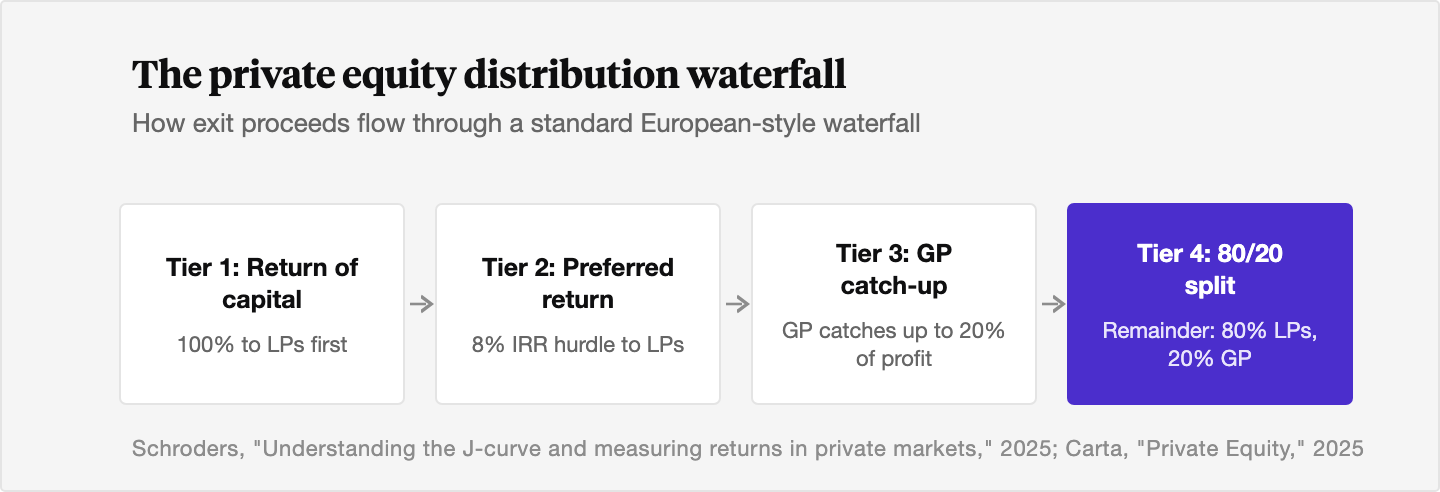
In a standard European-style structure, the GP earns nothing on profits until LPs have first received all their capital back, then an 8 percent annual preferred return on it [7]. Only after that does carried interest kick in, often through a catch-up that brings the GP up to its 20 percent share of total profit, after which everything splits 80 to LPs and 20 to the GP [7]. The investor gets paid first. That is the design.
4. Committed capital, capital calls, and the J-curve
You do not wire your money on day one, which is what trips up first-time investors.
When an LP joins a fund, it signs a subscription agreement committing a total amount, say 50 million dollars to a 1 billion dollar fund [1][3]. That is committed capital. The GP then draws it down over time through capital calls, also called drawdowns: a notice that says wire this portion now, to close a deal, fund a follow-on, or pay fees [1]. An LP usually has 10 to 15 business days to send the cash. Over a typical five-year investment period the GP might call 80 to 100 percent of the commitment in stages, and the uncalled balance is an obligation the investor has to keep liquid in the meantime [4].
Cash then flows back the other way as companies are sold, through the waterfall described above. Early on, calls exceed distributions, so the investor is net negative. Later, distributions exceed calls, so the investor turns net positive. Plotted over time, that pattern traces the letter J.
The J-curve is the single most important picture in private equity [1][2][5]. Net returns to investors are negative in the early years, because management fees hit committed capital from day one, deals carry acquisition and financing costs, and any early write-downs land before any gains [1][5][6]. A fund can sit at a TVPI, total value to paid-in, below 1.0 times and a DPI, distributions to paid-in, near zero for years before exits arrive [3]. Then the curve bends up. After the 2008 crisis and the dot-com bust, that bend took real patience to wait out, and the investors who held through the bottom captured the most. The lesson generalizes well beyond private equity.
5. Reading returns: IRR, MOIC, TVPI, and DPI
Four metrics carry almost all the weight in private equity reporting, and confusing them leads to bad comparisons.
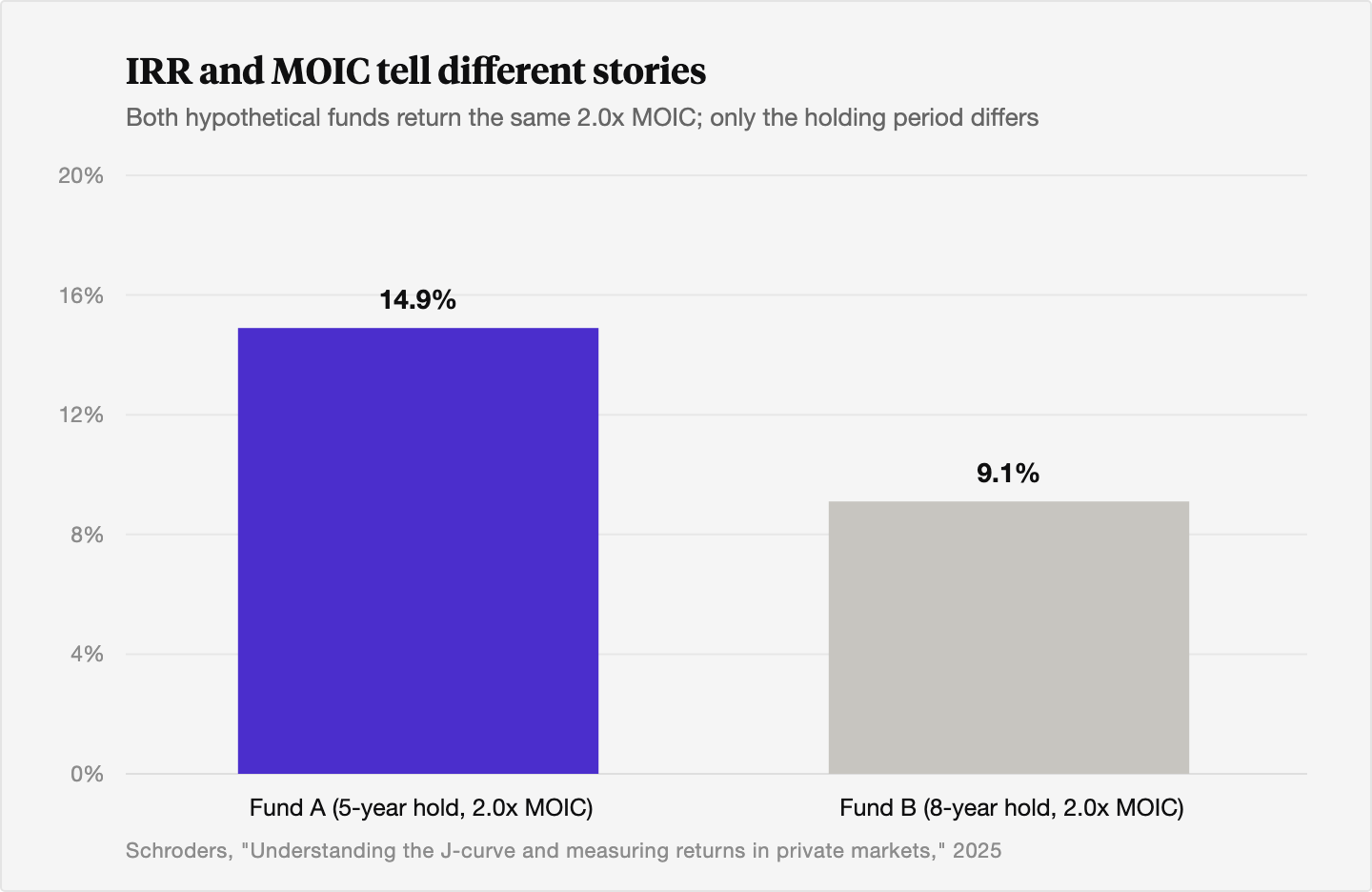
IRR, the internal rate of return, is the annualized rate that sets the net present value of all the fund's cash flows to zero [2][7]. It is time-weighted, so earlier distributions lift it and late ones drag it down. Invest 100 and get back 200 in five years and the IRR is about 14.9 percent. The same doubling stretched over eight years is about 9.1 percent [7]. The money back is the same; the IRR is very different.
MOIC, the multiple on invested capital, is total value divided by total invested capital, expressed as a multiple [7]. Get 250 back on 100 in and the MOIC is 2.5 times. MOIC ignores time entirely, which is exactly why you read it alongside IRR rather than instead of it. TVPI adds unrealized portfolio value to distributions and divides by paid-in capital, capturing both realized and on-paper value [3][7]. DPI counts only cash actually returned, so it is the honest measure of money in hand [3][7]. A fund showing a 1.30 times TVPI but a 0.40 times DPI has marked up its remaining holdings but has not yet sent most of the cash. In a slow exit market, that gap matters a great deal.
6. Returns and dispersion: what the recent data shows
Over long horizons, pooled private equity has beaten public equities, though the margin and the consistency are easy to overstate.
The American Investment Council, using PitchBook fund data, reported that US private equity delivered the highest net-of-fee returns of any major asset class over 5, 10, 15, and 20 year horizons as of mid-2023 [1]. Over 15 to 20 years, pooled net returns have run roughly 2 to 4 percentage points a year ahead of the S&P 500 [1][6]. The recent picture is less flattering. Hamilton Lane's 2026 Market Overview, with data through September 2025, found that over 1, 3, and 5 year windows private equity underperformed almost every public benchmark, including the S&P 500, even after stripping out the largest tech names [3]. One index cited by the Private Equity Stakeholder Project showed private equity returning 7.08 percent in 2024 against 25.02 percent for the S&P 500 [2]. We state the down stretch plainly because it is real, and because past performance is not predictive in either direction.
For an individual, dispersion matters more than the pooled averages. In private equity, the spread between the 5th and 95th percentile manager on ten-year IRR runs past [50 percentage points], compared with about [10 percentage points] across US large-cap public equity funds [5]. Top-quartile buyout funds have historically delivered high-teens to low-20s net IRRs while bottom-quartile funds sit in mid-single digits or worse [3][5]. The median manager may not beat an S&P 500 index fund. Almost all of the long-run outperformance in the pooled numbers comes from the top managers, and access to them is not evenly distributed. That is why manager selection, the analog of artist-market selection in our world, dominates the outcome.
Global private equity fundraising fell 11 percent in 2025, a fourth straight annual decline and the lowest in a decade [2]. And exits have slowed sharply since 2022, leaving distributions thin and NAV building up on the books [7]. High headline AUM and slow cash back to investors are both true at once.
7. How an individual can invest in private equity
For most of its history, private equity was closed to anyone who was not an institution or ultra-wealthy. That is changing, in stages.
The first gate is eligibility. An accredited investor, under SEC Regulation D, is an individual with more than 1 million dollars in net worth excluding their primary residence, or income over 200,000 dollars (300,000 jointly) in each of the last two years [4]. A qualified purchaser, the higher bar used for many institutional-style funds, generally needs at least 5 million dollars in investments [4]. Direct commitments to flagship funds still often start at 5 million dollars or more and expect qualified-purchaser status [4].
Below that, several routes have opened up.
A feeder fund pools many smaller investors and channels their money into a main institutional fund, commonly at 50,000 to 250,000 dollar minimums [4]. A fund-of-funds spreads capital across many underlying funds for diversification, with newer wealth-focused versions reaching down toward 25,000 to 100,000 dollars, at the cost of a second layer of fees [4]. The bigger structural shift since 2023 is the rise of semi-liquid vehicles: evergreen funds with no fixed term and periodic redemption windows, interval funds that repurchase a set slice of shares at NAV on a schedule, tender-offer funds, and non-traded business development companies. These have pulled minimums into the [10,000 to 50,000 dollar] range and, in some cases, opened to non-accredited investors through a prospectus [4][8]. Listed BDCs and listed private equity firms can be bought in an ordinary brokerage account with no accreditation at all.
The frontier is retirement plans. A 2026 White House Council of Economic Advisers chapter analyzed letting 401(k) and other defined contribution plans hold private equity, usually as a small 5 to 15 percent sleeve inside a target-date fund rather than as standalone fund picks [8]. The direction of travel is clear, the implementation is early, and the trade-offs of fees and liquidity inside a daily-valued retirement vehicle are not settled. Lower minimums do not remove the lock-up or the dispersion risk. They just change who is exposed to them.
8. Art and private equity: two illiquid alternatives compared
We spend our days in the art market, so we will draw the comparison directly and without a sales pitch. Both fine art and private equity are ways to diversify beyond public stocks and bonds, and the family resemblance runs deep.
The parallels are real. Both demand long holding periods: private equity funds run 10 to 12 years, and investment-grade art is typically a 3 to 10 year hold or longer [1][7]. Both are genuinely illiquid, with no central exchange and sale on someone else's timeline. Both ask for patience before returns show up. Private equity has its formal J-curve from fees and early costs, and art has an economic cousin of it, where buyer's premiums, insurance, and storage front-load the costs while an artist's market matures before any gain is realized [1][7]. And in both, selection is everything. The manager-dispersion gap in private equity has a direct analog in art, where outcomes hinge on the artist market, the specific work, the entry price, and the timing of the sale. We have always said that getting the artist market right comes first, because the best example by an artist nobody wants tends to be worth nothing.
The differences are where art earns its place in a portfolio. Private equity is, in effect, a leveraged extension of public equity. After adjusting for smoothed valuations, buyout returns correlate with public markets at roughly 0.6 to 0.8 [8]. When stocks fall hard, leveraged private companies feel it. Fine art behaves differently. Its long-run correlation to equities has been low and in many samples close to zero, because its prices are driven by wealth concentration, taste, and scarcity rather than corporate earnings cycles [1][2][4]. That is diversification as we define it: owning something largely indifferent to the forces moving everything else. Art also has a supply story private equity cannot match. A general partner can raise a bigger fund whenever demand allows, but no one will paint another Basquiat, and works keep leaving the market permanently into museums. Scarcity that increases over time is rare among assets. Finally, access differs. Direct private equity still typically expects six to seven figure commitments, while fractional art platforms have brought exposure to individual works down to the low thousands [1]. We are one of those platforms, and we will leave it there.
None of this makes one asset better than the other. They diversify different risks, and past performance is not predictive for either. The discipline, long horizons, selection, and patience, is the same. For a fuller treatment of these themes, see our comparison of art versus venture capital risk and return profiles, our framework for advisors weighing art as an alternative allocation, and the data on why patience is rewarded in art markets.
The Bottom Line
- Private equity is ownership in private companies, held inside closed-end funds that lock capital for about 10 to 12 years and return it only as businesses are sold.
- The two core strategies are buyouts, which use debt to take control of mature companies, and growth equity, which puts fresh capital into faster-growing companies for minority stakes.
- Returns trace a J-curve. They are negative early, from fees and costs, and bend up as exits arrive, so IRR and MOIC together tell you both the annualized rate and the simple multiple.
- Manager dispersion is enormous, with a ten-year IRR spread past [50 percentage points] between the best and worst managers, so selection decides the outcome and a median fund may trail an index.
- Individual access has widened from million-dollar commitments toward feeder, interval, and evergreen vehicles in the tens of thousands, with a 2025 to 2026 push to add private equity to retirement plans.
- Private equity and fine art are both long-hold, illiquid, selection-driven alternatives. Their key difference is correlation: private equity behaves like leveraged equity, while art has historically shown near-zero correlation to stocks.
Sources
- American Investment Council. "New Report: Private Equity Delivers Stronger Long-Term Returns Than Any Other Asset Class." Investment Council, 2023. https://www.investmentcouncil.org/new-report-private-equity-delivers-stronger-long-term-returns-than-any-other-asset-class/
- Private Equity Stakeholder Project. "Private Equity Underperforms." PESP, 2025. https://pestakeholder.org/reports/private-equity-underperforms/
- J.P. Morgan Asset Management. "Essentials of Private Equity Investing." J.P. Morgan, 2025. https://am.jpmorgan.com/us/en/asset-management/adv/insights/portfolio-insights/alternatives/essentials-of-private-equity-investing/
- Moonfare. "What Is Private Equity?" Moonfare PE Masterclass, 2025. https://www.moonfare.com/pe-masterclass/what-is-private-equity
- J.P. Morgan Asset Management. "Private Equity: Dispersion and the Case for Manager Selection." J.P. Morgan, 2026. https://www.youtube.com/watch?v=Ms971DYjo-w
- McKinsey & Company. "Global Private Markets Report 2026." McKinsey, 2026. https://www.mckinsey.com/industries/private-capital/our-insights/global-private-markets-report
- Schroders. "Understanding the J-curve and Measuring Returns in Private Markets." Schroders, 2025. https://www.schroders.com/en-us/us/intermediary/insights/understanding-the-j-curve-and-measuring-returns-in-private-markets/
- White House Council of Economic Advisers. "Unlocking Retail Access to Private Equity Investments through Defined Contribution Plans." Economic Report of the President, 2026. https://www.whitehouse.gov/wp-content/uploads/2026/04/ERP-2026-12.-Unlocking-Retail-Access-to-Private-Equity-Investments-through-Defined-Contribution-Plans.pdf
- Carta. "Private Equity." Carta Learn, 2025. https://carta.com/learn/private-funds/private-equity/
- Hamilton Lane. "J-Curves." Hamilton Lane Knowledge Center, 2025. https://www.hamiltonlane.com/en-us/knowledge-center/j-curves
- Fidelity. "What Is Private Equity?" Fidelity Learning Center, 2025. https://www.fidelity.com/learning-center/trading-investing/what-is-private-equity
- GSB Global. "The Case for Art as an Alternative Investment Strategy." GSB Global, 2025. https://gsbglobal.com/newsroom/the-case-for-art-as-an-alternative-investment-strategy/
- Maddox Gallery. "How the Art Liquidity Paradox Protects Fine Art Investment Returns." Maddox Gallery, 2025. https://maddoxgallery.com/news/495-how-art-liquidity-paradox-protects-fine-art-investment-returns/
- Harvard Law School Library. "Private Equity Research Guide." Harvard Library, 2025. https://guides.library.harvard.edu/law/private_equity
Disclosures
Investing involves risk. Past results are not indicative of future outcomes.
Masterworks is providing this communication as an agent for its issuer entities, not Masterworks Advisers. This material is produced by Masterworks for informational purposes only and does not constitute investment advice, a recommendation, or an offer or solicitation to buy or sell any security. Masterworks is not a licensed broker-dealer by the SEC or FINRA.
Masterworks can only make and accept sales after an offering statement has been filed, and "qualified", by the SEC. Any offers may be revoked before notice of qualification. Indications of interest involve no obligation. For further disclosure visit the offering documents filed with the SEC and Important Disclosures at masterworks.com/cd.
Forward-looking statements and internal estimates are based on assumptions that may prove incorrect, and actual outcomes may differ materially. Figures denoted in brackets are subject to confirmation. Investing in art and alternative assets involves risk, including loss of principal.
Art sales price data is comparative only. Each painting is unique and historical data is not a direct proxy for any specific painting or investment. Data represents whole art, not an investment into our offerings which includes fees and expenses. Any comparative images are not currently live offerings and are provided for educational purposes only.
Masterworks, LLC is located at 1 World Trade Center, 57th Floor, New York, NY 10007.


