
Masterworks Research · June 2026
The vehicles, eligibility thresholds, minimums, and fee tradeoffs that decide how an individual actually gets into private equity, and what the same access story looks like in art.
An individual today can invest in private equity through five practical routes: feeder funds on platforms like iCapital and Moonfare, registered interval and tender offer funds, business development companies (BDCs), evergreen or semi-liquid private funds, and secondaries platforms. Minimums run from the price of a single share for a listed BDC up to $100,000 to $250,000 for a direct secondary, and most routes require you to be an accredited investor, with the larger ones also requiring qualified-purchaser status. Getting in is now the easy part. The harder question is what you pay in fees and give up in liquidity to do so, and whether the wrapper improves your economics or simply packages a hard-to-reach asset for retail distribution.
This is the access companion to our explainer on what private equity is and how it works. We will not repeat the mechanics of buyouts, carry, and the J-curve here. We will walk the routes themselves, the eligibility gates, the due-diligence checklist, and the fee and liquidity math, then close with how the same access story has played out in fine art.
What You Need to Know
- Five routes, very different doors. Feeder funds, interval and tender offer funds, BDCs, evergreen funds, and secondaries platforms each carry their own minimums, eligibility tests, liquidity terms, and fee stacks. The wrapper, not the underlying strategy, usually decides whether the route fits you.
- Eligibility is the first gate. Most direct private equity routes require accredited-investor status, meaning over $200,000 in income ($300,000 with a spouse) or over $1 million in net worth excluding your home [1]. The largest funds add a qualified-purchaser test of $5 million in investments [2].
- Fees layer, and the layers compound. A flagship fund commonly charges roughly 2% management plus 20% carried interest, and a feeder or platform can add another 0.25% to 1% on top, pushing the all-in management drag toward 2% to 3% a year before carry [3].
- Liquidity is the real cost. Feeder funds lock capital for 10 to 12 years. Interval funds repurchase as little as 5% of shares per quarter and can prorate in stress [4]. There is rarely a clean exit when you want one.
- Policy is widening the door in 2025 and 2026. A 2025 federal directive and a Department of Labor reversal of 2021 guidance opened defined-contribution plans, including 401(k)s, to prudent private-market exposure, and managers have built evergreen products to fit [5].
1. Why private equity was hard to reach in the first place
Private equity is one of the largest asset classes on earth. The narrow private equity universe passed roughly $10 trillion in assets under management in 2025, and total private markets, including private credit, infrastructure, and real estate, sit somewhere between $16 trillion and $20 trillion [6][7]. For most of that history, an individual could not touch it.
The reason is structural, and it traces to two laws. Most private equity funds rely on exemptions from the Investment Company Act of 1940. A fund using the Section 3(c)(1) exemption can have no more than 100 beneficial owners, so it rations access. A fund using the Section 3(c)(7) exemption can take more investors but requires that every one of them be a qualified purchaser [2]. On top of that, the fund interests themselves are sold under Regulation D private-placement rules, which generally limit buyers to accredited investors [1]. Stack those two requirements and you get the historical reality: high minimums, gatekeeping by wealth, and no public marketing.
So the question of how to invest in private equity as an individual is really a question about wrappers. Each route below is a legal structure that pools individuals and either clears the eligibility tests on their behalf or sidesteps the private-placement regime entirely.
2. The accredited investor and qualified purchaser thresholds
Before the routes, the gates. Two status tests decide most of what you can access.
An accredited investor, under Rule 501 of Regulation D, is a person with income over $200,000 individually, or $300,000 jointly with a spouse, in each of the last two years with the expectation of the same this year, or a net worth over $1 million excluding the value of a primary residence [1]. Since 2020 the definition also recognizes professional credentials, including holders of the Series 7, Series 65, and Series 82 licenses, regardless of wealth [1].
A qualified purchaser is a higher bar set by Section 2(a)(51) of the Investment Company Act: a person who owns at least $5 million in investments, a defined term that covers securities and investment real estate but is not the same as net worth [2]. Many of the largest, most sought-after buyout and secondaries funds use the 3(c)(7) structure, which means the feeder you invest through must confirm you are a qualified purchaser to preserve the fund's exemption [2].
These numbers have not moved in years, and they are not indexed to inflation, which is part of the current policy debate. In June 2025 the House passed the Fair Investment Opportunities for Professional Experts Act, which would codify the existing thresholds, require the SEC to adjust them for inflation every five years, and add pathways based on demonstrated knowledge or an exam [8]. As of mid-2026 that bill has passed the House but is not law, so the operative tests remain $200,000 in income or $1 million in net worth, and $5 million in investments [1][8].
3. Feeder funds and access platforms
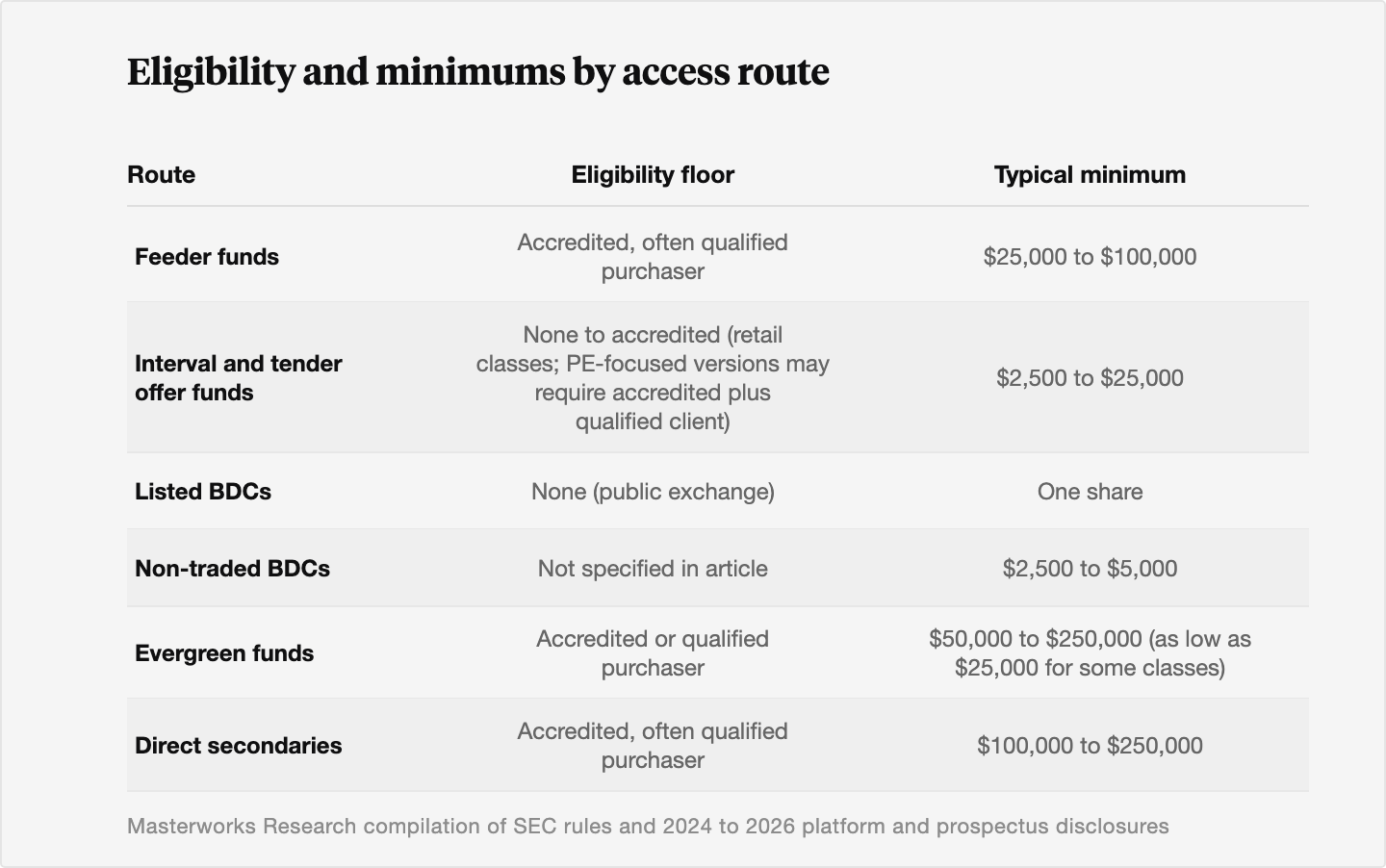
A feeder fund is the most direct way an individual buys into a brand-name private equity fund. It pools many smaller investors into a single vehicle, usually a Delaware LP or LLC, that then commits to a flagship fund whose own minimum might be $5 million to $25 million or more [3].
Platforms like iCapital, CAIS, and Moonfare run these feeders. Minimums on iCapital and CAIS sponsor programs typically land in the $25,000 to $100,000 range, and Moonfare's public materials describe per-fund minimums around 50,000 to 100,000 euros or the dollar equivalent [3]. The catch is eligibility and time. These feeders are sold under Regulation D, so they are limited to accredited investors, and many require qualified-purchaser status because the underlying fund uses the 3(c)(7) structure [3].
Liquidity is the part individuals underestimate. A feeder mirrors the underlying fund's life, usually 10 to 12 years, with capital called over the first several years and returned irregularly as exits happen [3]. There is generally no redemption right. Some platforms run internal secondary windows where you can try to sell your interest, but pricing and timing depend entirely on finding a buyer.
Fees come in two layers. The underlying fund charges roughly 1.5% to 2% management and 20% carried interest over a preferred return, and the feeder adds its own 0.25% to 1% management or platform fee [3]. Combine them and an individual can face an effective 2% to 3% annual management drag plus carry. That layering is the single most important thing to model before committing, and we return to it in section 6.
4. Interval funds, tender offer funds, and BDCs
If the feeder route asks for a six-figure check and a decade of patience, registered funds lower both bars. They are the most retail-accessible private equity routes, and they come in three close cousins.
Interval funds are closed-end funds registered under the 1940 Act that invest heavily in private markets. They publish a daily net asset value and must offer to repurchase at least 5% of shares at set intervals, usually quarterly [4]. Minimums for retail share classes often run $2,500 to $25,000, though more concentrated private equity versions can restrict themselves to accredited investors who are also qualified clients [9]. Fees look like alternatives, not index funds: management fees of roughly 1% to 1.75%, often a 10% to 15% incentive fee, plus possible servicing fees or sales loads [4][9].
Tender offer funds work similarly but provide liquidity through periodic tender offers at the board's discretion rather than a mandated repurchase schedule [4].
The liquidity here is real but limited. A quarterly repurchase of 5% to 25% of shares is the rule, and if more investors want out than the cap allows, redemptions are prorated [4]. In a stressed market, effective liquidity can be lower than the headline suggests. The one structural protection is that interval-fund repurchase terms are fixed in the prospectus and cannot be arbitrarily suspended [4].
Business development companies, or BDCs, are closed-end funds that invest mainly in private U.S. companies, often through debt paired with equity or warrants [2]. They come in two flavors. Listed BDCs such as Ares Capital trade on an exchange, so the minimum is one share and you get intraday liquidity, though the share price can swing to a discount or premium versus NAV. Non-traded BDCs sell through brokers at minimums around $2,500 to $5,000 and offer quarterly repurchase programs subject to caps, with boards able to modify or suspend those programs in adverse conditions [4]. BDCs can also run more leverage than interval funds, up to 2:1 debt-to-equity against the interval fund cap of 0.5:1, which raises both return potential and risk [4].
5. Evergreen funds and secondaries platforms
Two more routes round out the picture, and both have grown quickly.
Evergreen, or semi-liquid, funds are private open-end funds that raise capital continuously and offer periodic redemptions, usually quarterly, at a fund-determined NAV [3]. They blend primary commitments, secondaries, and co-investments to smooth cash flows and soften the J-curve. Minimums typically run $50,000 to $250,000, sometimes as low as $25,000 for certain share classes, and eligibility is usually accredited investor or qualified purchaser [3]. The redemption right is contractual, not statutory, so managers can impose lock-ups, redemption caps of 2% to 5% of NAV per quarter, and gates at their discretion [3]. Read that as: the liquidity is real until the moment everyone wants it at once.
Secondaries platforms let an individual buy seasoned private equity positions, which reduces the J-curve because the underlying portfolio is already partly built out. Direct secondaries on curated platforms typically require $100,000 to $250,000 per transaction and at least accredited, often qualified-purchaser, status, with no assured interim liquidity until the position is sold [3]. You can also reach secondaries indirectly through feeders into specialist managers like Ardian or Lexington, or through interval and evergreen funds that hold secondaries for liquidity management.
This whole segment is where 2025 and 2026 policy is pushing hardest. In August 2025 a federal directive instructed agencies to facilitate prudent inclusion of private-market assets in defined-contribution plans, and the Department of Labor rescinded 2021 guidance that had discouraged 401(k) plans from holding private equity [5]. Large managers responded by building evergreen products explicitly designed for advisory platforms and retirement accounts, including Blackstone's Private Equity Income Trust (BXPE), alongside semi-liquid vehicles from Apollo, KKR, and Hamilton Lane [5]. Blackstone's broader retail platform across real estate, credit, and private equity manages well over $200 billion of individual-investor assets, which is the scale these wrappers can reach [5]. The door is opening. The fee and liquidity tradeoffs behind it have not changed.
6. The due-diligence checklist before you commit
Access is the easy part now. Underwriting the specific vehicle is the work. In our view an individual should answer ten questions before subscribing, and the first three matter most.
First, net returns, not gross. Ask for net internal rate of return, after all fees and carried interest, across prior vintages, alongside TVPI, DPI, and a public-market-equivalent comparison where available [10]. A single strong headline fund tells you little. Consistent, auditable net performance across cycles tells you a lot.
Second, the full fee stack. Model the drag from the underlying fund, the feeder or platform, and vehicle expenses together, then compare the result against what the same capital could earn in a lower-fee alternative. A fund that returns 15% gross but charges 2% management, 20% carry, and a 0.75% feeder fee delivers meaningfully less to you, and the exact hit depends on when exits happen and whether carry is taken deal-by-deal or fund-wide [3][10].
Third, liquidity terms read literally. In a semi-liquid vehicle the headline redemption feature is constrained by lock-ups, gates, suspension rights, and proration. The practical test is whether the fund can meet redemptions in a down market or whether you are trapped longer than you planned [10].
The remaining items: confirm you can fund capital calls on short notice; understand the J-curve so early flat or negative marks do not surprise you; diversify across vintage years rather than betting one entry point; read the Form ADV, private placement memorandum, and limited partnership agreement side by side for conflicts and fees; ask for audited financials and the valuation policy; check key-person and removal provisions; and compare the all-in net return against a public benchmark net of the inconvenience of illiquidity [10]. The SEC's disclosure architecture, including Form ADV, helps you compare managers and spot related-party arrangements, though it does not replace your own diligence [10].
The honest summary for an individual entering through a wrapper is this. Access is now widely available. The questions that decide your outcome are what extra fee and liquidity cost you pay for that access, and whether the manager's net record justifies it.
7. The same democratization came to art, through a different rule
Private equity opened up through wrappers that clear the accredited and qualified-purchaser gates. Fine art opened up by sidestepping those gates entirely, using a different regulation, and the comparison is instructive for any investor weighing alternatives.
Fine art was a billionaire-only asset class for the same reason private equity was: large checks, personal relationships, and specialized access. A serious collection runs $50 million to $100 million, which is the kind of figure that turns art into a call option on the wealth of the top fraction of 1%. Fractional and securitized platforms changed the entry point by using Regulation A+, Tier 2, rather than the Regulation D private placements that govern most private equity feeders.
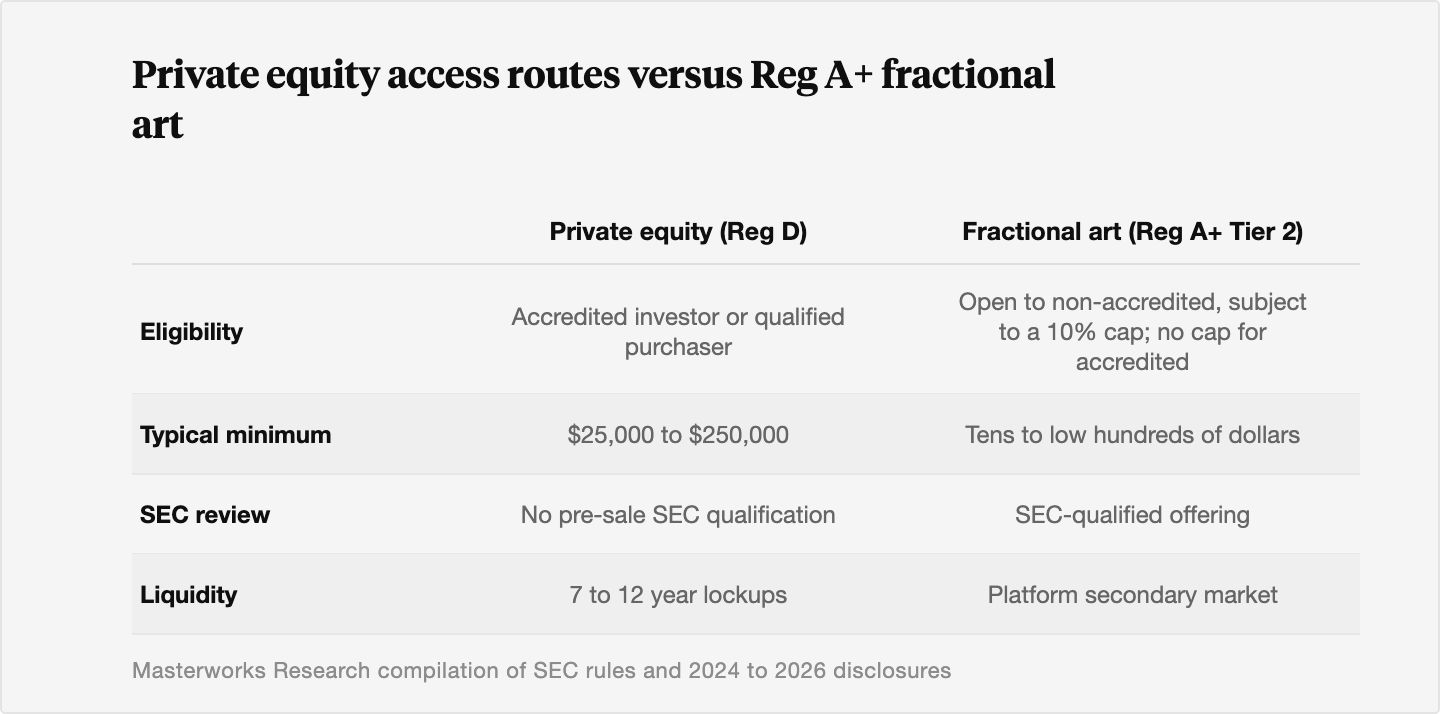
The legal difference is the whole story. A Reg A+ Tier 2 offering is a public, SEC-qualified offering, often called a mini-IPO, that allows up to $75 million in a 12-month period and is open to both accredited and non-accredited investors [11][12]. A non-accredited investor faces an annual cap of 10% of the greater of income or net worth, a retail-protection measure, while accredited investors face no cap [11][13]. The issuer must file a Form 1-A, get the offering qualified by the SEC, and provide audited financials and ongoing reports, which is a heavier disclosure burden than Reg D carries but the price of opening the asset to everyone [11]. Crucially, the shares are not restricted securities, so they can be resold, and platforms have paired them with alternative trading systems to offer at least some secondary liquidity [12].
The contrast in minimums and eligibility is stark. On Masterworks, each work is held by its own series and shares are issued at $20 per share under Regulation A, and investing there starts with Masterworks Club membership [11][12]. A typical private equity feeder asks $25,000 to $100,000 and requires accredited status; a direct secondary asks $100,000 to $250,000 [3]. The table below sets the two access stories next to each other.
A caveat belongs here, and it is the same one that governs every alternative. Liquidity on a fractional art platform is limited. Masterworks shares will no longer be tradable on the North Capital ATS effective around December 14, 2026, investors should consider the shares to be illiquid investments and be prepared to hold their shares for an indefinite period, and the primary exit is the eventual sale of the underlying work [12]. And the durability of art's historical appreciation, like the historical returns of any private equity vintage, is not a promise about the future. Past performance is not predictive. Art prices can fall, and they did over the three-year correction that ran into 2025. We have argued at length that patience is the asset that gets rewarded in art markets, and the same long-hold, illiquidity-tolerant temperament that private equity demands is what art demands too.
For investors thinking about where art fits alongside private equity in a portfolio, we have written a framework for advisors on art as an alternative allocation and a direct comparison of art versus venture capital risk and return profiles. The point of this section is narrower. The democratization you are watching in private equity, where evergreen funds and 401(k) access bring a once-institutional asset to the individual, already happened in art through a different door. Both stories trade the same coin: broader access in exchange for fees and limited liquidity.
The Bottom Line
- An individual can access private equity through feeder funds, interval and tender offer funds, BDCs, evergreen funds, and secondaries platforms, with minimums ranging from one share to $250,000 and most routes gated to accredited investors.
- Eligibility is the first hurdle. The accredited-investor test is over $200,000 in income or $1 million in net worth excluding your home, and the largest funds add a $5 million qualified-purchaser test that has not changed in years.
- Fees layer across the underlying fund and the access wrapper, which can push the all-in management drag toward 2% to 3% a year before carry, so the full fee stack should be modeled before committing.
- Liquidity is the real cost of these routes. Feeder funds lock up for a decade, interval and evergreen funds cap redemptions and can gate or prorate in stress, and there is rarely a clean exit on demand.
- Regulation A+ opened SEC-qualified fractional art offerings to non-accredited investors, a lower eligibility bar than any private equity route, in exchange for illiquid shares that investors should be prepared to hold for an indefinite period.
Sources
- U.S. Securities and Exchange Commission. "Accredited Investors." SEC.gov, updated April 24, 2026. https://www.sec.gov/resources-small-businesses/capital-raising-building-blocks/accredited-investors
- Morris, Manning & Martin LLP. "Closed-End Funds, Interval Funds or BDCs." MMM Law, 2025. https://www.mmmlaw.com/files/documents/10971675-2-31941_112134-BDC-vs.-Interval-Funds-vs.-Closed-End-Funds.pdf
- Investment Company Institute. "Perspective: The Closed-End Fund Market, 2025." ICI, April 3, 2026. https://www.ici.org/files/2026/per32-03.pdf
- CION Investments. "Understanding Interval Funds and BDCs." CION, May 14, 2026. https://cioninvestments.com/wp-content/uploads/Understanding-Interval-Funds-and-BDCs.pdf
- The White House. "Unlocking Retail Access to Private Equity Investments through Defined Contribution Plans." 2026 Economic Report of the President, April 2026. https://www.whitehouse.gov/wp-content/uploads/2026/04/ERP-2026-12.-Unlocking-Retail-Access-to-Private-Equity-Investments-through-Defined-Contribution-Plans.pdf
- McKinsey & Company. "Global Private Markets Report 2026." McKinsey, January 5, 2026. https://www.mckinsey.com/industries/private-capital/our-insights/global-private-markets-report
- J.P. Morgan Asset Management. "Alternative Investments Outlook 2026." J.P. Morgan, December 10, 2025. https://am.jpmorgan.com/content/dam/jpm-am-aem/global/en/insights/portfolio-insights/alternative-outlook.pdf
- National Association of Plan Advisors. "House Approves Legislation to Expand Accredited Investor Eligibility." NAPA-Net, June 24, 2025. https://www.napa-net.org/news/2025/6/house-approves-legislation-to-expand-accredited-investor-eligibility/
- Interval Fund Tracker. "Interval Funds Monthly: January 2026." Interval Fund Tracker, February 2, 2026. https://intervalfundtracker.com/2026/02/02/interval-funds-monthly-january-2026/
- Institutional Limited Partners Association. "Standardized Due Diligence Questionnaire." ILPA, 2024. https://ilpa.org/wp-content/uploads/2018/09/ILPA_Due_Diligence_Questionnaire_v1.2.pdf
- U.S. Securities and Exchange Commission. "Regulation A." SEC.gov, updated May 30, 2026. https://www.sec.gov/resources-small-businesses/exempt-offerings/regulation
- StartEngine. "The Difference Between Tier 1 and Tier 2 of Reg A Offerings." StartEngine, February 26, 2025. https://www.startengine.com/blog/understanding-the-differences-between-reg-a-tier-1-and-tier-2-offerings
- Amundsen Davis LLC. "Regulation A+ Securities Offerings: Comparison with Alternatives and Recent Developments." Amundsen Davis, updated June 7, 2026. https://www.amundsendavislaw.com/alert-RegulationASecuritiesOfferingsComparisonwithAlternativesandRecentDevelopments
Disclosures
Investing involves risk. Past results are not indicative of future outcomes.
Masterworks is providing this communication as an agent for its issuer entities, not Masterworks Advisers. This material is produced by Masterworks for informational purposes only and does not constitute investment advice, a recommendation, or an offer or solicitation to buy or sell any security. Masterworks is not a licensed broker-dealer by the SEC or FINRA.
Masterworks can only make and accept sales after an offering statement has been filed, and "qualified", by the SEC. Any offers may be revoked before notice of qualification. Indications of interest involve no obligation. For further disclosure visit the offering documents filed with the SEC and Important Disclosures at masterworks.com/cd.
Forward-looking statements and internal estimates are based on assumptions that may prove incorrect, and actual outcomes may differ materially. Figures denoted in brackets are subject to confirmation. Investing in art and alternative assets involves risk, including loss of principal.
Art sales price data is comparative only. Each painting is unique and historical data is not a direct proxy for any specific painting or investment. Data represents whole art, not an investment into our offerings which includes fees and expenses. Any comparative images are not currently live offerings and are provided for educational purposes only.
Masterworks, LLC is located at 1 World Trade Center, 57th Floor, New York, NY 10007.


