
Masterworks Research · June 2026
How Qualified Opportunity Zones defer and forgive capital gains, what the 10-year hold actually requires, and why the program was made permanent for 2027.
A Qualified Opportunity Zone is a tax incentive, created by the 2017 Tax Cuts and Jobs Act, that lets an investor defer tax on a capital gain by reinvesting that gain into a Qualified Opportunity Fund within 180 days, and then exclude all future appreciation on that fund investment from tax if it is held for at least 10 years [1][2]. The fund must channel the money into businesses or real estate located in one of roughly 8,764 designated low-income census tracts [3]. The trade is straightforward: you accept a long, illiquid, geographically constrained investment in exchange for deferring a gain you already owe and potentially never paying tax on the new gain. For an investor sitting on a large embedded gain and weighing tax-aware alternatives, the structure is worth understanding precisely, because the headline benefits come with real conditions and the program changed materially in 2025.
What You Need to Know
- Two benefits, one structure. Opportunity Zones offer two distinct tax breaks: deferral of an existing capital gain, and tax-free treatment of new appreciation after a 10-year hold. The second is the larger prize [1][2].
- The 10-year hold is the real lever. Hold a Qualified Opportunity Fund investment for at least 10 years and the IRS steps the basis up to fair market value at sale, so the appreciation in the fund is never taxed [1]. Sell earlier and you forfeit that benefit.
- The original deferral clock has run out. Gains deferred under the 2017 program were due to be recognized by December 31, 2026 [1][4]. The richer 5-year (10%) and 7-year (15%) basis step-ups are no longer reachable for legacy investments because the holding-period windows closed.
- The program is now permanent. The One Big Beautiful Bill Act, signed July 4, 2025, made Opportunity Zones a standing feature of the tax code, with new zones effective January 1, 2027, rolling 5-year deferral periods, and a new 30% basis step-up for rural zones [5][6].
- The benefits do not apply to art. Opportunity Zone tax treatment is tied to qualified zone businesses and real estate. Art is a separate kind of alternative with its own tax rules, which we cover at the end [7].
1. What an Opportunity Zone actually is
An Opportunity Zone is a census tract that a state governor nominated and the Treasury certified as economically distressed. The 2017 Tax Cuts and Jobs Act, signed December 22, 2017, created the designation and the incentive that comes with it [3][8]. About 8,764 tracts were certified in the first round, nearly all of them low-income communities [3].
The incentive is delivered through a Qualified Opportunity Fund, or QOF. A QOF is an investment vehicle, organized as a partnership or corporation, that exists to invest in qualified opportunity zone property: a stake in a business operating in a zone, or tangible property such as real estate used in a zone business [1]. The fund has to keep most of its assets in zone property to stay qualified. You do not get the tax benefit by buying property in a zone directly. You get it by routing eligible gains through a QOF [1].
The policy goal was to pull private capital into places that normal investment passes over. Roughly $100 billion has flowed into Opportunity Funds since 2018 [3]. Whether the money reached the residents it was meant to help is a separate and contested question, which we return to in Section 5.
2. The first benefit: deferring a capital gain you already owe
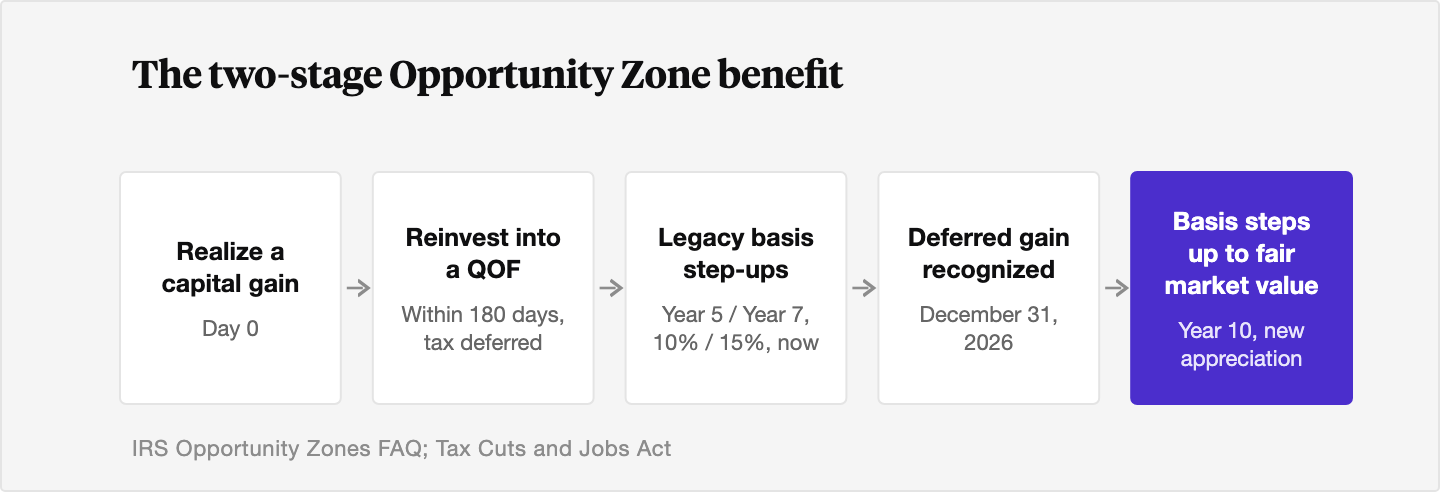
The entry mechanic is a reinvestment window. When you realize a capital gain, from selling stock, a business, or property, you generally have 180 days to roll that gain into a QOF [1]. Do that, and you defer the tax on the original gain. You keep your money invested instead of sending a check to the IRS now.
Deferral is not forgiveness. Under the 2017 program, the deferred gain became due on the earlier of the date you sold the QOF investment or December 31, 2026 [1][4]. That fixed inclusion date is the reason the legacy program is now winding down: any gain deferred years ago was scheduled to be recognized at the end of 2026, regardless of whether the investor still held the fund [4].
The 2017 law also offered a partial reduction of the deferred gain through a basis step-up. Hold the QOF investment for 5 years and 10% of the deferred gain was excluded; hold for 7 years and the exclusion rose to 15% [1]. Because both windows had to close before the December 31, 2026 inclusion date, those step-ups are no longer reachable for new money under the legacy rules. They are best understood as a feature of the original design that the calendar has overtaken.
3. The second benefit: the 10-year hold that makes new gains tax-free
The bigger incentive sits at the end. Hold a QOF investment for at least 10 years, and when you sell, you can elect to step the investment's basis up to its fair market value on the sale date [1]. The IRS states the result plainly: "the appreciation in the QOF investment is never taxed" [1].
This is the part worth being precise about. Deferral only delays a tax. The 10-year exclusion eliminates a tax, but only on the gain generated inside the fund, and only if you hold the full decade. An investor who reinvested a $1 million gain in 2019, watched the fund grow to $1.8 million, and held past 2029 would still owe the deferred tax on the original $1 million when it came due, but would owe nothing on the $800,000 of new appreciation at exit [1]. The first benefit is a loan from the government. The second is a genuine forgiveness, conditioned entirely on patience.
That condition is the catch. Ten years in a single illiquid, geographically concentrated vehicle is a long commitment, and the benefit is binary. We believe most of the real value in the program lives in this 10-year exclusion, which means the program rewards investors who can credibly hold and penalizes those who cannot.
4. What changed in 2025: the program is now permanent
For most of its life, Opportunity Zones were a temporary incentive with a hard 2026 expiration on the deferral benefit. The One Big Beautiful Bill Act, signed July 4, 2025, changed that. The law made the program a permanent part of the tax code rather than a one-time window [5][6].
The mechanics for new investments shift in 2027. Several changes are worth tracking:
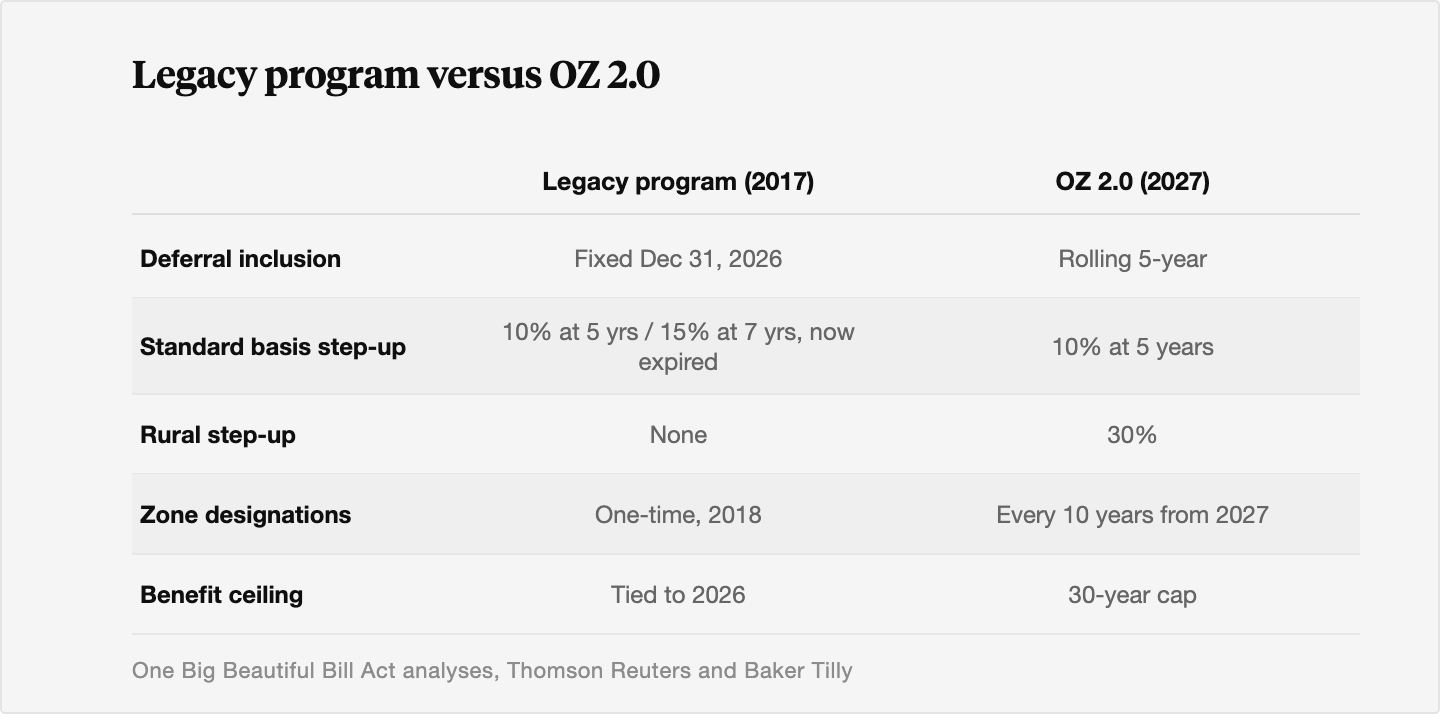
Rolling deferral. Investments made after December 31, 2026 receive a rolling 5-year deferral period that resets from each investment date, replacing the single fixed 2026 inclusion deadline of the legacy program [5][6].
New zones on a 10-year cycle. Governors designate a fresh set of zones effective January 1, 2027, and then re-designate every 10 years [5][9]. States were directed to make their selections by mid-2026 [5]. The new criteria narrow eligibility toward the lowest-income communities, which analysts expect to shrink the total number of zones [9].
A rural premium. The law creates Qualified Rural Opportunity Zones, with a 30% basis step-up for investments in designated rural areas (communities under 50,000 people), versus 10% for standard zones [5][3].
A 30-year ceiling. The new structure caps the deferral and exclusion benefit at 30 years [5].
More reporting. The law adds compliance and reporting requirements for funds and businesses, with penalties for noncompliance [5][6].
There is also an overlap period. Legacy zones and new zones coexist for a stretch, with old designations running through the end of 2028 [6]. For an investor, the practical takeaway is that the 2027 rules, not the expiring 2017 rules, govern any new Opportunity Zone decision from here.
5. The risks the headline benefits do not mention
The tax break is the easy part to describe. The risks deserve equal billing, because the structure concentrates several of them at once.
Illiquidity and the 10-year lock. The full benefit requires a 10-year hold in a single vehicle. That is longer than most private real estate funds and far longer than a liquid security. If your circumstances change, exiting early forfeits the exclusion and can be difficult at any price.
Geographic and asset concentration. A QOF must keep its capital in designated tracts. Roughly 75% of Opportunity Zone money through 2022 went into real estate, mostly residential [3]. An investor is taking concentrated exposure to specific local property markets, and a tax incentive does not make a bad project good.
The benefit is binary and tax-driven. A 10-year exclusion on appreciation is only valuable if the investment actually appreciates. Choosing a weak asset to chase a tax break is a common way to lose more on the investment than you ever saved on the tax. We would treat the tax benefit as a tiebreaker on an investment that already stands on its own, never as the reason to invest.
Policy and execution uncertainty. The evidence that the program delivered for the communities it targeted is thin. Treasury economists found that Opportunity Zone investment "tends to flow to census tracts with greater pre-existing private investment" rather than the most distressed areas, and broader research has found limited measurable benefit to residents [3]. That does not change an individual investor's tax math, but it speaks to the durability and political standing of a program that now runs on a 10-year redesignation cycle.
None of this is a verdict on Opportunity Zones. It is the reminder that a deferred or forgiven tax is a return only if the underlying investment survives the hold. Past performance of the program is not predictive of how any future fund performs.
6. How Opportunity Zones fit a tax-aware portfolio, and where art comes in
For an investor sitting on a concentrated, low-basis position, Opportunity Zones sit alongside a few other gain-management tools. Tax-loss harvesting offsets realized gains with realized losses inside a liquid portfolio. A 1031 exchange historically deferred gains by rolling them into like-kind real estate. Charitable remainder trusts convert an appreciated asset into an income stream while deferring the gain. Each tool fits a different situation, and we cover the broader menu in our pieces on real estate as an alternative investment and tax-loss harvesting.
Here is the honest boundary on art, because it matters. Opportunity Zone benefits are tied to qualified zone businesses and real estate. They do not apply to art. There is no Opportunity Zone treatment, no deferral, and no 10-year exclusion for buying a painting. An investor who likes the idea of a long-hold, real-asset allocation should understand that art is a different kind of alternative with its own tax profile, not a path into the Opportunity Zone benefit.
Art's tax treatment is in fact less favorable than the standard rate on most assets. The IRS classifies art as a collectible, so a long-term gain on a sold work is taxed at a maximum federal rate of 28%, higher than the 0%, 15%, or 20% rates on most long-term capital gains, and a high-income seller may owe an additional 3.8% net investment income tax on top [7][10]. The art-specific deferral tool that investors used to reach for, the 1031 exchange, was closed to art and other personal property by the 2017 tax law, which is exactly why the relevant art-tax conversation today centers on what changed and what options remain. We walk through that in art and 1031 exchanges.
So the link between Opportunity Zones and art is not a tax overlap. It is a portfolio-construction question. Both are long-hold, illiquid, real-asset allocations that behave differently from public equities. An advisor framing art as a diversifier is making a correlation argument, not a tax argument, and we lay out that case in our piece on art as an alternative allocation. The tax-aware tools that actually attach to art are the collectibles rate, gifting and estate planning, and giving vehicles. Opportunity Zones are not among them.
The Bottom Line
- A Qualified Opportunity Zone defers tax on an existing capital gain reinvested within 180 days, and after a 10-year hold it can exclude all new appreciation in the fund from tax.
- The 10-year exclusion is the program's most valuable feature, and it is binary: the full hold earns it, an early exit forfeits it.
- The legacy 2017 program is winding down because its deferred gains were due to be recognized by December 31, 2026, which also closed the 5-year and 7-year step-up windows for new money.
- The One Big Beautiful Bill Act made the program permanent from 2027, with rolling 5-year deferral, new zones on a 10-year cycle, a 30% rural step-up, and a 30-year benefit ceiling.
- Opportunity Zone benefits apply to zone businesses and real estate, not to art; art carries its own collectibles tax treatment and its own deferral history, and the connection to Opportunity Zones is one of portfolio construction, not shared tax treatment.
Sources
- Internal Revenue Service. "Opportunity Zones Frequently Asked Questions." IRS.gov, accessed June 2026. https://www.irs.gov/credits-deductions/opportunity-zones-frequently-asked-questions
- Internal Revenue Service. "Invest in a Qualified Opportunity Fund." IRS.gov, accessed June 2026. https://www.irs.gov/credits-deductions/businesses/invest-in-a-qualified-opportunity-fund
- Brookings Institution. "How did the One Big Beautiful Bill Act change Opportunity Zones?" Brookings.edu, 2025. https://www.brookings.edu/articles/how-did-the-one-big-beautiful-bill-act-change-opportunity-zones/
- Novogradac. "Despite Approaching 2026 Deferral Deadline on Capital Gains, Value Remains in OZ Investments in 2025." Novoco.com, 2025. https://www.novoco.com/periodicals/articles/despite-approaching-2026-deferral-deadline-on-capital-gains-value-remains-in-oz-investments-in-2025
- Thomson Reuters. "Tax Experts on OBBBA Changes to Opportunity Zones." tax.thomsonreuters.com, 2025. https://tax.thomsonreuters.com/news/tax-experts-on-obbba-changes-to-opportunity-zones/
- Baker Tilly. "Opportunity Zones 2.0: What is new." BakerTilly.com, 2025. https://www.bakertilly.com/insights/opportunity-zones-2-point-0-what-is-new
- Kiplinger. "Capital Gains on Collectibles: How They Are Taxed by the IRS." Kiplinger.com, 2025. https://www.kiplinger.com/taxes/how-collectibles-are-taxed
- Tax Foundation. "Opportunity Zones: What We Know and What We Don't." TaxFoundation.org, accessed June 2026. https://taxfoundation.org/research/all/federal/opportunity-zones-what-we-know-and-what-we-dont/
- Plante Moran. "The OBBB and Opportunity Zones 2.0." PlanteMoran.com, November 2025. https://www.plantemoran.com/explore-our-thinking/insight/2025/11/the-obbb-and-opportunity-zones-20
- Internal Revenue Service. "Topic No. 409, Capital Gains and Losses." IRS.gov, accessed June 2026. https://www.irs.gov/taxtopics/tc409
- Charles Schwab. "Tax on Collectibles, Art, and Other Valuables." Schwab.com, 2025. https://www.schwab.com/learn/story/how-collectibles-are-taxed
- Adams and Reese LLP. "Key Changes to the Opportunity Zone Program in the One Big Beautiful Bill Act." AdamsandReese.com, 2025. https://www.adamsandreese.com/insights/key-changes-to-the-opportunity-zone-program-in-the-one-big-beautiful-bill-act
Disclosures
Investing involves risk. Past results are not indicative of future outcomes.
Masterworks is providing this communication as an agent for its issuer entities, not Masterworks Advisers. This material is produced by Masterworks for informational purposes only and does not constitute investment advice, a recommendation, or an offer or solicitation to buy or sell any security. Masterworks is not a licensed broker-dealer by the SEC or FINRA.
Masterworks can only make and accept sales after an offering statement has been filed, and "qualified", by the SEC. Any offers may be revoked before notice of qualification. Indications of interest involve no obligation. For further disclosure visit the offering documents filed with the SEC and Important Disclosures at masterworks.com/cd.
Forward-looking statements and internal estimates are based on assumptions that may prove incorrect, and actual outcomes may differ materially. Figures denoted in brackets are subject to confirmation. Investing in art and alternative assets involves risk, including loss of principal.
Art sales price data is comparative only. Each painting is unique and historical data is not a direct proxy for any specific painting or investment. Data represents whole art, not an investment into our offerings which includes fees and expenses. Any comparative images are not currently live offerings and are provided for educational purposes only.
Masterworks, LLC is located at 1 World Trade Center, 57th Floor, New York, NY 10007.


