Masterworks Research · June 2026
How a 1920s avant-garde became the strongest segment of the high-end art market, and what is actually driving the re-rating.
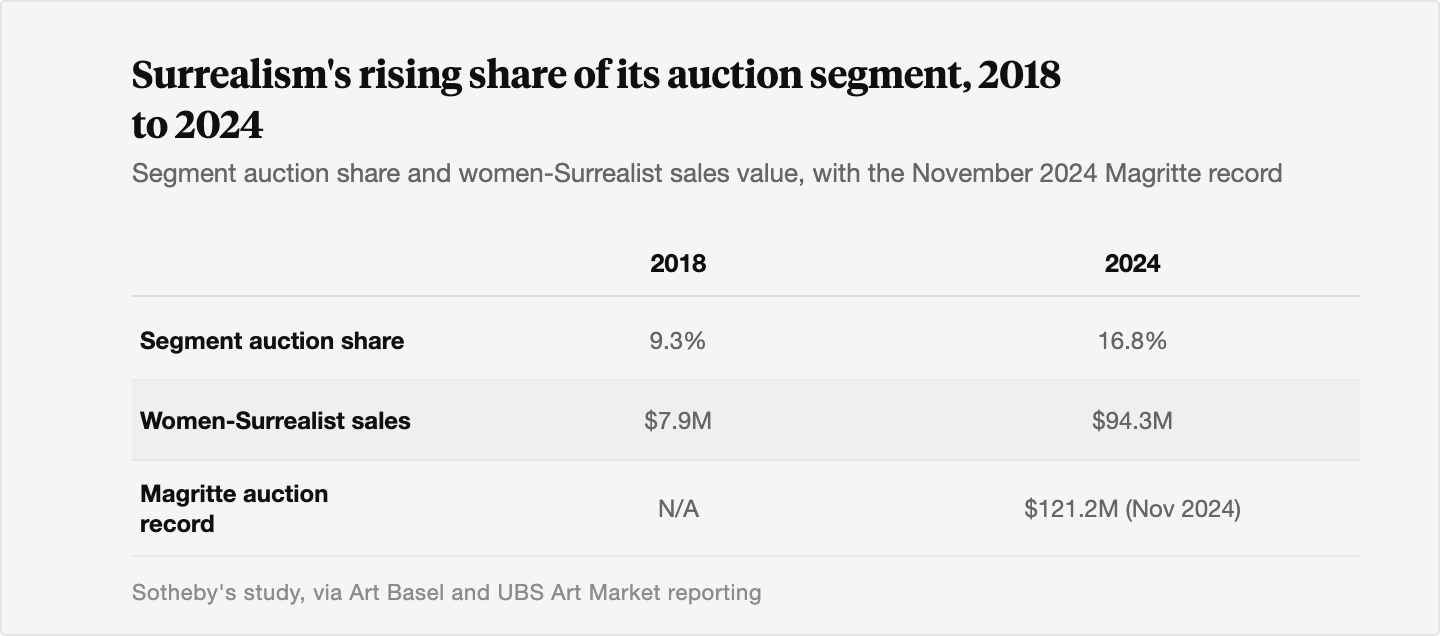
Surrealism is the artistic movement founded in Paris in 1924, built on dream imagery and the unconscious, and it is now one of the most resilient categories in the high-end art market. In November 2024, Rene Magritte's "L'empire des lumieres" sold for $121.2 million at Christie's New York, the highest auction price ever paid for a Surrealist work [1][2]. Over the same window, Surrealism's share of its auction segment nearly doubled, rising from 9.3% in 2018 to 16.8% in 2024, even as the broader market stayed soft [3]. For an investor, the question is not whether Surrealism is famous. It is whether a 100-year-old movement is re-rating for durable reasons or for a passing one.
What You Need to Know
- Surrealism is having its strongest market moment in decades. The movement's share of its relevant auction segment rose from 9.3% in 2018 to 16.8% in 2024, a near doubling, according to a Sotheby's study summarized by Art Basel [3].
- The category set a new ceiling in 2024. Magritte's "L'empire des lumieres" cleared $121.2 million at Christie's, more than 50% above his prior auction record of about $79 million set in 2022 [1][2][4].
- The 100-year centenary acted as a catalyst. A touring museum survey organized with the Centre Pompidou, featuring more than 500 works, ran from Brussels and Paris through to Philadelphia, and auction specialists tie a sharp rise in demand directly to it [3][5][6].
- The depth is widening, not narrowing. Sales for women Surrealists, led by Leonora Carrington, rose from $7.9 million in 2018 to $94.3 million in 2024, with Carrington setting a $28.5 million record [3][7].
- The price drivers are structural. Iconic recognizable imagery, deep scholarship, and scarcity of prime works in private hands are the forces behind the premiums, and they do not reverse quickly. Past performance is not predictive of future results.
1. What Surrealism is, and why it produced collectible icons
Surrealism was formally launched in Paris in 1924, when the poet Andre Breton published the "Manifesto of Surrealism" and defined the movement as "psychic automatism in its pure state" [8][9]. The idea, drawn from Freud, was to give direct expression to the unconscious through dreams, chance, and automatic creation, resolving waking life and dream into a single higher reality Breton called the "surreal" [8][9].
That program sounds abstract. What matters for the market is what it produced: a set of instantly recognizable images made by a small group of named artists over a few decades. Salvador Dali (1904 to 1989) gave the movement its melting clocks in "The Persistence of Memory" (1931). Magritte (1898 to 1967) gave it the bowler-hatted men, the floating rock, and the pipe captioned "Ceci n'est pas une pipe" [8]. Max Ernst pioneered frottage and grattage. Joan Miro built a language of biomorphic signs out of automatic drawing. Yves Tanguy filled vast illusionistic spaces with objects that exist nowhere [8].
Here is the part that translates to investing. A movement with a tight roster of name-brand artists and a stock of imagery that lives in posters, fashion, and film is a movement with a permanent demand base. The buyer pool for a melting clock or a Magritte daytime-night sky is far wider than the art world itself. We treat that cultural reach as quantifiable, and on the metrics we track, the cultural significance here is strong.
2. The record that reset the category: Magritte at $121 million
In our experience a record price for a top work does real work. It resets the reference point for the whole category and pulls up the A and B examples beneath it.
That is what happened on November 19, 2024. Magritte's "L'empire des lumieres" (1954), a daytime sky over a nighttime street, sold from the collection of Mica Ertegun at Christie's New York for $121.2 million, including fees [1][2]. It was a record for Magritte and the highest auction price ever paid for any Surrealist work [1][3]. To size the move, his prior auction record was roughly $79 million, set in 2022 [4]. The 2024 result cleared it by more than 50%.
A single record is not a trend. We have written before about the risk of reading one headline sale as a market signal, and the discipline applies here too. What makes this result more than a trophy is the company it keeps. The depth beneath the top is filling in.
3. The depth beneath the top: Dali, Miro, and the women Surrealists
A healthy category is not one artist. It is a roster with several liquid markets.
Dali's auction record stands at about $22 million, for "Portrait de Paul Eluard" (1929) at Sotheby's London in 2011 [10]. Miro's record is about $37 million, for "Peinture (Etoile Bleue)" (1927) at Sotheby's London in 2012 [10]. Ernst and Tanguy have cleared roughly $16 million and $7 million respectively at their peaks [10]. These are established, decades-deep markets, the kind of beachfront that actually trades.
The faster-moving story is at the edges of the canon. Sales for women Surrealists rose from $7.9 million in 2018 to $94.3 million in 2024, a near twelve-fold increase [3]. The anchor was Leonora Carrington's "Les Distractions de Dagobert" (1945), which sold for $28.5 million at Sotheby's New York in May 2024, against a previous Carrington record of $3.3 million set only two years earlier [3][7]. Di Donna Galleries founder Emmanuel Di Donna put the shift plainly: the Surrealist market was "limited to Magritte and Dali" before, and now there is "growing interest in female Surrealists" [3].
For an investor, a widening roster matters more than a single record. It is the difference between a fashion and an asset class.
4. Why the category re-rated: the centenary and a structural appetite
Surrealism turned 100 in 2024, and the art world marked it at scale. A touring survey organized with the Centre Pompidou in Paris, featuring more than 500 works and objects, ran through Brussels, Paris, Hamburg, Madrid, and on to a final stop at the Philadelphia Museum of Art from November 2025 into February 2026 [5][6]. The Pompidou show leaned heavily on women Surrealists, mirroring the same shift the salesroom was already pricing [11].
Centenaries tend to prompt reassessment, and the auction houses say this one did. Art Basel reported that senior specialists at Sotheby's and Christie's noticed a sharp rise in interest in Surrealist works since the centenary exhibitions [3]. Christie's London specialist Olivier Camu described his March 2025 sale as "our strongest ever," saying it "took off like fuel on fire" [3]. Crucially, this strength showed up while the wider market was subdued, which is part of why we pay attention. An appetite that holds up against a soft tape is reading off something other than the cycle.
5. The price drivers, in investor terms
A centenary explains timing. It does not explain why the prices hold. Three structural forces do, and none of them reverses on a one-year view.
Iconic, legible imagery. Dali's soft watches and Magritte's bowler hats are embedded in culture far beyond the gallery, which widens the bidder pool for canonical works. Collecting guidance is blunt that the signature motifs are what "sell for millions," and that painted Surrealist works carry a clear premium over works on paper [12]. Recognizable imagery is demand you can underwrite.
Scholarship. Both Magritte and Dali sit inside multi-volume catalogues raisonnes and a deep literature of retrospectives and monographs [12]. For a buyer this is not academic. Inclusion in the standard reference catalogue is what underpins authentication and confidence, and confidence is what supports a high bid. We think of scholarship as the infrastructure that lets a market clear at size.
Scarcity. Many of the best Surrealist paintings already sit in museums and long-term collections and will not return to the market [12][13]. The relevant supply is not "all Surrealist works." It is the narrow band of prime, iconic, well-provenanced oils, and that band is genuinely scarce. We have written separately on why provenance, the documented chain of ownership, is itself a price driver, because clean provenance is what keeps a top work liquid through any cycle.
Scarcity has a sweet spot. Too little supply and a market cannot sustain itself. Too much and demand drowns. The blue-chip Surrealist names sit closer to the scarce end, which is the side that holds value.
6. How a category like this fits an investor's thinking
We should be precise about what this is and is not. Surrealism is one segment of the Modern market, and Modern art has historically appreciated more slowly than post-1970 Contemporary work, which is where the fastest appreciation has tended to sit. So the case for Surrealism is not that it is the highest-growth corner of art. The case is durability: a category with permanent demand, deep scholarship, shrinking prime supply, and a price floor that just reset higher.
Two cautions belong in plain view. First, the strength is concentrated at the top. The very best, most iconic, best-documented works are doing the work, while lesser examples and weaker subjects remain exposed to the broader cycle, and Dali's aggregate auction totals have softened in some recent years [12]. Second, this is illiquid and long-horizon by nature. A trophy work may come up once in several seasons, which cuts both ways: it concentrates competition when one appears, and it means an owner cannot exit on demand.
Past performance is not predictive of future results. A record is a data point, not a promise.
The Bottom Line
- Surrealism is the 1924 Paris movement built on dream imagery, and a century later it is one of the most resilient segments of the high-end art market.
- Magritte's "L'empire des lumieres" set the category ceiling at $121.2 million in November 2024, the highest auction price ever for a Surrealist work, more than 50% above his prior record.
- The re-rating is broad as well as top-heavy: the segment's auction share nearly doubled from 2018 to 2024, and sales for women Surrealists rose roughly twelve-fold over the same window.
- The 2024 centenary, marked by a 500-plus-work touring survey with the Centre Pompidou, acted as a catalyst, and specialists tie a sharp rise in demand to it.
- The durable price drivers are iconic imagery, deep scholarship, and scarcity of prime works in private hands, with the strength concentrated in the best examples.
Sources
- Christie's. "The timeless power of Magritte's L'empire des lumieres." Christie's, November 2024. https://www.christies.com/en/stories/timeless-power-magritte-lempire-des-lumieres-5b3114f0ea0e48fe85e0afdbfd7340b3
- Christie's. "Rene Magritte, L'empire des lumieres, lot 6508394 (MICA: The Collection of Mica Ertegun)." Christie's, November 19, 2024. https://www.christies.com/en/lot/lot-6508394
- Art Basel. "Surrealism's second act: the 20th-century movement commanding today's market." Art Basel, October 14, 2025. https://www.artbasel.com/stories/art-market-surrealism-20th-century-movement
- MyArtBroker. "Auction Watch: Magritte's The Empire of Light sells for record $121.6 million at Christie's NYC." MyArtBroker, November 2024. https://www.myartbroker.com/auction/articles/auction-watch-magrittes-the-empire-of-light-sells-for-record-121.6-million-at-christies-nyc
- Philadelphia Museum of Art. "Dreamworld: Surrealism at 100 (press release)." Philadelphia Museum of Art, June 24, 2025. https://press.philamuseum.org/dreamworld-surrealism-at-100/
- Royal Museums of Fine Arts of Belgium. "IMAGINE! 100 Years of International Surrealism." Royal Museums of Fine Arts of Belgium, 2024. https://fine-arts-museum.be/en/exhibitions/imagine
- Art & Object. "10 Exhibitions Celebrating a Centennial of Surrealism in 2024-2025." Art & Object, 2024. https://www.artandobject.com/slideshows/10-exhibitions-celebrating-centennial-surrealism-2024-2025
- The Metropolitan Museum of Art. "Surrealism." The Met, accessed June 2026. https://www.metmuseum.org/essays/surrealism
- Wikipedia. "Surrealism." Wikipedia, accessed June 2026. https://en.wikipedia.org/wiki/Surrealism
- MyArtBroker / Invaluable. "Salvador Dali record prices and modern Surrealist auction records." MyArtBroker, accessed June 2026. https://www.myartbroker.com/artist-salvador-dali/record-prices/salvador-dali-record-prices
- Gallery Wendi Norris (via Artnet). "An Expansive New Surrealism Show Celebrates 100 Years at the Centre Pompidou." Artnet, October 4, 2024. https://gallerywendinorris.com/news/120-artnet-an-expansive-new-surrealism-show-celebrates-featuring-more-than-500-objects-the-centre-pompidou-s/
- We Art Online. "The Collectability and Investment Potential of Modern Surrealist Art." We Art Online, accessed June 2026. https://www.we-artonline.com/Guides/The-Collectability-and-Investment-Potential-of-Modern-Surrealist-Art
- Christie's. "100 years of Surrealism: A total revolution of the mind." Christie's, 2024. https://www.christies.com/en/stories/centenary-of-surrealism-1924-2024-833c59c4ab544664a2c08a85759c6ff2
- The Dali Museum. "Unleash Your Imagination with Two Surrealist Icons." The Dali Museum, accessed June 2026. https://thedali.org/press-room/unleash-imagination-works-two-surrealist-icons/
Related Reading
- What Blue-Chip Art Actually Means and Why It Matters
- When Markets Diverge: Why Contemporary Art and Old Masters Don't Move Together
- How Art Market Cycles Work: Expansion, Peak, Correction, and Recovery
- Understanding Provenance: Why an Artwork's History Drives Its Value
Disclosures
Investing involves risk. Past results are not indicative of future outcomes.
Masterworks is providing this communication as an agent for its issuer entities, not Masterworks Advisers. This material is produced by Masterworks for informational purposes only and does not constitute investment advice, a recommendation, or an offer or solicitation to buy or sell any security. Masterworks is not a licensed broker-dealer by the SEC or FINRA.
Masterworks can only make and accept sales after an offering statement has been filed, and "qualified", by the SEC. Any offers may be revoked before notice of qualification. Indications of interest involve no obligation. For further disclosure visit the offering documents filed with the SEC and Important Disclosures at masterworks.com/cd.
Forward-looking statements and internal estimates are based on assumptions that may prove incorrect, and actual outcomes may differ materially. Figures denoted in brackets are subject to confirmation. Investing in art and alternative assets involves risk, including loss of principal.
Art sales price data is comparative only. Each painting is unique and historical data is not a direct proxy for any specific painting or investment. Data represents whole art, not an investment into our offerings which includes fees and expenses. Any comparative images are not currently live offerings and are provided for educational purposes only.
Masterworks, LLC is located at 1 World Trade Center, 57th Floor, New York, NY 10007.