
Masterworks Research · June 2026
How realized losses offset gains, why the wash-sale rule sets the rules of the game, and where art and collectibles sit in the picture.
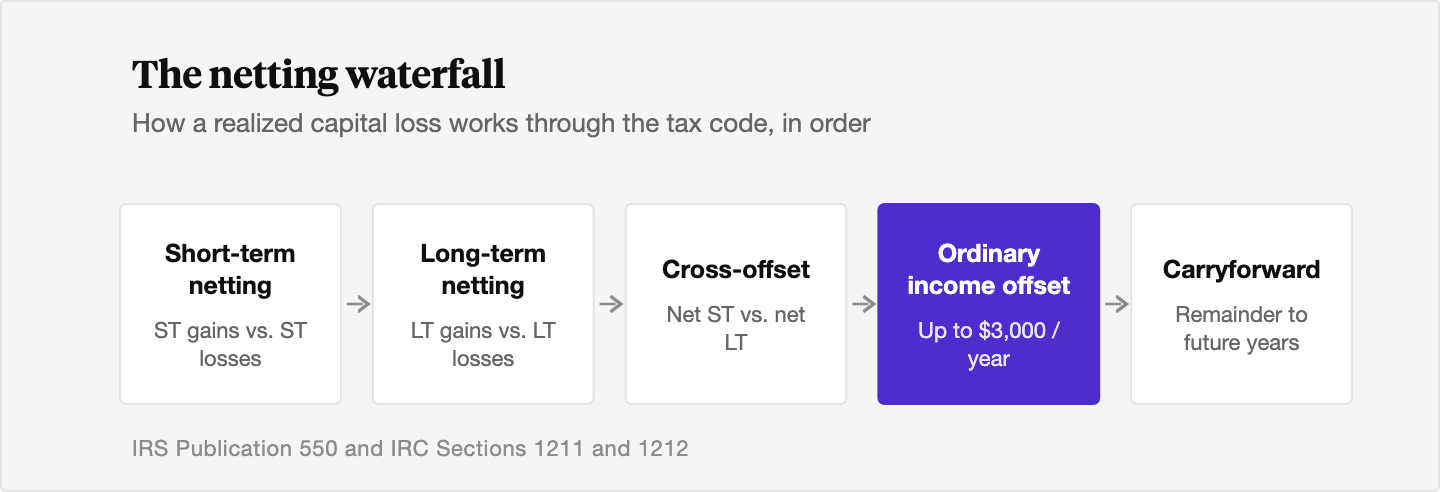
Tax-loss harvesting is the practice of selling an investment that has dropped below what you paid for it, locking in the loss, and using that loss to reduce the tax you owe on gains elsewhere in your portfolio. Under US federal rules, realized capital losses first offset realized capital gains of the same type, then offset the other type, and any net loss beyond that can reduce up to $3,000 of ordinary income per year, with the remainder carried forward to future years [1][2]. For investors, the point is straightforward: a down position is a paper loss until you sell it, and selling it can convert a portfolio setback into a real reduction in this year's tax bill. This is a general education piece, not tax advice, and the rules are technical, so anyone acting on this should work with a qualified tax professional.
What You Need to Know
- Losses offset gains first, then a slice of ordinary income. Short-term losses net against short-term gains and long-term against long-term, then the two sides offset each other. Any net capital loss left over can reduce up to $3,000 of ordinary income a year ($1,500 if married filing separately), and unused losses carry forward indefinitely [1][2].
- The wash-sale rule is the constraint that makes the strategy hard. Under IRC Section 1091, if you buy the same or a "substantially identical" security within 30 days before or after the loss sale, a 61-day window, the loss is disallowed and added to the cost basis of the replacement shares [3][4].
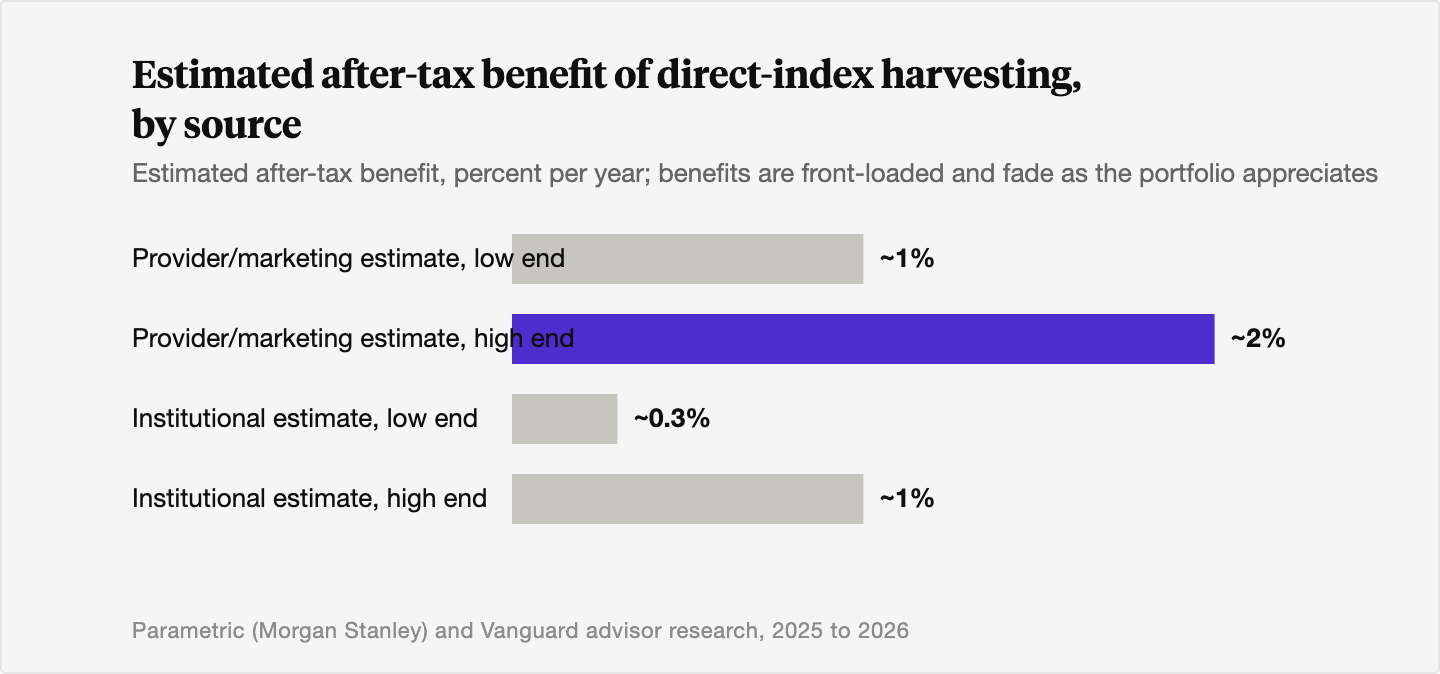
- Direct indexing is tax-loss harvesting at scale. Owning the individual stocks of an index in a separately managed account lets a manager harvest losses on single names even when the index is up. Providers cite roughly 1% to 2% a year in after-tax benefit in favorable conditions, though institutional research often lands lower, near 0.3% to 1% [5][6].
- The benefit fades as a portfolio appreciates. Harvesting works best early and in volatile markets. Over time, fewer positions trade below their cost basis, and the harvestable losses run dry [5].
- Art sits in a different tax bucket entirely. Long-term gains on collectibles, including art, are taxed at a maximum federal rate of 28%, versus 0%, 15%, or 20% on stocks. And because art is not a security, the wash-sale rule does not apply to it the way it applies to stocks [7][8].
1. What tax-loss harvesting actually does
Start with the mechanics, because the value of the strategy is entirely in the mechanics. When you sell a security in a taxable account for less than you paid, you realize a capital loss. That loss is not a deduction you simply subtract from your income. It moves through a netting order set by the tax code [1][2].
First, you net within each holding period. Short-term gains and losses (on assets held one year or less) net against each other. Long-term gains and losses (held more than a year) net against each other [1]. Then, if one side shows a net loss and the other a net gain, the loss offsets the gain across the two categories. If a net capital loss still remains after all of that, you can use up to $3,000 of it to reduce ordinary income such as wages and interest in the current year, $1,500 if you are married filing separately. Anything still left over carries forward to future tax years and keeps its character as a capital loss [1][2].
A simple worked example. Say you have a $10,000 short-term gain from one trade and a $4,000 long-term loss from another. The $4,000 loss offsets part of the gain, leaving $6,000 of short-term gain to be taxed at ordinary income rates [1]. Now flip it. You realize $2,000 of gains and $8,000 of losses. The $2,000 of gains is wiped out, you deduct $3,000 against ordinary income this year, and the remaining $3,000 carries forward [2].
The reason this matters is the after-tax return. Two investors can earn the same pre-tax return and keep very different amounts after the IRS is paid. Harvesting a loss does not change what your portfolio is worth. It changes what you owe on the gains you have already taken, and over many years that gap compounds. We would put it plainly: the loss was already real the day the price fell. Harvesting is the act of getting paid for it.
2. The wash-sale rule: the constraint that defines the game
Here is the catch that trips up most people. You usually do not want to be out of the market after you sell a position at a loss, because the whole point was to keep your exposure while booking the tax benefit. So you would like to sell and immediately buy back. The tax code blocks exactly that move.
Under IRC Section 1091, the wash-sale rule disallows a loss if you acquire the same or a "substantially identical" stock or security within 30 days before or 30 days after the sale, a 61-day window in total [3][4]. The IRS describes the rule in Publication 550. If you trigger it, the disallowed loss is not gone forever. It is added to the cost basis of the replacement shares, and the original holding period carries over, so the benefit is deferred rather than erased [3]. The exception is when the replacement is bought inside an IRA or Roth IRA. Under Revenue Ruling 2008-5, the loss is still disallowed, but the basis of the IRA is not increased, so in that case the loss is permanently forfeited [3].
The phrase "substantially identical" is where judgment enters, because the code never defines it numerically. Selling one S&P 500 fund and buying a different sponsor's S&P 500 fund is a gray area many practitioners treat as outside the rule, while selling and rebuying the exact same security is plainly inside it [3]. The standard practice is to sell the loser and rotate into a similar but not identical position, a different fund tracking a comparable index, to hold market exposure through the 31-day window.
One more wrinkle that matters for households. The statute is written per taxpayer, but the IRS has stated it considers a security sold at a loss by one spouse and repurchased by the other within the window to be a wash sale, and crypto assets currently sit outside Section 1091 because Congress has not extended it to them [3][4]. These are the kinds of edges where a tax professional earns their fee.
3. Short-term losses are worth more, and why timing matters
Not all harvested losses carry the same value, and understanding why changes how you think about which positions to sell. The reason traces back to the rate gap between short-term and long-term gains.
Short-term capital gains are taxed as ordinary income, which in 2026 runs up to a 37% top federal rate [9]. Long-term capital gains on most securities are taxed at 0%, 15%, or 20%, depending on income, with the 20% rate reaching in above roughly $545,500 for single filers and the 0% rate available below about $49,450 [9]. High earners may also owe the 3.8% Net Investment Income Tax once modified adjusted gross income passes $200,000 for single filers or $250,000 for those married filing jointly [9].
Because a short-term loss first offsets a short-term gain that would have been taxed at up to 37%, while a long-term loss first offsets a long-term gain taxed at up to 20% (or 23.8% with the surtax), a short-term loss can shelter income at a much higher rate. That makes the harvested loss more valuable per dollar. In our view this is the single most useful piece of the strategy that casual investors miss. The character of the loss, short or long, drives how much tax it saves, so the order in which you harvest is not arbitrary.
Timing also matters at the margin. Losses are most plentiful in down or volatile markets, which is precisely when investors are least inclined to act. A discipline that harvests opportunistically through the year, rather than scrambling each December, tends to capture more of them [2][6].
4. Direct indexing: harvesting at the security level
The blunt limit of harvesting a fund is that you can only sell the whole fund. If you own one S&P 500 ETF and the index is up 8% on the year, there is no loss to harvest, even if a third of the 500 underlying companies are down. Direct indexing solves that.
In a direct-indexing account, you own the individual stocks that make up an index in a separately managed account, often a sampled subset of a few hundred names rather than all of them, designed to track the benchmark closely [5][6]. Because you hold the constituents directly, a manager can scan every position, sell the ones trading below cost, book the losses, and rotate the proceeds into similar names to keep the market exposure intact. The losses get harvested at the security level, across hundreds of separate tax lots, even in a year the index rose [5][6].
How much does this add? Providers including Parametric, part of Morgan Stanley, cite third-party research showing tax management can add 1% to 2% a year in after-tax excess return in favorable conditions [6]. More conservative institutional work, including Vanguard's, tends to land lower, often in the range of roughly 0.3% to 1% a year for a typical investor, and stresses that the result is highly specific to tax bracket, market volatility, and how much in gains you have to offset [5][6]. We would treat the high end as a best case, not a base case.
The pitfalls are real and worth stating plainly. Direct indexing carries tracking error, since a sampled or customized portfolio drifts from the benchmark. It usually requires a higher minimum, commonly around $250,000 of taxable equity, and higher fees and trading costs than a plain ETF [5][6]. And the harvest engine slows over time: as markets rise, more positions sit above their cost basis, harvestable losses grow scarce, and what remains is a low-basis, highly appreciated portfolio [5]. The benefit is front-loaded. An investor should not project the first few years' tax alpha out forever.
5. The limits and pitfalls every investor should weigh
Tax-loss harvesting is a real tool, and it is also routinely oversold. A few honest caveats keep it in proportion.
It is deferral, not forgiveness, for most positions. When you harvest a loss and reinvest, your new position carries a lower cost basis, which means a larger taxable gain later. The benefit is the time value of paying tax later rather than now, plus the chance that the eventual gain is taxed at a lower long-term rate than the income the loss sheltered today [2]. That is worth real money over decades, but it is not free money.
It only works in taxable accounts. Losses inside an IRA or 401(k) generate no current deduction, because gains and losses inside those accounts are not currently taxable [1]. Harvesting is a feature of brokerage accounts, full stop.
And the costs can eat the benefit. Frequent trading means transaction costs, bid-ask spreads, and in customized strategies, management fees. The net benefit is the tax alpha minus those frictions, which is part of why the strategy is concentrated among larger, higher-bracket taxable accounts [5][6]. Past performance of any harvesting strategy is not predictive of future results, and the value depends heavily on tax rates that can change.
6. Where art and collectibles fit in the picture
This is general education, and the treatment of art is genuinely different from securities, so it deserves a clear-eyed section. None of this is tax advice, and anyone with art gains or losses should consult a tax professional, because the documentation requirements alone are subtle.
Start with the rate. Long-term gains on collectibles, a category the tax code defines to include works of art, antiques, gems, and coins under IRC Sections 1(h)(5) and 408(m), are taxed at a maximum federal rate of 28% [7][8]. That is higher than the 0%, 15%, or 20% rates that apply to long-term gains on stocks, and high earners may owe the 3.8% surtax on top [8]. Held a year or less, an art gain is short-term and taxed at ordinary income rates, just like a quick stock trade [7].
Now the wash-sale point, which is the bridge to everything above. The wash-sale rule in Section 1091 applies only to "stock or securities." Art is tangible personal property, not a security, so the statutory wash-sale rule does not reach it the way it reaches stocks [7][8]. In principle, that removes the 31-day constraint that governs harvesting securities. We would add a heavy caveat: other anti-abuse doctrines can still apply to sham transactions, and art's high transaction costs and illiquidity make rapid in-and-out trading impractical in the first place. The absence of a wash-sale rule is a structural fact about the asset, not a trading strategy.
The more useful point for an investor is how art interacts with the broader tax picture. Capital losses on art held as an investment are capital losses like any other, subject to the same netting rules and the same $3,000 annual cap against ordinary income [7][8]. The netting order even runs in the investor's favor in one respect: a net long-term loss in the 0/15/20% bucket is first applied against gains in the 28% collectibles bucket, so ordinary investment losses can offset the higher-taxed art gains before anything else [7]. There is one hard limit. A loss on art held for personal use, the painting hanging in your living room, is a non-deductible personal loss, the same as a loss on selling your car [7][8]. Investment intent, and the documentation to support it, is what separates a deductible capital loss from a personal one.
For investors who hold art through a structure such as Masterworks, where works are bought, held, and eventually sold by an issuer entity, the gain or loss flows through differently than holding a physical canvas, and what happens at a sale is covered in what happens when Masterworks sells a work. How art earns a place in a diversified allocation in the first place is the subject of art as an alternative allocation: a framework for advisors. And for the separate question of deferring gains on physical art, the rules changed materially, which we cover in art and 1031 exchanges: what changed and what options remain.
The Bottom Line
- Tax-loss harvesting sells losing positions to realize capital losses, which offset capital gains and, beyond that, up to $3,000 of ordinary income a year, with unused losses carried forward.
- The wash-sale rule under IRC Section 1091 disallows the loss if you rebuy the same or a substantially identical security within a 61-day window, so harvesting usually means rotating into a similar but not identical position.
- Short-term losses tend to be worth more than long-term losses, because they first offset gains taxed at higher ordinary income rates.
- Direct indexing extends harvesting to the individual stocks of an index, adding an estimated 0.3% to 2% a year in after-tax benefit depending on the source, with the benefit front-loaded and fading as a portfolio appreciates.
- Art and collectibles sit in a separate tax bucket: long-term gains face a maximum 28% federal rate, and because art is not a security, the wash-sale rule does not apply to it the way it does to stocks. None of this is tax advice; consult a tax professional.
Sources
- Internal Revenue Service. "Topic No. 409, Capital Gains and Losses." IRS.gov, February 25, 2026. https://www.irs.gov/taxtopics/tc409
- Internal Revenue Service. "Publication 550, Investment Income and Expenses." IRS.gov, 2025 (capital gain and loss netting, $3,000 limit, carryforward rules). https://www.irs.gov/publications/p550
- Cornell Law School, Legal Information Institute. "26 U.S. Code Section 1091, Loss from wash sales of stock or securities." Reviewed June 13, 2026. https://www.law.cornell.edu/uscode/text/26/1091
- Fidelity Investments. "Wash-Sale Rules: Avoid this tax pitfall." Fidelity Learning Center, March 26, 2026. https://www.fidelity.com/learning-center/personal-finance/wash-sales-rules-tax
- Vanguard for Advisors. "What Is Direct Indexing?" Vanguard, May 1, 2025. https://advisors.vanguard.com/investments/personalized-indexing/what-is-direct-indexing
- Parametric Portfolio Associates (Morgan Stanley). "What is Direct Indexing? Exploring Tax-Efficient Customization." Parametric, March 24, 2026. https://www.parametricportfolio.com/blog/direct-indexing
- The Tax Adviser. "The taxation of collectibles." The Tax Adviser (AICPA), November 1, 2019; updated June 20, 2026. https://www.thetaxadviser.com/issues/2019/nov/taxation-collectibles/
- Charles Schwab. "Tax on Collectibles, Art, and Other Valuables." Schwab Learn, August 15, 2025. https://www.schwab.com/learn/story/how-collectibles-are-taxed
- Fidelity. "Capital gains tax: Definition, rates, and ways to save." Fidelity Learning Center, October 20, 2025 (2026 long-term rate brackets and NIIT thresholds). https://www.fidelity.com/learning-center/smart-money/capital-gains-tax-rates
- Morgan Stanley. "Tax-Loss Harvesting Can Work Year-Round for Investors, Here's How." Morgan Stanley, June 15, 2026. https://www.morganstanley.com/articles/tax-loss-harvesting
- Charles Schwab. "How to Cut Your Tax Bill with Tax-Loss Harvesting." Schwab Learn, December 11, 2024. https://www.schwab.com/learn/story/how-to-cut-your-tax-bill-with-tax-loss-harvesting
- Internal Revenue Service. "Revenue Ruling 2008-5, Section 1091, Loss from Wash Sales of Stock or Securities." IRS.gov, 2008. https://www.irs.gov/pub/irs-drop/rr-08-05.pdf
- Morgan Stanley. "Direct Indexing: What It Is and Its Benefits." Morgan Stanley, November 18, 2025. https://www.morganstanley.com/articles/what-is-direct-indexing-benefits
- NerdWallet. "2025 and 2026 Capital Gains Tax Rates and Rules." NerdWallet, October 9, 2025. https://www.nerdwallet.com/taxes/learn/capital-gains-tax-rates
Disclosures
Investing involves risk. Past results are not indicative of future outcomes.
Masterworks is providing this communication as an agent for its issuer entities, not Masterworks Advisers. This material is produced by Masterworks for informational purposes only and does not constitute investment advice, a recommendation, or an offer or solicitation to buy or sell any security. Masterworks is not a licensed broker-dealer by the SEC or FINRA.
Masterworks can only make and accept sales after an offering statement has been filed, and "qualified", by the SEC. Any offers may be revoked before notice of qualification. Indications of interest involve no obligation. For further disclosure visit the offering documents filed with the SEC and Important Disclosures at masterworks.com/cd.
Forward-looking statements and internal estimates are based on assumptions that may prove incorrect, and actual outcomes may differ materially. Figures denoted in brackets are subject to confirmation. Investing in art and alternative assets involves risk, including loss of principal.
Art sales price data is comparative only. Each painting is unique and historical data is not a direct proxy for any specific painting or investment. Data represents whole art, not an investment into our offerings which includes fees and expenses. Any comparative images are not currently live offerings and are provided for educational purposes only.
This material is general information and does not constitute tax, legal, or accounting advice. Tax treatment depends on individual circumstances and current law, which is subject to change. Consult a qualified tax professional before acting on any strategy described here.
Masterworks, LLC is located at 1 World Trade Center, 57th Floor, New York, NY 10007.


