
Masterworks Research · June 2026
How an adviser is paid shapes what an adviser recommends. Here is the difference between the three models, the standard each one owes you, and the all-in cost over a lifetime.
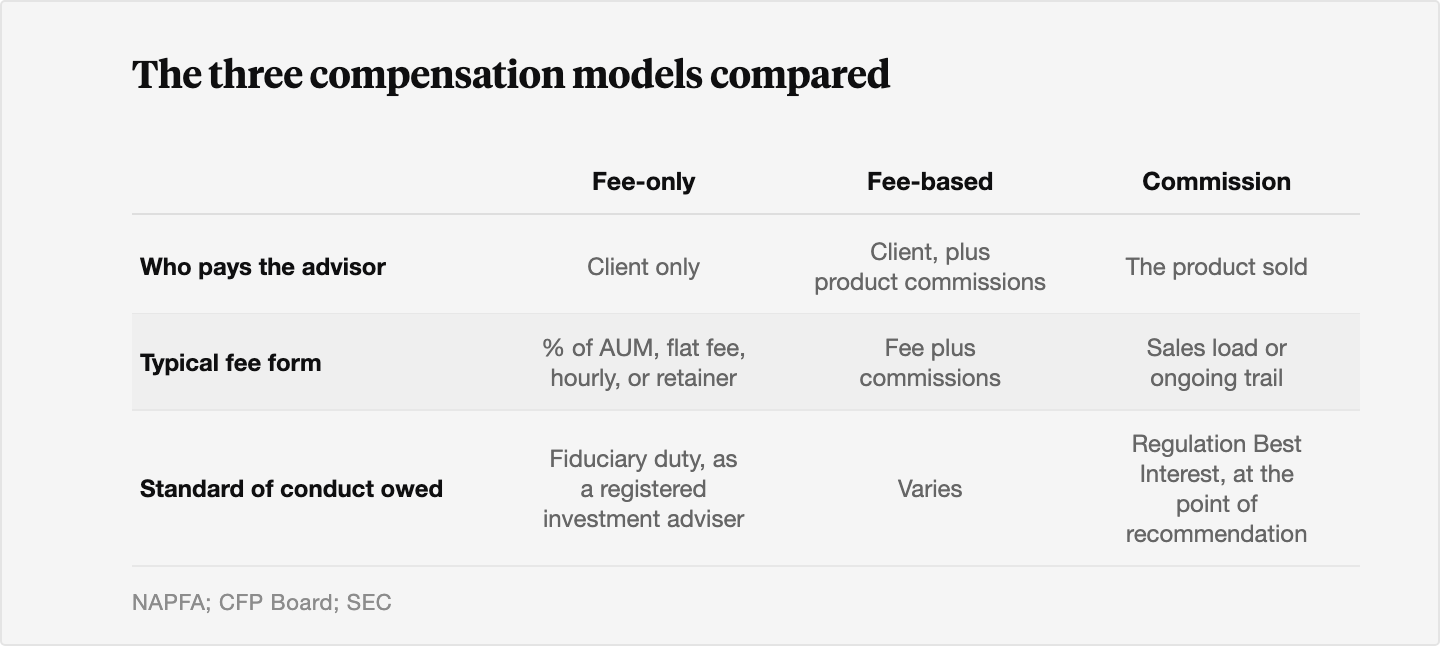
A fee-only adviser is paid only by you, the client, through a percentage of assets, a flat fee, an hourly rate, or a retainer, and earns nothing from selling products. A commission adviser is paid by the products they sell. A fee-based adviser does both. The model matters because it sets the conflict of interest and the legal standard you are owed, and because the headline advisory fee is rarely the whole cost. For an investor, the practical question is simple to ask and hard to answer without the documents: who pays this person, and what does the relationship cost me all in, every year, for as long as I hold the account.
What You Need to Know
- Fee-only means one payer. A fee-only adviser is compensated solely by the client and accepts no commissions or product-sale compensation. That structure, in the words of the National Association of Personal Financial Advisors (NAPFA), "minimizes conflicts and ensures that your financial planner acts as a fiduciary." [1]
- The standard you are owed depends on the registration, not the title. A registered investment adviser owes a fiduciary duty across the whole relationship. A broker giving recommendations is held to Regulation Best Interest, a best-interest standard that the SEC applies at the moment of a recommendation and does not extend to ongoing monitoring of your account. [2][3]
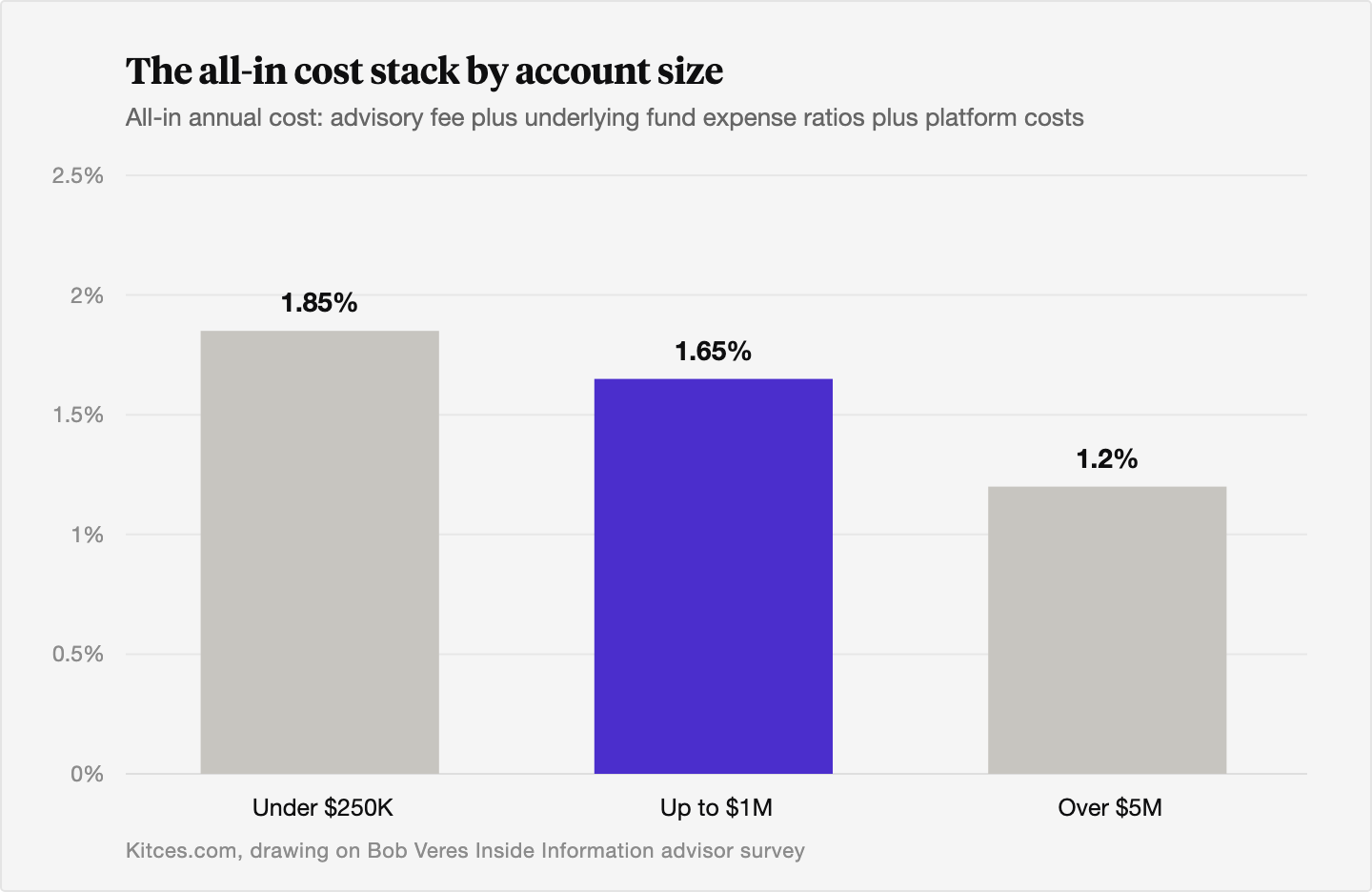
- The advisory fee is not the all-in cost. Add the expense ratios of the underlying funds and any platform or trading costs, and the typical all-in cost on a $1M account runs near 1.65% a year, against a headline advisory fee near 1%. [4]
- A 1% fee compounds against you. On a $500,000 portfolio earning 7% a year for 25 years, a 1% annual fee reduces the ending balance by roughly $560,000 versus no fee. [5]
- You can find out how an adviser is paid in two filed documents. Form CRS and Form ADV disclose the fee model, the conflicts, and the standard of conduct. Both are public. [6][7]
1. The three compensation models, defined
Start with the cleanest line in the business. A fee-only adviser is, in NAPFA's definition, "compensated directly by their clients for advice, plan implementation and for the ongoing management of assets," with neither the adviser nor any related party receiving compensation that depends on the purchase or sale of a financial product. [1] The fee can take one of four shapes: a percentage of assets under management (AUM), a flat annual fee, an hourly rate, or a retainer. The common thread is the single payer. You pay; the product manufacturer does not.
A commission adviser sits at the other end. They earn compensation from selling financial products, such as mutual funds, annuities, or insurance policies, and typically charge no separate planning or advisory fee. [8] The product pays them, often through a sales load or an ongoing trail, and the cost is embedded in what you buy rather than billed to you directly.
A fee-based adviser is the hybrid, and the source of most of the confusion. A fee-based adviser charges a fee and may also collect commissions on products the client buys. [8] The word looks almost identical to "fee-only," which is part of the problem. The CFP Board draws the line sharply: if a CFP professional or their firm receives any sales-related compensation, that professional may not hold themselves out as "fee-only." [9]
2. Fiduciary duty versus Regulation Best Interest
The compensation model is half the picture. The other half is the legal standard the adviser owes you, and the two do not always travel together.
A registered investment adviser owes a fiduciary duty. That duty applies to the relationship in its entirety, not just at the point of a single transaction, and it requires the adviser to act in your best interest, to recommend the best available option for your specific situation, and to disclose and manage conflicts of interest. [2]
A broker making recommendations is held to a different standard, Regulation Best Interest, which the SEC adopted in June 2019 with a compliance date of June 30, 2020. [10] Reg BI requires that a broker-dealer act in the retail customer's best interest and not place its own interests ahead of the customer's at the time it makes a recommendation. [2] The phrase "at the time it makes a recommendation" is doing the work here. As the SEC and FINRA describe it, Reg BI imposes a heightened standard of care at the moment of a recommendation and does not impose an ongoing duty to monitor the account, which contrasts with the continuous fiduciary duty an investment adviser owes. [3]
So the question "is my adviser a fiduciary" is really two questions. Under what registration are they acting, and over what stretch of the relationship does the standard apply. A fee-only registered investment adviser owes the fiduciary duty across the relationship. A commission broker owes Reg BI at the point of sale.
3. The conflict each model creates
Every compensation model carries a conflict. Honest disclosure starts with naming them.
The commission model creates the most direct one. When an adviser is paid by the product, the incentive runs toward the product that pays the adviser, which is not always the product that fits the client. NAPFA puts it plainly: "Due to the conflict of interest inherent in these transactions, these advisors may have difficulty putting the client's interest above their own." [1] A higher-commission annuity can beat a lower-commission index fund on the adviser's ledger while losing on the client's.
The fee-based model carries the same conflict in a quieter form. Because a fee-based adviser can collect commissions alongside a fee, the choice between the product that pays a commission and the product that does not is a live conflict on every recommendation. [8]
Fee-only is not conflict-free. An AUM fee creates its own tension: any recommendation that pulls money out of the managed account, paying off a mortgage, buying an illiquid asset, holding cash, lowers the fee. We think this conflict is smaller and easier to see than a commission, because the adviser and the client both win when the portfolio grows. The point is not that one model is pure. The point is that the conflicts differ in size and direction, and you should know which one you are living with.
4. The all-in cost is bigger than the headline fee
Here is where most investors underestimate what they pay. The advisory fee is the number you see. It is not the number that leaves your account.
The typical advisory fee for a roughly $1M portfolio sits near 1% of assets, and Kitces benchmarking shows the median fee drifting down for larger accounts, toward 0.75% above $2M and 0.50% above $5M. [11] On top of that fee sit the expense ratios of the funds the adviser puts you in. The asset-weighted average expense ratio across US mutual funds was around 0.36% in recent industry data, with index funds far cheaper and actively managed funds running 0.50% to 1.00% or more. [12] Then add platform and trading costs.
Stack them and you get the all-in cost. Drawing on Bob Veres's Inside Information advisor survey, Kitces put the total all-in cost on an up-to-$1M account near 1.65% a year, built from roughly a 1% advisory fee plus about 0.65% of underlying investment and platform costs. [4] The all-in figure runs higher for smaller accounts, around 1.85% under $250,000, and lower for larger ones, near 1.2% above $5M. [4]
The lesson for the investor: ask for the all-in number, not the advisory fee. A "1% adviser" who builds your portfolio out of 0.80% active funds is costing you closer to 1.80%.
5. What 1% costs over a lifetime
A percentage point sounds small in a single year. Compounded across an investing lifetime, it is one of the largest costs most people will ever pay, and the math runs against you in a way that is easy to miss.
Fees compound in reverse. Each year the fee comes out of the base on which future growth is calculated, so the drag is not a flat toll. It grows. A useful approximation: an investment paying a 1% annual fee for N years gives up close to N% of its ending value to fees. Over 30 years, that is roughly 30%. [5]
Put numbers on it. A $500,000 portfolio earning 7% a year for 25 years grows to about $2.71M with no fee and about $2.15M after a 1% annual fee, a difference of roughly $560,000. [5] On a $100,000 investment compounding at the same rate for 30 years, a 1% fee cuts the ending balance by close to $496,000, about 24% of the fee-free result. [5]
None of this means the fee is wrong. A good adviser can earn it through tax management, behavior coaching in a panic, and disciplined rebalancing. It means the fee is real money, it compounds, and it deserves to be measured against what the adviser actually delivers. Past performance does not predict future results, and no fee structure changes that.
6. How to find out how your adviser is paid
You do not have to take the answer on faith. Two documents, both public, both filed, tell you how an adviser is compensated and what standard they owe.
Form CRS, the Client Relationship Summary, is a short disclosure that broker-dealers and SEC-registered investment advisers must give retail investors. It summarizes, in one place, the services the firm offers, the fees and costs you will pay, the conflicts of interest the firm has, the standard of conduct it is held to, and whether the firm or its professionals have reportable legal or disciplinary history. [6] One detail worth knowing: Form CRS does not require the word "fiduciary." It requires both brokers and advisers to say they must act in your "best interest," which is why reading past the label matters. [3]
Form ADV goes deeper. It is the registration and disclosure document an investment adviser files with the SEC, and it lays out the fee schedule, the compensation arrangements, and the conflicts in more detail than the CRS summary. [7] Both are searchable through the SEC's public systems.
Three questions cut through almost any pitch. Are you a fiduciary, in writing, at all times. How are you paid, and do you or your firm receive any commission or third-party compensation. And what is my all-in annual cost, advisory fee plus fund expenses plus platform costs. An adviser who answers all three cleanly is telling you most of what you need to know.
7. Why this matters when art enters the portfolio
This is where the compensation model stops being an abstraction. When an adviser recommends an alternative allocation, an art allocation among them, the way that adviser is paid shapes the advice.
A commission-driven recommendation toward any alternative product carries the same conflict it carries everywhere: the product that pays the adviser may not be the product that fits the client. A fee-only fiduciary recommending the same allocation is working from a different incentive. Knowing which one you are hearing from is the first filter on any alternatives pitch.
The second filter is cost, and it applies to art the same way it applies to a mutual fund. Any art allocation should be judged net of all the layered fees, the advisory fee on top, plus whatever the art vehicle itself charges underneath. We have written before that art has historically shown low correlation to equities, with its highest correlation, to gold, sitting around 0.1 to 0.2, which is part of why some investors treat a small allocation as portfolio ballast. That case stands or falls on the numbers after every fee comes out, not before. The same compounding math from Section 5 applies: a layered fee structure on an illiquid, long-hold asset compounds against the investor just as an advisory fee does.
For investors weighing an adviser and an alternative allocation together, the related reading is here: how to choose a wealth manager or RIA, private banking vs. wealth management and what HNW clients get, what a family office is, in plain English, and art as an alternative allocation, a framework for advisors.
The Bottom Line
- Fee-only advisers are paid only by the client and accept no product commissions. Commission advisers are paid by the products they sell. Fee-based advisers do both.
- The legal standard depends on the registration. A registered investment adviser owes a fiduciary duty across the relationship; a broker owes Regulation Best Interest at the point of a recommendation.
- Every model carries a conflict. The commission and fee-based models tie pay to product sales; the fee-only AUM model ties pay to keeping assets in the managed account.
- The all-in cost, advisory fee plus fund expense ratios plus platform costs, runs near 1.65% a year on a typical $1M account, well above the headline 1%.
- A 1% annual fee can reduce a portfolio's ending value by roughly 24% over 30 years, because fees compound in reverse.
- Form CRS and Form ADV, both public, disclose how an adviser is paid and what standard they owe. Read them before you sign.
- When an adviser recommends an art or other alternative allocation, judge it net of all layered fees, and weigh whether the recommendation is fee-only fiduciary advice or a commission-driven sale.
Sources
- National Association of Personal Financial Advisors (NAPFA). "What Is Fee-Only Advising?" NAPFA, accessed June 2026. https://www.napfa.org/financial-planning/what-is-fee-only-advising
- FINRA. "SEC Regulation Best Interest and Form CRS: What You Need to Know." FINRA.org, accessed June 2026. https://www.finra.org/investors/insights/sec-regulation-best-interest-and-form-crs-what-you-need-know
- ACA Group. "SEC Adopts Advice Standards and Form CRS for Broker-Dealers and RIAs." ACA Global, 2019. https://web.acaglobal.com/blog/sec-form-crs
- Kitces, Michael. "Independent Financial Advisor Fees Comparison: The All-In Costs." Kitces.com, accessed June 2026. https://www.kitces.com/blog/independent-financial-advisor-fees-comparison-typical-aum-wealth-management-fee/
- Truthifi. "Free Advisor Fee Calculator: Is Your 1% Really 1%?" Truthifi, 2026. https://truthifi.com/education/advisor-fee-fair
- SEC. "Form CRS Relationship Summary." US Securities and Exchange Commission, accessed June 2026. https://www.sec.gov/files/formcrs.pdf
- SmartAsset. "Understanding Form CRS." SmartAsset, accessed June 2026. https://smartasset.com/financial-advisor/form-crs
- PathView. "Fee-Only vs. Fee-Based Financial Advisors: Which Is Better?" PathView, accessed June 2026. https://pathview.com/whats-the-difference-between-fee-only-and-fee-based-financial-advisors/
- Kitces, Michael. "Fee-Only Requirements Under CFP Board New Rules." Kitces.com, accessed June 2026. https://www.kitces.com/blog/fee-only-definition-cfp-board-requirements-sales-related-compensation-disclosure/
- SEC. "Confirmation of June 30 Compliance Date for Regulation Best Interest and Form CRS." US Securities and Exchange Commission, 2020. https://www.sec.gov/newsroom/speeches-statements/clayton-compliance-date-regulation-best-interest-form-crs
- Kitces, Michael. "How Financial Advisors Actually Charge for Their Services." Kitces.com, accessed June 2026. https://www.kitces.com/blog/financial-advisors-charge-services-fee-structure-advisory-firm-profession-aum-pricing-insight/
- Boldin. "Mutual Fund Fees Explained: Hidden Costs and What to Avoid." Boldin, accessed June 2026. https://www.boldin.com/retirement/fees-and-expenses-on-mutual-funds-and-etfs-a-complete-guide-to-the-often-misunderstood-and-hidden-costs-of-investments/
- SEC. "Regulation Best Interest, Form CRS and Related Interpretations." US Securities and Exchange Commission, accessed June 2026. https://www.sec.gov/about/divisions-offices/division-trading-markets/regulation-best-interest-form-crs-related-interpretations
- CFP Board. "Code of Ethics and Standards of Conduct: Guidance for Fee-Only Advisors." CFP Board, accessed June 2026. https://www.cfp.net/-/media/files/cfp-board/standards-and-ethics/compliance-resources/cfp-board-guidance-for-fee-only-advisors.pdf
Disclosures
Investing involves risk. Past results are not indicative of future outcomes.
Masterworks is providing this communication as an agent for its issuer entities, not Masterworks Advisers. This material is produced by Masterworks for informational purposes only and does not constitute investment advice, a recommendation, or an offer or solicitation to buy or sell any security. Masterworks is not a licensed broker-dealer by the SEC or FINRA.
Masterworks can only make and accept sales after an offering statement has been filed, and "qualified", by the SEC. Any offers may be revoked before notice of qualification. Indications of interest involve no obligation. For further disclosure visit the offering documents filed with the SEC and Important Disclosures at masterworks.com/cd.
Forward-looking statements and internal estimates are based on assumptions that may prove incorrect, and actual outcomes may differ materially. Figures denoted in brackets are subject to confirmation. Investing in art and alternative assets involves risk, including loss of principal.
Art sales price data is comparative only. Each painting is unique and historical data is not a direct proxy for any specific painting or investment. Data represents whole art, not an investment into our offerings which includes fees and expenses. Any comparative images are not currently live offerings and are provided for educational purposes only.
Masterworks, LLC is located at 1 World Trade Center, 57th Floor, New York, NY 10007.


