Masterworks Research · June 2026
Market Records | Fine Art Market Strategy
How a 1,175 dollar New Orleans find became a 450 million dollar record, and why attribution and provenance, not paint, decide what a masterpiece is worth.
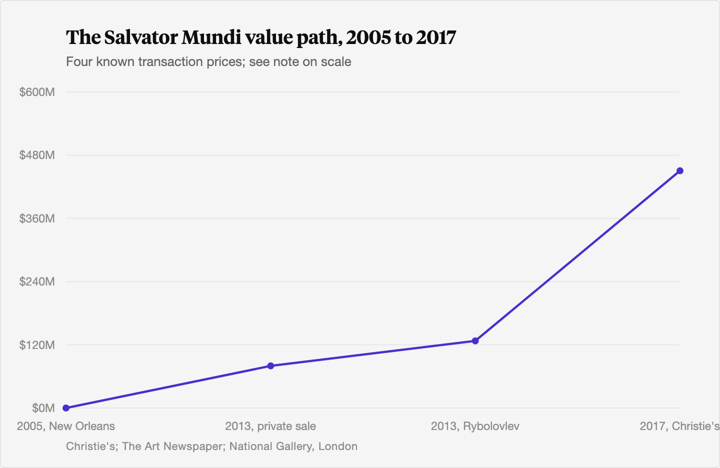
Salvator Mundi is a panel painting of Christ that sold at Christie's New York on November 15, 2017 for 450,312,500 dollars, still the highest price ever paid for any artwork at auction. [1][2] The same panel had changed hands at a New Orleans estate sale in 2005 for about 1,175 dollars, catalogued as a damaged copy. [3] Almost the entire gap between those two numbers traces to one variable: the market came to accept the work as an autograph painting by Leonardo da Vinci, an attribution that remains contested to this day and that few investors outside the art world recognize as the central driver of the price.
What You Need to Know
- A 1,175 dollar panel became a 450.3 million dollar record on the strength of a name. Two dealers bought it in 2005 as a "copy after Leonardo," restored it, and the National Gallery in London exhibited it as a Leonardo in 2011. [3][4] The physical object barely changed. The attribution did.
- The Leonardo attribution is genuinely contested. Scholars who accept it (Martin Kemp, Luke Syson) sit opposite those who downgrade it to workshop or a minor share of Leonardo's own hand. One Oxford art historian estimated as little as [5% to 20%] is autograph Leonardo. [5][6]
- Provenance and condition carried as much weight as the brushwork. A change of mind in the thumb of the blessing hand, visible under the paint, was read as evidence of an original composition rather than a copy. The walnut panel had been cracked, cut down, and heavily overpainted before restoration. [3][7]
- The buyer chain ran from a New Orleans saleroom to a Saudi royal. A 2013 private sale at roughly 80 million dollars, a resale to Dmitry Rybolovlev at 127.5 million, then the 2017 record, with the winning bid widely reported as made for the Saudi crown prince. [2][8]
- The work has not been seen in public since the 2017 sale. A planned unveiling at Louvre Abu Dhabi was cancelled in 2018, and the painting was absent from the Louvre's 2019 Leonardo retrospective. Its location is undisclosed. [8][9]
1. The 1,175 dollar discovery in New Orleans
In the spring of 2005, a small New Orleans auction house offered a battered panel of Christ as Salvator Mundi, "Savior of the World," in an estate sale. It was catalogued as a copy after Leonardo, with no suggestion the master had touched it. Among the buyers that day was Alexander Parish, a New York dealer who hunts overlooked Old Masters, working with the Renaissance specialist Robert Simon. They bought the panel for a total of about 1,175 dollars. [3][7]
That price tells you exactly what the market believed at the time. A damaged copy by an unknown hand is worth roughly what the wood and the frame are worth. The same image, if accepted as Leonardo's, belongs to a corpus of fewer than twenty surviving paintings widely credited to him. [4] The object was identical on the morning of that sale and the morning after. What had not yet changed was the market's belief about who painted it.
For an investor, the lesson is that in fine art, the asset is not only the physical thing. It is the physical thing plus the market's confidence about its author, its history, and its condition. Strip the confidence away and a Leonardo is a few hundred dollars of old wood.
2. The restoration that built the case
Once the panel reached New York, its condition revealed centuries of mishandling. The image was buried under heavy overpaint, the walnut panel had cracked and been crudely repaired, and earlier restorers had tried to improve the picture rather than conserve it. [3][7] The owners turned to Dianne Dwyer Modestini, a conservator associated with the Institute of Fine Arts at New York University, who spent years removing later additions layer by layer. [3]
As she worked, Modestini found qualities that did not read as routine copying: the modeling of the face, the transitions in the flesh tones, the handling of the blessing hand. The detail most often cited is a pentimento, a change of mind, in the thumb of that hand. The thumb had been painted in one position and then moved. A copyist transcribes an existing image and has no reason to revise it. An original author reconsiders the composition as he goes. [3][7] That single technical observation became one of the load-bearing arguments for an original Leonardo.
We would frame the restoration in investing terms. Condition and conservation are not cosmetic. They are part of the underwriting. A work's surface tells you what survives of the original, how much is later intervention, and therefore how much of what you are buying is the named artist at all. The restorer's report is closer to a quality-of-earnings review than to a touch-up.
3. From New Orleans to the National Gallery
The turning point came in London. In 2008, with the cleaning underway, the panel was brought to the National Gallery, where a small group of Leonardo scholars examined it in private ahead of a planned exhibition. The review fell short of a unanimous verdict, yet it opened a serious re-examination of the work's status. [3][7] After further study, the Gallery took the decisive step. For its 2011 blockbuster "Leonardo da Vinci: Painter at the Court of Milan," open from November 9, 2011 to February 5, 2012, the museum hung the restored Salvator Mundi as a work by Leonardo da Vinci. [4]
That endorsement is the engine of the whole story. A national museum exhibiting the panel as autograph Leonardo did for its value what an investment-grade rating does for a bond. It converted a private claim into an institutional one. The work was now provenanced, restored, and presented inside the canon, and the market repriced it accordingly.
This is how cultural significance translates into money, and we like to quantify it rather than wave at it. The variables that move art prices are the gallery and the dealers behind a work, the museums that show or own it, and the scholars who vouch for it. The National Gallery show supplied all three at once. The price that followed was the market pricing in that institutional confidence.
4. The attribution debate, and why it is the whole investment
Most coverage of the 450 million dollar headline skips a basic fact: the Leonardo attribution is not settled. It is actively disputed by serious scholars, and the disagreement is not about taste. It is about how much of the visible painting is Leonardo's own hand.
Specialists cluster into a few camps. Some accept it as essentially Leonardo, damaged and heavily restored, with the master responsible for the design and the finest passages. Martin Kemp, one of the earliest academic supporters, and Luke Syson, who curated the 2011 National Gallery show, sit broadly here. [5][6] Others argue for substantial workshop participation. The Oxford art historian Matthew Landrus told the press in 2018 that the panel is "probably between only [5% and 20%] painted by Leonardo," with much of the rest by a studio assistant. [5] A third group treats it as a high-quality workshop product that may go back to a lost Leonardo design but contains little or no surviving autograph paint. [6]
Complicating matters, the Louvre in Paris is reported to have studied the painting technically before its 2019 Leonardo retrospective and to have concluded it was by Leonardo, but the work was never shown there and, under French museum rules governing privately owned works, no official attribution was ever published. [6][9] The strongest institutional endorsement available is therefore one the public cannot read.
For an investor, this is the heart of the case. A 450 million dollar valuation rests on a question that the world's leading Leonardo scholars cannot agree on. The price did not buy certainty. It bought the prevailing consensus at a single moment, and consensus on attribution can move. We would put it flatly. When the thesis behind a price is a contested expert judgment rather than a settled fact, the price carries the risk of that judgment changing.
5. The buyer chain and the 2017 record
The path from New Orleans to the record runs through a short, steep ladder of resales. After the 2011 exhibition, the painting was offered privately. It changed hands in a Sotheby's-brokered private sale at a figure reported between 75 and 80 million dollars. The Swiss dealer Yves Bouvier then sold it to the Russian billionaire Dmitry Rybolovlev in 2013 for 127.5 million dollars, a markup that later became the subject of a long legal dispute between the two men. [2]
Rybolovlev consigned it to Christie's, which ran an aggressive global marketing campaign branding it "The Last da Vinci." On November 15, 2017 the hammer fell at 400 million dollars, 450,312,500 dollars with the buyer's premium, a new auction record for any work of art. [1][2] Christie's own sale record confirms the price and the record but does not name the buyer. Later reporting identified the winning bid as placed by Prince Badr bin Abdullah al-Saud, widely understood to be acting for Saudi Crown Prince Mohammed bin Salman, with the work publicly framed as an acquisition for the Department of Culture and Tourism in Abu Dhabi and Louvre Abu Dhabi. [2][8]
Two features of this chain matter for investors. The first is concentration of demand. A 450 million dollar painting is not bought by a market. It is bought by one of a handful of people on earth who can write that check, which is why we describe high-end art prices as a call option on the wealth of the top fraction of one percent. The second is the role of the record itself. Christie's set a record by manufacturing certainty around a contested object, through the venue, the campaign, and the single word "Leonardo." That is the marketing of provenance operating at full scale.
6. The disappearance, and the liquidity it exposes
Since the 2017 sale, the most famous painting in the world has not been seen in public. A planned unveiling at Louvre Abu Dhabi was announced and then cancelled in September 2018, with no new date given. [8][9] The Louvre in Paris had a place reserved for it in the 2019 exhibition marking the 500th anniversary of Leonardo's death, and it did not come. [9] Press reports have speculated that it was stored on the crown prince's yacht. As of the most recent reporting in late 2024, its location was still undisclosed and researchers described its whereabouts as unknown. [9]
The disappearance is partly a story about a single secretive owner, but it also exposes a feature of the asset class that investors should sit with. The most valuable painting ever sold cannot be marked, cannot be readily shown, and would be difficult to resell without reopening the attribution question in public. A 450 million dollar asset that no one can see and few can value is illiquid in the most literal sense. That is the extreme end of a spectrum every art investor lives on, and it argues for the things we apply to every position: diversification rather than a single trophy, a long holding period, and a sober view of how and when an exit actually happens.
Related Reading
- Understanding Provenance: Why an Artwork's History Drives Its Value
- What Blue-Chip Art Actually Means and Why It Matters
- Price-Tier Analysis: How 100K, 1M, and 10M Works Behave Differently
- How Art Market Cycles Work: Expansion, Peak, Correction, and Recovery
Sources
- Christie's. "Christie's Sells Leonardo da Vinci's 500-Year-Old Masterpiece Salvator Mundi for $450,312,500." Christie's Press Release, November 2017. https://press.christies.com/christies-sells-leonardo-da-vincis-500-year/
- Adam, Georgina. "Five Years Since the $450m Salvator Mundi Sale: A First-Hand Account of the Nonsensical Auction." The Art Newspaper, November 15, 2022. https://www.theartnewspaper.com/2022/11/15/five-years-since-the-450m-salvator-mundi-sale-a-first-hand-account-of-the-nonsensical-auction
- Modestini, Dianne Dwyer. "History of the Salvator Mundi." Salvator Mundi Revisited, accessed June 2026. https://salvatormundirevisited.com/History-of-the-Salvator-Mundi
- "Salvator Mundi (painting)." Wikipedia, last updated June 2026. https://en.wikipedia.org/wiki/Salvator_Mundi_(painting)
- Steinhauer, Jillian. "Leonardo Had Help: Oxford Art Historian Asserts New Attribution for Salvator Mundi." Hyperallergic, August 2018. https://hyperallergic.com/leonardo-had-help-oxford-art-historian-asserts-new-attribution-for-salvator-mundi/
- "Why Is the Salvator Mundi Called the World's Most Controversial Painting?" Encyclopaedia Britannica, accessed June 2026. https://www.britannica.com/story/why-is-the-salvator-mundi-called-the-worlds-most-controversial-painting
- Albrecht, Sandra (interview with Robert Simon). "Revisiting the Salvator Mundi by (Probably, Possibly) Leonardo da Vinci, with Robert Simon." The Art Law Podcast, September 14, 2020. https://artlawpodcast.com/2020/09/14/revisiting-the-salvator-mundi-by-probably-possibly-leonardo-da-vinci-with-robert-simon/
- Christie's. "The Last da Vinci: Leonardo's Salvator Mundi." Christie's Stories, accessed June 2026. https://www.christies.com/en/stories/the-last-da-vinci-salvator-mundi-e646f1b46c3b4ca1bcdba9cf751c7597
- "Salvator Mundi: Leonardo da Vinci's Missing Masterpiece?" The British Academy Blog, November 15, 2024. https://www.thebritishacademy.ac.uk/blog/salvator-mundi-leonardo-da-vincis-missing-masterpiece/
- Christie's. "2017 Highlight: Leonardo's Salvator Mundi." Christie's Stories, accessed June 2026. https://www.christies.com/en/stories/2017-highlight-leonardo-salvator-mundi-6f32f4dd4b274ec1b0d99037a7c6d97e
- Fiorio, Maria Teresa. "'It Is Not the Salvator Mundi': A Questionable Attribution to Leonardo da Vinci." Academia.edu, 2020. https://www.academia.edu/42636495/_It_is_not_the_Salvator_Mundi_A_questionable_attribution_to_Leonardo_da_Vinci
Disclosures
Investing involves risk. Past results are not indicative of future outcomes.
Masterworks is providing this communication as an agent for its issuer entities, not Masterworks Advisers. This material is produced by Masterworks for informational purposes only and does not constitute investment advice, a recommendation, or an offer or solicitation to buy or sell any security. Masterworks is not a licensed broker-dealer by the SEC or FINRA.
Masterworks can only make and accept sales after an offering statement has been filed, and "qualified", by the SEC. Any offers may be revoked before notice of qualification. Indications of interest involve no obligation. For further disclosure visit the offering documents filed with the SEC and Important Disclosures at masterworks.com/cd.
Forward-looking statements and internal estimates are based on assumptions that may prove incorrect, and actual outcomes may differ materially. Figures denoted in brackets are subject to confirmation. Investing in art and alternative assets involves risk, including loss of principal.
Art sales price data is comparative only. Each painting is unique and historical data is not a direct proxy for any specific painting or investment. Data represents whole art, not an investment into our offerings which includes fees and expenses. Any comparative images are not currently live offerings and are provided for educational purposes only.
Masterworks, LLC is located at 1 World Trade Center, 57th Floor, New York, NY 10007.