Masterworks Research · June 2026
What the $110.5 million record, eight years of results since, and a fixed supply tell us about whether the most expensive American artist at auction still has room to run.
Jean-Michel Basquiat's auction market has not peaked in any structural sense, but it has matured into a top-heavy, two-speed market where the best early canvases stay strong and lesser material faces real price pressure. His $110.5 million record from 2017 has stood unbeaten for eight years, which is the single most cited piece of evidence for the bear case [1]. The bull case rests on a fact that does not change: he died in 1988, so the supply is permanently fixed, while a global base of museums and collectors keeps competing for the same finite group of works [2]. For an investor, the question is not whether Basquiat is culturally important. It is whether the price you pay leaves room for appreciation, and that depends almost entirely on which Basquiat you are buying.
What You Need to Know
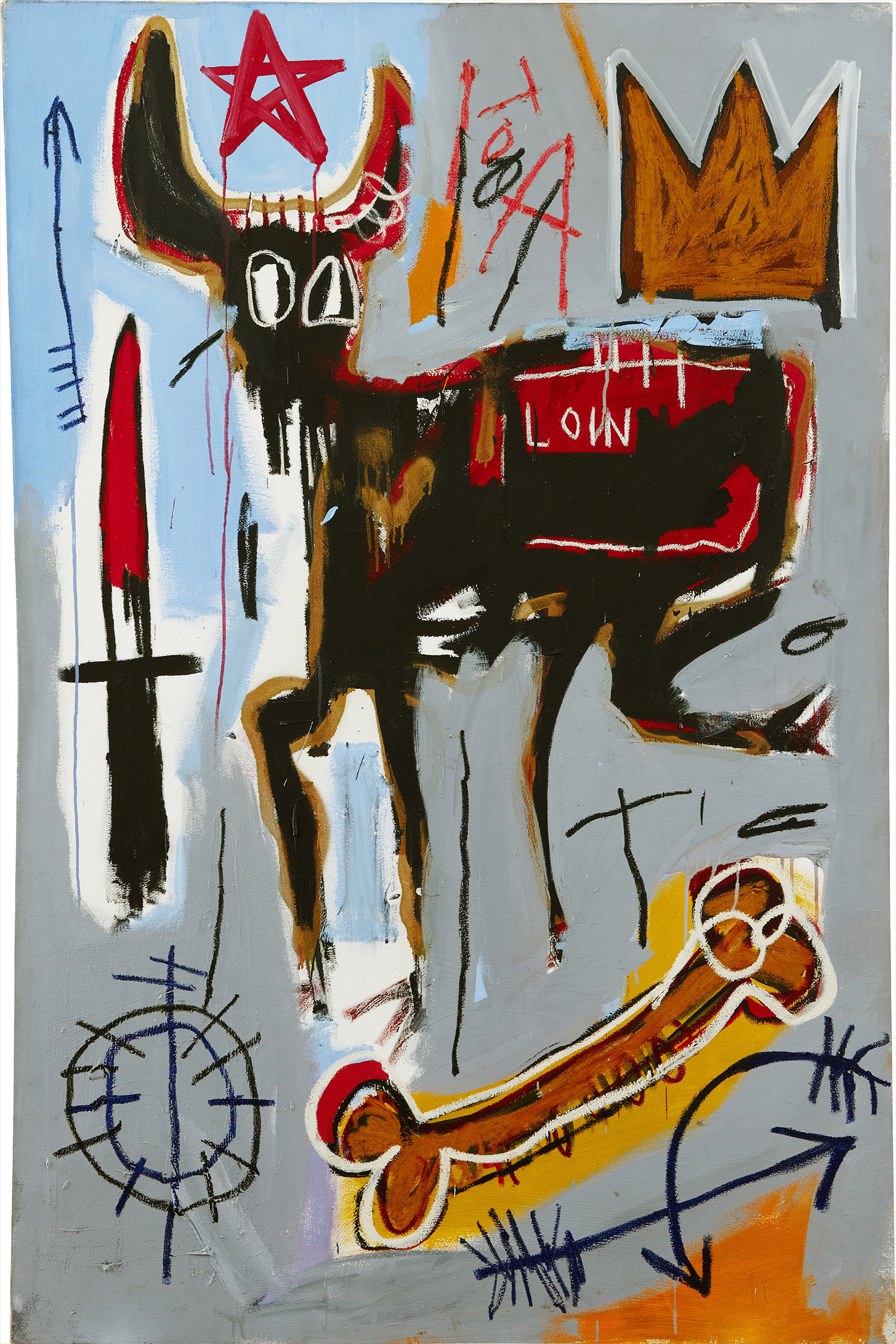
- The record is old and unbeaten. Basquiat's Untitled (1982), the skull painting, sold at Sotheby's New York on 18 May 2017 for a premium-inclusive $110,487,500, bought by Yusaku Maezawa [1]. It remains the most expensive work by an American artist ever sold at auction, and no Basquiat has come within $17 million of it since [1][3].
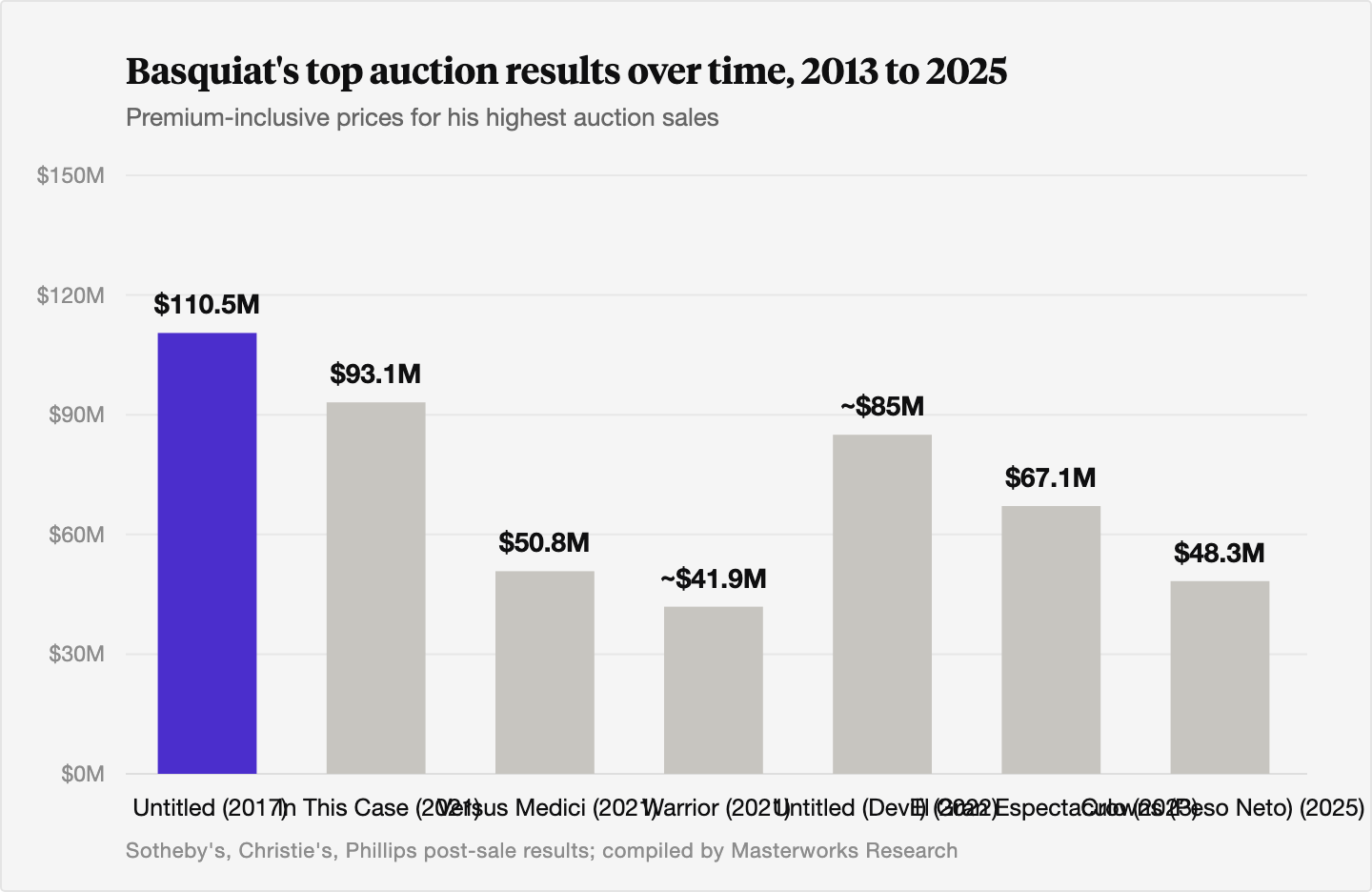
- Top works still clear eight figures. Since the record, In This Case made $93.1 million (Christie's, 2021), Untitled (Devil) roughly $85 million (Phillips, 2022), El Gran Espectaculo (The Nile) $67.1 million (Christie's, 2023), and Crowns (Peso Neto) $48.3 million (Sotheby's, November 2025) [4][5][6].
- Supply cannot grow. Basquiat produced roughly 1,000 paintings and about 2,000 works on paper before his death at 27, and that number is fixed forever [2]. Each museum acquisition removes a work from the tradeable pool for decades.
- The market is concentrated and cyclical. His total auction turnover hit about $439.6 million in 2021, then fell by roughly half in 2022 as the broader contemporary correction took hold [7]. Value clusters in a small number of early-1980s masterpieces, which makes the top of the market thin.
- Quality is the whole game. In our view, the upside sits with iconic 1981 to 1984 canvases that have strong condition and provenance. The clearest downside risk sits with works on paper, prints, and interchangeable secondary material, where oversupply weighs on price [6][8].
1. The $110.5 million record and why it still anchors the Basquiat art market
Start with the number that frames everything. On 18 May 2017, Basquiat's Untitled (1982), a large skull canvas, sold at Sotheby's New York for $110,487,500, reported everywhere as $110.5 million [1]. The buyer was the Japanese collector and entrepreneur Yusaku Maezawa. The work had last changed hands at auction in 1984 for $19,000, so the 2017 result was more than 5,000 times the earlier price [9].
That sale did two things at once. It made Basquiat the most expensive American artist ever sold at auction, passing Andy Warhol, and it set the highest auction price for any work created after 1980 [1][3]. Both records are still standing in 2026.
Here is the part that matters for an investor. A record price resets the reference points for an entire artist market. When a skull canvas clears $110 million, it pulls up the perceived value of the next tier of major works, the way a single beachfront sale reprices the street. That is the bull mechanism. The bear reading of the same fact is simpler. Eight years on, nothing has beaten it, and a ceiling that has not advanced in eight years is information too.
2. Major Basquiat auction results since the record: a high end that still works
The headline records since 2017 show a market that is functioning at the top, even if it has not set a new peak.
The clearest comparables, all premium-inclusive:
- In This Case (1983): $93.1 million, Christie's New York, 2021 [4].
- Versus Medici (1982): $50.8 million, Sotheby's New York, 2021 [4].
- Warrior (1982): roughly $41.9 million, Christie's Hong Kong, March 2021, then the most expensive Western artwork sold at auction in Asia [4].
- Untitled (Devil) (1982): about $85 million, Phillips New York, May 2022, again to Maezawa [4].
- El Gran Espectaculo (The Nile) (1983): $67.1 million, Christie's New York, May 2023 [4].
- Crowns (Peso Neto) (1981): $48.3 million against a $35 million to $45 million estimate, Sotheby's New York, 18 November 2025 [5][6].
A note on how we read this list. The pattern is a stair-step down from the 2017 high, then a steady floor in the $40 million to $90 million range for the best canvases. The 2025 Crowns (Peso Neto) result is the one to weigh most heavily, because it is recent and it beat its high estimate in a salesroom that had spent three years correcting [5][6]. A work clearing the top of its estimate during a recovery is a healthier signal than a record set at a frothy peak.
The 2025 season also produced Baby Boom (1982) at $23.4 million at Christie's and Sabado por la Noche (1984) at HKD 112.6 million at Christie's Hong Kong, which shows demand is still global and not confined to New York [6][10]. These are real numbers, and they are not the numbers of a market that has rolled over.
3. Why finite supply supports the Basquiat investment thesis
This is the structural argument, and it is the strongest one in Basquiat's favor.
Basquiat died in 1988 at age 27. His working period runs from roughly 1978 to 1988, and the institutions that know the body of work best put his output at approximately 1,000 paintings and about 2,000 works on paper [2]. The Broad, the Fondation Louis Vuitton, and Levy Gorvy Dayan all land in the same range [2]. That number is fixed. No new Basquiat will ever be painted.
We think about this the way we think about every artist market: as a supply question first. Most asset classes can manufacture more supply when prices rise. A fixed body of work cannot. And the tradeable float keeps shrinking, because museums acquire works and hold them for decades. Basquiat is now in MoMA, the Whitney, the Met, the Broad, the Brooklyn Museum, the Guggenheim Abu Dhabi, and the Fukuoka Art Museum, among others [2]. Every one of those acquisitions takes a work off the market, in many cases permanently.
Translate that into investing terms. The supply curve is effectively vertical and slowly tightening. If demand holds or grows, the math pushes prices up over long horizons for the strongest works. That is the same dynamic we describe for the broader category in what blue-chip art actually means and why it matters.
The caution that belongs next to this: a fixed supply supports prices only where demand is real. Scarcity alone does not make a work valuable. There is no shortage of mediocre Basquiat works on paper, and scarcity does nothing for them.
4. The demand drivers: museums, a global collector base, and cultural staying power
Supply is half the equation. The demand side is what separates Basquiat from other artists who died young with a fixed catalog.
Three drivers do the work. The first is institutional validation. Major museums across three continents now treat Basquiat as canonical twentieth-century art, and that consensus removes works from circulation while signaling permanence to private buyers [2]. The second is exhibitions. The Fondation Louis Vuitton mounted a 120-work survey and the landmark Basquiat x Warhol show, the artist's family organized the immersive King Pleasure exhibition that toured to general audiences, and in January 2026 the Louisiana Museum opened Headstrong: Basquiat on Paper [2][8]. Each show generates scholarship, press, and new collectors, which shifts the demand curve outward against a supply that cannot move.
The third driver is cultural reach, and this is where Basquiat is unusual. His crowns, skulls, and text appear on apparel sold in mainstream retail, which spreads recognition far beyond the collector base without diluting the supply of originals [11]. The themes in the work, race, power, and wealth, keep new generations rediscovering him. That matters because it lowers the risk that a 1980s name becomes a period piece that the next cohort of buyers ignores.
We try to quantify cultural significance rather than assert it. On gallery representation, museum ownership, and the profile of who collects him, Basquiat scores about as high as any postwar artist. That is the demand half of the scarcity-plus-status pairing, and it is why his prices have held a floor that thinner markets have not.
5. The bear case: a market that may have peaked
Honesty about the downside is the point of this section. There are real reasons to think the most expensive Basquiat works have already had their moment.
The first is the record itself. Eight years without a new high is a long time for a name this liquid and this celebrated. If demand were still accelerating at the very top, you would expect a challenger to $110.5 million to have appeared by now, and none has [1][3].
The second is concentration. Basquiat's value is packed into a small set of canonical 1981 to 1983 canvases, which means the headline market depends on a handful of trophy works and the handful of ultra-wealthy buyers who chase them [6]. When that demand is absent, prices can swing hard. His total auction turnover ran about $439.6 million in 2021, then fell by roughly half in 2022 as the contemporary market corrected [7]. A market that can halve in a year is not a placid one.
The third is the broader cycle. The contemporary correction that began after the 2021 peak hit Basquiat alongside everything else, and 2024 was a soft year, particularly for prints and works on paper [6][8]. Buy-in risk, the chance a lot fails to sell, remains real for works with weaker condition, thinner provenance, or less exhibition history. And the works-on-paper and print markets carry genuine oversupply risk, because there are simply more of those objects than there are masterpiece canvases [6][8].
We will state the uncomfortable version plainly. If you buy an average Basquiat at a peak-cycle price, the fixed supply will not save you. The scarcity argument protects masterpieces, not interchangeable material.
6. The bull case: room to run for the best works
The case for upside is narrower than the bear case, and stronger where it applies.
It rests on the three structural facts already covered, working together. Supply is fixed and the tradeable float keeps shrinking. Demand is global, institutional, and culturally durable. And the high end is still clearing, with Crowns (Peso Neto) beating its estimate at $48.3 million in late 2025 and a major canvas estimated above $45 million heading to a Sotheby's evening sale in 2026 [5][6][8]. A market with a flat record but a rising floor for quality is consolidating, not collapsing.
There is also a cyclical tailwind. The 2025 recovery in postwar and contemporary art has been led by the high end, with works above $10 million showing the clearest rebound while the mid-market stays selective [6][7]. That is exactly where Basquiat's best work sits. We have written about how these phases tend to play out in how art market cycles work: expansion, peak, correction, and recovery, and the current pattern of high-end strength leading the way is a familiar one. The same bifurcation by price band shows up across the market, which we cover in price-tier analysis: how $100K, $1M, and $10M works behave differently.
The conviction has limits, and we will keep them in view. A new record is not guaranteed, the buyer pool at the very top is thin, and past performance is not predictive of future results. We believe the room to run is concentrated in the best 1981 to 1984 canvases, and we would not extend the same optimism to the rest of the catalog.
7. How a disciplined buyer would approach Basquiat
The practical takeaway is a buying discipline, not a price call. Basquiat is one of the few artists whose top works sit so far above the rest of the contemporary field that he functions as a reserve name in a serious collection, alongside Warhol and Picasso. We cover that company in Picasso at auction in 2026: still the most traded name in art.
Our own approach to any artist starts with the market, then the specific work at the right price. For most names we stay disciplined on price for liquidity reasons, generally favoring works in the low to mid eight figures rather than the $50 million to $100 million marquee lots [12]. Scott Lynn has said publicly that Basquiat is the one name we would stretch above that usual ceiling for, because the combination of fixed supply and global demand is rare enough to justify it [12]. That is a comment on the quality of the artist market, not a signal about any specific work.
So the question for a buyer is the same one we ask internally. Is this an A-grade canvas from his strongest years, in good condition, with clean provenance, bought at a price that leaves room? If yes, the structural case is intact. If it is a late work, a damaged work, or a work on paper bought at a top-of-cycle number, the scarcity story will not carry it.
The Bottom Line
- Basquiat's $110.5 million record has stood since May 2017, and no work has come close to challenging it, which is the central piece of evidence for the bear case.
- Top canvases still clear $40 million to $90 million, and Crowns (Peso Neto) beat its estimate at $48.3 million in November 2025, so the high end of the market is functioning.
- The supply is permanently fixed at roughly 1,000 paintings and 2,000 works on paper because Basquiat died in 1988, and museum acquisitions keep shrinking the tradeable pool.
- Demand is global, institutional, and culturally durable, which is what separates Basquiat from other artists who died young with a fixed catalog.
- The market is concentrated and cyclical, with turnover that ran about $439.6 million in 2021 and fell by roughly half the next year, so the top of the market is thin and can move fast.
- In our view, the room to run sits with the best early canvases bought at a sensible price. Past performance is not predictive, and the scarcity argument protects masterpieces, not interchangeable material.
Sources
- Sotheby's. "Basquiat Reigns Supreme At Evening Sale." Sotheby's, 3 November 2017. https://www.sothebys.com/en/slideshows/basquiat-reigns-supreme-at-evening-sale
- Levy Gorvy Dayan. "Jean-Michel Basquiat." Levy Gorvy Dayan, accessed June 2026. https://www.levygorvydayan.com/artists/jean-michel-basquiat
- CeFaan Kim / CBS. "One of the most consequential artists of the 20th century." Facebook, 21 October 2025. https://www.facebook.com/CeFaanKimTV/posts/one-of-the-most-consequential-artists-of-the-20th-century-got-a-nyc-street-co-na/1332547524908191/
- Andipa Editions. "The Most Expensive Jean-Michel Basquiat Paintings Sold at Auction." Andipa Editions, updated 27 March 2025. https://andipaeditions.com/es/blog/168-the-most-expensive-jean-michel-basquiat-paintings-as-sold-at-auction/
- Artnet News. "Basquiat Painting Makes $48.3 Million in Auction Debut." Artnet News, 18 November 2025. https://news.artnet.com/market/basquiat-crowns-peso-neto-sothebys-auction-2697577
- Guy Hepner. "The Jean-Michel Basquiat Market Report 2025." Guy Hepner, 12 May 2026. https://guyhepner.com/news/462-the-jean-michel-basquiat-market-report-2025
- Guy Hepner. "The Basquiat Market in 2026." Guy Hepner, 12 May 2026. https://guyhepner.com/news/517-the-basquiat-market-in-2026
- Artsy. "A major Jean-Michel Basquiat painting is expected to sell for over $45 million in May." Artsy, 10 March 2026. https://www.artsy.net/article/artsy-editorial-major-jean-michel-basquiat-painting-expected-sell-5-million-may
- Artsy. "What Makes 1982 Basquiat's Most Valuable Year." Artsy, updated 27 October 2025. https://www.artsy.net/article/artsy-editorial-1982-basquiats-valuable-year
- Christie's. "Jean-Michel Basquiat: Art for sale, auction results and history." Christie's, updated 10 April 2026. https://www.christies.com/en/artists/jean-michel-basquiat
- Smarthistory. "Jean-Michel Basquiat, Horn Players." Smarthistory, updated 7 February 2025. https://smarthistory.org/jean-michel-basquiat-horn-players/
- Worth. "Want to Invest in a Banksy Painting? Masterworks Makes It Easy." Worth, updated 10 March 2026. https://worth.com/want-to-invest-in-a-banksy-painting-masterworks-makes-it-easy/
- The Broad. "Jean-Michel Basquiat, Bio." The Broad, accessed June 2026. https://www.thebroad.org/art/jean-michel-basquiat
- Fondation Louis Vuitton. "Jean-Michel Basquiat." Fondation Louis Vuitton, updated 29 May 2026. https://www.fondationlouisvuitton.fr/en/events/jean-michel-basquiat
Disclosures
Investing involves risk. Past results are not indicative of future outcomes.
Masterworks is providing this communication as an agent for its issuer entities, not Masterworks Advisers. This material is produced by Masterworks for informational purposes only and does not constitute investment advice, a recommendation, or an offer or solicitation to buy or sell any security. Masterworks is not a licensed broker-dealer by the SEC or FINRA.
Masterworks can only make and accept sales after an offering statement has been filed, and "qualified", by the SEC. Any offers may be revoked before notice of qualification. Indications of interest involve no obligation. For further disclosure visit the offering documents filed with the SEC and Important Disclosures at masterworks.com/cd.
Forward-looking statements and internal estimates are based on assumptions that may prove incorrect, and actual outcomes may differ materially. Figures denoted in brackets are subject to confirmation. Investing in art and alternative assets involves risk, including loss of principal.
Art sales price data is comparative only. Each painting is unique and historical data is not a direct proxy for any specific painting or investment. Data represents whole art, not an investment into our offerings which includes fees and expenses. Any comparative images are not currently live offerings and are provided for educational purposes only.
Masterworks, LLC is located at 1 World Trade Center, 57th Floor, New York, NY 10007.