
Masterworks Research · June 2026
What a commitment to a drawdown fund really obligates you to, how managers pull that capital deal by deal, and why the structure that powers most private equity is largely absent from a Regulation A+ art investment.
A drawdown fund does not take your money on day one. You sign a subscription agreement committing a fixed dollar amount, and the fund manager then "calls" that capital in pieces over several years as deals close, usually with a notice period of 10 to 15 days per call. The gap between what you have committed and what has actually been called is your uncalled capital, and it sits with you, not the fund, until the manager asks for it. For investors weighing private equity, venture, private credit, or a traditional closed-end art fund, this single mechanic shapes everything that follows: the early paper losses of the J-curve, the order in which money comes back through the waterfall, the penalties for missing a call, and the reported return itself.
What You Need to Know
- Committed capital and called capital are not the same thing. You commit a fixed amount up front, but the manager draws it down over the investment period, typically in tranches of 10% to 25% of your commitment per call. The uncalled balance is money you have promised but not yet paid. [1][2]
- The J-curve means early returns are negative by design. Fees and the first investments are paid before any value is realized, so a fund's reported return dips for the first three to five years before distributions turn it positive. [3]
- Missing a capital call is expensive. Limited partnership agreements commonly impose penalty interest of prime plus 3% to 5%, suspension of voting and distribution rights, and in severe cases forfeiture or forced sale of 25% to 50% of the defaulting investor's interest, often well below net asset value. [4][5]
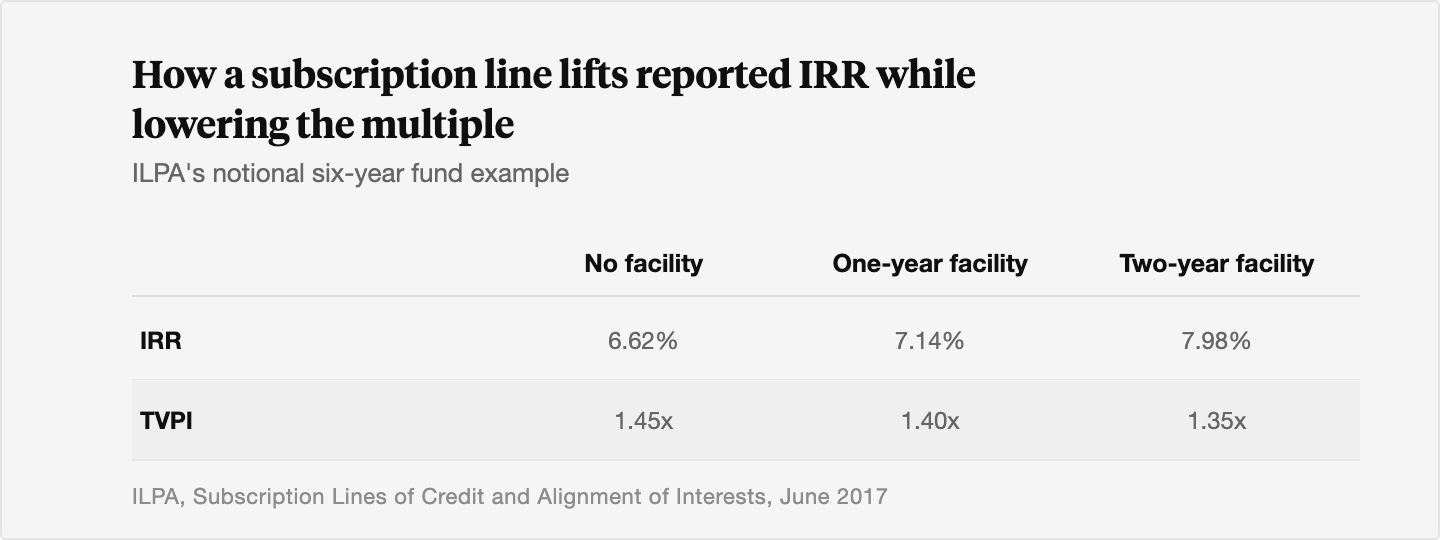
- Subscription lines of credit flatter early IRR. When a fund borrows to fund deals and delays calling investor capital, it shortens the measured time that capital is at work. ILPA's notional example shows reported IRR rising from 6.62% with no facility to 7.98% with a two-year facility, while the multiple on invested capital falls from 1.45x to 1.35x. [6]
- A Regulation A+ fractional art investment is fully funded. You buy your shares in full at the time of purchase, so there is no commitment to call, no J-curve from uncalled capital, no default risk, and no cash drag on a promised-but-unpaid balance. A traditional closed-end art fund, by contrast, is a drawdown vehicle. [7][8]
1. Committed capital versus called capital
Start with the distinction that trips up most first-time investors. When you join a drawdown fund, you sign for a commitment, say $1 million. That number does not move into the fund. It sits in your own account until the general partner, the GP who runs the fund, issues a capital call requesting a specific slice of it. [1][2]
The vocabulary is worth getting right because the reporting depends on it. Your committed capital is the full amount you promised. Your paid-in capital, also called called or drawn capital, is what you have actually wired in response to calls. The difference between the two is your uncalled capital, sometimes called your unfunded commitment. Across a fund, the pool of uncalled capital is what the industry calls dry powder, the firepower a manager keeps in reserve to act on deals as they appear. [1][2]
Calls usually arrive in pieces. A single call commonly represents 10% to 25% of an investor's total commitment, and the calls land throughout the investment period, which typically runs three to five years. [1][2] So a $1 million commitment might be drawn through six or eight separate notices over four years rather than in one lump sum.
This is a promise, not a deposit. Until the GP calls it, your money is yours to manage. The moment a call notice arrives, the clock starts.
2. How a capital call works, and the notice period
A capital call, also called a drawdown, is a formal written request from the GP for investors to send in part of their committed capital. The notice states the amount due, the purpose (a specific acquisition, a follow-on investment, management fees, or fund expenses), and the deadline. [1][2]
That deadline is short. Most limited partnership agreements give investors a window of roughly 7 to 15 days to wire the funds, with 10 business days a common figure. [1][9] The brevity is the point. The manager calls capital only once a deal is close to closing, so the money needs to arrive fast. An investor who treats a commitment as a someday obligation rather than a live one can get caught.
The reason funds operate this way comes down to keeping capital productive. If a fund collected the entire commitment up front, most of it would sit in a low-yield account for years while the manager searched for deals, dragging down the fund's return. Calling capital just in time, as investments are made, aligns the fund's cash inflows with its outflows and leaves the uncalled balance earning a return in the investor's hands rather than the fund's. [10] We will come back to the cash drag problem, because it does not disappear. It moves to the investor's side of the ledger.
3. The J-curve: why early returns look bad on purpose
Plot a drawdown fund's cumulative return against time and the line tends to trace the shape of a J. It dips below zero for the first few years, bottoms out, then climbs back through the starting point and keeps going. [3]
The mechanism is straightforward. In the early years, capital is called to buy assets and to pay management fees, while value creation and sales lag behind. Money is going out before anything meaningful is coming back. The reported return is negative not because the fund is failing but because the costs land first and the gains land later. [3]
The trough, sometimes called the valley of tears, typically lasts three to five years, with investor frustration peaking around year three or four. [3] As portfolio assets mature and the manager begins selling, distributions start to outpace contributions and the curve turns up. This is normal. A drawdown investor who panics at the bottom of the J is reacting to the structure, not to a verdict on the investment.
It is worth being honest about what the J-curve costs an investor in patience. The capital is illiquid, the early marks are down, and the payoff sits years out.
4. The distribution waterfall and recallable distributions
When assets are sold, the proceeds do not split pro rata and evenly. They flow through a distribution waterfall, a contractual order of priority that governs who gets paid and when. [11]
The conventional sequence runs in tiers. First, investors get their called capital back. Second, they receive a preferred return, a hurdle rate often set around 6% to 8% in fund structures, before the manager shares in profits. Third, once investors are made whole on capital and preferred return, the GP takes carried interest, its share of the profits, commonly 15% to 25% above the hurdle. [11][8] Carried interest is earned only after investors have received their capital back, which is the entire reason the waterfall exists in this order.
One clause inside the waterfall deserves close reading: recallable distributions. Some agreements let the manager distribute proceeds to investors and then call that same money back later, to fund follow-on investments or cover fund obligations. [3] A distribution you received is not always permanently yours. An investor tracking only the cash that has arrived, without reading the recallable-distributions language, can misjudge how much of the commitment is truly retired.
5. What happens when an investor misses a call
Defaulting on a capital call is one of the few genuinely punitive events in fund investing. The remedies are written into the limited partnership agreement, and they are designed to be severe enough that defaulting is almost never rational. [4][5]
The structure usually starts with a notice-and-cure period, then escalates. Common remedies include penalty interest on the unfunded amount, often at rates around prime plus 3% to 5%, charged until the investor pays. The GP can suspend the defaulting investor's voting rights and withhold distributions, applying those withheld amounts against what is owed. [4][5]
The harshest tools attack the interest itself. The GP may dilute the defaulting investor's stake in proportion to the shortfall, forfeit a significant portion of the existing interest for the benefit of the other investors, or force a sale of the interest at a steep discount. Reported terms run to forfeiture of 25% to 50% of the existing fund interest and forced sales at 50% or more below net asset value in the most severe cases. [4][5] An investor who fails to meet a call can lose far more than the amount of the missed call.
The lesson for anyone evaluating a drawdown commitment is to size it against capital you can produce on 10 days' notice for years, not against capital you expect to have someday.
6. Commitment pacing and deliberate over-commitment
Because a fund rarely calls 100% of committed capital at once, and because distributions from older funds eventually come back, sophisticated investors do not hold cash equal to their full commitments. They practice commitment pacing, layering commitments across vintage years so that distributions from earlier funds help fund the calls of later ones. The goal is a self-funding portfolio that reaches a steady state, where cash coming in from mature funds covers cash going out to new ones. [3][12]
This is also why large investors deliberately over-commit. An institution with $1 million of liquid capital might commit $1.5 million across several funds, on the expectation that calls and distributions will offset rather than ever requiring the full $1.5 million in cash at one moment. [3] The same layering logic is what makes a fund of funds attractive to investors who want diversified vintage exposure without managing the pacing themselves, though it adds a second fee layer for the service.
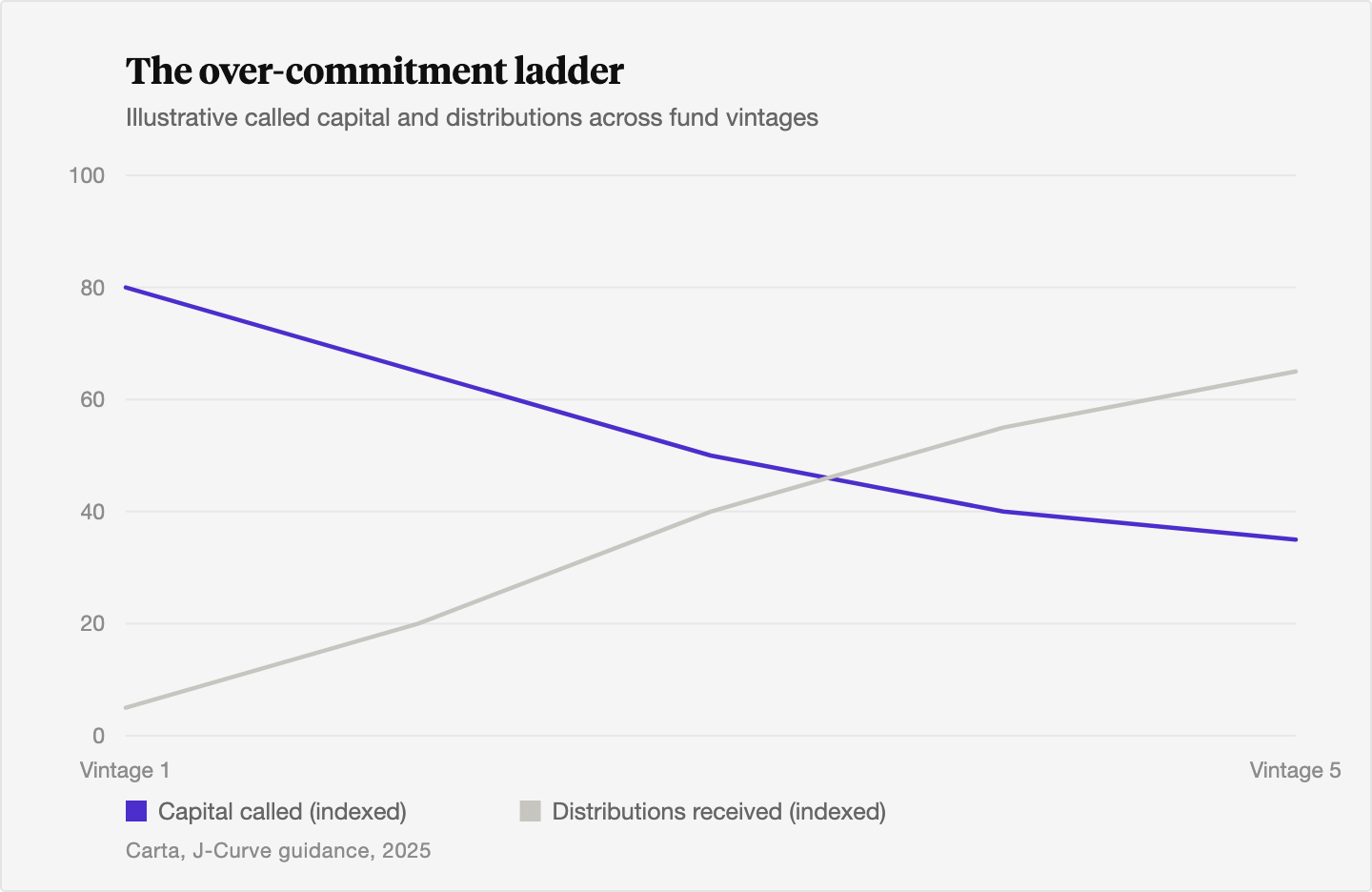
The strategy works until it does not. In a market shock, distributions can stall while calls keep arriving, and an over-committed investor can face calls with no offsetting cash coming in. ILPA flagged exactly this cumulative liquidity risk, noting that a market event could trigger simultaneous calls across multiple funds and leave investors unable to meet accumulated obligations. [6] Over-commitment is leverage on a liquidity schedule, and like any leverage it cuts both ways.
7. The cash drag on uncalled capital
Recall the just-in-time logic from section 2: capital stays with the investor until called, so it does not sit idle inside the fund. That solves the fund's cash drag. It hands the investor a version of the same problem.
The uncalled balance has to be held somewhere safe and liquid, because a call can arrive on short notice. Parking it in cash or short-term instruments means it earns very little while it waits, which drags on the investor's overall return. Reach for yield by putting uncalled capital into something less liquid, and you risk not being able to fund a call on time, which routes back to the default penalties in section 5. [10][13]
So the reinvestment problem is real and unavoidable in a drawdown structure. The investor either accepts a low return on the uncalled reserve or accepts liquidity risk on it. There is no version where the committed-but-uncalled money works as hard as fully deployed capital.
8. Subscription lines of credit and the flattered IRR
The last piece is the one that most distorts how drawdown funds look on paper. A subscription line of credit is a revolving loan to the fund, secured by investors' uncalled commitments, that lets the GP fund a deal with borrowed money and call investor capital later. [14][6]
Used as a short bridge, this is mostly administrative convenience. Used aggressively, it changes the reported return. Internal rate of return is time-sensitive: it measures the annualized return on capital weighted by how long that capital is at work. Delay the day investor capital is actually called, and you shorten the measured holding period, which mechanically lifts IRR without changing a single dollar of profit. [14][6]
The Institutional Limited Partners Association, the main standards body for fund investors, put numbers to this. In ILPA's notional six-year example, a fund with no credit facility reports an IRR of 6.62%. The same fund using a one-year facility reports 7.14%, and with a two-year facility, 7.98%. Over the same fund, the multiple on invested capital, which the borrowing does not flatter, falls from 1.45x to 1.40x to 1.35x as the interest cost mounts. [6]
ILPA also cited a Cobalt analysis of 498 funds finding the IRR boost is front-loaded: a median increase of 206 basis points by year three, falling to 35 to 45 basis points by the end of a fund's life. [6] The effect is largest exactly when a manager is raising the next fund and quoting recent IRR.
The takeaway is not that subscription lines are illegitimate. It is that an early-stage IRR quoted by a fund using one is not comparable to an unlevered IRR, and ILPA's central recommendation is that managers disclose net IRR both with and without the facility. [6] An investor who does not ask is measuring two funds with different rulers.
The Bottom Line
- A commitment to a drawdown fund is a promise to send money on short notice over several years, not a payment made up front. The uncalled balance stays with the investor until the manager calls it.
- The J-curve is structural. Negative early returns reflect fees and investments landing before realizations, and the trough usually lasts three to five years.
- Distributions follow a contractual waterfall, return of capital first, then a preferred return, then carried interest, and some distributions can be recalled later.
- Missing a capital call can trigger penalty interest, loss of rights, and forfeiture or forced sale of a large share of the investor's interest, far exceeding the missed amount.
- Commitment pacing and over-commitment manage the cash flow but add liquidity risk, and uncalled capital carries an unavoidable cash drag.
- Subscription lines can flatter early IRR without improving the actual multiple, which is why with-and-without disclosure matters.
- A fully funded investment, including a Regulation A+ fractional art offering, sidesteps the call mechanic, the default risk, and the uncalled-capital drag entirely.
How this compares to investing in art
Most ways an individual owns art are fully funded. You pay the full price of the work, or of your shares in it, at the time you buy. There is no commitment to call later.
This is the structure of a Regulation A+ fractional art investment like the one Masterworks operates, and it differs from how an individual typically reaches private equity as an individual investor, where feeder funds and interval funds still sit on a drawdown chassis. Each artwork is offered as an SEC-qualified offering, and an investor buys shares in full at purchase rather than committing capital to be drawn down over years. [7][8] In practice that removes the entire drawdown apparatus this article describes. There is no uncalled commitment, so there is no capital-call notice to track, no J-curve created by phased funding, no default penalty for a missed call, and no cash drag on a promised-but-unpaid balance. The fees still exist and the asset is still illiquid over a multi-year hold, but the funding mechanics are simpler.
A traditional closed-end art fund is the opposite case, and worth naming plainly. These vehicles, often structured as private funds relying on exemptions such as Section 3(c)(7) of the Investment Company Act, raise capital from a small number of large investors who commit and are drawn down exactly like a private equity fund. The economics rhyme with private equity too: fund terms around 7 to 10 years, management fees of roughly 1.5% to 2.5%, and carried interest of 15% to 25% over a preferred return. [8] The British Rail Pension Fund's celebrated art program of the 1970s and 1980s, which committed roughly 40 million pounds to art over several years, is the historical archetype of this committed-capital approach. [15] An investor in a closed-end art fund inherits the full set of drawdown features, capital calls, the J-curve, the waterfall, and default risk, that a fractional buyer does not.
We think the distinction is worth understanding before allocating across alternative investments generally. The structure determines the administrative burden and the liquidity profile as much as the asset does. Past performance of any art strategy is not predictive of future results, and art remains an illiquid, long-term holding regardless of how it is funded.
Sources
- Carta. "What is a Capital Call in Private Equity and Venture Capital?" Carta Learn, 2025. https://carta.com/learn/private-funds/management/capital-calls/
- bunch. "Capital Call/Drawdown." bunch Private Markets Glossary, 2025. https://www.bunch.capital/private-markets-glossary/capital-call-drawdown
- Carta. "J-Curve: Definition, Drivers and Mitigation Strategies." Carta Learn, 2025. https://carta.com/learn/private-funds/management/fund-performance/j-curve/
- Mayer Brown. "Understanding LPA Default Remedies." Mayer Brown Insights, August 2024. https://www.mayerbrown.com/en/insights/publications/2024/08/understanding-lpa-default-remedies
- Dentons. "Limited partner defaults in private equity: Risks, remedies and practical considerations." Dentons Insights, May 2023. https://www.dentons.com/en/insights/articles/2023/may/25/limited-partner-defaults-in-private-equity
- Institutional Limited Partners Association. "Subscription Lines of Credit and Alignment of Interests: Considerations and Best Practices for Limited and General Partners." ILPA, June 2017. https://ilpa.org/wp-content/uploads/2017/06/ILPA-Subscription-Lines-of-Credit-and-Alignment-of-Interests-June-2017.pdf
- Masterworks. "Masterworks FAQ." Masterworks Insights, 2026. https://insights.masterworks.com/masterworks-faq/faq/
- MOMAA. "Art Investment Funds and Institutional Vehicles." Modern Museum of Art Antibes, 2025. https://momaa.org/art-investment-funds/
- AngelList. "How Do Capital Calls Work?" AngelList Education Center, 2025. https://www.angellist.com/learn/capital-calls
- Moonfare. "Cash management: How to keep capital working between drawdowns." Moonfare Blog, 2025. https://www.moonfare.com/blog/cash-management-private-equity
- Wall Street Prep. "J-Curve Effect: Private Equity Fund Economics." Wall Street Prep Knowledge, 2025. https://www.wallstreetprep.com/knowledge/j-curve/
- Schroders. "Understanding the J-curve and measuring returns in private markets." Schroders Insights, 2025. https://www.schroders.com/en-us/us/intermediary/insights/understanding-the-j-curve-and-measuring-returns-in-private-markets/
- ArchBridge Family Office. "How To Manage Private Equity Capital Calls." ArchBridge Insights, 2025. https://archbridge.com/insights/how-to-manage-private-equity-capital-calls/
- CAIA Association. "Subscription Line of Credit: Benefits, Risks, and Distortions." Portfolio for the Future, September 2020. https://caia.org/blog/2020/09/29/subscription-line-of-credit-benefits-risks-and-distortions
- The Actuary. "How art helped British Rail beat inflation." The Actuary, March 2025. https://www.theactuary.com/2025/03/07/how-art-helped-british-rail-beat-inflation
Disclosures
Investing involves risk. Past results are not indicative of future outcomes.
Masterworks is providing this communication as an agent for its issuer entities, not Masterworks Advisers. This material is produced by Masterworks for informational purposes only and does not constitute investment advice, a recommendation, or an offer or solicitation to buy or sell any security. Masterworks is not a licensed broker-dealer by the SEC or FINRA.
Masterworks can only make and accept sales after an offering statement has been filed, and "qualified", by the SEC. Any offers may be revoked before notice of qualification. Indications of interest involve no obligation. For further disclosure visit the offering documents filed with the SEC and Important Disclosures at masterworks.com/cd.
Forward-looking statements and internal estimates are based on assumptions that may prove incorrect, and actual outcomes may differ materially. Figures denoted in brackets are subject to confirmation. Investing in art and alternative assets involves risk, including loss of principal.
Art sales price data is comparative only. Each painting is unique and historical data is not a direct proxy for any specific painting or investment. Data represents whole art, not an investment into our offerings which includes fees and expenses. Any comparative images are not currently live offerings and are provided for educational purposes only.
Masterworks, LLC is located at 1 World Trade Center, 57th Floor, New York, NY 10007.


