
Masterworks Research · June 2026
How the 20% performance share works, the hurdle and catch-up that gate it, the tax debate around it, and where the same fee logic shows up in art investing.
Carried interest, or "carry," is the share of a fund's investment profits that the manager keeps as payment for generating those profits. The market standard is 20%, almost always paired with a 2% annual management fee, the structure the industry calls "2 and 20." In most private equity and venture funds, the manager earns that 20% only after investors first get their capital back plus a minimum return, usually around 8%, called the hurdle rate or preferred return. For an investor weighing any private fund, art included, carry is the single most important line in the fee schedule, because it determines how much of the upside you keep and how closely the manager's payday is tied to yours.
What You Need to Know
- Carry is a profit share, not a fee on assets. The standard is 20% of investment profits, layered on top of a roughly 2% annual management fee. The "2 and 20" model is the benchmark for both private equity and venture capital [1][9].
- A hurdle rate protects investors first. A typical 8% preferred return means the manager collects no carry until limited partners have received their capital back plus an 8% annualized return [2][6]. Below that line, the profit split does not begin.
- The distribution waterfall sets the order of payment. Cash flows back in four tiers: return of capital, then the preferred return, then a general-partner catch-up, then the final 80/20 split [1][6].
- In the United States, carry is currently taxed as long-term capital gains if the underlying asset is held more than three years, a rule set by the 2017 tax law and left unchanged by the 2025 One Big Beautiful Bill Act [3][5]. The policy fight over taxing it as ordinary income is not settled.
- Art funds and fractional-art platforms use the same template. A management fee of roughly 1% to 2% plus a performance share near 20% is common, so the alignment-and-fee questions that apply to private equity apply here too [10][11].
1. What carried interest actually is
Start with the structure of a private fund, because the term only makes sense inside it. A fund has two sides. The limited partners (LPs) put up the capital. The general partner (GP), the management firm, runs the fund, sources deals, and decides what to buy and sell. The GP earns two things: a management fee, typically about 2% of assets or committed capital each year, which covers salaries and operations, and carried interest, a share of the profits the fund produces [1][9].
Carried interest is that profit share. The market convention is 20%. If a fund turns $100 million of invested capital into $200 million, the $100 million gain is split, and the GP's carry, before any hurdle, would be 20% of that gain, or $20 million [1].
The word "carry" is old. It traces to medieval and Renaissance sea trade, when a ship's captain took a share, often around 20%, of the profit on the cargo he "carried" and sold, having put in the work and the risk rather than the capital. The modern fund manager occupies the same seat. The LPs own the cargo. The GP carries it to market and keeps a fifth of the gain.
The reason carry sits at the center of fund economics is that it is the variable piece. The management fee is paid whether the fund wins or loses. Carry is paid only on profit. So when an investor asks how a manager really gets paid on a good outcome, the answer is almost always carried interest.
2. The 2 and 20 model, and why 20% became the number
The "2 and 20" structure, a 2% management fee plus 20% carried interest, is the default across private equity, venture capital, and most hedge funds [1][9]. It is so standard that deviations from it are themselves a negotiating point.
The 2% is meant to keep the lights on. On a $500 million fund, 2% is $10 million a year, enough to pay a team and run operations without depending on a successful exit that may be years away. The 20% is the incentive. It is the manager's share of value created, and it is the line that, in a strong fund, dwarfs the management fee [9].
Why 20% specifically? There is no law behind it. It is a convention that hardened over decades because it sat at a workable middle. A much smaller carry would weaken the manager's incentive to push for the best outcome. A much larger one would transfer too much of the investor's upside to the manager. We see the same instinct toward a balanced middle in our own corner of the market, where too little supply starves a market and too much drowns it. Twenty percent has held as the steady center for fund profit sharing in the same way.
In recent years, larger and more sophisticated investors have pushed on the 2%, especially on very large funds where 2% generates fee income far beyond operating cost. The 20% carry has proved far stickier. It is the part managers defend hardest, because it is the part that pays them when they perform.
3. The hurdle rate: investors get paid first
In a typical private equity fund, the manager does not earn carry on the first dollar of profit, a mechanism that most often gets missed. Investors are entitled to a minimum return first, called the hurdle rate or the preferred return. The common figure is 8% [2][6].
Put yourself in the LP's seat. You commit $10 million to a fund. The hurdle says that before the manager takes any profit share, the fund must first return your $10 million, then pay you an 8% annualized return on top. Only after you have cleared both does the GP begin to collect carry [2][6]. A fund with an 8% preferred return must give back 108% of invested capital before the manager earns a cent of carry [2].
The hurdle exists to make sure the manager is paid for genuine outperformance, not for a result an investor could have gotten in a low-cost public index. If a fund returns only 6% a year, below the 8% hurdle, the LPs keep nearly all of it and the GP earns no carry. The manager has not beaten the bar, so the manager does not share in the result [2][6].
This is the part of the structure that does the most to protect investors. The hurdle is a floor under the LP's return that the manager has to clear before getting paid on profit.
4. The distribution waterfall, tier by tier
The order in which cash flows back to each party is called the distribution waterfall. Picture a set of pools stacked down a hillside. Each fills completely before spilling into the next. The standard private equity waterfall has four tiers [1][6].
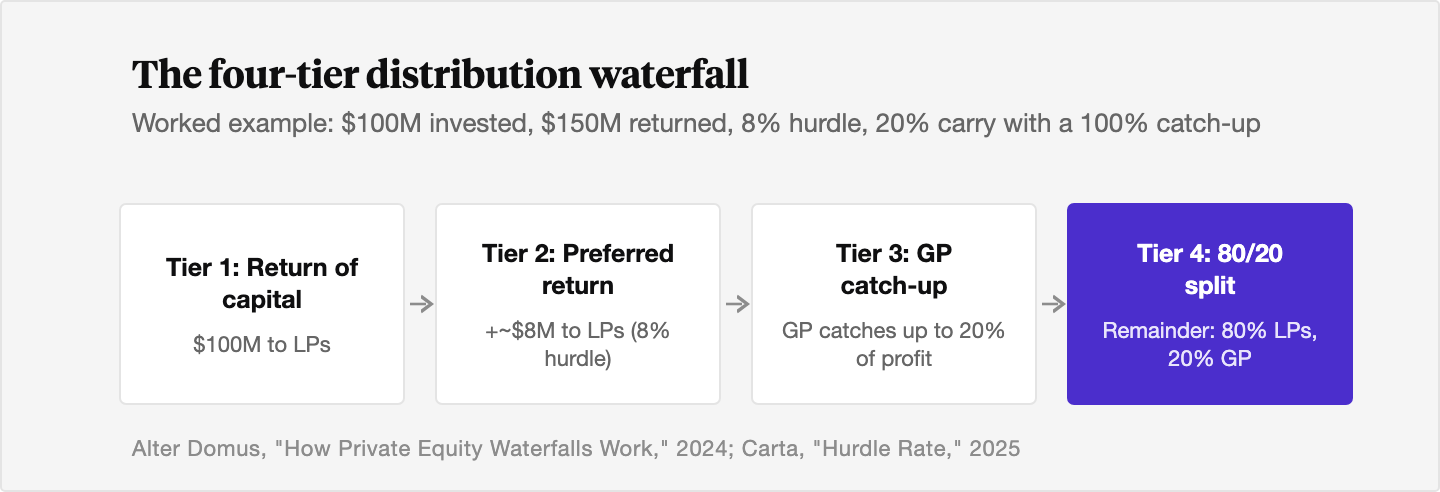
Say LPs commit and invest $100 million, the hurdle is 8%, the carry is 20%, and there is a full "100% catch-up." The fund eventually returns $150 million in total, a $50 million profit. Here is how the waterfall pays out, assuming for simplicity the preferred return tier comes to roughly $8 million.
- Return of capital. The first $100 million goes back to the LPs. They are whole on their principal before anyone shares in profit [6].
- Preferred return. The next roughly $8 million goes to the LPs as their 8% hurdle. Now the LPs have their money back plus the minimum return they were promised [2][6].
- GP catch-up. Once the LPs have their preferred return, the catch-up gives the next dollars to the GP until the GP has captured 20% of the profit distributed so far. A "100% catch-up" means 100% of cash in this tier goes to the GP until that 20/80 balance is reached [1][8].
- The 80/20 split. Everything left over is split 80% to the LPs and 20% to the GP, the carried interest doing its job [1][6].
The catch-up tier is the piece outsiders find odd. Its logic is that the 20% carry is meant to apply to the whole profit, not only the slice above the hurdle. The hurdle pays LPs first. The catch-up then lets the GP "catch up" to its full 20% share of total profit, after which both sides split concurrently. Not every fund includes a catch-up, and the catch-up rate is negotiable, but a 100% catch-up to a 20% carry is the common design [8].
5. European versus American waterfalls, and the clawback
Two flavors of waterfall exist, and the difference matters more than the geographic labels suggest [4][6].
A European, or whole-fund, waterfall runs the tiers across the entire fund. The GP earns no carry until the LPs have received all of their capital back plus the preferred return on the whole portfolio. The Institutional Limited Partners Association (ILPA), the main body representing large fund investors, has endorsed the whole-fund structure as the fairest method for aligning GP and LP interests [4].
An American, or deal-by-deal, waterfall runs the tiers on each investment separately. The GP can collect carry on an early winner before the fund as a whole has returned investor capital [4][6]. This pays the manager faster, and it introduces a real risk: the GP may collect carry on early wins, then later deals lose money, and the GP ends up having been paid carry it did not actually earn across the full fund.
That risk is why deal-by-deal funds carry a clawback provision, a contractual obligation for the GP to return excess carry at the end of the fund's life [1][6]. On paper it protects LPs. In practice it is hard to enforce. By the time a clawback triggers, which can be ten or twelve years in, the individuals who received the carry may have left the firm, and recovery can require litigation. One review cited by industry counsel found that fewer than 15% of triggered clawbacks are recovered in full [4]. ILPA's deal-by-deal model agreement tries to blunt this by requiring the GP to escrow 30% of carry distributions and to run interim clawback tests during the fund's life [4].
The takeaway for an investor reading a fund's terms: a European waterfall pays the manager later and aligns the two sides more tightly. The clawback is a backstop, and a backstop is weaker than not needing one. We would read the waterfall language closely before the headline carry number.
6. The tax debate: capital gains or ordinary income?
Carried interest sits at the center of a long-running tax fight in the United States. When a manager receives carry, is that payment investment gain, taxed at the lower long-term capital gains rate, or is it compensation for work, taxed at the higher ordinary income rate?
Under current law, carry is generally treated as a capital gain. The 2017 Tax Cuts and Jobs Act added a condition: to qualify for long-term capital gains treatment, the underlying asset tied to the carried interest must be held more than three years, under Internal Revenue Code Section 1061 [3]. The IRS rule "recharacterizes certain net long-term capital gains" on a carried interest as short-term, and so taxed at ordinary rates, if the three-year period is not met [3]. The rule applies to tax years beginning after December 31, 2017 [3].
The stakes are the rate gap. As of the 2025 to 2026 debate, the top long-term capital gains rate is about 23.8%, including the 3.8% net investment income tax, while the top ordinary income rate reaches about 40.8% [5]. Critics call the gap the "carried interest loophole" and argue carry is really compensation for managing other people's money. Defenders argue carry is a genuine equity stake in an investment outcome and should be taxed like one.
The reform attempts are bipartisan and so far unsuccessful. President Obama called for taxing carry as ordinary income. President Trump called for it in his first term and again more recently. Democrats tried in 2022 to extend the holding period from three years to five and could not find unanimous support within their own party [5]. The Congressional Budget Office has estimated that taxing carry as ordinary income would raise about $13 billion over the 2025 to 2034 window [5]. Despite all of it, the 2025 One Big Beautiful Bill Act, signed July 4, 2025, made no change to carried interest taxation [5]. The three-year rule stands.
For an investor, the practical point is narrower than the headlines. The tax treatment of carry is the manager's tax issue, not directly the LP's. But it shapes manager behavior, including the incentive to hold assets longer than three years, and it is a useful signal of how policy may move.
7. Does carry actually align managers and investors?
The case for carried interest is alignment. Because the GP's largest payday comes only after investors do well, and only above the hurdle, carry ties the manager's economics to the investor's [1]. A manager who owns 20% of the upside has a powerful reason to grow the portfolio rather than simply gather assets and collect a fee. Most serious funds reinforce this by requiring the GP to invest its own money alongside LPs, a "GP commitment" that puts the manager's capital at the same risk as the investor's.
The case against is more subtle. Carry is a one-sided bet. The GP shares in the gains but not, beyond its own commitment, in the losses. That asymmetry can reward swinging for the fences, since a manager captures 20% of a big win but bears only its small stake of a big loss. Deal-by-deal waterfalls sharpen the concern, because carry paid early on winners may never be fully clawed back if later deals sour [4]. A high management fee can also dull the alignment, since a manager collecting large fees on assets is paid well even without performance.
The honest read is that carry aligns interests well when it is structured well: a meaningful hurdle, a whole-fund waterfall, a real GP commitment, and a management fee sized to operations rather than to profit. The structure does the aligning. The label does not. This is why we treat the fine print of a fund's terms as more telling than its stated carry percentage.
8. How performance fees show up in art investing
The same logic carries directly into art as an investment, because art funds and fractional-art platforms are private investment vehicles, and they price themselves like one.
The common art-fund structure mirrors 2 and 20. Industry summaries describe a management fee of roughly 1% to 2% of assets per year, plus a performance allocation of around 20% of the fund's net profit [10][11]. Closed-end art funds frequently follow the private equity template more fully, with management fees in the 1.5% to 2.5% range plus performance fees of 15% to 25% above a preferred return of 6% to 8% [10]. The pioneers used this shape. The Fine Art Fund Group, founded in London in 2001, ran a closed-end private equity style structure with high minimums and a multiyear hold, and reported annual returns of about 16% on the works it had sold from its first two funds [10]. The British Rail Pension Fund, the most studied institutional art investment, put roughly £40 million into about 2,400 works in the 1970s as an inflation hedge and is generally reckoned to have earned around four percentage points a year above inflation over a hold that ran into 2003 [11]. Past performance like this is not predictive of any future result.
Because the fee shape is the same, the questions are the same. Is there a hurdle, so the manager earns the performance share only above a minimum return? How is profit defined, and net of which costs, given that art carries real expenses for storage, insurance, and transaction fees? How long is the hold, and how is the platform's own capital committed alongside investors? These are the alignment questions from sections 3 through 7, asked about paintings instead of companies.
For Masterworks specifically, we will not state fee figures here. The terms of any Masterworks offering, including any management fee and any share of appreciation, are set out in the offering documents filed with the SEC, and those documents govern. An investor evaluating any art platform, ours included, should read the fee and waterfall terms in the filings rather than rely on a general explainer. The point of this piece is to make those terms legible. Art investing involves risk, including loss of principal, and past performance is not predictive of future results.
For how art behaves as a portfolio holding and how to think about the hold period that performance fees are built around, see our companion pieces on private equity mechanics, art as an alternative allocation, art versus venture capital risk and return, and why patience tends to be rewarded in art markets.
The Bottom Line
- Carried interest is the manager's share of fund profits, conventionally 20%, paired with a roughly 2% annual management fee in the "2 and 20" model.
- A hurdle rate, commonly 8%, requires that investors get their capital back plus a minimum return before the manager earns any carry.
- The distribution waterfall pays in four tiers: return of capital, preferred return, GP catch-up, then an 80/20 split, and whether it runs whole-fund (European) or deal-by-deal (American) materially changes alignment.
- In the United States, carry is currently taxed as long-term capital gains when the asset is held more than three years, and the 2025 tax law left that treatment unchanged despite a long-running reform debate.
- Art funds and fractional-art platforms use the same management-fee-plus-performance-share template, so the same hurdle, waterfall, and alignment questions apply, and the governing numbers for any specific offering live in its filed documents.
Sources
- Carta. "What Is Carried Interest? Definition, Taxation and Fee Structures." Carta Learn, 2025. https://carta.com/learn/private-funds/management/carried-interest/
- Carta. "Hurdle Rate: Explainer for Fund Managers and Investors." Carta Learn, 2025. https://carta.com/learn/private-funds/management/carried-interest/hurdle-rate/
- Internal Revenue Service. "Section 1061 Reporting Guidance FAQs." IRS.gov, accessed June 2026. https://www.irs.gov/businesses/partnerships/section-1061-reporting-guidance-faqs
- Katten Muchin Rosenman LLP. "ILPA Releases Deal-By-Deal Model LPA." Katten Insights, 2024. https://katten.com/ilpa-releases-deal-by-deal-model-lpa
- Bipartisan Policy Center. "The 2025 Tax Debate: Carried Interest and Tax Breaks for Sports Teams." BipartisanPolicy.org, 2025. https://bipartisanpolicy.org/explainer/the-2025-tax-debate-carried-interest-and-tax-breaks-for-sports-teams/
- Alter Domus. "How Private Equity Waterfalls Work." AlterDomus.com, 2024. https://alterdomus.com/insight/private-equity-waterfall/
- Kirkland & Ellis LLP. "Final One Big Beautiful Bill Act Features Enhanced Tax Breaks and Targeted Tax Increases, But No Changes to Carried Interest." Kirkland Alert, July 2025. https://www.kirkland.com/publications/kirkland-alert/2025/07/final-one-big-beautiful-bill-act
- Rundit. "A Comprehensive Guide to Catch-Up Period in Private Equity." Rundit Blog, 2025. https://rundit.com/blog/a-comprehensive-guide-to-catch-up-period-in-private-equity/
- Qubit Capital. "Carried Interest in Venture Capital: How Profit Sharing Works." Qubit.capital, 2025. https://qubit.capital/blog/carried-interest-venture-capital
- Center for Art Law. "Art Investment Funds: The Basics." ItsArtLaw.org, May 2015 (fee-structure conventions). https://itsartlaw.org/2015/05/19/art-investment-funds-the-basics/
- Investment and Pensions Europe (IPE). "Fine Art of Art Investing." IPE.com, accessed June 2026. https://www.ipe.com/fine-art-of-art-investing/17160.article
- Moonfare. "Hurdle Rate (Preferred Return) in Private Equity." Moonfare Glossary, 2025. https://www.moonfare.com/glossary/hurdle-rate-preferred-return
- Paul Hastings LLP. "One Big Beautiful Bill Act, A Private Equity Perspective." PaulHastings.com, 2025. https://www.paulhastings.com/insights/client-alerts/one-big-beautiful-bill-act-a-private-equity-perspective
Disclosures
Investing involves risk. Past results are not indicative of future outcomes.
Masterworks is providing this communication as an agent for its issuer entities, not Masterworks Advisers. This material is produced by Masterworks for informational purposes only and does not constitute investment advice, a recommendation, or an offer or solicitation to buy or sell any security. Masterworks is not a licensed broker-dealer by the SEC or FINRA.
Masterworks can only make and accept sales after an offering statement has been filed, and "qualified", by the SEC. Any offers may be revoked before notice of qualification. Indications of interest involve no obligation. For further disclosure visit the offering documents filed with the SEC and Important Disclosures at masterworks.com/cd.
Forward-looking statements and internal estimates are based on assumptions that may prove incorrect, and actual outcomes may differ materially. Figures denoted in brackets are subject to confirmation. Investing in art and alternative assets involves risk, including loss of principal.
Art sales price data is comparative only. Each painting is unique and historical data is not a direct proxy for any specific painting or investment. Data represents whole art, not an investment into our offerings which includes fees and expenses. Any comparative images are not currently live offerings and are provided for educational purposes only.
Masterworks, LLC is located at 1 World Trade Center, 57th Floor, New York, NY 10007.


