Masterworks Research · June 2026
How a return to figurative painting created the first great contemporary art boom, why most of it corrected, and why one name now carries the category.
Neo-Expressionism was an international return to large, gestural, figurative painting in the late 1970s and early 1980s, led by Jean-Michel Basquiat and Julian Schnabel in New York, Francesco Clemente in Italy, and Anselm Kiefer and Georg Baselitz in Germany [1]. It produced the first true boom in the contemporary art market, a speculative run that peaked in 1989 and 1990 and then corrected sharply. For investors the movement is useful for a different reason than its aesthetics. It is a clean, well documented case study in how a new category goes from speculative spike to blue-chip maturity, and in how, decades later, a single artist can come to define an entire market.
What You Need to Know
- Neo-Expressionism brought figuration back. After roughly two decades in which Minimalism and Conceptualism dominated, painters in the US, Germany, and Italy returned to recognizable figures, dense surfaces, and emotional, often violent imagery [1]. The market reception was immediate and aggressive.
- It drove the first contemporary art boom, then corrected. A broad art market index roughly quadrupled between 1982 and 1990, then prices fell about 55% from 1990 to 1993 as recession and the bursting of Japan's asset bubble hit at once [2][3]. Many Neo-Expressionist names that were hot in the 1980s never recovered their peak prices.
- Basquiat now carries the category. His 1982 skull painting Untitled sold for $110.5 million at Sotheby's in 2017, the first work made after 1980 to clear $100 million [4]. In 2024 he was the most valuable contemporary artist at auction, accounting for roughly 12% of all contemporary sales on about $183 million of turnover [5].
- The spread between Basquiat and his peers is enormous. Basquiat's record is $110.5 million [4]. Kiefer's auction high sits near $4 million [6]. Most Schnabel plate paintings trade in the low single-digit millions on the private market [7]. The category did not rise together. One artist pulled away.
- The cycle is the lesson. Speculative booms in a young category tend to overshoot, correct hard, and then sort into a small set of durable names. We believe that pattern, more than any single price, is what the 1980s teach an investor.
1. What Neo-Expressionism was, and why it arrived when it did
Neo-Expressionism describes a revival of expressionist painting that emerged in the late 1970s and ran through the 1980s [1]. The work shared a recognizable set of traits: large scale, heavy and textured paint, vivid clashing color, and a return to the human figure and to narrative drawn from history, myth, and street culture [1]. It pulled from early twentieth century German Expressionism, from Surrealism, from Abstract Expressionism, and from Pop.
The arrival makes sense in the context of what came before it. For most of the 1960s and 1970s, the prestige end of the art world was held by Minimalism and Conceptualism, movements that often pushed painting itself to the margins. Neo-Expressionism was a reaction to that, a deliberate turn back toward paint, image, and feeling. It was also international from the start. Critics gave the regional variants their own labels: the Neue Wilden, or New Fauves, in Germany; the Transavanguardia in Italy; Figuration Libre in France; and a loose group of young American painters centered on New York [1].
A note on why this matters for an investor and not only an art historian. New categories are where the largest repricing happens, up and down. When a fresh style captures attention, demand can arrive faster than the supply of quality work, and prices move quickly. That is the setup for a boom. It is also the setup for a correction when the demand turns out to be thinner than it looked. Neo-Expressionism ran that full cycle inside about a decade.
2. The names that defined the movement
Abstractions are easier to evaluate with proper nouns attached, so here is the cast.
In New York, Jean-Michel Basquiat moved from graffiti under the tag SAMO to gallery walls, building a visual language out of street imagery, jazz, hip hop, and Afro-Caribbean references [1]. Julian Schnabel arrived loudly, best known for his plate paintings, large canvases studded with shards of broken crockery [7]. David Salle worked alongside them in the same downtown scene and the same handful of galleries.
In Italy, Francesco Clemente, Sandro Chia, and Enzo Cucchi made up the core of the Transavanguardia, drawing on art history, mythology, and pop culture in equal measure [1]. In Germany, Georg Baselitz, famous for painting his subjects upside down, helped lead a revival that dominated German art through the 1970s, and Anselm Kiefer built monumental, layered works that confronted German history and myth [1].
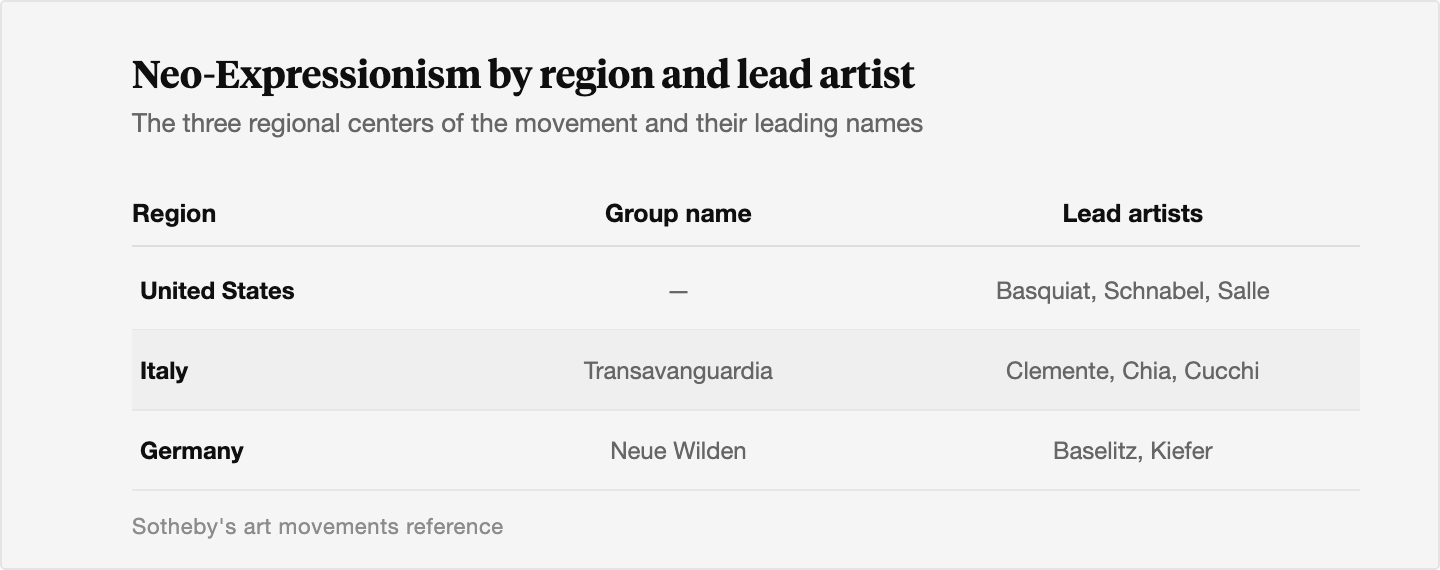
The names matter because they did not all end up in the same place. Thirty years on, their markets diverged by orders of magnitude. Understanding why is most of the investing lesson here.
3. The 1980s boom: a new market learns to speculate
The 1980s are when the art market became what it is today, a luxury market and a functioning economy for dealers, galleries, and midmarket artists at the same time. Neo-Expressionism was the fuel. Dealers marketed these painters with an aggressiveness the art world had not seen, and the work sold [1].
The dynamics were unusually commercial for the period. Mary Boone, who became the defining dealer of the decade, built her gallery around Schnabel and Salle and placed their work with collectors like Charles Saatchi and the Rubells [8]. Schnabel's plate paintings, which debuted at Boone's gallery in 1979, sold for roughly $25,000 to $60,000 in the early 1980s, and by 1983 a plate painting reached $93,500 at auction, a striking sum for work that recent [7]. Prices that climb that fast, that soon after a work is made, are a signal worth respecting in either direction.
Basquiat's market shows the speculative temperature most clearly. An untitled 1983 work sold at Christie's in November 1988 for $110,000, about four times its high estimate, and between May 1989 and November 1990, 29 separate Basquiats sold at $200,000 or more at international auctions [8]. A broad art market index roughly quadrupled over the decade, rising from a low near 243 in 1982 to about 855 by 1990 [2].
Translate that into investing terms. You had a new category, a small float of quality work, a wave of new buyers including Japanese collectors flush from a property bubble, and dealers running hard marketing. Demand outran supply, and prices went vertical. Those are the exact conditions under which a market overshoots fair value.
4. The correction: most of the boom did not hold
Then it broke. In early 1990 the market collapsed [2]. A US recession and the bursting of Japan's stock and property bubbles arrived together, and Japanese demand, which had pushed prices to their peak, evaporated [3]. Prices in the broad art market fell roughly 55% between 1990 and 1993, and auction sales in some segments dropped by more than half in a single year [3]. A full recovery to the late 1980s peak took years, not months.
The correction was not evenly distributed, and that is the part investors should sit with. Schnabel's plate paintings, the emblem of the boom, cracked along with the market and spent years out of favor, with critics describing them as relics [7]. The aggregate index recovered eventually, but many individual Neo-Expressionist names did not return to their 1989 highs for a long time, and some never did at their boom-era pricing.
We have written before about how these phases tend to play out, the expansion, the peak, the correction, and the recovery, in how art market cycles work: expansion, peak, correction, and recovery. The 1980s Neo-Expressionist boom is close to a textbook example of the full arc, with the added lesson that recovery happens at the level of the individual artist, not the category. The index coming back does not mean your specific name came back.
5. Why Basquiat pulled away from the field
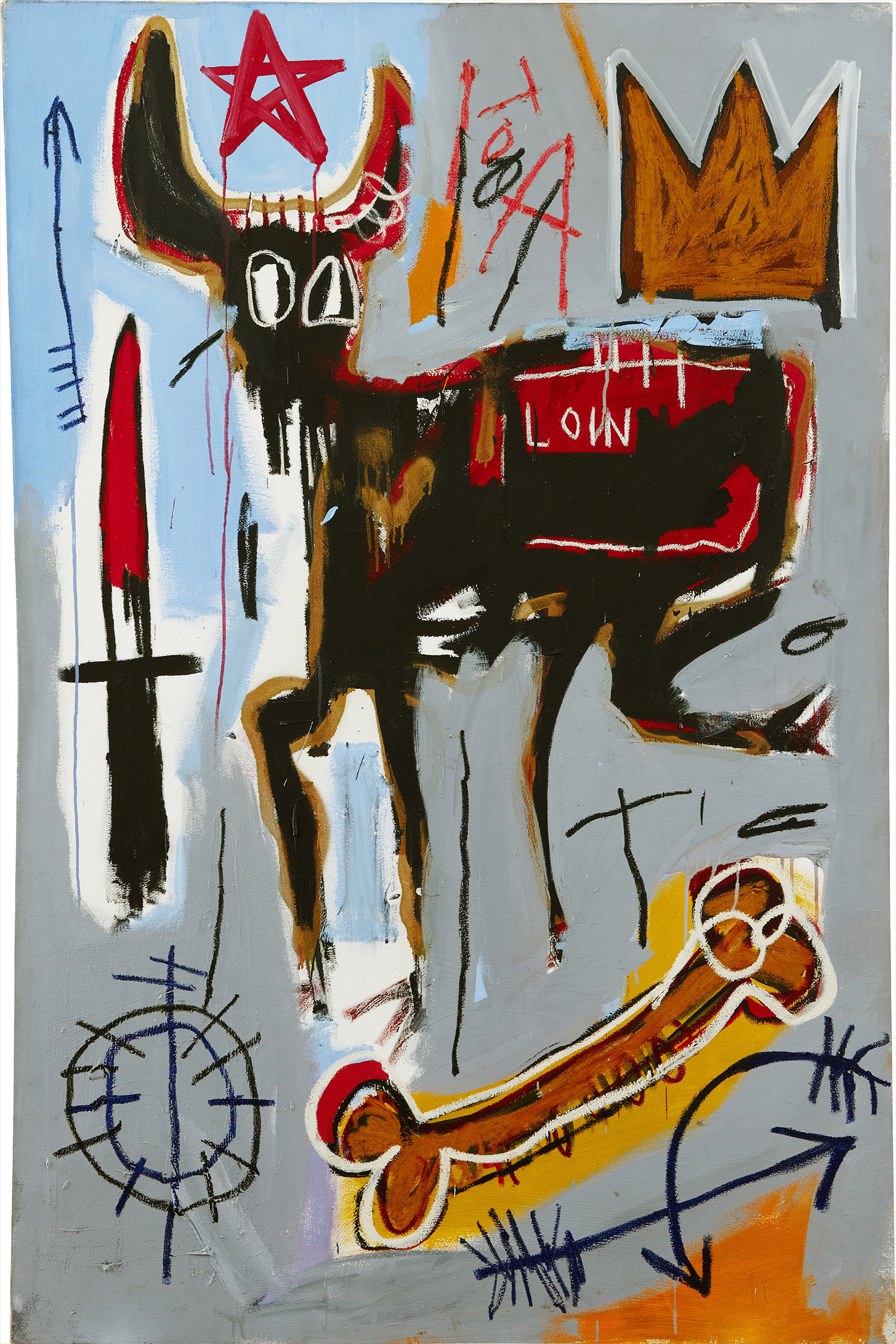
The most important fact about Neo-Expressionism today is how far one artist has separated from the rest. Basquiat's 1982 Untitled skull painting sold for $110.5 million at Sotheby's in May 2017, against a $60 million estimate, bought by the collector Yusaku Maezawa [4]. It was the first work made after 1980 to pass $100 million at auction, and at 21, the age Basquiat was when he painted it, he became the youngest artist to clear that mark [4].
Now look at the rest of the field. Kiefer's auction record sits near $4 million [6]. Baselitz, whose work helped set a record at Christie's $852.9 million November 2014 sale, the highest single auction total of its time, trades far below Basquiat's level [9]. Most of Schnabel's plate paintings change hands privately in the low single-digit millions, with his top public results an order of magnitude under that [7]. The same movement, the same boom, and a price gap of more than 25 to 1 between its leading name and its other major figures.
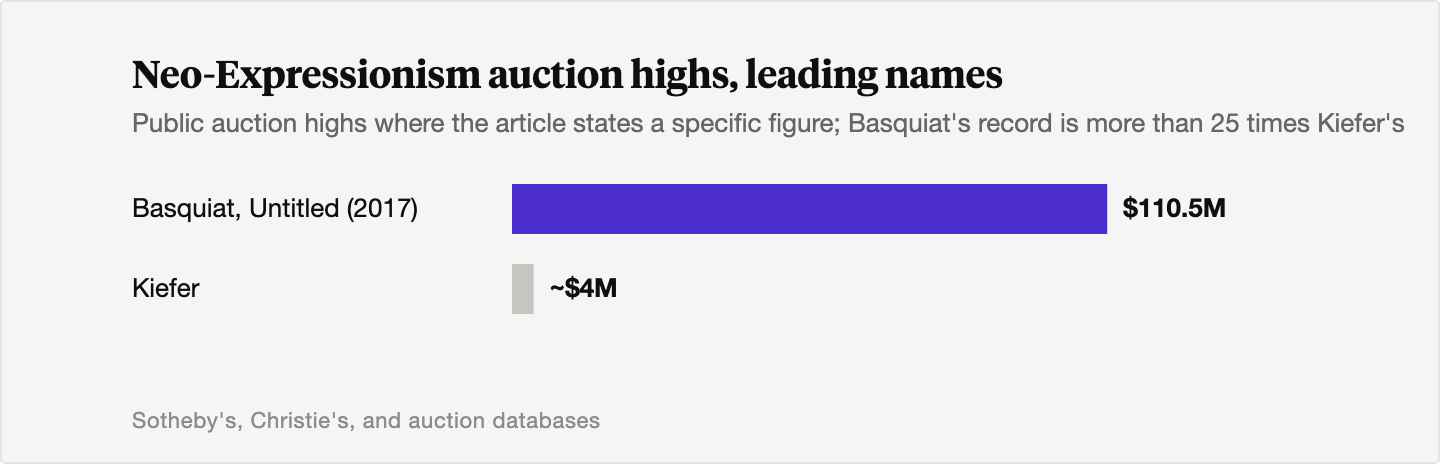
Why did Basquiat separate? In our view it comes down to the same things that drive any artist market: a recognizable and singular body of imagery, deep institutional and museum support, a fixed and shrinking supply since his death in 1988, and demand from the very top of the wealth distribution. His best work sits in the price band, above $10 million, that has shown the clearest strength in the current recovery. We work through the bull and bear case on his market in detail in Basquiat at $100M+: has the market peaked or is there room to run?.
6. From speculative boom to blue-chip category
The arc from 1982 to today is the arc from speculation to blue chip. In the 1980s Neo-Expressionism was a young, fashionable, lightly tested market where prices ran ahead of any track record. After the correction, the work that had real institutional and collector demand behind it slowly re-rated upward over decades, while the work that was bought on momentum stayed flat or fell. Today the strongest examples, led by Basquiat, are core holdings in serious contemporary collections.
This is what blue-chip status actually means. It is not a label an auction house grants. It is the result of an artist's market surviving a full cycle, holding museum and collector demand through a downturn, and coming out with prices supported by something more durable than a fad. We define the term and the tests behind it in what blue-chip art actually means and why it matters. Neo-Expressionism is a good illustration because the same movement produced both outcomes: a handful of names that earned blue-chip status and many that did not.
There is a portfolio point underneath this. Contemporary art and older categories do not move on the same clock, and the recoveries after the 1990 crash favored postwar and contemporary names over the previously overheated Impressionist market [3]. We cover that divergence in when markets diverge: why contemporary art and old masters don't move together. For an investor, the takeaway is that the category and the cycle both matter, and that the artist market is the unit that ultimately decides the outcome.
The Bottom Line
- Neo-Expressionism was an international return to figurative, gestural painting in the late 1970s and 1980s, led by Basquiat, Schnabel, Clemente, Kiefer, and Baselitz.
- It fueled the first true contemporary art boom, with a broad index roughly quadrupling from 1982 to 1990 before prices fell about 55% in the 1990 to 1993 correction.
- The correction sorted the movement. Some names re-rated upward over decades and others never recovered their boom-era prices.
- Basquiat now dominates the category, with a $110.5 million record and roughly 12% of all contemporary auction sales in 2024, while peers like Kiefer top out near $4 million.
- The durable lesson is the cycle itself: young categories overshoot, correct, and resolve into a small set of blue-chip names. The artist market, not the movement label, decides which.
- Past performance is not predictive of future results, and a single record sale is a weak basis for any forecast.
Sources
- Sotheby's. "Neo-Expressionism: History, Characteristics, Artists." Sotheby's Art Movements. https://www.sothebys.com/en/art-movements/neo-expressionism
- MyArtBroker. "A Concise History of the Art Market." MyArtBroker, 2024. https://www.myartbroker.com/investing/articles/concise-history-of-the-art-market
- Fiveable. "Market Crashes and Recoveries in the Art World." Art Market Economics study guide, 2024. https://fiveable.me/art-market-economics/unit-13/market-crashes-recoveries-art-world/study-guide/E2HkHegaiqYjkF8n
- Wikipedia. "Untitled (1982 Basquiat skull painting)." Accessed June 2026. https://en.wikipedia.org/wiki/Untitled_(1982_Basquiat_skull_painting)
- Maddox Gallery. "Global Art Market Reports Reveal Critical Trends Reshaping the Art Market for 2025 (UBS, Artnet, Artprice)." Maddox Gallery, 2025. https://maddoxgallery.com/news/426-global-art-market-reports-reveal-5-critical-trends-reshaping-the-art-market-in-2025/
- Artnet. "Anselm Kiefer." Artnet artist price database. Accessed June 2026. https://www.artnet.com/artists/anselm-kiefer/
- Artnet News. "Julian Schnabel's Plate Paintings Captured the '80s Zeitgeist and Then Disappeared. Here's Why Collectors Are Reconsidering Them Now." Artnet News, 2021. https://news.artnet.com/market/julian-schnabel-plate-paintings-2022028
- Artsy. "The Rise and Fall of Mary Boone." Artsy Editorial. https://www.artsy.net/article/artsy-editorial-rise-fall-mary-boone-revolutionary-art-dealer-going-prison-tax-fraud
- Artnet News. "Epic Christie's $852.9 Million Blockbuster Contemporary Art Sale Is the Highest Ever." Artnet News, November 2014. https://news.artnet.com/market/epic-christies-8529-million-blockbuster-contemporary-art-sale-is-the-highest-ever-166404
- ARTnews. "Record-Breaking $110.5 M. Basquiat Shocks Attendees at Sotheby's $319.2 M. Postwar and Contemporary Evening Sale." ARTnews, May 2017. https://www.artnews.com/art-news/market/record-breaking-110-5-m-basquiat-shocks-attendees-at-sothebys-319-2-m-postwar-and-contemporary-evening-sale-8374/
- NPR. "At $110.5 Million, Jean-Michel Basquiat's Painting Becomes Priciest U.S. Artwork Ever Sold." NPR, May 19, 2017. https://www.npr.org/sections/thetwo-way/2017/05/19/529096175/at-110-5-million-basquiat-painting-becomes-priciest-work-ever-sold-by-a-u-s-arti
- MyArtBroker. "Jean-Michel Basquiat Value: Top Prices Paid at Auction." MyArtBroker, accessed June 2026. https://www.myartbroker.com/artist-jean-michel-basquiat/record-prices/jean-michel-basquiat-record-prices
- TheArtStory. "Neo-Expressionism Movement Overview." TheArtStory. https://www.theartstory.org/movement/neo-expressionism/
- EBSCO Research. "Neoexpressionism in Painting." EBSCO Research Starters, Visual Arts. https://www.ebsco.com/research-starters/visual-arts/neoexpressionism-painting
Disclosures
Investing involves risk. Past results are not indicative of future outcomes.
Masterworks is providing this communication as an agent for its issuer entities, not Masterworks Advisers. This material is produced by Masterworks for informational purposes only and does not constitute investment advice, a recommendation, or an offer or solicitation to buy or sell any security. Masterworks is not a licensed broker-dealer by the SEC or FINRA.
Masterworks can only make and accept sales after an offering statement has been filed, and "qualified", by the SEC. Any offers may be revoked before notice of qualification. Indications of interest involve no obligation. For further disclosure visit the offering documents filed with the SEC and Important Disclosures at masterworks.com/cd.
Forward-looking statements and internal estimates are based on assumptions that may prove incorrect, and actual outcomes may differ materially. Figures denoted in brackets are subject to confirmation. Investing in art and alternative assets involves risk, including loss of principal.
Art sales price data is comparative only. Each painting is unique and historical data is not a direct proxy for any specific painting or investment. Data represents whole art, not an investment into our offerings which includes fees and expenses. Any comparative images are not currently live offerings and are provided for educational purposes only.
Masterworks, LLC is located at 1 World Trade Center, 57th Floor, New York, NY 10007.