
Masterworks Research · June 2026
Op Art and Kinetic Art are a small, fashion-cycle collecting category with a devoted buyer base, a clear top tier in Riley and Vasarely, and liquidity that is thinner than the blue-chip names, which is exactly what makes the category worth understanding before you allocate.
Op Art and Kinetic Art are two closely linked movements from the mid-twentieth century built around one idea: motion. Op Art (short for optical art) makes a static, flat surface appear to vibrate, flicker, and move through precise geometric pattern, while Kinetic Art uses real or apparent physical movement, often in three dimensions [1]. Both peaked in the 1960s, anchored by the Museum of Modern Art's survey "The Responsive Eye" in New York from February to April 1965 [1]. For an investor, the category is worth understanding because it behaves like a textbook niche: a handful of canonical names with real institutional backing, modest prices relative to their art-historical weight, and a buyer pool small enough that liquidity at the top can be uncertain. The category is a useful case study in what a niche can and cannot do inside a portfolio.
What You Need to Know
- This is a niche, not a blue-chip market. The very top Op and Kinetic results rarely clear roughly $1 to $2 million, while blue-chip Post-War and Contemporary names regularly trade above $50 million per work [3][4]. The category sits in day sales and themed auctions, not the trophy evening sales.
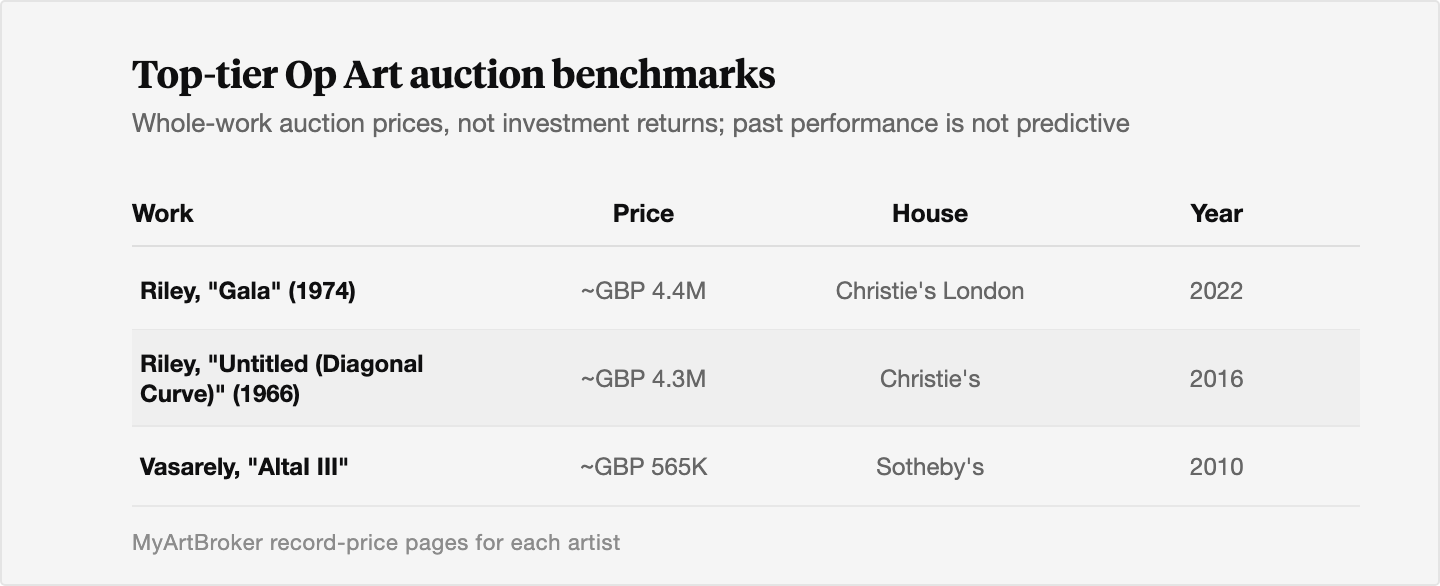
- The top tier is led by Bridget Riley and Victor Vasarely. Riley's auction record is about GBP 4.4 million for "Gala" (1974) at Christie's London in 2022 [5]. Vasarely's headline record is far lower, near GBP 565,000 for "AltaI III" at Sotheby's in 2010, with most strong works trading in the low to mid six figures [6].
- Demand is devoted but narrow. Op and Kinetic collecting is concentrated among Latin American abstraction specialists, European Op and Kinetic collectors, and design-minded buyers. That base can be sticky through downturns, but it is small, so the bidder pool on a high-ticket lot is thin [3].
- Liquidity is lumpy and the holding period is long. A narrow buyer pool means realized prices depend heavily on who is in the room. Advisers consistently frame art as a long-term, illiquid asset, and in a thin niche that horizon stretches further, often well past the standard 3 to 10 year frame [7].
- A niche can still matter, on its own terms. Canonical art-historical status, prices that are modest relative to that status, and museum validation give the category a credible floor and asymmetric upside if it is rediscovered. Past performance is not predictive.
1. What Op Art and Kinetic Art actually are
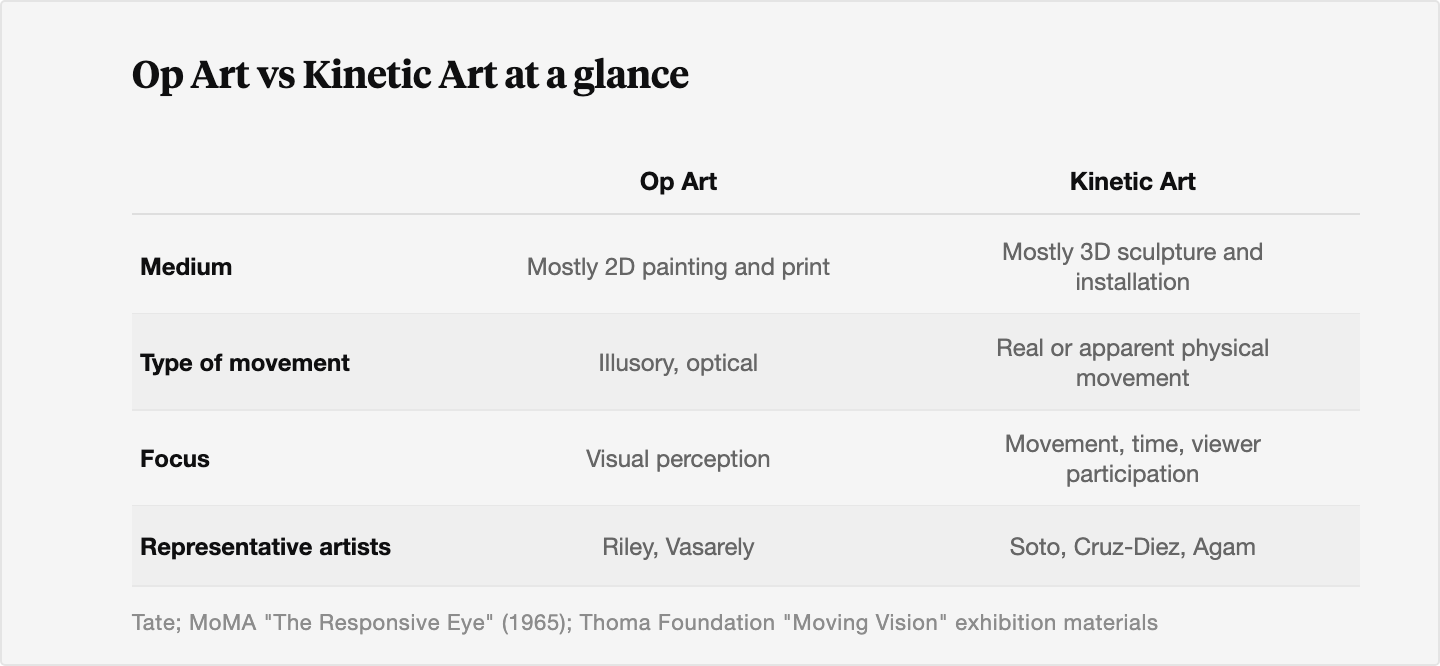
The two terms get used together, but they describe different things.
Op Art is mostly two-dimensional. An artist arranges grids, stripes, checkerboards, and wave patterns with enough precision that the eye and brain read movement into a surface that never moves. Bridget Riley's early black-and-white canvases such as "Fall" (1963) and "Current" (1964) create a strong sensation of flicker and wave, and Riley herself described her work as based on empirical study of perception [1]. Victor Vasarely built a personal geometric language, his "plastic alphabet," and series such as "Vega" that bulge and vibrate off a deformed grid [1]. The subject of an Op work is perception itself.
Kinetic Art is mostly three-dimensional and involves real or apparent motion. The term goes back to Naum Gabo and Antoine Pevsner in 1920, and Alexander Calder's mobiles around 1930 are a foundational case [1]. By the late 1950s and 1960s it had become a full international movement. The Venezuelan artist Jesus Rafael Soto suspended rods and wires to create vibrating spatial fields and later built walk-through "Penetrables" that the viewer activates by moving through them [1][2]. Carlos Cruz-Diez, also Venezuelan, made "Physichromies" and "Chromosaturations," colored structures whose hue shifts as you move past them [2]. Yaacov Agam sits between the two, making relief and lenticular works whose image changes with the viewer's position [1][2].
The two movements were shown together throughout the 1960s and 1970s under one banner, "perceived and real movement," which is why the market treats them as a single collecting category today [1].
2. Why the 1960s peak still anchors the market
The category has a clear historical center of gravity, and that center is the 1960s. The term "Op Art" first appeared in print in Time magazine in October 1964, and MoMA's "The Responsive Eye," curated by William C. Seitz, ran from February to April 1965 and did more than any other single event to push Op Art into the public eye, including fashion and graphic design [1].
That history matters to an investor for a simple reason. The works that anchor the market today, and command the highest prices, are overwhelmingly the prime 1960s canvases. Riley's record-tier results are her mid-1960s curve and stripe paintings. Vasarely's strongest auction comparables are his 1950s and 1960s Op canvases [5][6]. The 1960s peak is the part of each artist's output the market underwrites most confidently, because those works carry the exhibition histories and the scholarly weight that thin markets lean on.
By the late 1960s the novelty had faded, fashion had borrowed Op patterns into commercial design, and the category's avant-garde shine dimmed [1]. The artists kept working, and the best of them, Riley above all, kept producing rigorous work for decades. The lesson for a buyer is that period and quality do most of the pricing. A late, lesser work by a canonical name is a different asset from a prime 1960s example, even with the same signature on it.
3. The top tier: Riley and Vasarely
Two names sit at the top of the category, and they behave differently.
Bridget Riley is the closest thing Op Art has to a blue-chip name. Her auction record is about GBP 4.4 million for "Gala" (1974), sold at Christie's London in 2022 [5]. The next results down are tightly clustered: "Untitled (Diagonal Curve)" (1966) at about GBP 4.3 million at Christie's in 2016, and "Zing 2" (1971) at about GBP 3.2 million at Christie's in 2021 [5]. Her market is narrow but deep. There is a concentrated, committed base of institutions and serious private collectors, prime 1960s canvases are scarce, and sell-through on her lots at the major houses is generally high. Below the GBP 1 million line, her graphic, color-legible works find broad demand, which makes that band the most liquid part of her market.
Victor Vasarely is a different shape of market. His headline auction record sits far below Riley's, near GBP 565,000 for "AltaI III," an early monochrome Op work, at Sotheby's in February 2010 [6]. Vasarely produced a large volume of work across France and Hungary over several decades, so his comparables are more dispersed and his supply is far higher. The effect is a broad, liquid mid-market in the low to mid six figures and below, with a thinner high end and wide price differentiation between top-tier and secondary works [6]. In our framework, Riley reads as a low-volume, high-conviction name and Vasarely as a high-volume mid-market cornerstone, two different liquidity profiles within the same category.
4. The kinetic names: Soto, Cruz-Diez, and Agam
The kinetic side of the category is led by the Venezuelan masters and one Israeli artist, and the most useful single data point sits with Carlos Cruz-Diez. His verified auction high is about $879,000 for a "Physichromie Panam" work at Sotheby's [4]. (We flag that some dealer listings quote a higher figure near $1.2 million for a Cruz-Diez "Physichromie"; the Sotheby's-confirmed result we can verify is the $879,000 figure, and we treat the higher number as [unconfirmed] pending a clean primary record.) His market is the broadest of the three, helped by a large, recognizable, serially produced body of work that supports relatively transparent pricing, with strong turnover in the roughly $10,000 to $250,000 range and a thinner top end [2][4].
Jesus Rafael Soto is the canonical kinetic master of the group, held by MoMA, Tate, and the Pompidou, with mid-market liquidity in the low to mid six figures and a smaller pool of bidders for his major historical works and large Penetrables [2][3]. Yaacov Agam has the longest market history and the most uneven profile, very liquid in the low thousands for multiples and editions and thinner at six figures [2]. Across all three, the pattern repeats: a deep, accessible edition and mid-price market, and a top end that depends on a small group of committed collectors and institutions.
The category is edition-heavy, a structural feature that weighs heavily for an investor. Riley, Vasarely, Agam, and Cruz-Diez all produced extensive prints and multiples, which builds a broad, low-priced market but can cap the scarcity premium that drives appreciation in the unique blue-chip canvases [3].
5. How thin is the liquidity, really
Blue-chip Post-War and Contemporary art regularly sees single works clear $50 million or more, with several lots a year above $10 million at the major houses. The top of the Op and Kinetic market rarely exceeds roughly $1 to $2 million [3][4]. The category trades largely in day sales, themed abstraction sales, and Latin American sales, not the ultra-trophy evening sales [3].
A narrow buyer pool changes how exits work. With few natural buyers, a price depends heavily on who is bidding on a given night and whether two determined collectors collide. Absent that competition, even historically important works can hammer below estimate or fail to sell against a reserve [7]. Advisers across private banking consistently frame art as a long-term, illiquid, buy-and-hold asset, and in a thin niche that is doubly true [7]. Liquidity tends to be lumpy, clustered around specific events such as a retrospective, an estate sale, or a curated themed auction, rather than continuous.
We would translate that into two practical rules. Underwrite a long holding period, well beyond the standard 3 to 10 year frame, and after realistic transaction costs and a potential liquidity discount. And size any position so that you are never a forced seller, because in a market with a tiny bidder pool, a forced sale usually means a distressed price [7]. That discipline applies in every category, and it is sharper here than in most.
6. Why a niche can still matter to an investor
None of that makes the category uninvestable. It makes it a specific kind of allocation with a specific case.
Riley, Vasarely, Soto, Cruz-Diez, and Agam are firmly written into the twentieth-century canon, held in the permanent collections of MoMA, Tate, and the Pompidou, yet their prices are modest relative to that art-historical weight [2][3]. When a category is overlooked, a small rise in global demand can produce an outsized price move, because the tradable supply of prime works is tiny [3].
Institutional validation is the strongest medium-term driver of value in a thin market. Museum retrospectives, permanent-collection placement, and scholarly attention broaden the buyer pool, harden the canon, and filter for quality and provenance, all of which a thin, opaque market leans on heavily [7]. The signals are live. In 2026 the Serpentine in London put Soto's "Penetrable" (1992) on free display, framing it as a landmark of Latin American kinetic art [2]. Riley's continued high-profile museum presence keeps reinforcing the "Op Art resurgence" narrative, and that attention spills over to Vasarely, Soto, Cruz-Diez, and Agam [3].
A sticky, devoted base is the third piece. A cult collector base tends to be less price-sensitive and more willing to hold through cycles, which can support a floor of demand that more speculative young-artist markets lack [7]. That floor is not a guarantee of stable prices, and the category is more exposed than most to fashion cycles and curatorial emphasis. But for a long-horizon buyer who is not forced to sell, a niche with canonical names, museum backing, and a devoted base is a coherent satellite position, not a core holding. The same logic that governs category choice across the broader art market applies in miniature here. The choice of artist market does most of the work, and the discipline is to buy the best example you can in a market likely to hold.
The Bottom Line
- Op Art creates illusory motion on a flat surface, while Kinetic Art uses real or apparent physical movement, and both peaked in the 1960s around MoMA's "The Responsive Eye" in 1965.
- The category is a genuine niche. The top results rarely clear roughly $1 to $2 million, against blue-chip names that trade above $50 million, and the works sit in day and themed sales rather than trophy evening sales.
- Bridget Riley leads the field with an auction record near GBP 4.4 million for "Gala" (1974), a narrow but deep market with a committed institutional base.
- Victor Vasarely runs as a high-volume mid-market cornerstone, with a far lower headline record near GBP 565,000 and broad liquidity below the high end. Carlos Cruz-Diez leads the kinetic names with a verified high near $879,000.
- Liquidity is thin and lumpy, the holding period is long, and the right way to own the category is as a long-horizon satellite allocation sized so you are never a forced seller. Past performance is not predictive.
Sources
- Museum of Modern Art and Tate. "The Responsive Eye (1965); Kinetic art and Op art definitions and history." Tate Art Terms, updated June 18, 2026. https://www.tate.org.uk/art/art-terms/kinetic-art
- Artsper and Serpentine Galleries. "Carlos Cruz-Diez auction ranges; Jesus Rafael Soto Penetrable (1992) display." Artsper, February 10, 2026; Serpentine, June 17, 2026. https://www.artsper.com/us/contemporary-artists/france/1072/carlos-cruz-diez
- Whitehot Magazine. "The Resurgence of Op and Kinetic Art." Whitehot Magazine, May 23, 2025. https://whitehotmagazine.com/articles/resurgence-op-kinetic-art/3490
- Sotheby's. "Carlos Cruz-Diez, Physichromie Panam, auction result and artist results page." Sotheby's, updated October 24, 2025. https://www.sothebys.com/en/artists/carlos-cruz-diez
- MyArtBroker. "Bridget Riley Value: Top Prices Paid at Auction." MyArtBroker, 2026. https://www.myartbroker.com/artist-bridget-riley/record-prices/bridget-riley-record-prices
- MyArtBroker. "Victor Vasarely Value: Top Prices Paid at Auction." MyArtBroker, 2026. https://www.myartbroker.com/artist-victor-vasarely/record-prices/victor-vasarely-record-prices
- RBC Wealth Management; Citrin Cooperman; National Bank of Canada; Destiny Family Office. "The risks of investing in art: illiquidity, narrow buyer pools, long holding periods, and the role of institutional validation." Various, 2024 to 2026. https://www.rbcwealthmanagement.com/en-us/insights/is-artwork-a-wise-investment
- Thoma Foundation. "Moving Vision: Op and Kinetic Art of the Sixties and Seventies." Thoma Foundation, updated January 18, 2026. https://thomafoundation.org/exhibitions-events/our-collection-on-tour/moving-vision-op-and-kinetic-art-of-the-sixties-and-seventies/
- Wikipedia. "Kinetic art." Wikipedia, updated March 11, 2026. https://en.wikipedia.org/wiki/Kinetic_art
- Citrin Cooperman. "Investing in Art: A Growing Asset Class." Citrin Cooperman, August 4, 2025. https://www.citrincooperman.com/In-Focus-Resource-Center/Investing-in-Art-A-Growing-Asset-Class
- National Bank of Canada. "How to invest in art: the risks and rewards." National Bank, April 3, 2025. https://www.nbc.ca/personal/advice/savings-investment/how-to-invest-in-art.html
- Bank of America. "U.S. Art Market Rebounds, Posting a 23% Increase in Auction Sales." Bank of America Newsroom, March 9, 2026. https://newsroom.bankofamerica.com/content/newsroom/press-releases/2026/03/u-s--art-market-rebounds--posting-a-23--increase-in-auction-sale.html
Related Reading
- What Blue-Chip Art Actually Means and Why It Matters
- Price-Tier Analysis: How $100K, $1M, and $10M Works Behave Differently
- When Markets Diverge: Why Contemporary Art and Old Masters Don't Move Together
- How Art Market Cycles Work: Expansion, Peak, Correction, and Recovery
Disclosures
Investing involves risk. Past results are not indicative of future outcomes.
Masterworks is providing this communication as an agent for its issuer entities, not Masterworks Advisers. This material is produced by Masterworks for informational purposes only and does not constitute investment advice, a recommendation, or an offer or solicitation to buy or sell any security. Masterworks is not a licensed broker-dealer by the SEC or FINRA.
Masterworks can only make and accept sales after an offering statement has been filed, and "qualified", by the SEC. Any offers may be revoked before notice of qualification. Indications of interest involve no obligation. For further disclosure visit the offering documents filed with the SEC and Important Disclosures at masterworks.com/cd.
Forward-looking statements and internal estimates are based on assumptions that may prove incorrect, and actual outcomes may differ materially. Figures denoted in brackets are subject to confirmation. Investing in art and alternative assets involves risk, including loss of principal.
Art sales price data is comparative only. Each painting is unique and historical data is not a direct proxy for any specific painting or investment. Data represents whole art, not an investment into our offerings which includes fees and expenses. Any comparative images are not currently live offerings and are provided for educational purposes only.
Masterworks, LLC is located at 1 World Trade Center, 57th Floor, New York, NY 10007.


